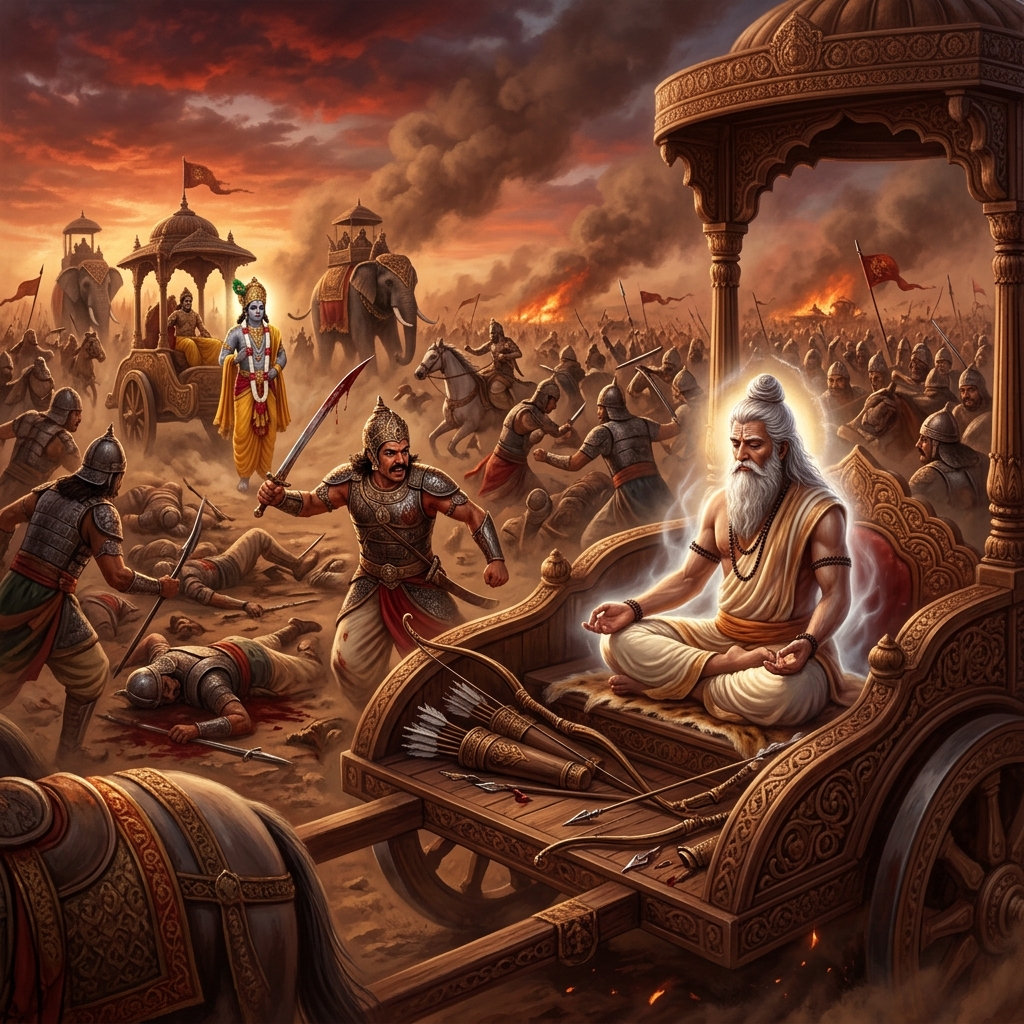
The Commander Accused
Duryodhana tells Drona to his face that he is sparing them
The Seal of the Commander
On the eleventh morning, with Bhishma carried from the field on a bed of his own arrows, Drona took up the white umbrella and the conch of the Kaurava host. Duryodhana himself placed the seal in his hands, before the assembled kings, and called him the one general who could still finish what ten days had not.
The praise did not survive the first private meeting. That evening, in the commander's tent, Duryodhana came alone except for Karna, who stood by the tent pole with his arms folded and said nothing, which was itself a kind of speech. Duryodhana did not sit.
"I said this once to your general before you," he told Drona, "and I will not pretend I have forgotten how he answered it. You know the accusation. I am not accusing you of losing. I am accusing you of choosing not to win."
Drona set down the cup he had been holding. "Bhishma heard that from you and it changed nothing in him that mattered. Say what you have come to say plainly, Acharya to student, or don't say it at all."
"Plainly, then. Ten days under Bhishma, the Pandavas breathing. One day under you, and I do not see Yudhishthira's head on a spear either. You raised those boys at my father's table beside my own sons. I would be a fool not to wonder which lesson took."
Karna's silence thickened. Drona looked at him rather than at Duryodhana. "Your friend there has an opinion he is too well mannered to give voice to in front of his king. Ask him instead whether any man alive stops Arjuna when Krishna is holding the reins. Then come back and accuse me of gentleness."
Duryodhana left without answering, but he did not leave convinced, and both men in that tent understood he would be back the moment the field gave him a new grievance to bring.
The Vow That Would Not Close
Drona had promised, before witnesses, to take Yudhishthira alive and deliver him in chains, a boast he had not needed to make and now could not unmake. Twice he drove for the Pandava king's chariot with that vow sitting behind his eyes, and twice Arjuna was there before him, close enough that the promise had to be abandoned rather than kept, the Kaurava ranks parting to let Drona's chariot back out of a press it could not survive.
Each evening after, Duryodhana found him. He did not shout. He had learned that shouting only bought him Drona's silence, so instead he asked, quietly, in front of whoever happened to be standing near the fires, whether the acharya required a third attempt to remember that a promise made before the assembled kings was a debt like any other.
"You gave your word for me," Duryodhana said, the second night, Karna a few steps off pretending to check his bowstring. "I did not ask for it. You offered it, the way a man offers something he expects to be believed capable of delivering."
"I am an old man driving into a wall of Pandava chariots that did not exist when I first picked up this bow," Drona said. "Arjuna is faster than my vow. That is not treachery. That is arithmetic."
"Bhishma had arithmetic too, once he decided to use it as an excuse."
Drona's hand tightened on the cup he was not drinking from. "Say Bhishma's name to me once more this week and I will hand this umbrella back to whichever of your brothers wants it next." He did not raise his voice. That was the part Duryodhana noticed and did not mention to Karna until they had walked well clear of the tent: the acharya's answers were getting shorter, and a short answer from a patient man was worth watching.
A Wall Built of Warriors
When Arjuna swore his own vow, that Jayadratha would die before the next sunset or he would walk into the fire himself, Drona built the answer to it out of men. He set ring inside ring around Jayadratha that day, warrior behind warrior in a formation meant to make one archer's promise physically impossible to keep, and for most of the day it held. The sun sank toward the western hills with Jayadratha still breathing and the Kaurava lines still standing between him and Arjuna's chariot.
It did not hold long enough. What happened at the last light of that day belongs to Arjuna's story and not to this one; it is enough to say that when the sun reappeared where Drona's whole formation had believed it set, the wall came apart from the inside, and Jayadratha's head left his shoulders before true dusk.
Duryodhana rode to the commander's tent that night with grief for his brother-in-law still raw in his face, and for once the accusation came out as something closer to a genuine question. "I gave you every man I could spare to build that wall. Explain to me how a wall you built falls down."
"Walls fall," Drona said, "when the thing on the other side of them is not a man being reasoned with." He did not look up from the map spread across the table. "I have told you three times now what stops us. Krishna is not on our side of the field, and Arjuna is not going to run out of reasons to believe him."
"Karna believes he could have held that wall."
"Then next time," Drona said, and for the first time his voice went past cold into something with an edge on it, "put Karna inside it and see how the count of the dead changes."
Count Your Own Throws
By the fourth or fifth night of it, the shape of the exchange had worn itself smooth, the way a path across a courtyard wears smooth from the same feet crossing it the same way. Duryodhana would arrive with the day's failure freshly named, another Pandava alive who should by rights not have been, another plan that had looked complete on the map and come apart on the field. Drona had stopped waiting for him to finish.
"Say it," he told Duryodhana one such evening, Ashwatthama standing quietly near his father now, having taken to attending these meetings without being asked. "You think I hold back for love of them. I will not insult either of us by denying I loved them once, as students, the way I loved your sons. But love is not what is stopping this army. Bhishma is dead trying to stop it and could not. What I am telling you, and what you refuse to hear, is that no general born stops Arjuna while that charioteer is beside him."
"Then what do you suggest, acharya. That I make peace."
"I suggest," Drona said, "that you count your own throws before you count mine. It was a pair of dice that opened this war, not a bow, and the man who owned that hall counted every point in his favor and still could not close his hand around what he wanted. I am fighting the war you built. Do not accuse me of choosing its outcome."
Ashwatthama's jaw tightened at the mention of the dice hall, an old wound in that family reopened without warning. Duryodhana said nothing for a long moment, and when he left, he left without the parting insult he usually managed. Karna watched him go and then looked at Drona with something that was not quite sympathy and not quite warning.
The Weapons He Had Kept in Reserve
What changed after that was not visible in any single order Drona gave, only in the accumulation of small refusals he stopped making. He had fought for eleven days the way a teacher fights, keeping the deadliest of his astras in reserve, matching force to the man in front of him rather than to the army behind that man, sparing where sparing cost him nothing. After enough evenings of being told that mercy was cowardice wearing a Brahmin's thread, he began to close that gap.
He called down weapons meant for single champions into ground crowded with ordinary soldiers who had no astra of their own to answer with. He stopped waiting for a worthy opponent to present himself before unleashing something that could kill twenty men who were not that opponent. None of it broke the war's rules outright, not in a way any elder could point to and name, but the Pandava captains who watched it happen began speaking of the change among themselves, and word of that talk reached Yudhishthira's tent before it reached Duryodhana's.
Drona did not tell Duryodhana what he had done or why. He did not need to; the king had been asking for exactly this since the day the umbrella changed hands, and a man who finally gets what he demanded rarely thinks to ask what it cost the one who supplied it.
Karna, watching from his own chariot two days later as the acharya's astras lit the evening sky over ground that should not have needed them, understood something Duryodhana had not yet worked out: that a commander accused often enough of sparing his enemies will eventually stop sparing anyone, including, in the end, himself.
Dharma Lesson
A leader who is trusted only on condition of results will eventually be pushed past the line he set for himself. Duryodhana's suspicion of Drona was never really about Drona's loyalty; it was a way of buying more violence with shame instead of asking for it honestly. The lesson lands hardest on the accuser: what he calls out of a man he must then live with.