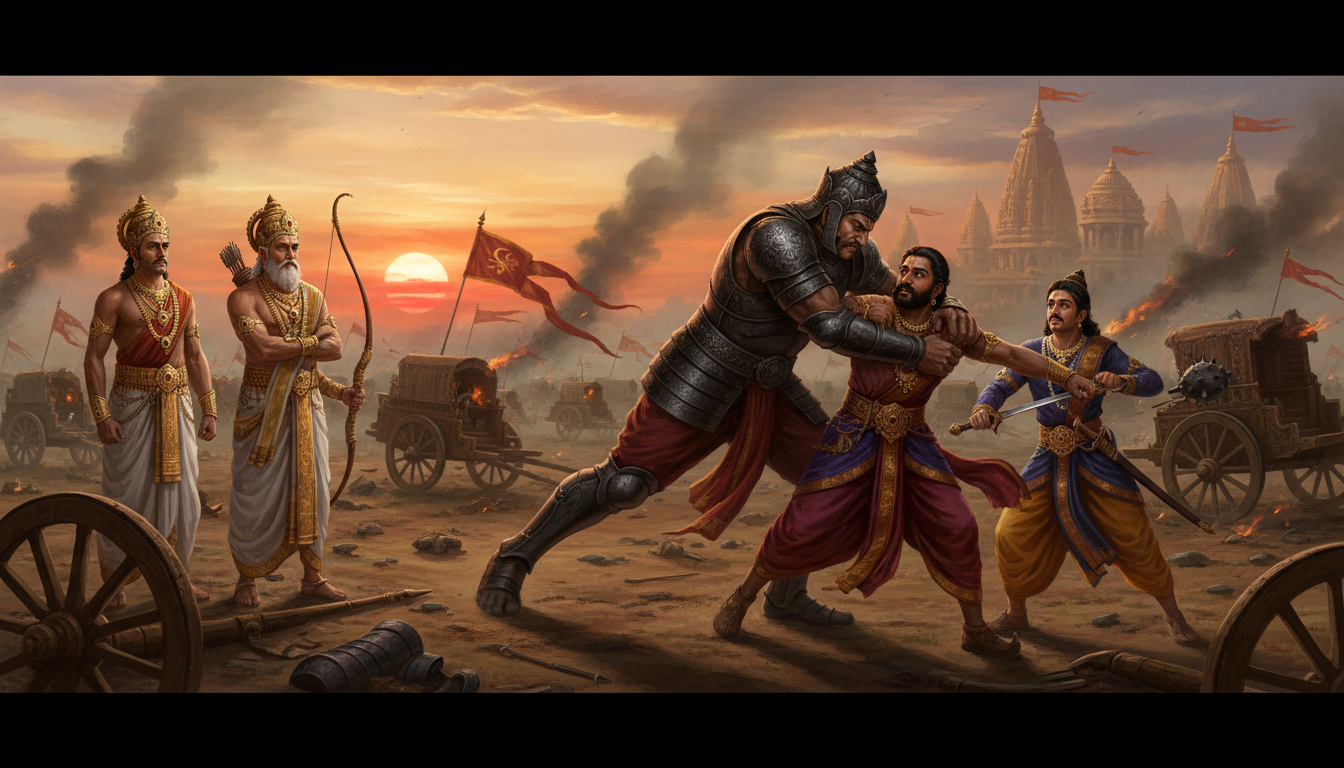
Held Back by Bhima's Arms
Satyaki and Dhrishtadyumna nearly finish the war for the Kauravas
The Noise That Came Back
For a little while after Drona fell there was hardly any noise at all on that stretch of the field. The Kuru host had broken and run the way water runs off a tilted plate. Men were carrying their fathers and their sons out of the press on the floors of chariots and washing them with water. Some had thrown away their armour to run faster.
Then it started again. First the conches, thin and scattered, then the drums, then the clatter of car-wheels turning back the way they had come, and over all of it one voice, a roaring that seemed to come up out of the ground, and the sound of it made the hair stand on the arms of veterans.
Yudhishthira turned in his chariot.
"That army was finished," he said. "It was running and it was not going to stop. Who has turned it around? Dhananjaya, you know every voice on this field. Who is that, roaring like the wielder of the thunderbolt himself?"
Arjuna did not answer at once. He was looking across the churned ground toward the sound.
"When that man was born," he said at last, "Drona gave away a thousand cows to brahmanas of high worth, because he had waited a long time for a son and had nothing else to give. And the child, the moment he came into the world, neighed aloud like Indra's horse, and the three worlds trembled at the sound of it. There was nobody visible in the room, but a voice spoke out of the air and gave him his name from that neighing. Ashwatthama. The horse-voiced.
"That is who is roaring, king. Prishata's son took my preceptor by the hair and cut his head off as though the old man had never had a teacher of his own, and had no son alive to answer for him. Ashwatthama will not forgive that. Not ever, not for anything."
He turned then and looked at his brother, and his face was not the face of a man reporting on the enemy.
"You told your preceptor a lie," Arjuna said, "for the sake of a kingdom."
An Untruth in the Garb of Truth
"You know the dictates of righteousness better than any of us," Arjuna said, "and you have done a very sinful thing. Your ill fame for the killing of Drona will last in the three worlds as long as there are creatures in them to tell it, the way Rama's does for the killing of Bali.
"Do you know what he thought of you? He said it himself, more than once. 'The son of Pandu is possessed of every virtue. He is besides my disciple. He will never speak an untruth to me.' That was why he believed you. You did add the word elephant. You added it under your breath while Panchajanya was blowing, and it was still an untruth in the garb of truth, and he took it as truth because it came out of your mouth.
"And he laid down his weapons. You saw it. He put his bow out of his hands in the middle of a battle he was winning and sat down on the floor of his car with his eyes shut and went away into yoga, an old brahmana at his devotions, grieving, unwilling to fight. And a disciple abandoned every rule of conduct there is and killed him where he sat.
"Now protect Prishata's son if you can, you and all your counsellors together. I tell you plainly that we cannot. That man over there has just heard how his father's hair was held, and today he will burn us."
He was crying by then, and not troubling to hide it.
"I shouted," he said. "I shouted at the top of my voice for somebody to save the preceptor's life and my voice went nowhere. Most of our lives are behind us. What is left of them is stained by this one act.
"He was a father to us by the love he bore us, and by the scriptures too. Dhritarashtra had given him the whole earth and, worth more than the earth, all his children to teach. And still, honoured like that by our enemy and rich from his hand, the old man went on loving us like his own sons. He could not have been killed by Indra himself while he was fighting. He died because a word of yours made him put his bow down.
"He believed that for his sake I could give up anything. Father, brother, children, wife, my own life. He believed that. And when they came to kill him I stood there wanting a kingdom and did not move. For that fault I am already in hell, king, and ashamed, and death looks better to me now than living does."
The great car-warriors standing around them heard all of it and not one of them said a word, agreeable or disagreeable.
Bhima Loses His Temper
Bhima broke the silence, and he was shaking.
"You preach morality like an anchorite in the woods," he said. "Like a brahmana of rigid vows with all his senses under control. Listen to what a Kshatriya is. A Kshatriya is called that because he rescues others from wounds and injuries, and being such a man he must also save himself from wounds and injuries. He shows forgiveness to three and three only, the gods, the brahmanas and his preceptor, and by doing his own duty he wins the earth, and piety, and fame, and prosperity with it. You have every attribute of that order in you. It does not look well on you to talk like an ignorant man.
"Your prowess is Sakra's own, and you have never gone past the bounds of morality any more than the ocean goes past its shores. You laid down thirteen years of anger for the sake of virtue, and today your heart has followed after virtue and your understanding has bent toward compassion.
"But the kingdom was taken from us unrighteously. Draupadi was dragged into that assembly by her hair and insulted in front of the whole court. We were put in bark and deerskin and driven into the woods, and we deserved none of it, and they held us to thirteen years of it. You have forgiven all of it. Every item on that list demanded rage, and you bore it quietly because you are wedded to your duty.
"I remembered every item. I came here with you to collect on it. If you have gone indifferent, I will kill the wretches who robbed us myself.
"You said to us once, 'Addressing ourselves to battle, we will exert to the utmost extent of our abilities.' Today you stand there reproaching us and hunting after virtue, so those words were untrue when you said them. We are frightened already, brother, and you cut the core of our hearts with your speech, like a man pouring acid on the sores of wounded men.
"You are virtuous but you do not know what righteousness consists of. Kesava is standing right here, and you are praising the son of Drona, a warrior who does not come up to a sixteenth part of you.
"I can tear this earth open in a rage, or split mountains with that mace of mine when I whirl it. With my arrows I can rout the united celestials with Indra at their head, and the Rakshasas and the Asuras after them. Knowing that this is your brother, you have no business being afraid of Drona's son.
"Or stand here, if you like, with all these bulls among men around you. Alone and unsupported, with my mace, I will beat that one down for you."
The Fire-Born Answers
Then the son of the Panchala king spoke, and he came at Arjuna the way Hiranyakasipu came at the roaring Vishnu, with no fear in him at all.
"The sages laid down six duties for brahmanas," Dhrishtadyumna said. "Assisting at sacrifices. Teaching. Giving away. Performing sacrifices. Receiving gifts. And study, sixth. Name me the one of those six that Drona was devoted to. He had fallen away from the duties of his own order and taken up ours, and he used superhuman weapons to kill us with, and while he called himself a brahmana he made a habit of irresistible illusion. Today he was killed by an illusion himself. What exactly is improper in that?
"His son is roaring over there because of what I did. What do you lose by it? I do not find it wonderful that Drona's son will urge the Kauravas into battle and get them killed, since he cannot protect them any more than his father could.
"You know morality. Why do you call me a slayer of my preceptor? I was born for this. That is not a figure of speech. I came up out of my father's sacrificial fire already grown, holding a bow, for exactly this. How do you decide whether to call a man a brahmana or a Kshatriya, when in battle proper acts and improper acts were all the same to him? He used the Brahma weapon in a temper on men who had no weapons at all. Why should such a man not be killed by any means we have? The righteous say that an unrighteous man is the equal of poison. You are well versed in the truths of morality. So why are you reproaching me?
"That cruel car-warrior was seized by me and killed by me and I have done nothing worth reproaching. I cut off that head, a head like the blazing sun, like virulent poison, like the fire at the end of the Yuga. Why will you not applaud an act that deserves applause?
"He had killed my kinsmen. Nobody else's. And I will tell you the truth, Vibhatsu: having only cut off his head, the fever in my heart has not gone down. What pierces me now is that I did not throw that head into the country of the Nishadas, the way his was thrown." He meant Jayadratha's, and everyone standing there knew it.
"It has been heard that a man incurs sin by not killing his enemies. The duty of a Kshatriya is to slay or be slain. Drona was my enemy. He has been righteously killed by me in battle, exactly as you killed the brave Bhagadatta, who was your friend. You killed your own grandsire and you consider that act righteous. Why is mine unrighteous?
"Because of our relationship I cannot lift my head in front of you. I am like an elephant lying down with a ladder against his side so puny creatures can climb on his back. So do not reproach me. I forgive every fault in your speech for the sake of Draupadi and for Draupadi's children, and for no other reason at all.
"My hostility with that preceptor came down from father to son. Everybody in the world knows the history. Are the sons of Pandu the only people who do not? The eldest son of Pandu has not been untruthful. I am not sinful. The wretched Drona was a hater of his own disciples.
"Now fight. Victory will be yours."
Was There No Kshatriya There
In Hastinapur, in the lamplit room where he heard the war, the blind king stopped his charioteer in the middle of the account.
"That man had studied the Vedas with all their branches," Dhritarashtra said. "The entire science of arms lived in him, and modesty with it. There are men walking around today who can do superhuman things the gods themselves cannot do, and they can do them because he was patient with them. And he was the son of a great Rishi.
"And he was insulted in front of everybody by that low, wicked, mean-minded, sinful Dhrishtadyumna, the slayer of his own preceptor. Was there no Kshatriya in that whole gathering who felt called upon to show some anger? Fie on the Kshatriya order. Fie on wrath itself, if that is all it comes to.
"Tell me, Sanjaya. When the sons of Pritha heard him say those things, and all the other royal bowmen in the world with them, what did they say to the prince of Panchala?"
"They said nothing, king," Sanjaya said. "Every person present heard the words of Drupada's son, who is a doer of crooked deeds, and every person present stayed perfectly silent.
"Arjuna would not look at him. He kept casting glances sideways at Prishata's son, with tears and with sighing, and his whole face said fie, fie, and his mouth said nothing. Yudhishthira stood there ashamed, and Bhima after all that shouting, and the twins and Krishna and the others, all of them bashful like men caught at something, with the fighting going on a mile away, and nobody said one word.
"Then Satyaki spoke."
Satyaki Says It Aloud
"Is there no man here," Satyaki said, "who will kill this sinful wretch without waiting any longer? This lowest of men, standing in front of us making that speech?
"The Pandavas are condemning you for what you did. Look at them. They condemn you the way brahmanas condemn a man of the Chandala class, by standing there unable to speak. You have earned the censure of every honest man alive, and you are not ashamed to open your mouth in the middle of an assembly of respectable people.
"Despicable wretch. Why did your tongue not split into a hundred pieces, and your head with it, while you were reaching for your own preceptor? And having done it, here you are praising yourself among human beings, and drawing down on your head the censure of the Parthas and of all the Andhakas and all the Vrishnis at once. For that you deserve to die at our hands. There is no use keeping you alive another moment. Who is there in the world but you who would cause the death of a virtuous preceptor by seizing him by the hair?
"Your ancestors for seven generations, and your descendants for seven generations, have been stripped of fame and dropped into hell, and it happened at the moment they got you.
"And you stand there charging Partha with the slaughter of Bhishma. That illustrious person accomplished his own death, and you know it. Truly speaking, it was your own brother who did it, Sikhandin, that foremost of all sinners, and there is nobody in the world more sinful than the sons of the Panchala king. Your father created Sikhandin for the destruction of Bhishma, deliberately, as an instrument. Arjuna did nothing that day but stand behind him and keep him alive.
"Having got you and your brother among them, the Panchalas have fallen off from righteousness altogether, stained with meanness, haters of friends and preceptors both.
"Say those words again in front of me and I will break you with this mace of mine, which is as strong as the thunderbolt. You are the slayer of a brahmana. You are guilty of nothing less than that. Men have to go and look at the sun to purify themselves after they have looked at you. You wretch of a Panchala, you of wicked conduct, speaking evil first of my preceptor and then of my preceptor's preceptor. Have you no shame?
"Wait. Wait there. Bear one stroke of this mace, one, and I will stand and bear as many strokes of yours as you like."
High Morality Is Difficult to Ascertain
Dhrishtadyumna heard all of it out. Then he smiled, which was worse than shouting, and answered him.
"I have heard your words, son of Madhu's race, and I have forgiven them. You are unrighteous and sinful yourself, and you want to rebuke the honest. Forgiveness is applauded in this world, but sin does not deserve forgiveness, and a man of sinful soul always thinks the forgiving man is simply powerless. You are censurable from the tip of your toe to the ends of your hair, and you still want to speak ill of other people.
"What is more sinful than what you did to Bhurishravas? He was sitting in praya, fasting to death, with his arm cut off. He had laid his weapons aside. He was armless, and you killed him, and you had celestial weapons at your disposal at the time. Now tell me what was improper in what I did.
"That valiant enemy of yours struck you with his foot and threw you down on the earth. Why did you not kill him then, and show your manliness? You waited until Partha had already beaten him. Then you killed the brave son of Somadatta, acting most unrighteously, and now you lecture me.
"When Drona was routing the Pandava forces I went at him and shot thousands of arrows, and I did what had to be done. You have behaved like a Chandala yourself, and you want to reproach me in harsh words. You are the abode of all sinful deeds, not I. Do not blame me again. Be silent. That is the reply I give you with my lips. If out of folly you repeat any of it, I will send you to Yama's abode with my arrows.
"By righteousness alone, fool, nobody has ever defeated his enemies. Listen now to the unrighteous acts of the Kurus. Pandu's son Yudhishthira was unrighteously cheated by them at dice. Draupadi was unrighteously persecuted by them. The Pandavas with Krishna in their company were exiled and robbed of everything they had, most unrighteously. By an act of unrighteousness the ruler of the Madras was taken away from our side by the enemy on the road. By an act of unrighteousness the son of Subhadra was killed by six men at once.
"And on this side: by an act of unrighteousness Bhishma the Kuru grandsire was killed. Bhurishravas, by an act of unrighteousness, was killed by you, who are so acquainted with righteousness.
"That is what the enemy has done and what the Pandavas have done. Every one of them is brave, every one knows what morality is, and every one has acted like this, for victory.
"High morality is difficult of ascertainment. So is immorality, and for the same reason. Fight now with the Kauravas, and do not go home to the house of your fathers."
The Sixth Step
Satyaki began to tremble from his head to his feet. The rage came up in him until his eyes went the colour of copper, and he stopped answering, which was the dangerous sign.
He laid his bow down on the floor of his car, carefully, the way a man puts down something he will not need again. Then he took up his mace. He was breathing in long hisses, like a snake.
He went for the prince of the Panchalas the way Yama goes for something his own size.
"I will not speak harshly to you," he said as he came. "I will kill you. You deserve to be killed."
Vasudeva said one word, and Bhima was already moving. He came off his chariot in a jump and got both arms around Satyaki from behind.
It was not enough. Satyaki went on walking, dragging the mighty son of Pandu after him with his heels ploughing the ground, and Bhima was the strongest man alive and could not stop him at once. He got his feet planted at last and set his whole weight against it, and brought him to a halt on the sixth step.
Then Sahadeva came down off his own car and stood in front of them, unarmed, in the middle of a battlefield, and talked.
"Tiger among men. Son of Madhu's race. Listen to me. We have no friends dearer to us than the Andhakas and the Vrishnis and the Panchalas. And the Andhakas and the Vrishnis, and Krishna most of all, have no friends dearer than us. And the Panchalas, if they searched the whole world out to the edge of the sea, would not find friends dearer to them than the Pandavas and the Vrishnis.
"You are that kind of friend to this prince. He is that kind of friend to you. All of you are to us what we are to you.
"You know every duty there is. Remember now the duty you owe to friends, and hold back this anger of yours that has the prince of the Panchalas for its object. Be calm, foremost one of Sini's race. Forgive Prishata's son, and let Prishata's son forgive you, and we will practise forgiveness too. What is there in the world better than forgiveness?"
Release Him
While Sahadeva was still speaking, the son of the Panchala king began to smile again, and he called out over the young man's shoulder.
"Release Sini's grandson, Bhima. You are so proud of your prowess in battle. Let him come at me like the wind going at a mountain, and I will quiet his rage and his desire for battle with my keen arrows, and take his life with them.
"The Kauravas are coming, look. I will kill this one first and then do that great work of the Pandavas that has presented itself. Or let Phalguna hold off the enemy while I deal with him.
"He takes me for the armless Bhurishravas. Release him. Either I will kill him or he will kill me."
Satyaki, held fast in Bhima's arms, began to shake all over again, hissing like a snake. Both were men of enormous strength, and they stood ten paces apart bellowing at each other like two bulls, in the middle of an army that had just lost its preceptor and was about to be attacked by that preceptor's son.
It took Vasudeva and king Yudhishthira the just, working at it together with great effort, to bring those two down. When it was finished their eyes were still blood-red, and neither had taken a word back.
Then the Kshatriyas of the Pandava army turned around and went out against the warriors of the hostile army, because Ashwatthama was still roaring on the other side of the field and the sun was still up.
They had won the fight that ended Drona, and within the hour of winning it they came within six steps and one mace-swing of finishing themselves. Nobody would defend the method. Arjuna would not look at the man who used it. Satyaki wanted him dead and said so in front of everyone. The only answer anybody could make was Dhrishtadyumna's, which was to lay out every unrighteous act on both sides in one list, put his own at the end of it, and say that morality is not so easily read. It was true, and it settled nothing, and they went back to the fighting because there was nothing else to do with the afternoon.
Dharma Lesson
A victory won by a method nobody will defend leaves the winners unable to look at each other. Dhrishtadyumna's answer, that both camps have already done unrighteous things and that high morality is difficult to ascertain, is true and settles nothing. An army that has to be physically restrained from killing its own commander has not really won anything yet.