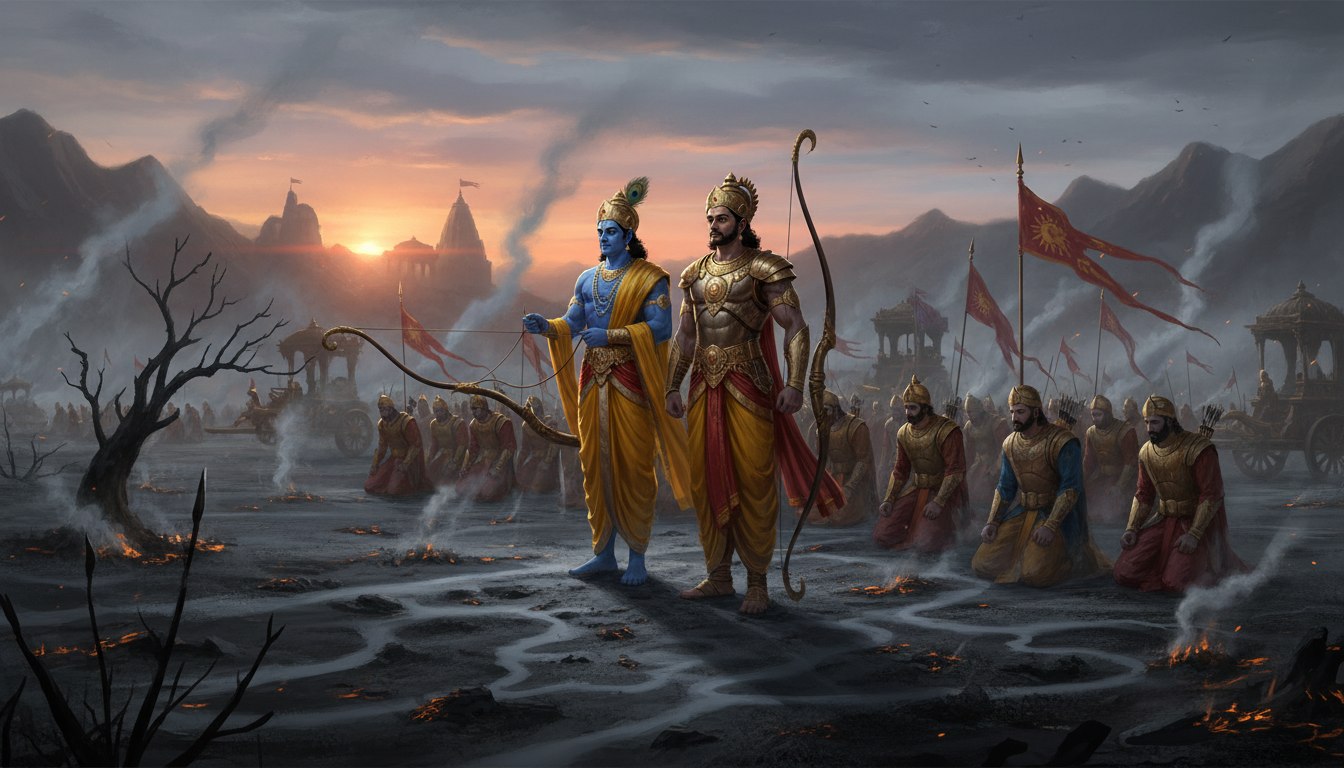
The Weapon That Would Not Burn Them
Ashwatthama's fire, and why it left two men standing
The Mountain He Made
Drona had been dead about an hour.
His son went through the Pandava line in that hour like the Destroyer at the end of a Yuga, and with his broad-headed arrows he piled a mountain of the dead in one place on that field. The standards of the cars were its trees. The weapons standing up out of it were its pointed summits. The lifeless elephants were its rocks and the horses its Kimpurushas and the bows lying across it its creepers and plants. It had a population, as mountains do: the carrion birds crying on every side of it were its birds, and the spirits that walked on it were its Yakshas.
Then he stood up in his car and roared, and said his vow again where Duryodhana could hear it.
"Kunti's son Yudhishthira put on the outward garb of virtue and nothing else, and with it he made my father, who was righteously engaged in battle, lay down his weapons. So: in his very sight I will rout his army and destroy it. When I have mangled all his troops I will kill the sinful prince of the Panchalas. And I will kill every one of the rest of them if they contend with me. I tell you truly. Rally your troops."
Duryodhana rallied them, dispelling their fear with one long leonine shout, and the two hosts came together again like two oceans at full tide, the Kauravas because their fear had been taken off them and the Pandavas and Panchalas because Drona was dead and they had become fierce.
Thousands of drums were beaten on both sides at once. The noise of it was the noise the ocean made when it was churned.
Lay Down Your Weapons
Then, aiming at the whole host of the Pandavas and the Panchalas at once, Drona's son invoked the weapon called Narayana.
Thousands of arrows with blazing mouths came up into the sky like snakes with fire in their throats. Iron balls appeared, shining in the clear firmament like planets. Sataghnis came, some running on four wheels and some on two, and maces without number, and discs with edges sharp as razors and faces bright as the sun. Wherever a great car-warrior of the Pandavas stood and fought, exactly there the weapon grew stronger, and it burned that army the way fire takes dry grass in summer.
Yudhishthira looked at it and gave up.
"Dhrishtadyumna, fly, and take the Panchalas with you. Satyaki, go, with the Vrishnis and the Andhakas. Vasudeva will find his own means of safety; he is competent to advise the whole world and does not need advising by me. We should not fight any longer. I say this to all the troops. As for myself, I will ascend a funeral pile with all my brothers.
"I crossed the ocean of Bhishma and the ocean of Drona, which the timid cannot cross. Shall I now drown with everyone I have in a puddle the size of a cow's hoofprint?"
Then Krishna forbade the flight with a motion of his arms and said the thing that stopped it.
"Lay down your weapons, all of you, quickly, and get down off your vehicles. This is the means the illustrious one himself ordained for baffling this weapon. Come down onto the earth from your elephants and your horses and your cars. If you stand on the ground weaponless it will not kill you. Wherever you fight to quell its force, the Kauravas will grow stronger than you. But the men who throw their weapons away and step down will not be slain today. And the men who contend against it, even in imagination, will all be slain, though they hide deep under the earth."
An entire army heard that, and threw its weapons on the ground, and drove the desire for battle out of its heart.
The One Man Who Would Not
Bhimasena watched them doing it and could not bear it.
"None should lay down his weapons here," he said. "I will oppose this weapon of Drona's son with my shafts. With this heavy mace of mine that is decked with gold I will career about this battle like the Destroyer himself and quell it. There is no man here equal to me in prowess, as there is no light in the sky equal to the sun. Look at these two arms of mine, like the trunks of two great elephants, able to pull down the mountain of Himavat. I am the one person here who has the might of a thousand elephants. I have no peer, as Sakra has none in heaven.
"Let people see today what these two arms can do while they are putting out the bright and blazing weapon of Drona's son. If there is nobody else here capable of standing against the Narayana, then I will stand against it, in front of all the Kurus and all the Pandavas.
"Arjuna. Vibhatsu. You should not lay Gandiva aside. A stain will attach to you if you do, like the stain on the moon."
Arjuna did not take the bait, and his answer is one of the strangest sentences in that whole war.
"Bhima, this is my great vow: that my Gandiva shall never be used against the Narayana weapon, against kine, or against brahmanas."
So Bhima went alone. He rode at Ashwatthama in a car of solar effulgence whose rattle was like the roar of clouds, and being quick-handed beyond other men he covered Drona's son with a shower of weapons inside the time it takes to blink.
And Drona's son smiled at him as he came, and answered him properly, and covered him with arrows charged with mantras and tipped with fire.
The weapon found what it had been waiting for. Every blazing shaft in that sky turned and went toward one car. Bhimasena in the middle of it looked like a mountain at evening with fire all over it, and the fire increased on him as a conflagration increases when the wind assists it, and the last of the Pandava army threw down what it was holding and got off its horses and stood on the ground and watched him burn.
Two Men Walk Into the Fire
Arjuna covered his brother with the Varuna weapon, which is water against fire, and because his hands were fast and the flame was thick nobody on that field could see that he had done it.
It was not enough. Bhima and his car and his horses and his driver could no longer be looked at, like a fire standing inside another fire. As the luminaries all run toward the Asta hill at the close of night, so every burning shaft in the sky ran toward that one car. And then the weapon began to go into his body the way the Yuga fire, when it has finished consuming the universe, at last enters the mouth of the Creator. You cannot see a flame that has gone into the sun. Nobody could see what was going into Bhima.
So the two of them got down.
Arjuna and Vasudeva alighted from their car, in the middle of a battlefield, without weapons, in front of two armies that were standing on the ground watching, and walked into that fire.
It did not consume them. It did not touch them. They had laid their weapons aside, and there was the Varuna weapon in it, and there was besides the matter of who they were, which nobody on that field yet knew.
Then Nara and Narayana laid hold of Bhimasena and dragged him out, and dragged his weapons out after him, and he roared while they did it, and the weapon flared up higher because he was still fighting it in his mind.
"How is this, son of Pandu?" Krishna said, holding him. "We forbade you and you still do not abstain from battle. If the Kurus could be beaten today, we would be fighting too, and so would all these foremost of men. Look. Every warrior of your host has come down off his car. So come down off yours."
And he brought Bhima down onto the earth with his own hands, his eyes red as blood, sighing like a snake, and took the weapons out of his grip.
The Narayana weapon went quiet.
The air cleared, in every direction, cardinal and subsidiary. Sweet breezes began to blow. The birds and the animals became calm. The horses and the elephants grew cheerful and so did the men, and Bhima, standing on the ground with nothing in his hands, shone like the morning sun.
It Cannot Be Used Twice
The remnant of the Pandava host picked its weapons up again and formed line.
Duryodhana saw that and went to Drona's son at once. "Ashwatthama. Use that weapon again, quickly. The Panchalas have arrayed themselves and they want victory."
Ashwatthama sighed, and answered him without any cheer in his voice at all.
"That weapon cannot be brought back, king. It cannot be used twice. If it is called a second time it will kill the man who calls it, without any doubt. Vasudeva has caused it to be baffled by the means you saw. That is why the destruction of the enemy has not been accomplished today."
Then he said the thing that was actually eating him.
"Defeat and death are the same. Rather, defeat is worse than death. Look at them. The enemy, beaten and made to lay down his arms, looks as though he has been deprived of life, and he is standing there alive."
"Then if it cannot be used twice," Duryodhana said, "let those slayers of their preceptor be killed with other weapons. Every celestial weapon there is lives in you, as they live in the three-eyed god. If you do not wish a man to escape you, Purandara himself in a rage could not escape you."
It was the wrong thing to say to a man who had just been shown, in front of an army, that his weapons had a limit.
What He Did Instead
He went for Dhrishtadyumna first, remembering his father, with the lion's tail on his banner and all his fear thrown away, and pierced the Panchala prince with twenty-five small arrows. Dhrishtadyumna answered with sixty-four, and the two of them worked at each other until Ashwatthama cut the standard and the bow, and then made him steedless and driverless and carless, and the Panchala troops broke and ran.
Satyaki drove his car in to cover them, and hit Ashwatthama with eight keen shafts, and then twenty more, and killed the driver's horses, and cut the bow and the standard, and broke the gold-decked car into pieces, and put thirty arrows into his chest, so that for a while Drona's son sat in the wreck of his vehicle not knowing what to do next.
When he came back he was smiling, and what he said then was a promise the whole world would eventually have to live with.
"Grandson of Sini, I know your partiality for Dhrishtadyumna, that slayer of his preceptor. You will not be able to rescue him, and you will not be able to rescue yourself. I swear to you by truth and by my ascetic austerities: I shall know no peace until I have slain all the Panchalas. Unite the forces of the Pandavas and the Vrishnis together if you like. I will still kill the Somakas."
Then he shot one arrow that went through Satyaki's armour and through his body and into the earth like a hissing snake going into its hole, and Satyaki sat down on the floor of his car covered in his own blood with his bow slack in his hand, and his driver took him away.
With another shaft he struck Dhrishtadyumna between the eyebrows, and the prince, already much pierced, held himself upright by taking hold of his flagstaff.
Five men came at him then together: Arjuna, Bhimasena, Vrihatkshatra of Puru's race, the young prince of the Chedis, and Sudarsana who led the Malavas. They advanced twenty paces and struck him with twenty-five arrows at the same moment, and he cut all twenty-five out of the air with twenty-five of his own.
Then he took Sudarsana's two arms and his head with three arrows, as the man sat in his car. He cut the Paurava's chariot into small fragments and lopped off his two arms, smeared with sandal-paste, and then his head. And he sent the young ruler of the Chedis, who was the colour of a dark lotus, to Yama's abode with his driver and his horses.
Bhima came at him for that, and they fought each other to a standstill with the wind unable to find room between the arrows, until Drona's son put a straight shaft into the forehead of Bhima's driver Visoka, who fell into a swoon and let go of the reins, and the horses bolted and carried Bhimasena off the field in the sight of every bowman there.
Ashwatthama blew his conch joyfully, and the Panchalas abandoned Dhrishtadyumna's car and fled on every side.
Words He Had Never Used on a Friend
Arjuna went after him, and the troops that Govinda and Arjuna rallied stood on the field again, and he brought his car up close to the man with the lion's tail on his banner and said this to him:
"Show me now the might you have. The energy. The knowledge. The manliness. Show me your affection for the sons of Dhritarashtra and your hatred for us and whatever high mettle you are capable of. Prishata's son, the slayer of Drona, will quell your pride today. Come and encounter the prince of the Panchalas, that hero like the Yuga fire, and the Destroyer himself with Govinda beside him. You have displayed your pride in this battle. I will put it out."
In Hastinapura the old king stopped his charioteer there.
"The preceptor's son is possessed of might and worthy of respect," Dhritarashtra said. "He bears great love to Dhananjaya and the high-souled Dhananjaya loves him in return. Vibhatsu had never addressed Drona's son in that way before. Why did the son of Kunti speak to his friend in such words?"
"Because of the young ruler of the Chedis," Sanjaya said, "and Vrihatkshatra of Puru's race, and Sudarsana the chief of the Malavas, who was well accomplished in the science of arms, all three of them killed in front of him within a few minutes. Because Dhrishtadyumna had been defeated and Satyaki carried off bleeding and Bhima taken off the field by bolting horses. Because of what Yudhishthira had said about a funeral pile, which had gone into him and stayed there. And because of all his old griefs, which came back at once.
"Such wrath rose in him as he had never felt in his life. That is why, like a vulgar person, he addressed the preceptor's son, who was worthy of every respect, in language that was unworthy and indecent and bitter and harsh."
Sanjaya was not excusing him. He was reporting a fact about grief: it comes out of a man's mouth aimed at whoever is standing in front of him, and Arjuna's friend was standing in front of him.
The Agneya
Addressed in those harsh and cruel words by Partha, Drona's son became highly angry with Partha, and angrier still with Krishna.
He stayed where he was on his car, resolutely. He touched water. Then he invoked the Agneya weapon, which the gods themselves cannot resist, and aiming it at all his enemies, the ones he could see and the ones he could not, he charged a blazing shaft with mantras until it had the light of a smokeless fire in it, and let it go on every side at once.
Dense showers of arrows came out of it into the sky. They were burning, and they closed on Partha from all directions. Meteors flashed down out of the firmament. A thick gloom came over the Pandava host and then over every quarter of the horizon.
Rakshasas and Pisachas crowded together somewhere in that dark and cried out. Inauspicious winds began to blow. The sun stopped giving heat. Ravens croaked fiercely on all sides. The clouds roared and rained blood. Birds and beasts and cattle became uneasy, and so did Munis of high vows whose souls were under complete control. The elements themselves seemed disturbed. The sun seemed to turn in its place. The universe was scorched and running a fever. Animals on the land ran breathing hard, looking for anyone who would protect them. The water heated, and the creatures living in the water were burnt.
From every direction, and from the sky, and out of the earth itself, sharp arrows fell with the speed of Garuda or the wind. Men struck by them went down like trees burnt by a raging fire. Huge elephants fell all around, bellowing like thunder. Others ran to and fro screaming as though they were in a forest fire. The horses and the cars burnt like the tops of trees. Thousands of chariots came down on every side.
It seemed that the divine lord Agni himself was burning that army, the way the Samvarta fire burns everything at the end of a Yuga.
And the Kuru soldiers, standing safely at the edge of it, filled with joy, blew thousands of trumpets and shouted like lions, because in that darkness the entire Pandava army, with Savyasachin in the middle of it, had ceased to be visible.
Everything Is Untrue
We had never before, O king, heard of or seen the like of the weapon that Drona's son created in wrath on that occasion.
Then Arjuna, inside it, invoked the Brahma weapon, which baffles every other weapon and was ordained by the Lotus-born himself.
In a moment the darkness was gone. Cool winds blew. Every point of the compass became clear and bright, and both armies saw what was on the ground.
A full akshauhini lay burnt, and the forms of the slain could not be told apart from one another.
And standing in the middle of it, together, like the sun and the moon in the sky, were Kesava and Arjuna.
They were not wounded. Not either of them, not anywhere. The car under them was whole, with its banners and standards and horses, the Anukarsa unjoined, and every one of the mighty weapons stowed on it uninjured.
Both hosts had believed those two were dead. Now the Pandava troops made the noises living armies make, conches and drums together, and the Kauravas stood and wondered, and the two heroes blew their own conches, cheerful and unwounded.
The son of Drona looked at them for a long moment.
He reflected on what had happened. Then anxiety and grief filled him, and he began to breathe long and hot, and he laid aside his bow and got down off his car and said, out loud, "Fie. Fie. Everything is untrue."
And he ran away from the fight.
What Vyasa Told Him on the Road
On the road he met Vyasa, standing in his way: the abode of Saraswati, the compiler of the Vedas, unstained by sin, of the hue of a rain-charged cloud.
Ashwatthama saluted him with his voice choked, like a man with nothing left.
"Sire. Is this an illusion, or is it some caprice on the part of the weapon? I do not know what it is. Why has my weapon become fruitless? What breach was there in the method of invoking it? Or is it something abnormal, or is it a victory over Nature that those two have won, since they are still alive?
"Neither Asuras nor Gandharvas nor Pisachas nor Rakshasas nor Uragas nor Yakshas nor birds nor human beings can venture to baffle that weapon when I shoot it. It has slain one akshauhini and stopped. It is capable of killing every creature there is. For what reason could it not kill Kesava and Arjuna, who both have the attributes of humanity? Answer me truly, holy one. I want to hear the whole of it."
"He who is called Narayana," Vyasa said, "is older than the oldest. For some purpose of his own he took birth as the son of Dharma. On the mountain of Himavat he stood with his arms upraised and underwent the severest austerities, subsisting on air alone, for sixty-six thousand years, and then austerities of another kind for twice that time, until his energy filled the space between earth and heaven. And he saw Rudra, whom the wicked never see, who has the moon on his forehead and snakes for a sacred thread. He praised him. And the great god gave him boons.
"'Through my grace you shall be of immeasurable might. No god, no Asura, no Uraga, no Pisacha, no Gandharva, no man, no Rakshasa, no bird, no creature in this universe shall be able to bear your prowess. None among the celestials shall vanquish you in battle. None shall cause you pain with the thunderbolt or with anything wet or dry, mobile or immobile. And if you ever come to battle against me, you shall be superior to myself.'
"Those were the boons. That god now walks the earth as Vasudeva, beguiling the universe with his illusion. And from Narayana's asceticism was born a great Muni named Nara, equal to Narayana. Know that Arjuna is none other than that Nara. Those two Rishis, older than the oldest gods, take birth in every Yuga for the purposes of the world.
"That is who you shot at this afternoon."
Then he told him the rest of it, which was harder to hear.
"You also, great heart, have been born as a portion of Rudra, by virtue of your religious acts and your austerities, endued with great energy and great wrath. In a former life you regarded the whole universe as Mahadeva and emaciated yourself with vows to gratify him, and worshipped him with mantras and homa and offerings, and he was pleased with you, and gave you the boons you had cherished in your heart. Like theirs, your birth and your acts and your penances are superior. And Kesava, whom you have hated all day, is the devoted worshipper of Rudra who sprang from Rudra himself, and adores him in every Yuga."
Drona's son heard it out. Then he bowed to Rudra, and he regarded Kesava as worthy of the highest regard, and the marks of a great gladness appeared on his body, which was not what anyone would have predicted of him an hour earlier.
He bowed to the great Rishi. Then he turned and looked at the Kuru army, and gave the order to withdraw it for the night. The Pandavas withdrew theirs as well.
And so, having fought for five days and caused an immense carnage, that brahmana well versed in the Vedas, Drona, repaired to the region of Brahma.
Dharma Lesson
A weapon that fails against unarmed men is telling its owner something about the men, not about the weapon. Ashwatthama has the finest arms of anyone alive on that field and they will not do the one thing he wants, and the reason turns out to be nothing he did wrong. When he is told the truth he bows to it, which is the only unbroken thing he does in the whole war.