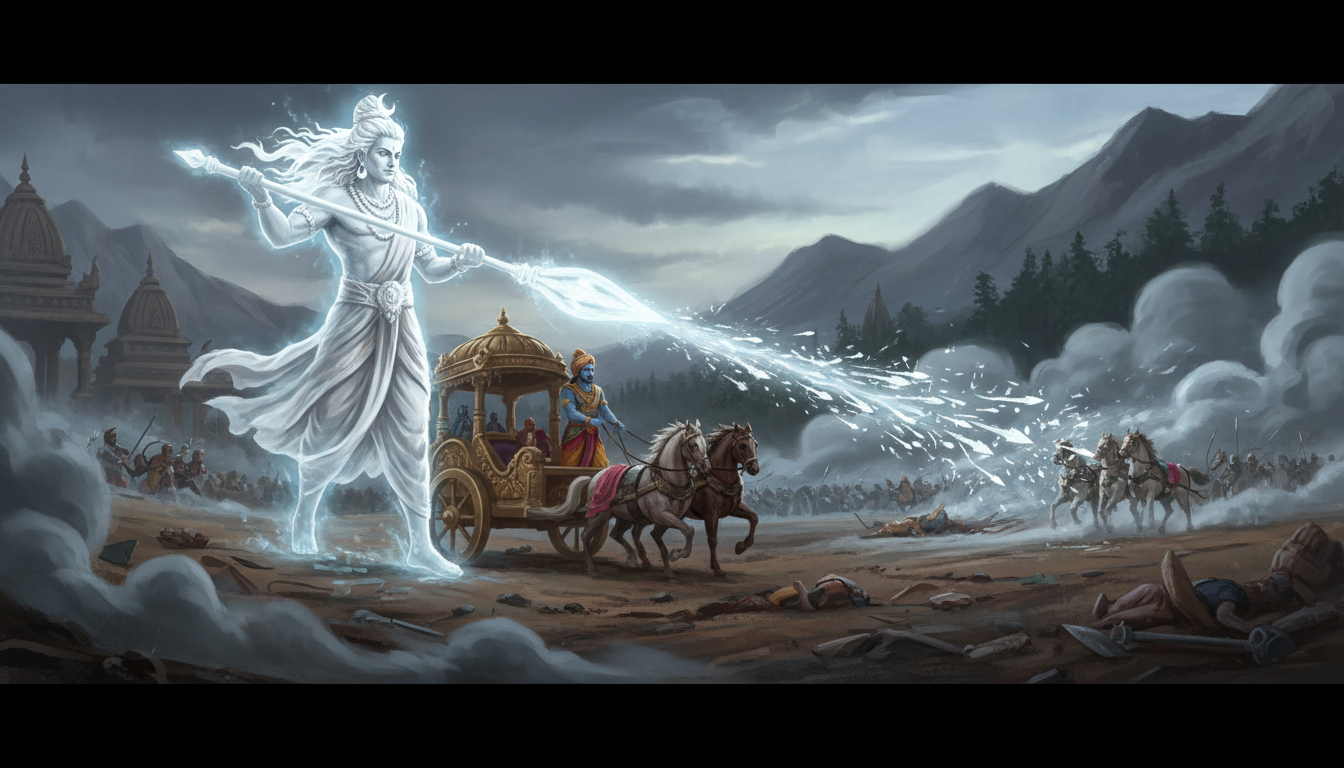
The One Who Walked Ahead of the Chariot
Arjuna finally asks who has been winning his battles
The Field After the Preceptor
"Upon the slaughter of that Atiratha, Drona, by Prishata's son," Dhritarashtra said, "what did my sons and the Pandavas next do?"
"Nothing, king, for a while. That is the honest answer. The Kuru army had gone off the field in every direction at once and the Pandavas were standing in the middle of a plain with nobody in front of them and did not seem to know what to do with the quiet."
The searchers were out looking for the body among thousands of headless trunks and could not find it. Somewhere out beyond the lines Bhima was still slapping his armpits. Arjuna had got down off his car and was standing on the ground, which he did not often do in the middle of a day, and he had not put the Gandiva down and he had not spoken to anybody.
And out of the smoke came an old man walking, in no hurry, the way he does. The son of Parasara went where he liked in that war and no arrow ever came near him. He had come thither, they said afterwards, in the course of his wanderings.
Arjuna saw him and went straight over, and did not ask about Drona, and did not ask about the days to come, and did not ask any of the things a commander would ask.
He asked about something he had been seeing for a week and had told nobody.
It is worth saying what he had done in that week, king, so that you know what kind of man was asking. He had cut a road three yojanas deep through the array your preceptor built on the day of Jayadratha's slaughter, which the Charanas in the sky called the last muster of its kind on earth. He had killed the Sindhu king inside a false dusk. He had fought all through the night that followed and through the whole of the next day. The bards on both sides had already begun making the songs. And the man in the middle of the songs walked up to an old ascetic on a burnt field and said, in effect, that he did not think the work had been his.
A Person of Blazing Hue
"O great Rishi. While I was engaged in slaying the foe in battle with showers of bright shafts, I continually beheld before me, proceeding in advance of my car, a person of blazing hue, as if endued with the effulgence of fire.
"He carried a lance and he held it up. Wherever he proceeded with that uplifted lance, all the hostile warriors were seen to break before him.
"They were broken in reality by him. People regarded the foe to have been broken by me. Following in his wake, I only destroyed those who had already been destroyed by him.
"Holy one, tell me who that was. That foremost of persons, armed with a lance, resembling the sun himself in energy, that was thus seen by me.
"He did not touch the earth with his feet.
"Nor did he hurl his lance even once. In consequence of his energy, thousands of lances issued out of that one lance held by him."
Sanjaya said: consider what that man was actually saying, king, on the day his enemies had begun calling him the greatest bowman who ever lived. He was saying that he had spent a week following something through a broken army and finishing off men who were already finished. He had not told Krishna. He had not told his brothers. He had waited for somebody to come who could be asked, and had gone on shooting in the meantime.
Thou Hast Seen Sankara
"You have seen Sankara," Vyasa said.
And then he stood there on that field, with the fires still going and the carts still coming, and told him who that is, in the manner of the old teaching, which does not summarise.
"That First cause, from which the Prajapatis have sprung. That puissant Being endued with great energy. He that is the embodiment of heaven and earth and sky. The Divine Lord, the protector of the universe, the great Master, the giver of boons, called also Isana. Seek the protection of that boon-giving Deity, that lord of the universe.
"He is called Mahadeva, of Supreme Soul, the one only Lord, with matted locks, the abode of auspiciousness. Of three eyes and mighty arms, he is called Rudra, with his locks tied in the shape of a crown and his body attired in skins. He is Hara and Sthanu. He is Sambhu, self-born, the lord of all creatures, the origin of the Past and the Future and the Present. He is Yoga and the lord of Yoga. He is called Sarva. He is superior to everything. The Soul of knowledge, incapable of being compassed by knowledge, the highest of all knowledge, he is unknowable, and through grace he gives to his worshippers the boons they desire.
"And his companions, Partha, are celestial beings of diverse forms. Some are dwarfs. Some have matted locks and some are bald. Some have short necks, some large stomachs, some huge bodies, some long ears. All of them have deformed faces and mouths and legs and strange attire. That Supreme Deity, called Mahadeva, is worshipped by followers that are even such.
"Even that Siva, endued with such energy, proceeds through kindness in advance of you."
Who Else Could It Have Been
"Ask yourself the other question," Vyasa said, "since you have asked me this one.
"In that fierce battle, Partha, the one that made the very hair stand on end, who else than the divine Maheswara, that foremost of all bowmen, that Deity of divine form, could even in imagination venture to vanquish that force which was protected by those great smiters and bowmen, Aswatthaman and Karna and Kripa?
"You went through it. You have been going through it for days. Did you at any point work out how?"
Arjuna did not answer.
"None can venture to stay before the warrior that has Maheswara walking before him. There is no being in the three worlds that is equal to him. At the very scent of the enraged Mahadeva, foes in battle tremble and become senseless and fall down in large numbers. It is for this that the gods in heaven adore him and bow to him.
"Bow down yourself, son of Kunti, to him that is peace. To Rudra of the blue throat, exceedingly subtle, of great effulgence. To him called Kapardin, him that is terrible, him of the tawny eyes, him that is boon-giving. To that great ordainer of red locks and righteous conduct. To him that has the mountains for his habitation, and barks of trees for his attire, and arms decked with ornaments of gold. To him that is the lord of all trees and of all kine, to him whose body is shrouded with trees, to him who is the celestial generalissimo, to him who has the sacrificial ladle in his hand.
"To him who wields the bow. To him with whom the bow is a favourite weapon; who is himself the shaft impelled by the bow; who is the bowstring and the bow; and who is the preceptor teaching the use of the bow."
That last one, king, was said to an archer standing in his own dust on the day his teacher had died. I do not think it was said carelessly.
The Teeth of Surya
"I will now tell you, according to my knowledge and as I have heard them, the divine deeds of Mahadeva of supreme wisdom.
"If Mahadeva becomes angry, neither gods nor Asuras nor Gandharvas nor Rakshasas, even if they hide themselves in the deep oceans, can have peace.
"In the days of old, Daksha collected the articles necessary for a sacrifice. Mahadeva destroyed that sacrifice in wrath. He became very stern on that occasion. He shot an arrow from his bow and uttered terrible roars, and the celestials were filled with anxiety and fright. When he became angry and the Sacrifice in its embodied form fled away, the gods were exceedingly frightened at the twang of his bow and at the sound of his palms. The gods and the Asuras all fell down and submitted to him. All the waters swelled up in agitation and the earth trembled. The mountains split. All the points of the compass and the Nagas became stupefied. The universe was enveloped in a thick darkness and could no longer be seen. The splendour of all the luminaries, with the sun, was destroyed.
"Surya was then eating the principal oblation. Smilingly, Sankara approached him and tore out his teeth.
"The gods humbled themselves and fled away trembling. Once more he aimed at them a shower of blazing and keen arrows that resembled flames of fire mixed with smoke. Beholding that arrowy shower, all the gods bowed down to Maheswara and assigned to Rudra a substantial share in sacrifices. In fright they sought his protection. His wrath being dispelled, the great God then restored the sacrifice. The gods that had fled away came back.
"They are afraid of Maheswara to this day."
The Car He Rode Against the Three Cities
"Formerly the valiant Asuras had three cities in heaven, each of them excellent and large. One was made of iron, another of silver, the third of gold. The golden city belonged to Kamalaksha, the silver to Tarakaksha, and the iron one had Vidyunmalin for its lord. With all his weapons, Maghavat could make no impression on those cities.
"Afflicted, all the gods sought the protection of Rudra and said, 'These terrible dwellers of the triple city have received boons from Brahma. Filled with pride, they are afflicting the universe. None save you is competent to slay them. Slay these enemies of the gods, and creatures slain in every sacrifice shall then be yours.'
"He accepted, and then he built himself a car, Partha, and I want you to hear what it was made of, since you have been standing on one for eighteen days.
"He made the two mountains Gandhamadana and Vindhya the two poles of it. He made the earth with her oceans and forests his battle car. He made Sesha, that prince of snakes, the axle. He made the moon and the sun the two wheels. He made Elapatra and Pushpadanta the two pins of the yoke. He made the Malaya mountains the yoke, and the great Takshaka the string for tying the yoke to the poles, and the creatures about him the traces.
"He made the four Vedas his four steeds. He made the supplementary Vedas the bridle bits. He made Gayatri and Savitri the reins, and the syllable Om the whip, and Brahma the driver.
"And making the Mandara mountains the bow, and Vasuki the bowstring, and Vishnu his excellent shaft, and Agni the arrowhead, and Vayu the two wings of that shaft, and Yama the feathers in its tail, and lightning the whetting stone, and Meru the standard, Siva mounted that car, which was composed of all the celestial forces, and proceeded for the destruction of the triple city.
"He caused an array to be formed, called after his own name. And then he stood immovable for a thousand years.
"When the three cities came together in the firmament, he pierced them with that terrible shaft of his, consisting of three knots. The Danavas were unable even to gaze at it."
The Child on Parvati's Lap
"While the triple city was beginning to burn, the goddess came there to behold the sight. She had a child on her lap: a child with a bald head and five clumps of hair on it.
"The goddess asked the deities who that child was.
"Sakra, through ill feeling, endeavoured to strike the child with his thunderbolt. The divine lord Mahadeva, for the child was none other, smiling, paralysed the arm of the enraged Sakra where it was.
"Then Sakra, with his arm hanging useless, went with all the celestials to lord Brahma of unfading glory. They bowed to him with their heads and said, with joined hands, 'Some wonderful creature, O Brahma, lying on the lap of Uma in the form of a child, was beheld by us but not saluted. We have all been vanquished by him. We desire to ask you who he may be. That boy, without fighting at all, has with the greatest ease vanquished us all, with Purandara at our head.'
"The Grandsire reflected for a moment and understood. And he said, 'That child is the divine Hara, the Lord of the entire mobile and immobile universe. There is nothing superior to Maheswara. That Being of immeasurable splendour whom you beheld with Uma had assumed the form of a child for Uma's sake. Let us all go to him. You could not recognise the master of the universe.'
"So they all went back, with the Grandsire, to that child endued with the effulgence of the morning sun, and Brahma adored him: 'You are Sacrifice. You are the stay and refuge of the universe. This whole universe with its mobile and immobile creatures is pervaded by you. O lord of the past and the future, let Sakra, afflicted with your wrath, have your grace.'
"Maheswara was gratified. Desirous of extending his grace, he laughed aloud. And the arm of the thunder-wielding Sakra regained its natural state."
Why He Is Called Each of the Things He Is Called
"All the attributes of that God are not capable of being enumerated by me even if I were to recite them continually for a thousand years, son of Pandu. But take the names, since names are what a man can carry away with him.
"Since he always protects the creatures of the universe, and sports with them, and is the lord of all creatures, therefore he is called Pasupati.
"Since with respect to the past, the future and the present that God has many forms, he is on that account called Vahurupa.
"Since he possesses the worlds, he is for that reason called Sarva. Since his form is like that of smoke, he is called Dhurjjati. Since the Viswedevas are in him, he is called Viswarupa.
"Since three goddesses adore him and have recourse to him, Firmament, Water and Earth, he is for that reason called Tryamvaka.
"Since he always increases all kinds of wealth and wishes the good of mankind in all their acts, he is for that reason called Siva.
"Since he protects this vast universe, he is called Mahadeva. Since he is great and ancient and is the source of life and of its continuance, he is called Sthanu. Since the solar and the lunar rays of light that appear in the world are spoken of as the hair on the Three-eyed one, he is called Vyomakesa.
"Since, afflicting Brahma and Indra and Varuna and Yama and Kuvera, he destroys them ultimately, he is for that reason called Hara. Since he is the Past, the Future and the Present, and in fact everything in the universe, he is called Bhava.
"And since Maheswara, by means of his two eyes closed in meditation, created through sheer force of will a third eye on his forehead, he is for that reason called the Three-eyed.
"Half his soul is fire and half is the moon. With the auspicious form he practises Brahmacharya. With the terrible form he devours everything. And since he burns, since he is fierce, since he is endued with great prowess, and since he devours flesh and blood and marrow, he is for this called Rudra."
You Were Shown Him Once Before
"Even such is the deity called Mahadeva, armed with Pinaka, who was seen by you engaged in slaying your foes in advance of your car."
And then Vyasa said the thing that made Arjuna sit down on the pole of his own chariot.
"You have seen him before, Partha. After you had vowed to slay the ruler of the Sindhus, Krishna showed you this God, in your dream, sitting on the top of that foremost of mountains."
The night of the vow. The bed of kusa grass with the weapons laid round it. The mountain, and the errand, and the thing that had been given him there.
"It is he who gave you those weapons with which you slew the Danavas. This illustrious God proceeds in advance of you in battle."
So it had not been a favour done once and finished. The gift had walked in front of him every morning since, and he had gone on shooting behind it for a week thinking he was doing it himself, and the only reason he now knew otherwise was that he had happened to be standing on an empty field when a wanderer came past.
"That hymn approved of the Vedas, called the Sata-Rudriya, in honour of that God of gods, that excellent and famous and life-enhancing and sacred hymn, has now been explained to you. This hymn of four divisions, capable of accomplishing every object, is sacred, destructive of all sins, competent to drive away all stains and to kill all sorrows and all fears. The man who always listens to it succeeds in vanquishing all his foes and is highly respected in the region of Rudra.
"Go and fight, son of Kunti. Defeat is not for you, that have Janardana on your side for your adviser and your protector."
And having addressed Arjuna in those words, king, the son of Parasara went away to the place he had come from, in no hurry, the way he does.
And Arjuna got back up on his car, and Krishna took the reins without asking what had been said, and the fifteenth day went on.
He never mentioned it again, king, so far as anybody heard. He did not tell his brothers. He did not put it into any of the speeches he made afterwards, and when men praised him for the road he cut on the fourteenth day he let them, because there is no graceful way to stand in front of an army and explain that the breaking had been done by somebody walking a few paces ahead of you who never once put his feet down.
Dharma Lesson
The victories a person is proudest of may have been decided by something walking ahead of them that they never thought to ask about. Arjuna cut a road through an army for a week and then said plainly that he had only been finishing men who were already broken. Honest accounting of one's own success is itself a form of worship, and it is the question, not the credit, that brings the answer.