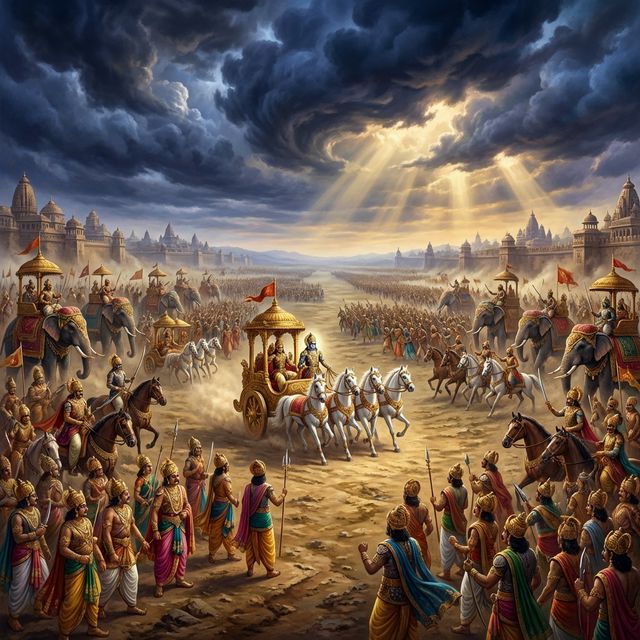
The Sword That Broke on the Shield
Abhimanyu strips a king of everything, and Jayadratha comes down off his car to stop him
The River Drona Made
Sanjaya was telling it to a blind man in a hall, and on the eleventh morning of the war he had a new commander to describe.
Bhishma was down on his bed of arrows. Drona had taken the command, and Drona had promised Duryodhana that he would bring Yudhishthira to him alive. The Pandavas had heard of that promise through their spies before the sun was properly up, and Arjuna had said that the firmament with its stars might fall and the earth split into fragments before Drona seized his brother while he lived. Then the conchs were blown on both sides and the two hosts went slowly toward each other.
"Then Drona," said Sanjaya, "causing a great confusion in the Pandava host, careered through it like a conflagration consuming a forest of trees."
The Srinjayas trembled when they saw him. The twang of his constantly stretched bow was heard like the roar of thunder. He shot with such lightness of hand that the shafts seemed to fall the way a summer cloud, helped by the wind, pours hail-stones, and the gold-decked bow on his quickly-moving car looked from a distance like lightning inside a mass of dark cloud.
Sanjaya, who had been describing chariots and standards for eleven days, reached for something larger, and made a river out of him.
It had its source in the impetuosity of Drona's wrath. The combatants were its waves and the fallen were the timber floating on it. Coats of mail were its lilies. Cars were its eddies and its tortoises both, elephants and steeds were its banks, and heads were the stones lying scattered on the bed of it. Torn umbrellas were its swans, and diadems the small birds that adorned it, and lances the fish. It could be crossed by men of exceeding energy and could not be crossed by the timid, and it carried mighty car-warriors away by the thousand to the abode of Yama.
And into that river, from every side at once, the Pandavas headed by Yudhishthira rushed at the man who was making it.
Every Man Found His Own Enemy
The brave men of Dhritarashtra's army came out to meet that charge from every side, and the battle broke apart into pairs, the way it does when both hosts are past caring about the shape of the line.
Shakuni, full of a hundred kinds of deceit, went at Sahadeva and put keen shafts through his charioteer and his standard and his car. Sahadeva was not much excited by it. He cut off Shakuni's standard and bow and driver and car with sharp arrows and then put sixty shafts into the man himself, and Shakuni came down off the wreck with a mace in his hands and felled Sahadeva's driver with it. So the two of them stood on the ground with maces, uncle and nephew, like two crests of hills.
Drona pierced Drupada with ten shafts and took as many back. Bhima shot Vivinsati, a son of Dhritarashtra, with sharp arrows, and it was thought highly wonderful that the man did not tremble; then Vivinsati took Bhima's horses and standard and bow away from him all at once, and the troops raised a shout for him, which Bhima could not bear, so he killed the horses with his mace and Vivinsati came down with a sword and a shield.
Shalya laughed while he shot at Nakula, his own sister's son, as if in dalliance, to make him angry. Nakula cut off his uncle's horses and umbrella and standard and charioteer and bow and then blew his conch.
Dhrishtaketu cut Kripa's arrows out of the air and put seventy into him. Satyaki laughed and put a long arrow into the centre of Kritavarman's chest, and Kritavarman answered with seventy, and could no more move Satyaki than a wind can move a mountain. Senapati struck Susharma in the vitals and took a lance in the shoulder-joint for it. Virata, with his Matsyas around him, held Karna, and men on both sides remarked on it. Drupada and Bhagadatta made a battle beautiful to watch. Bhurishravas covered Shikhandi, and Shikhandi put ninety shafts into him and made him tremble. Ghatotkacha and Alambusha, both rakshasas, both able to make a hundred illusions, fought each other with illusions and delighted the field.
And out of all that noise one chariot came on with its horses at the gallop, and a man on it roared at Abhimanyu.
The Arrow That Was Not Loosed
The man who roared was Paurava, a king of the old Puru line fighting on Duryodhana's side, and he came at Abhimanyu with fleet steeds and a car duly equipped and a great deal of confidence.
Abhimanyu was sixteen years old. He was Arjuna's son by Subhadra, Krishna's nephew, and he had been on the field since the first day, and Sanjaya calls him here what he calls the great ones, a chastiser of foes.
Paurava covered him with a thick shower of arrows. That was the whole of Paurava's part in it.
What Arjuna's son did next he did in a fixed order, and the order matters, because it is the order in which a car-warrior is taken apart. First the standard, so that his men cannot find him. Then the umbrella, which is the mark of his rank. Then the bow, which is his hands. All three went to the earth in the time it takes to say it. Then seven arrows into Paurava himself, and five more that took the driver and the horses, and the Pandava troops, seeing it, were gladdened, and Abhimanyu roared like a lion again and again for them.
Then he fixed on the bow-string an arrow that was certain to take away Paurava's life.
There was a moment there in which a king of the Purus stood on a car he could not move, in front of a boy who had already beaten him and was now simply going to finish it, and every man near enough to see the arrow knew what it was for.
It was Kritavarman, Haridika's son, of the Bhoja house, who saved him. He was fighting Satyaki a little way off and he saw the shaft come to the string, and with two arrows of his own he cut off both the bow and the arrow on it.
Abhimanyu threw the broken bow aside. He did not send for another one.
He took up a bright sword and a shield.
Garuda Lifting a Snake
What followed was watched by both armies, and Sanjaya reports it as a thing seen rather than a thing counted.
He whirled the shield, which was decked with many stars, and he whirled the sword, and he coursed about the field on foot showing what he could do. He whirled them before him and whirled them on high. Now he shook them, now he jumped up himself, and from the manner of his handling those weapons it seemed that with him there was no difference between the offensive weapon and the defensive one. The shield came round like a blade. The sword came round like a wall.
Then he jumped up onto the shafts of Paurava's car, and roared aloud, and mounted it.
He took Paurava by the hair. With the same motion he kicked the new driver off the car and killed him, and with one stroke of the sword he brought down what was left of the standard, and then he lifted the king of the Purus bodily off his own chariot floor.
"Like the Garuda," said Sanjaya, "raising a snake from the bottom of the sea, agitating the waters."
All the kings on that field saw Paurava then, held up in the air by a boy, with his hair dishevelled and nothing in his hands, and what they thought he looked like is set down without kindness. Like an ox that has lost its senses, at the point of being killed by a lion.
Abhimanyu was not going to keep him. That is not what a man does with an enemy he has hauled off a chariot by the hair in front of two armies. He was holding him up so that everyone could see, and he was going to kill him where he held him.
And on the Kaurava side one man could not brook the sight of it.
The Shield With a Hundred Bells
Jayadratha, the ruler of the Sindhus, took up a sword and a shield and jumped down from his car with a loud roar.
Of all the men on that field he was the one with the least business coming to the rescue of anybody. He was Vriddhakshatra's son and Dhritarashtra's son-in-law, and in the forest years he had carried Draupadi off in his chariot while her husbands were away hunting, and Bhima had run him down and Arjuna had let him go alive with his head shaved in five tufts. Sanjaya names him here in the plainest way there is. A sworn foe of Abhimanyu's father.
His shield bore the device of a peacock, and it was decked with a hundred small bells hung in rows, so that a man could hear him coming across a battlefield.
Abhimanyu heard him, and let Paurava go.
He left the beaten king lying on his own chariot floor and leapt off it like a hawk going off a branch, and came down on the earth on his feet.
Jayadratha's people did not let him land quietly. Lances and axes and scimitars came at him from every side while he was still finding his footing, and he cut them out of the air with the sword or turned them away with the shield, every one, showing all the warriors there the strength of his own arms.
Then he raised the large heavy sword again and lifted the shield again, and went toward the son of Vriddhakshatra the way a tiger goes toward an elephant.
No Difference Between Them
They came together and attacked each other cheerfully, with their swords, like a tiger and a lion using their claws and their teeth.
Sanjaya, describing it to the blind king, keeps saying the same thing in different ways, and the repetition is the point. None could notice any difference between those two lions among men as regards the whirl-strokes, or the descent of their swords, or the handling of their shields. As regards the descent and the whiz of the blades, and the warding off of each other's blows, it seemed there was no distinction between the two. They coursed beautifully in the outward track and the inward track, circling and closing and breaking away, and they looked to the men watching like two winged mountains.
One of them was a king who had been fighting wars since before the other was born. The other was sixteen.
And the field could not tell them apart.
It did not end because one of them was the better swordsman. It ended because of a shield.
Abhimanyu stretched out his sword to make a pass, and in that opening Jayadratha struck at the shield instead of the man. The shield was covered with a plate of gold. The Sindhu king's large sword went into it and stuck there, and he pulled at it to get it free, and he pulled hard, and the blade broke.
He was standing on open ground in front of Arjuna's son with a hilt in his hand.
Jayadratha retreated six steps, quickly. Sanjaya counted them, as he counted everything. Within the twinkling of an eye he was seen to be mounted on his own car, and the sword-fight was over, and Abhimanyu, having nobody left to fight on foot, went back and climbed onto his own excellent chariot.
The kings of the Kuru army closed round him on all sides.
He stood up on the car among them, and looked across at Jayadratha, and whirled the sword and the shield over his head, and shouted.
The Dart Sent Back
Having vanquished the ruler of the Sindhus, that slayer of hostile heroes began to scorch the division of the Kaurava army in front of him the way the sun scorches the world.
Shalya, the king of Madra, put a stop to it. He hurled at the boy a fierce dart made wholly of iron, decked with gold and set with stones of lapis lazuli, that came through the air resembling a blazing flame of fire.
Abhimanyu jumped up and caught it.
Sanjaya gives the image that was already in his mouth from an hour before, and gives it the other way round. Like Garuda catching a mighty snake as it falls from above. The boy who had lifted Paurava out of a chariot like an eagle taking a serpent out of the sea now had a serpent of iron in his hands out of the sky, and with it held he drew his sword as well, so that both his hands were full and neither of them was empty.
All the kings there, on both sides, uttered a leonine shout at the sight of it.
Then he threw the dart back. It went with the whole might of his arms behind it, that great effulgent thing with the lapis on it, like a snake that has recently cast off its slough, and it reached Shalya's car and killed Shalya's driver and pitched him out of his niche onto the ground.
Virata cried out. So did Drupada, and Dhrishtaketu, and Yudhishthira, and Satyaki, and the Kekaya princes, and Bhima, and Dhrishtadyumna, and Shikhandi, and the twins, and the five sons of Draupadi. Excellent, they shouted, from all across that field. Excellent. Arrows sang and men roared, and none of it retreated, and none of it stopped, and the son of Arjuna stood in the middle of the noise his elders were making for him.
Dhritarashtra's sons could not brook the sight of their enemy's victory. All of them at once surrounded Subhadra's son and covered him with showers of arrows, the way clouds pour rain on the breast of a mountain.
And Shalya, wishing them well and remembering his charioteer, turned his car and came at the boy in a rage.
Dharma Lesson
Abhimanyu wins two fights in this hour and neither is decided by strength. Paurava falls because a boy took his standard, his umbrella and his bow in the right order, and Jayadratha survives because his own pull on a stuck blade breaks it. Skill here is not force but knowing exactly what to remove from a man, and the field, which cannot tell the two swordsmen apart, is a reminder that a reputation earned over thirty years buys no advantage against someone who has simply practised harder. What the day does not show, and what makes it hard to read afterwards, is that the sixteen-year-old who could have killed Jayadratha and chose the shield-work instead will die inside a formation five days later, with this same king holding the gate behind him.