The Warning in the Dream
A father begs his son to live, and the son chooses to be remembered
The Fear He Never Named
"Stop there," said Janamejaya, "and tell me one thing before you go on. When Lomasa came down into the forest with a message from Indra for the son of Pandu, he said to him, 'That intense fear of thine which thou dost never express to any one, I will remove after Dhananjaya goeth from hence.' What fear was that? What was there in Karna that frightened Yudhishthira? And why, being frightened, did he never once say so aloud?"
Vaisampayana said, "You have asked well, tiger among kings, and I will tell you the whole of it.
"Yudhishthira was afraid of two ornaments. Karna had come into the world already wearing them: a coat of mail grown into his skin, close as a second body, and a pair of earrings that had risen long ago out of the nectar of immortality. While he wore them there was no weapon in the three worlds that could open him. Arjuna was gone up to heaven to learn the arts of the gods and would be a long time coming back, and every season some new report came in of what the son of Radha had done in the east or the south, and the eldest Pandava listened to each of them and said nothing. A king who names his fear aloud has not put it down; he has only handed it to his brothers to carry as well.
"Twelve years of the exile had worn away and the thirteenth had set in. In that year Sakra, who was always a friend to the sons of Pandu, settled on a thing he had been turning over for a long while. He would go to Karna himself, in the dress of a beggar, and ask him for the earrings.
"And Surya, whose whole wealth is his brightness, came to know what the chief of the celestials intended, and went at once to his son."
The Brahmana in the Dream
Karna lay that night at his ease on a rich bed spread with a costly sheet, a man devoted to the brahmanas and truthful in his speech, sleeping as such men sleep. And the god, filled with tenderness for his son, put on by ascetic power the form of a handsome brahmana versed in the Vedas, and walked into his dream, and spoke to him sweetly.
"Listen to these words of mine, O son, thou foremost of truthful persons. I tell thee today out of affection what is for thy great good. Sakra is coming. With the object of obtaining thy earrings, and moved by the desire of benefiting the sons of Pandu, he will come to thee disguised as a Brahmana. He knows thy character, as all the world knows it: that when pious people solicit thee thou givest, and never takest. Thou givest a brahmana wealth or whatever else is asked of thee, and thou refusest nothing to anybody. Knowing thee to be such, the subduer of Paka himself will come to beg of thee thy earrings and thy coat of mail.
"When he begs them, it behoveth thee not to give them away, but to gratify him with sweet speeches to the best of thy power. Refuse him. Refuse him repeatedly, with various reasons, and offer him instead other kinds of wealth: gems, and women, and kine, and cite him the old precedents while thou art doing it. Even this is for thy supreme good. For if thou givest away those beautiful earrings that were born with thee, thy life will be shortened and thou wilt meet with death. Arrayed in thy mail and thy earrings thou art incapable of being slain by any foe in battle. Lay my words to heart. Both those jewelled ornaments have sprung from Amrita. Preserve them, my son, if thy life is at all dear to thee."
I Am He of a Thousand Rays
In his sleep Karna sat up and looked at the stranger. "Who art thou that tellest me so, and showest me such kindness?" he said. "If it pleases thee, illustrious one, tell me who thou art in the guise of a Brahmana."
"O son, I am he of a thousand rays," the brahmana said. "Out of affection I am pointing out to thee the path. Act according to my words, for it is for thy great good to do so."
"Then this alone is great fortune for me," said Karna, "that the god of splendour himself should address me tonight, seeking my welfare. But listen now to what I have to say, and let it not offend thee, for it is only from affection that I say it. If I am dear to thee, thou shouldst not be the one to dissuade me from the observance of my vow. The whole world knows what my vow is: that I am prepared to give away life itself unto superior Brahmanas. If Sakra comes to me disguised as a Brahmana, and comes to beg for the benefit of the sons of Pandu, I will give him the earrings and the excellent mail, so that my fame, which has spread over the three worlds, may not suffer any diminution.
"For persons like us it is not fit to save life by a blameworthy act. On the contrary it is proper for us to meet death with the approbation of the world, and under circumstances that bring fame. Therefore I will bestow the earrings on Indra, and the mail with them. Consider what he is doing. If the slayer of Vala and Vritra comes in a beggar's cloth to ask a mortal for the ornaments he was born in, and asks for them on behalf of five men he favours, that will conduce to my fame and lead at the same time to his infamy. The shame in that transaction is not mine to carry."
What Fame Is For
"I wish for fame in this world," Karna went on, "even if it is to be purchased with life itself. They that have fame enjoy the celestial regions; they that are destitute of it are lost. Fame keeps people alive in this world even like a mother. Infamy kills men, though they go on moving about with their bodies undestroyed. That fame is the life of men is evidenced by an ancient sloka sung by the Creator himself: in the next world it is fame that is the chief support of a person, while in this world pure fame lengthens life.
"So by giving away my earrings and my mail, with both of which I was born, I shall win eternal fame. And by giving to brahmanas duly, according to the ordinance; and by offering up my body as a gift to the gods in the sacrifice of war; and by achieving feats difficult of performance; and by conquering my foes in fight, I shall acquire nothing but renown. And by dispelling on the field of battle the fears of the affrighted who beg me for their lives, and by relieving old men and boys and brahmanas from terror and anxiety, I shall win excellent fame and the highest heaven.
"My fame is to be protected with the sacrifice of even my life. This too, know thou, is my vow. And by giving away so valuable a gift to Maghavan while he stands before me in the dress of a Brahmana, I shall acquire in this world the most exalted state that is open to a man."
He said it without heat and without hurry, the way a man reads out a reckoning he has already made and checked. The god in the brahmana's body heard his son price his own life and find it cheap.
A Garland Round the Neck of a Corpse
"Never do anything, O Karna, that is harmful to thyself and to thy friends," said Surya, "to thy sons, thy wives, thy father and thy mother. Men desire renown in this world and lasting fame in heaven without wishing to sacrifice their bodies for it. But thou desirest undying fame at the expense of thy life, and she will take thy life without doubt.
"In this world the father, the mother, the son and the other relatives are of use only to him that is alive. As regards kings, it is only while they are alive that prowess can be of any use to them. Dost thou understand this? Fame is for the good of those only that are alive. Of what use is fame to the dead, whose bodies have been reduced to ashes? One that is dead cannot enjoy renown. The fame of one that is dead is like a garland of flowers around the neck of a corpse.
"I tell thee this because thou reverest me, and they that worship me are always protected by me. And there is more. There is a profound mystery in all this, ordained by fate, and it is for that reason as much as any other that I speak. Act without mistrust of any kind. It is not fit for thee to know the thing itself, for it is a secret even to the gods, and so I do not reveal it. Thou wilt understand it in time.
"I say again what I have said. When the wielder of the thunderbolt asks thee for them, do not give him thy earrings. With those earrings on thee thou lookest beautiful, like the Moon in a clear sky between the stars of Visakha. And know this: while thou art furnished with them, Arjuna will never be able to vanquish thee in fight, though Indra himself come down to his assistance. Thou art always challenging the man who draws the bow with his left hand, and he will surely meet thee. If thou wishest to vanquish Arjuna in battle, these earrings should never be parted with to Sakra."
Death Is Not So Terrible to Me as Untruth
"Thou knowest me for thy worshipper, lord of splendour," Karna said, "and so thou knowest also that there is nothing which I cannot give away in charity. Neither my wives, nor my sons, nor my own self, nor my friends are so dear to me as thou art, for the veneration I feel for thee. High-souled persons bear a loving regard for those who love them, and thou hast said to me tonight what is for my benefit because Karna reveres thee and knows no other deity in heaven.
"Yet with my head bent I beseech thee again, and again I place myself in thy hands, and I will repeat the answer I have already given. It behoveth thee to forgive me. Death itself is not fraught with such terrors for me as untruth is. As regards the brahmanas especially, I do not hesitate to yield up my life even for them.
"And as to what thou hast said of Phalguna, the son of Pandu, let thy grief be dispelled, for I shall surely conquer Arjuna in battle. Thou knowest that I have great strength of weapons, obtained from Jamadagnya and from the high-souled Drona. Permit me now to observe my vow, so that to him of the thunderbolt, when he comes to beg of me, I may give away even my life."
There was a silence in the dream. The god had come down through the whole height of the sky to save one man, and had been answered courteously, at length, and without a single opening left in the argument. He had told his son that his life was at stake and his son had thanked him for the news.
Then Name Your Price
"If thou wilt give away thy earrings to the wielder of the thunderbolt," said Surya at last, "then at least do this for the securing of victory. Say to him, 'O thou of a hundred sacrifices, I shall give thee the earrings under a condition.' Understand why he is coming. Furnished with those ornaments thou art incapable of being slain by any being, and it is because he desires to behold thee slain in battle by Arjuna that the destroyer of the Danavas wishes to strip thee of them. So adore him with truthful words, that lord of the celestials armed with weapons that are never frustrated, and then beseech him also, saying, 'Give me an infallible dart, capable of slaying all foes, and I will give thee the earrings with the excellent coat of mail.' On that condition, and on no other, shouldst thou give them up. With that dart thou wilt slay foes in battle, for that dart of the chief of the celestials does not return to the hand that hurls it without slaying enemies by hundreds and by thousands."
Having said this, the thousand-rayed deity suddenly vanished away, and Karna was awake in an empty room with the taste of the words still in his mouth.
The next day, when he had told his prayers standing in the water with his hands raised, he related the dream to the Sun itself: the brahmana, the warning, the argument, and every word that had passed between them in the night. And that enemy of Swarbhanu, the resplendent and divine Surya, heard him out and said, with a smile, "It is even so."
So Radha's son knew the whole of the matter. And knowing it, and being now set upon obtaining the dart, he remained where he was and waited for Vasava to come.
Welcome, Brahmana
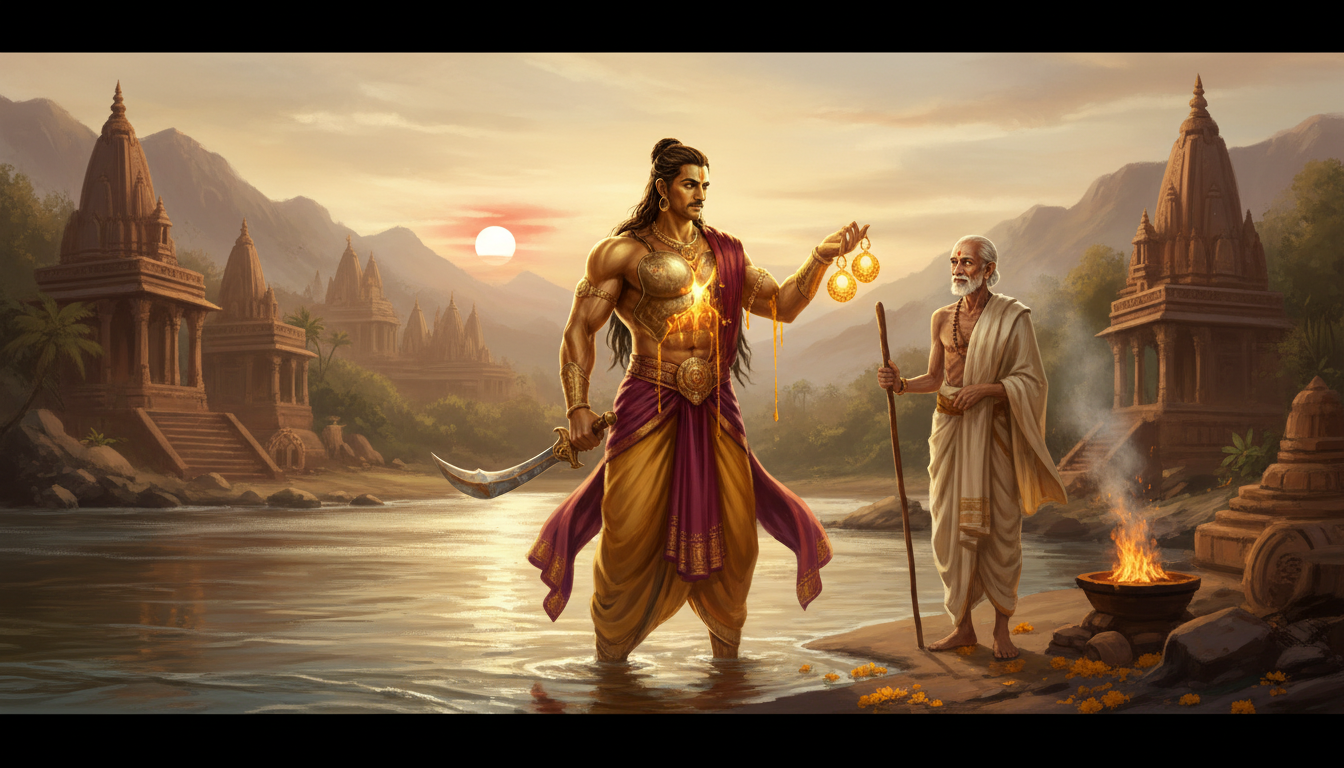
The king of the celestials presented himself in the guise of a brahmana, and Karna, seeing him, said, "Welcome!" and gave him the honours a guest is owed. Then, as though he knew nothing at all of what was coming, Adhiratha's son said, "Of a necklace of gold, and beauteous damsels, and villages with plenty of kine, which shall I give thee?"
"I ask thee not to give me a necklace of gold," the brahmana said, "nor fair damsels, nor any other agreeable object. Give those to them that ask for them. If thou art sincere in thy vow, then cut off from thy person this coat of mail that was born with thy body, and these earrings, and bestow them on me. I desire that thou give them to me quickly, for this one gain of mine will be reckoned above every other gain."
"O Brahmana," said Karna, "I will give thee homestead land, and fair damsels, and kine, and fields. My mail and my earrings I am unable to give thee."
The brahmana said nothing and asked for nothing else. Karna urged him with one thing after another; he worshipped him duly and sought to pacify him to the best of his power; and still that best of brahmanas would not name another boon.
At last Karna smiled and tried once more. "My mail was born with my body, O regenerate one, and this pair of earrings arose out of Amrita. It is on account of these that I am unslayable in the worlds. Therefore I cannot part with them. Take from me instead the entire kingdom of the earth, rid of its enemies and full of prosperity; it is yours in a word. But if I am stripped of my earrings and of the mail born with my body, I shall be liable to be vanquished by my foes."
The brahmana stood in the sun with his hand out and did not move.
I Knew You Before You Came
Then Karna laughed outright and named him.
"O god of gods, even before this I had recognised thee. O Sakra, it is not proper for me to confer on thee an unprofitable boon, for thou art the very lord of the celestials. Being the Creator and lord of all beings, it is thou that shouldst be conferring boons on me. If I give thee this coat of mail and these earrings I am sure to meet with destruction, and thou for thy part shalt undergo ridicule. Therefore take my earrings and my excellent mail in exchange for something conferred by thee on me. Otherwise I will not bestow them on thee."
"Even before I came to thee, Surya had known my purpose," said Sakra, "and without doubt it is he who has unfolded everything to thee. Be it as thou wishest, my son. Except the thunderbolt alone, tell me what thou desirest to have."
Karna came close to him, his purpose within reach at last. "In exchange for my coat of mail and my earrings, give me a dart that cannot be baffled, and that is competent to destroy hosts of enemies when they are arrayed in order of battle."
Vasava fixed his mind a moment upon the dart to bring it there, and then he set out the terms. "Take it on these conditions. When I encounter the Daityas in battle, this dart hurled by my hand destroys enemies by hundreds and comes back to my hand when its work is done. In thy hand, son of a Suta, it will slay one powerful enemy only, and having achieved that it will return, roaring and blazing, to me."
"I desire to slay in fierce fight even one enemy of mine," said Karna, "one who roars fiercely and is hot as fire, and of whom I am afraid."
"Thou shalt slay such a roaring and powerful foe," said Indra. "But know that the one thou seekest to slay is protected by an illustrious personage. He whom men versed in the Vedas call the invincible Boar and the incomprehensible Narayana, even that Krishna himself, is protecting him."
The Cutting
"Even if this be so," Karna said, "give me the weapon that will destroy one powerful foe. I on my part will bestow on thee my mail and my earrings, cutting them off my person. Grant me only this: that my body, thus wounded, may not be unsightly."
"As thou art bent upon observing the truth," said Indra, "thy person shall not be unsightly, nor shall any scar remain upon it. Thou shalt be possessed of the complexion and the energy of thy father himself. But hear the condition on the dart. If, maddened by wrath, thou hurlest it while there are still other weapons left to thee, and when thy life is not in imminent peril, it will fall upon thyself."
"As thou directest me, O Sakra, I shall hurl this Vasavi dart only when I am in imminent peril," Karna said. "Truly I tell thee this."
Then, taking the blazing dart in one hand, he began with the other to peel the natural mail off his body. The whole host of the celestials and of men and of Danavas that had gathered unseen to watch set up a leonine roar. He betrayed no contortion of face while he peeled it. He was smiling now and again as he worked, as at some private joke, and celestial kettledrums began to sound over him and celestial flowers came down. He cut the excellent mail off his person and handed it to Vasava still dripping. Then he cut the earrings from his ears and made them over to Indra also. It is from this that he came to be called Karna.
Sakra, having thus beguiled the man he had made famous by the asking, thought with a smile that the business of the sons of Pandu was already completed, and ascended to heaven. When the news went round, the sons of Dhritarashtra were distressed and shorn of their pride, and the sons of Pritha, learning what plight had befallen the son of the charioteer, were filled with joy. And so the fear Yudhishthira had never spoken of to anybody was taken away from him without his having once had to ask.
Dharma Lesson
A vow is only tested when keeping it costs more than breaking it would, and the man who has already priced his own life can be argued with but not bought. Karna hears every reason to live and answers each one, because what he is defending is not the ornaments but the single fact that he has never refused a beggar.