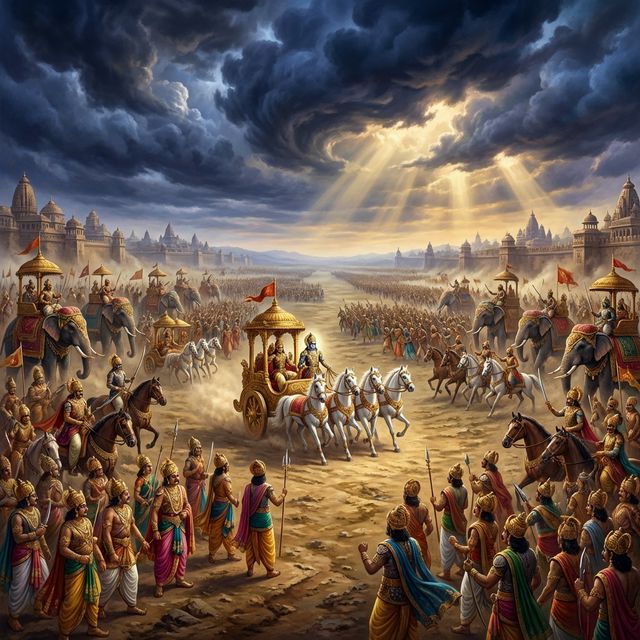
The Mole and the Charioteer
How Damayanti Was Found in Chedi and Nala in Ayodhya
A Thousand Kine for a Rumour
Yudhishthira had lost a kingdom at dice, and the sage Brihadashva was telling him about a king who had lost one the same way, so that a man sunk in self-reproach might hear his own case argued under another man's name.
The tale had reached its darkest turn. Nala, ruler of the Nishadhas, beaten at the dice by his own brother and stripped of everything, had cut his sleeping wife's garment in half in the forest and walked away from her. He had come at last to the city of Ayodhya and taken service with king Rituparna under the name of Vahuka, a man of unsightly appearance and short arms who could drive horses faster than anyone alive and cook better than anyone in the household. Damayanti, princess of Vidarbha, had come out of the same forest by another road and was living in the palace of the king of the Chedis, taken for a sairindhri, a well-born serving-woman fallen out of her station. Neither of them knew that the other was still breathing.
Vaishampayana, who set down the whole of it long afterwards, put the next part without ornament.
After Nala, despoiled of his kingdom, had with his wife become a bondsman, king Bhima of Vidarbha, who was Damayanti's father, sent out brahmanas to search for him.
He did not send them out empty. He gave them profuse wealth first, and then he named his price.
"Do ye search for Nala, and also for my daughter Damayanti. He who achieveth this task, that is, ascertaining where the ruler of the Nishadhas is, and bringeth him and my daughter hither, will obtain from me a thousand kine, and fields, and a village resembling a town. Even if failing to bring Damayanti and Nala here, he that succeeds in learning their whereabouts will get from me the wealth represented by a thousand kine."
A thousand cattle for a rumour. A village for the pair of them brought home alive. The brahmanas went out cheerfully in all directions, into cities and provinces, and for a long while they found nothing at all.
The Lotus Stalk Covered in Mire
Then one of them came to the beautiful city of the Chedis.
His name was Sudeva. He entered the palace during the hour of the king's prayers, when the household was quiet and the women were at their own business, and he saw a woman sitting beside the princess Sunanda, and he stopped where he stood.
Her beauty was only slightly perceptible, like the brightness of a fire enveloped in curls of smoke. She was soiled and she was emaciated. Sudeva looked at her large eyes and began, silently and carefully, to reason his way to a conclusion, and the reasoning came out of him in the shape of a lament.
"As I saw her before, this damsel is even so at present. O, I am blest, by casting my eyes on this fair one, like Sree herself delighting the worlds. Resembling the full moon, of unchanging youth, illumining all sides by her splendour, possessed of large eyes like beautiful lotuses, she looketh like a lotus-stalk transplanted by adverse fortune from the Vidarbha lake and covered with mire in the process.
"Oppressed with grief on account of her husband, she looketh like the night of the full moon when Rahu hath swallowed that luminary, or like a stream whose current hath dried up. Her plight is very much like that of a ravaged lake with the leaves of its lotuses crushed by the trunks of elephants, and with its birds and fowls affrighted by the invasion. Indeed, this girl of delicate frame, deserving to dwell in a mansion decked with gems, is now like an uprooted lotus-stalk scorched by the sun. Destitute of ornaments though deserving of them, she looketh like the moon newly bent in heaven but covered with black clouds.
"Verily, the husband is the best ornament of a woman, however destitute of ornaments she may be. Without her husband beside her, this lady, though beautiful, shineth not. It is a hard feat achieved by Nala, that he liveth without succumbing to grief, though separated from such a wife.
"When shall this girl, crossing this ocean of woe, regain the company of her lord, as Rohini regaineth the Moon? Surely the king of the Nishadhas will experience in regaining her the delight that a king deprived of his kingdom experienceth in regaining his kingdom."
He had talked himself all the way to certainty. Then he crossed the floor.
I Am the Friend of Thy Brother
"O princess of Vidarbha," he said, "I am Sudeva, the dear friend of thy brother. I have come here, seeking thee, at the desire of king Bhima."
She did not answer that at once, and he did not wait for her to. He gave her the news first, in the order in which a person starves for it.
"Thy father is well, and also thy mother, and thy brothers. And thy son and daughter, blessed with length of days, are living in peace. Thy relatives, though alive, are almost dead on thy account, and hundreds of brahmanas are ranging the world in search of thee."
Damayanti knew him then. She began to ask after her relatives and her kinsmen, one after another, every name in its turn, the way a person does who has had no word of any of them for a very long time and cannot bear to leave one out. And then, oppressed with grief at the unexpected sight of this brahmana who was her brother's friend, she wept bitterly.
Sunanda saw the two of them talking apart, and saw the weeping, and was distressed, and went to her mother.
"Sairindhri is weeping bitterly in the presence of a brahmana. If thou likest, satisfy thyself."
So the mother of the king of the Chedis came out of the inner apartments to the place where the girl was standing with the stranger. She had taken this woman into her house out of pity, without a name and without a history, and she had never asked for either. She called Sudeva over and asked now.
"Whose wife is this fair one, and whose daughter? How hath this lady of beautiful eyes been deprived of the company of her relatives and of her husband as well? And how also hast thou come to know this lady fallen into such a plight? I wish to hear all this in detail from thee. Do truly relate unto me who am asking thee about this damsel of celestial beauty."
Sudeva sat down where he was, at his ease, like a man who has carried something heavy a long way and has just been told to set it down, and began to relate the true history of Damayanti.
The Mole Between the Eyebrows
"There is a virtuous and illustrious ruler of the Vidarbhas, Bhima by name. This blessed lady is his daughter, and widely known by the name of Damayanti. And there is a king ruling the Nishadhas, named Nala, the son of Virasena. This blessed lady is the wife of that wise and righteous monarch. Defeated at dice by his brother, and despoiled of his kingdom, that king, accompanied by Damayanti, went away without the knowledge of any one. We have been wandering over the whole earth in search of Damayanti. And that girl is at last found in the house of thy son."
Then he gave them his proof, and the proof was small enough to be washed off.
"No woman existeth that is her rival in beauty. Between the eye-brows of this ever-youthful damsel there is an excellent mole from birth, resembling a lotus. Noticed by us before, it seems to have disappeared, covered as her forehead is with a coat of dust, even like the moon hid in clouds. Placed there by the Creator himself as an indication of prosperity and wealth, that mole is visible faintly, like the cloud-covered lunar crescent of the first day of the lighted fortnight. And covered as her body is with dust, her beauty hath not disappeared. Though careless of her person, it is still manifest, and shineth like gold. This girl, capable of being identified by this form of hers and that mole, hath been discovered by me as one discovereth a fire that is covered, by its heat."
Sunanda went to her and washed the dust from between her eyebrows.
The mole came out from under it like the moon in the sky just emerged from the clouds. Sunanda saw it and the queen-mother saw it, and both of them began to weep, and they put their arms round Damayanti and stood there holding her without saying anything for a while.
Then the queen-mother spoke, still shedding tears, in gentle accents.
"By this thy mole, I find that thou art the daughter of my sister. O beauteous girl, thy mother and I are both daughters of the high-souled Sudaman, the ruler of the Dasarnas. She was bestowed upon king Bhima, and I on Viravahu. I witnessed thy birth at our father's palace in the country of the Dasarnas. O beautiful one, my house is to thee even as thy father's. And this wealth, O Damayanti, is thine as much as mine."
The nameless woman who had been living quietly in that palace was her sister's child, and she had been sheltering in her own family's house the whole time without either of them knowing it.
The Litter Out of Chedi
Damayanti bowed down to her mother's sister with a glad heart, and then asked to leave.
"Unrecognised, I have still lived happily with thee, every want of mine satisfied and myself cared for by thee. And happy as my stay hath been, it would, without doubt, be happier still. But, mother, I have long been an exile. It behoveth thee, therefore, to grant me permission to depart. My son and daughter, sent to my father's palace, are living there. Deprived of their father, and of their mother also, how are they passing their days stricken with sorrow. If thou wishest to do what is agreeable to me, do thou without loss of time order a vehicle, for I wish to go to the Vidarbhas."
Her aunt said, with a glad heart, "So be it."
She got her son's permission, and then she sent Damayanti out of Chedi the way a king's daughter travels. A handsome litter carried by men. A large escort. Food and drink and garments of the first quality. The woman who had walked into that city in half a garment went out of it in a covered chair with an armed guard on both sides of the road.
Soon enough she reached the country of the Vidarbhas, and her relatives came out rejoicing and received her with respect. She found her father and her mother well, her children well, all her maids well, and having found them so she worshipped the gods and the brahmanas according to the superior method, which is to say she did it thoroughly, as a person does who is paying off a debt carried a long time in silence.
King Bhima, rejoicing at the sight of his daughter, gave Sudeva a thousand kine and much wealth and a village. The price cried at the outset had been honestly earned by the one man who could remember a mole.
She spent that night in her father's mansion and recovered from the fatigue of the road. In the morning she went to her mother.
"O mother, if thou wishest me to live, I tell thee truly: do thou endeavour to bring Nala, that hero among men."
The venerable queen was filled with sorrow and could not answer. She stood there bathed in tears with nothing to say, and the women of the inner apartments, seeing her like that, broke out into exclamations of "Oh" and "Alas" and began to cry bitterly. Half that household understood at once what the other half had not dared to say aloud: the girl had come home, and she was not going to stay.
O Beloved Gambler
The queen went to Bhima.
"Thy daughter Damayanti mourneth on account of her husband. Nay, banishing away all bashfulness, she hath herself, O king, declared her mind to me. Let thy men strive to find out Nala the righteous."
So the brahmanas were sent out a second time, in all directions, with the same instruction: exert yourselves to discover Nala. Before they went they came to Damayanti to tell her they were leaving. She had something ready for them, and it was not a description of her husband. It was a speech, to be cried aloud in every realm and every assembly, whether anybody appeared to be listening or not.
"O beloved gambler, where hast thou gone, cutting off half of my garment and deserting the dear and devoted wife asleep in the forest? And that girl, as commanded by thee, stayeth expecting thee, clad in half a piece of cloth and burning with grief. O king, O hero, relent towards her, and answer her who incessantly weepeth for that grief.
"Assisted by the wind, fire consumeth the forest. The wife is always to be protected and maintained by the husband. Why then, good as thou art and acquainted with every duty, hast thou neglected both the duties? Possessed of fame and wisdom, and lineage, and kindness, why hast thou been unkind? I fear this is owing to the loss of my good luck. Therefore, O tiger among men, have pity on me. O bull among men, I have heard it from thee that kindness is the highest virtue."
Then she told them what to do if an answer ever came, and this is the part that shows what kind of mind she had.
"Speaking so, if anybody answereth you, that person should by all means be known, and ye should learn who he is, and where he dwelleth. Do ye bring me the words of him who, hearing this your speech, will chance to answer. Ye should also act with such care that no one may know the words ye utter to be at my command, nor that ye will come back to me. And ye should also learn whether that answerer is wealthy, or poor, or destitute of power, in fact all about him."
She was not sending out a lament. She was setting a snare, baited with the one accusation on earth that only one man could answer to, and she had built into it the instruction that the snare must never look like a snare.
The brahmanas went out into cities and kingdoms and villages, into the retreats of ascetics and the camps of cowherds, and everywhere they went they recited what she had given them.
The Charioteer Who Answered
A long time passed. Then a brahmana named Parnada came back to the city of the Vidarbhas and stood before Bhima's daughter.
"O Damayanti, seeking Nala, the king of the Nishadhas, I came to the city of Ayodhya, and appeared before the son of Bhangasura. And, O best of women, I repeated those words of thine in the presence of the blessed Rituparna. But hearing them, neither that ruler of men nor his courtiers answered anything, although I uttered them repeatedly."
He had cried the speech in that hall until it would have been discourteous to cry it again, and the whole court had let it go past like weather.
"Then, after I had been dismissed by the monarch, I was accosted by a person in the service of Rituparna, named Vahuka. And Vahuka is the charioteer of that king, of unsightly appearance and possessed of short arms. And he is skilful in driving with speed, and well acquainted with the culinary art. And sighing frequently, and weeping again and again, he inquired about my welfare, and afterwards said these words.
"Chaste women, although fallen into distress, yet protect themselves and thus certainly secure heaven. Although they may be deserted by their lords, they do not yet become angry on that account, for women that are chaste lead their lives encased in the armour of virtuous behaviour. It behoveth her not to be angry, since he that deserted her was overwhelmed with calamity and deprived of every bliss. A beauteous and virtuous woman should not be angry with one that was deprived by birds of his garment while striving to procure sustenance, and who is being consumed with grief. Whether treated well or ill, such a wife should never indulge in ire, beholding her husband in that plight, despoiled of kingdom and destitute of prosperity, oppressed with hunger and overwhelmed with calamity."
Parnada stopped there, because that was all of it.
"Hearing these words of his, I have speedily come here. Thou hast now heard all. Do what thou thinkest proper, and inform the king of it."
He did not know what he had brought back. He had gone to Ayodhya looking for a king and returned with a stableman's opinion about the tempers of wives. But the answer had been made in the terms of the question. Nobody had told him about the birds that carried off a garment. Nobody in that hall knew that half a cloth had been cut from a sleeping woman. The man who defended the deserter to the deserted wife, weeping while he did it, had answered the one charge in her speech that no other man alive could have been accused of.
Tomorrow, After the Sun Has Risen
Damayanti heard him out with tears in her eyes. Then she took her mother aside, and the first thing she said was not about Nala.
"O mother, king Bhima should not, by any means, be made acquainted with my purpose. In thy presence will I employ that best of brahmanas, Sudeva. If thou desirest my welfare, act in such a way that king Bhima may not know my purpose. Let Sudeva without delay go hence to the city of Ayodhya, for the purpose of bringing Nala, O mother, having performed the same auspicious rites by virtue of which he had speedily brought me into the midst of friends."
Her father was to be kept out of it. A king cannot help doing things in the manner of a king, and what she intended would not survive being done officially.
She waited until Parnada had recovered from his journey, and then she worshipped him with profuse wealth and told him what he had done.
"When Nala will come here, O brahmana, I will bestow on thee wealth in abundance again. Thou hast done me the immense service which none else indeed can do me, for owing to that service of thine I shall speedily regain my lost lord."
Parnada comforted her, uttering benedictory words of auspicious import, and went home regarding his mission to have been successful, which it had been, in a way he never entirely understood.
After he had gone, Damayanti, oppressed with grief and distress, called Sudeva to her in her mother's presence. The man who had found her by a mole was to be sent for the thing the mole had proved.
"O Sudeva, go thou to the city of Ayodhya, straight as a bird, and tell king Rituparna living there these words. Bhima's daughter, Damayanti, will hold another swayamvara. All the kings and princes are going thither. Calculating the time, I find that the ceremony will take place tomorrow. O represser of foes, if it is possible for thee, go thither without delay. Tomorrow, after the sun hath risen, she will choose a second husband, as she doth not know whether the heroic Nala liveth or not."
There was no swayamvara. There were no kings on the roads. There was a distance between Ayodhya and Vidarbha that no team of horses on earth could cover between one sunrise and the next, and there was exactly one man alive who would be asked to try.
Sudeva set out, and said to Rituparna all that he had been directed to say.
Dharma Lesson
Recognition in this episode is never a matter of proclamation. Damayanti is found by a birthmark under a coat of dust, and Nala is found because a stranger's speech about the patience of wives contains a detail about stolen garments that only one man could have known. What survives ruin is not rank or beauty or name, but the small unremovable marks of who a person is. Damayanti's cleverness lies in trusting those marks, and in building a search that lets them speak without being asked.