The Five Lakes of Blood
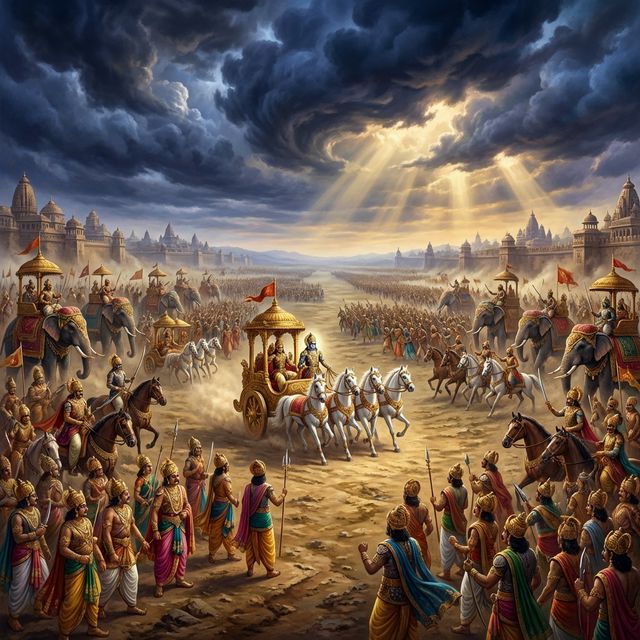
Parashurama's oblation to the fathers at Samantapanchaka
The Road That Priced Everything
Narada came to the Kamyaka forest in the years of the exile, and Yudhishthira, who had lost a kingdom at dice and had nothing left to spend but time, asked him the question a poor man asks.
Sacrifices, the king knew, are for the wealthy. They require various materials and diverse things in large measures, and a man without cattle or gold or grain cannot perform them at all. Was there anything a man might do instead, singly, without allies, without wife or children, without means, that carried the same fruit?
There was, and Narada did not answer out of his own mouth. He answered by repeating a conversation that had taken place long before, when the Kuru house was young and Bhishma sat in a hermitage asking after the fords, and the sage Pulastya, one of the mind-born sons of Brahma, appeared before him and offered him whatever he cared to ask for.
Bhishma asked about tirthas.
A tirtha is a crossing place. The word means the shallow in a river where a man can get across, and it came to mean any spot where the distance between this world and the other is thin enough to be walked. Pulastya's answer was a road. He named the fords of the whole earth in the order a pilgrim walks them, beginning at Pushkara, which is the tirtha of the God of gods and equal to that deity himself, and going down the Narmada and along the southern ocean and up again by the Sindhu and the Vitasta, and at every stop he priced the merit exactly, in horse sacrifices and in gifts of kine, the way a merchant prices grain.
Yudhishthira listened. Somewhere far along that road, after many hundred fords, it turned inland and came to a flat country lying between two rivers.
"One should next proceed, O king," Pulastya said, "to the adored Kurukshetra, at sight of which all creatures are freed from their sins."
The Dust of That Country
Everything Pulastya said about that country he said twice, once here and once again at the very end of the road, and it comes out the same both times, which is how this part of the epic marks a thing it does not want misremembered.
He is freed from all sins who constantly says, "I will live in Kurukshetra." Not the man who lives there. The man who says it. The very dust of Kurukshetra, conveyed by the wind, leads a sinful man to a blessed course hereafter, so that a traveller on some road far off, with the wind in his face, is being worked upon without knowing it. They that dwell in Kurukshetra, which lies to the south of the Saraswati and the north of the Drishadvati, are said to dwell in heaven.
That is the boundary, and it is worth holding on to, because everything that follows happens inside it. Two rivers, one above and one below, and the country between them.
A man should reside there a month, Pulastya said. The gods with Brahma at their head go there, and the Rishis, the Siddhas, the Charanas, the Gandharvas, the Apsaras, the Yakshas and the Nagas, all of them repairing again and again to the highly sacred Brahmakshetra, the field of Brahma. The sins of one who desires to repair to Kurukshetra even mentally are all destroyed, and he goes in the end into the region of Brahma. Going there in a pious frame of mind, a man obtains the fruit of the Rajasuya and of the horse sacrifice together, which are the two most expensive rites a king can buy, and he obtains them by walking.
Bhishma was hearing this a long time before the war. He would be an old man lying on a bed of arrows in that same country before anybody had reason to call it anything except holy.
The road went in at the gate.
The Gate a Brahmin Dug
The fords of Kurukshetra come in a crowd, and Pulastya went through them the way a man counts beads.
First one salutes the Yaksha called Mankanaka, that mighty gatekeeper of Kuvera, and obtains the fruit of giving away a thousand kine. Then the excellent region of Vishnu, where Hari is always present, and a bath there is a horse sacrifice and a passage to the abode of Vishnu. Then Pariplava, celebrated over the three worlds. Then Prithivi. Then Shalukini, where a bath in the Dasaswamedha is worth ten horse sacrifices. Then Sarpadevi, that excellent tirtha of the Nagas, which carries a man to the region of the Nagas. Then Tarantuka the gatekeeper, where one night's residence is worth a thousand cows.
Then Panchananda, and the tirtha there called Koti. Then the tirtha of the twin Aswins, where a man obtains personal beauty, which is the only reward on the whole road that nobody would think to ask for out loud. Then Varaha, where Vishnu formerly stood in the form of a boar. Then Sama in Jayanti, and Ekahansa, and Kritasaucha, where the pilgrim obtains the lotus-eyed deity and perfect purity of soul. Then Munjavata, sacred to the illustrious Sthanu, where a man who goes a single night without food obtains the status called Ganapatya.
And there, Pulastya said, is the celebrated tirtha called Yakshini, where a man obtains the fruition of all his desires.
Then he stopped counting and said two things about it.
That tirtha is regarded as the gate of Kurukshetra, and the pilgrim should walk round it with concentrated soul.
And: equal unto the Pushkaras, it was created by the high-souled Rama, the son of Jamadagni.
Pushkara was the first ford on the road and the greatest of them, the one that is equal to the deity himself. Here at the entrance to the holiest field on earth stood its equal, and it had not been made by a god or found by a Rishi or opened by a river. It had been dug by a brahmin who is remembered for an axe.
Rama of the Bhrigu Race
Who he was can be said in a few lines, and Pulastya did not spend even that many, because Bhishma knew.
Rama was the son of Jamadagni and a descendant of Bhrigu, born into the race of brahmins whose whole business is the fire and the recitation, and he carried an axe. When the thousand-armed king Kartavirya wronged that hermitage and the sage was killed in it, Rama answered, and the answer did not stop with the man who had done it. He cleared the earth of kshatriyas twenty-one times. That is a story, and it is told elsewhere, and it is not this one.
This one begins where that one leaves off. On the ground, with the work finished and the field full.
The pilgrim, said Pulastya, should next repair with concentrated soul to the Rama-hrada. The lakes of Rama.
There is a habit in this part of the epic that repays attention. A tirtha is almost never simply a place. It is a place where something happened once that was extreme enough to leave the ground permanently altered, and a pilgrim who bathes there is stepping into the residue of an event. Varaha, a few fords back, is where Vishnu stood in the shape of a boar. Manusha, further on, is where a herd of black antelopes afflicted by a hunter's arrows plunged into the water and came out of it human beings. Vyasasthali is where Vyasa, burning with grief for his son, resolved to cast off his body and was talked out of it by the gods.
So a pilgrim arriving at the Rama-hrada with his diet regulated and his senses subdued, standing at the gate of the most sacred field in the three worlds, has to be told what happened there. Pulastya told him in one sentence, before he explained anything at all.
"There, O king, the heroic Rama of resplendent energy, exterminating the Kshatriyas by his might, dug five lakes."
And Filled Them
Five. Not one, and not a hundred. Five pits opened in the flat ground between the two rivers, and he filled them, O tiger among men, with the blood of his victims.
Pulastya put three words at the end of that sentence which are easy to walk past. As heard by us.
The epic uses that formula sparingly. It is what a narrator says when he is handing on something he did not see and will not vouch for beyond the fact that this is what the tradition holds, and it is Pulastya who says it here, a son of Brahma who had told Bhishma at the start of the whole discourse that his eyes could penetrate into everything. He is not softening the account. He is marking it. Whatever else the five lakes are, they are the one item on a road of many hundred fords that arrives with a note attached to it.
Consider what is being described, because the road has been pricing every stop in cattle and horse sacrifices, and it is about to price this one.
A man of the priestly order, whose caste may not take life and whose entire inheritance is the fire and the word, had destroyed the warrior order of the whole earth twenty-one times over, out of grief first and then out of the momentum of it, and when he was finished he did not wash. He dug. He made five reservoirs in the field of Brahma and filled them to the lip with what he had spilled, and there was enough to fill them.
That is what the pilgrim is standing in front of when he comes to the gate of Kurukshetra with his senses subdued and his vows in order. Not a battlefield. Water that is not water, standing still in five pits, in a country where the dust itself carries men to heaven.
And then Rama did the thing that made it a tirtha instead of a monument.
The Oblation
Having filled those lakes with kshatriya blood, Rama offered oblations of blood to his sires and grandsires.
There is a rite that everyone in this epic performs, and that Yudhishthira, sitting in the forest listening to Narada, had been told to perform at nearly every ford on the road. You go down into the water. You take it up in your cupped hands and let it fall, and you name your father and your grandfather and his father before him, and the water goes to them. It is the smallest and most ordinary act in the whole literature. A boy can do it. It costs nothing. The entire road Pulastya was describing is built out of it, ford after ford: bathe here, and worship the Pitris and the gods, and obtain the merit of the gift of a thousand kine.
The Pitris are the fathers. Not the ancestors as a family sentiment, but an order of beings, stationed in the firmament, who are fed by their descendants and have no other food.
Rama stood in his own lakes and performed the ordinary rite with the wrong liquid.
He lifted it in his hands and let it fall for Jamadagni, who had been cut down in his own hermitage, and for Jamadagni's father, and for his father, back along the line of Bhrigu, and what ran out between his fingers was the blood of everyone who could be held responsible for that death and of a great many who could not.
By any reckoning it should be the most monstrous act on the road. A man drowning his own fathers in the consequences of his rage and calling it devotion.
The Pitris were gratified.
The Fathers in the Firmament
Gratified with the oblations, those Rishis then addressed Rama.
Pulastya calls them Rishis at that moment, and the word is worth catching, because it says what the fathers of that house were. Not merely dead men. The seers of the Bhrigu race, and their descendant was standing in a lake of blood in the field of Brahma, and they came and stood in the sky over him and spoke to him like relatives who are pleased.
"O Rama, O Rama, O thou of great good fortune, we have been gratified with thee, O thou of the Bhrigu race, for this thy regard for the Pitris, and thy prowess, O exalted one. Blessed be thou, and ask thou the boon thou choosest. What is that thou desirest, O thou of great splendour?"
Read it for what it praises. Two things, and they are named in one breath. Thy regard for the Pitris, which is the rite he had just performed. And thy prowess, which is what had supplied the material for it. They did not separate the two, and nobody standing in the sky above those lakes told him that he had done anything wrong.
That is the difficulty the passage leaves standing, and the epic does not reach in to remove it. The fathers of a brahmin house were satisfied by an offering of blood, and were pleased enough to pay for it, and they used the same tone for the killing that they used for the piety.
Everything now depends on what a man asks for when he is standing in the middle of what he has done and is told that he may have whatever he likes.
Rama joined his hands. He was speaking upward, to figures stationed in the firmament above that flat country, with the five lakes at his feet and every reward in the three worlds available to him for the asking.
The Three Things He Asked
"If ye have been gratified with me," he said, "if I have deserved your favour, I desire this favour of the Pitris."
Then three things, in order.
"That I may have pleasure again in ascetic austerities."
He did not ask to be able to perform them. A man of his line could always perform them. He asked for the pleasure of them to come back. Somewhere in the long course of his wrath the taste had gone out of the one occupation that was properly his, and he had noticed it, and that is the first thing he wanted returned. It is the request of a man who has counted privately what his anger cost him, before anyone has told him what it cost anybody else.
"Let me also, through your power, be freed from the sin I have committed by exterminating, from wrath, the Kshatriya race."
That is the second, and it is a confession. He names the act. He names the motive, and the motive he names is not justice or duty but wrath. He calls the whole of it a sin, and he says so in front of the fathers who had praised him for the same act two sentences earlier. Their approval did not persuade him. He knew the correct name for what he had done, and used it, with the blood still standing in the pits behind him.
"Let also my lakes become tirthas celebrated over the world."
That is the third, and it is the strangest of them, and it is the reason a pilgrim was standing at that water listening to the story generations afterward.
He did not ask for the lakes to be drained, or filled in, or covered over, or forgotten. He asked for them to be kept, and named, and visited. He asked that the worst thing he had ever made should become a place where other people could go to be made clean.
Nothing in the three was for himself except the return of an appetite.
They Have Perished by Their Own Misdeeds
The Pitris, hearing these blessed words of Rama, were highly gratified, and filled with joy they answered him.
They took the three in the order he had asked them.
"Let thy asceticism increase in consequence of thy regard for the Pitris." Granted, and more than granted. He had asked for the pleasure of austerity to come back to him, and he was given growth in it.
"Thou hast exterminated the Kshatriyas from wrath. Freed art thou already from that sin, for they have perished as a consequence of their own misdeeds."
That is the sentence the episode exists to deliver, and it should be read slowly, because it does not say the comfortable thing. It does not call the killing righteous. It repeats the word wrath and leaves it attached to him. What it says is that the men who died had earned their deaths by their own conduct, so that the sin he was carrying had not in fact been on his account, and that he was free of it already, before he asked, and had been walking about under a debt that was never his.
Then the third.
"Without doubt, these lakes of thine will become tirthas. And if one, bathing in these lakes, offereth oblations of the water thereof to the Pitris, the latter, gratified with him, will grant him desire, difficult of fulfilment in the world, as also eternal heaven."
Water. The oblation at the Rama-hrada is the ordinary rite with the ordinary liquid, performed by anybody who walks that far, and it works there better than it works almost anywhere on earth, because of what one man once poured out of his hands on that spot.
Having granted him these boons, the Pitris joyfully saluted Rama of the Bhrigu race and disappeared there and then.
It was thus, said Pulastya, that the lakes of the illustrious Rama of the Bhrigu race became sacred. Leading a Brahmacharya mode of life and observing sacred vows, one should bathe in them. Bathing therein and worshipping Rama, one obtains the merit of the gift of gold in abundance.
He had come to that place to make an offering to the dead. He went away from it to sit down and be an ascetic, which was the first thing he had asked for.
The Northern Altar of the Grandsire
The road went on. Pulastya did not linger at the lakes any longer than the story required, and the fords came in a crowd again. Vansamulaka, where a pilgrim raises his own race. Kayasodhana, which purifies the body. Lokoddara, where Vishnu of great prowess had formerly created the worlds. Sree, and Kapila, and Surya, and Gobhavana, and Shankhini. Brahmavarta, and Sutirtha in the Amvumati, where the Pitris are ever present along with the gods.
Further along was Saptasaraswata, where the Rishi Mankanaka cut his hand on the pointed blade of a kusa grass and vegetable juice ran from the wound instead of blood, and he danced with wonder-expanded eyes until Mahadeva pressed his own thumb with a fingertip and ashes white as snow came out of it. That is told elsewhere as well.
And there was Prithudaka, of which Pulastya said the largest thing he said about anywhere. The learned have said that Kurukshetra is holy; that holier than Kurukshetra is the Saraswati; that holier than the Saraswati are all the tirthas together; and that holier than all the tirthas together is Prithudaka.
And at the end, Sannihati, where every tirtha on earth or in the firmament, every river and lake and spring and tank, large and small, comes month after month and mingles, so that a man who bathes there on the day of the new moon during a solar eclipse and performs a sraddha for his fathers obtains the merit of a thousand horse sacrifices properly celebrated. Near it is Koti-tirtha, where one first worships the Yaksha doorkeeper Machakruka.
Then Pulastya said again what he had said on the way in, about the dust that the wind carries, and about the man who has only to utter the words "I will go to Kurukshetra" once to be cleansed of all his sins, and about the country between the two rivers being heaven. And then he closed the boundary.
"That which lieth between Tarantuka and Arantuka and the lakes of Rama and Machakruka is Kurukshetra. It is also called Samantapanchaka, and is said to be the northern sacrificial altar of the Grandsire."
Four marks at the corners. Two yakshas who keep gates, a doorkeeper, and five pits that a brahmin dug and filled and then gave away.
Narada finished. The Pandavas were still in the forest with years to spend, and the ground he had just measured out by its four corners was the ground they would be given to fight on.
Dharma Lesson
The fathers absolve Parashurama, but they do it without pretending the killing was fine: they name his wrath twice and tell him the dead were destroyed by their own misdeeds, not by his virtue. What the episode watches is the moment he is offered anything he likes and asks for almost nothing, and the one thing he does ask for himself is the ability to enjoy his proper work again, which is what rage had quietly taken from him. The rest he spends on the lakes, requesting not that his worst act be erased but that it be turned into a place where strangers can wash. That is a harder kind of repentance than forgetting, and the epic marks it by making the water of those pits, in every later age, the ordinary water a son pours for his father.