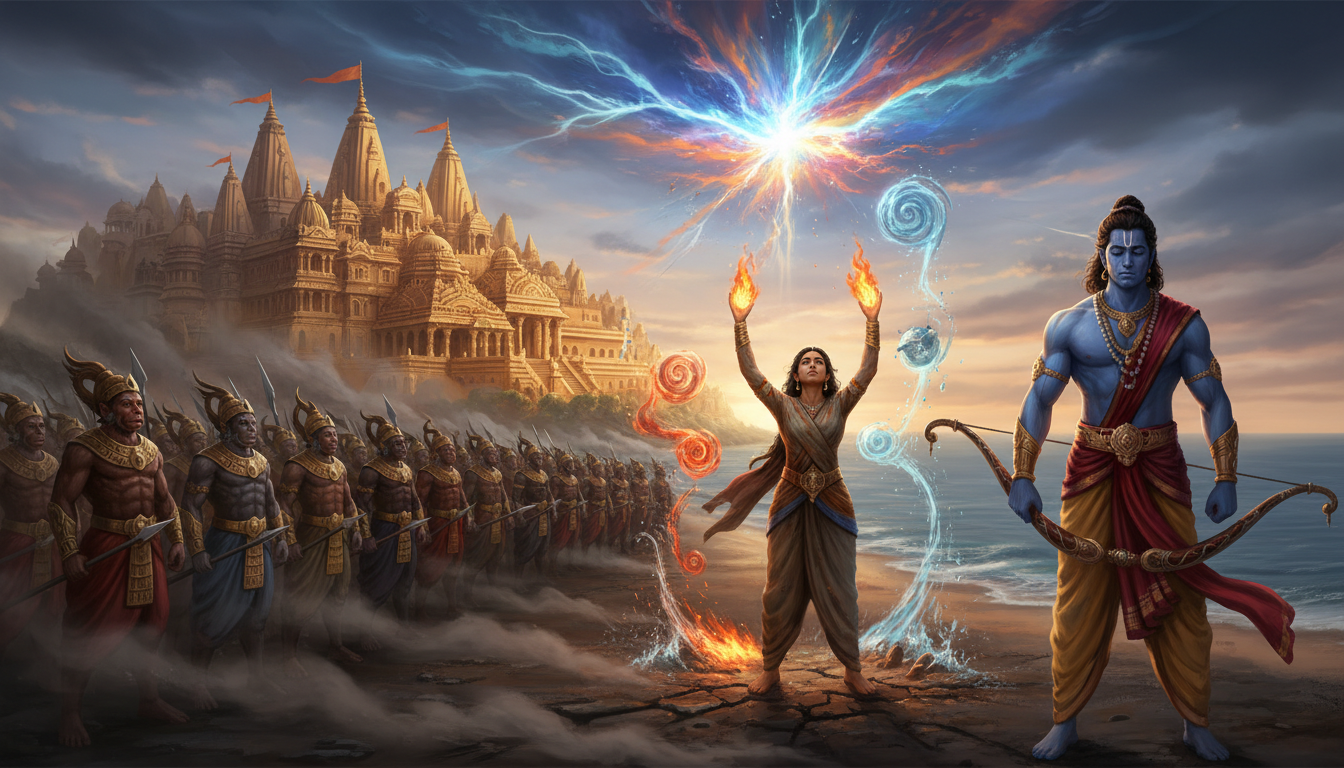
The Sky Like a Festival
Having slain Ravana, that wretched king of the Rakshasas and foe of the celestials, Rama rejoiced exceedingly with his friends and with Sumitra's son beside him.
The celestials came down with the Rishis at their head and worshipped Rama of the mighty arms, blessing him and uttering the word Jaya over and over, and the Gandharvas and all the denizens of the celestial regions gratified him with hymns and with showers of flowers until the air over the burnt city was full of petals. Then, having duly worshipped him, they all went away again to the regions they had come from, and for a while the firmament looked as though a great festival were being held in it.
On the ground, the army was counting its dead.
And Rama, that conqueror of hostile cities, did the first thing a victor does, which tells you what kind of victor he is. He bestowed Lanka upon Vibhishana. He did not garrison it, or burn what was left of it, or carry its treasure north. He gave the island to the brother who had walked out of it, and turned to go home.
Then word came out through the gate that they were bringing her.
Avindhya Brings Her Out
That old and wise counsellor of Ravana's, the one known by the name of Avindhya, who had sent messages to her through a rakshasi when it could have cost him his head, came out of the city in a small procession. Vibhishana walked at the front. Sita walked behind Vibhishana. Avindhya walked last, behind her, as an old servant does.
And with great humility Avindhya said to the illustrious descendant of Kakutstha: "O illustrious one, accept thou this goddess, Janaka's daughter of excellent conduct."
Hearing that, the descendant of Ikshwaku's race alighted from his excellent chariot and stood on the ground to receive her, and looked at her.
She was bathed in tears. She was afflicted with grief. She was besmeared with filth, and there were matted locks on her head, and she was attired in dirty robes, because she had spent a year refusing to be dressed by anybody in Lanka.
Everything she was wearing was evidence of her fidelity. Every one of those marks was a refusal she had made and gone on making. And the man she had made them for stood and looked at the whole of it, and what he saw was not a wife who had held out. It was a woman who had been in another man's house for a year, in front of an army of monkeys and bears and rakshasas who were all now looking at him to see what he would do about it.
Rama was afraid of the loss of his honour. That is the reason the old text gives, and it does not give another.
Go Wheresoever Thou Likest
"Daughter of Videha," he said, "go wheresoever thou likest. Thou art now free. What should have been done by me hath been done."
He said it out loud, in the open, with Lakshmana at his shoulder and Sugriva's whole host within hearing.
"O blessed lady, owning me for thy husband, it was not meet that thou shouldst grow old in the abode of the Rakshasa. It is for this that I have slain that wanderer of the night."
So the war had not been fought for her. It had been fought for the insult; it had been fought because a man of his house could not let his wife grow old in another man's city. He was telling her, in front of everyone, that she had been the occasion of the war and not its purpose.
"But how can one like us, acquainted with every truth of morality, embrace even for a moment a woman that had fallen into other's hands? O princess of Mithila, whether thou art chaste or unchaste, I dare not enjoy thee, now that thou art like sacrificial butter lapped by a dog."
Whether thou art chaste or unchaste. He did not accuse her of anything. That is what makes it worse rather than better: he was not saying she had done wrong, he was saying it no longer mattered whether she had, because the question could be asked, and a king cannot live with a question.
He had said it in the plural, too. One like us. Not I cannot, but one in my position cannot, which is the sentence a man reaches for when he is doing a thing he could not defend in his own name. He was speaking as the head of the house of Ikshwaku to an army and to whatever the army would say when it got home, and the woman he had crossed an ocean for happened to be standing in the way of it.
Like a Plantain Tree Cut From Its Roots
Hearing those cruel words, that adorable girl suddenly fell down in great affliction of heart, like a plantain tree severed from its roots. The colour that had been suffusing her face out of joy at the sight of him disappeared as quickly as watery particles vanish off a mirror that has been breathed upon.
And hearing those words of Rama, all the monkeys also, and Lakshmana with them, became still as dead. Nobody moved. Nobody spoke for him and nobody spoke against him. An army that had crossed the ocean on a bridge of stones for this woman stood in complete silence and looked at the ground.
Then the sky opened, and it did not open quietly.
The divine and pure-souled Brahma of four faces, the Creator of the Universe himself, sprung from a lotus, showed himself upon his car to Raghu's son. And Sakra came, and Agni, and Vayu, and Yama, and Varuna, and the illustrious Lord of the Yakshas, and the holy Rishis. And king Dasaratha also came, in a celestial and effulgent form, upon a car drawn by swans, a dead father arriving at his son's worst hour.
The firmament, crowded now with celestials and Gandharvas, became as beautiful as the autumnal sky spangled with stars, and under it a woman was lying on the ground in dirty robes with her face in the dust.
If I Have Sinned
And rising up from the ground, the blessed and famous princess of Videha stood in the midst of all of them and spoke to Rama of the wide chest.
She began by acquitting him, which nobody had asked her to do.
"O prince, I impute no fault to thee, for thou art well acquainted with the behaviour that one should adopt towards both men and women. But hear thou these words of mine."
Then she called the elements as witnesses, and she called them in the only form of oath that cannot be faked, because it asks for the penalty to fall at once, in public, on the body of the person swearing.
"The ever-moving Air is always present within every creature. If I have sinned, let him forsake my vital forces.
"If I have sinned, then let Fire, and Water, and Space, and Earth, like Air whom I have already invoked, also forsake my vital forces."
She had named the five things a body is made of, and asked them all to leave it, on the spot, if the charge that had not quite been made against her were true. She was inviting her own death in front of the army, as an argument.
"And as, O hero, I have never, even in my dreams, cherished the image of any other person, so be thou my lord as appointed by the gods."
Then she stopped, and stood there, and waited to see whether she would fall.
The Answer in the Air
After Sita had spoken, a sacred voice resounding through the whole of that region was heard in the skies, and it gladdened the hearts of the high-souled monkeys, who had been standing there in misery with nothing to hit.
The Wind-god was heard first, because he had been invoked first.
"O son of Raghu, what Sita hath said is true. I am the god of Wind. The princess of Mithila is sinless. Therefore, O king, be united with thy wife."
Then the god of Fire spoke, and Fire is the witness at every marriage ever made, and he said: "O son of Raghu, I dwell within the bodies of all creatures. O descendant of Kakutstha, the princess of Mithila is not guilty of even the minutest fault."
Then Varuna: "O son of Raghu, the humours in every creature's body derive their existence from me. I tell thee, let the princess of Mithila be accepted by thee."
Three of the five she had called upon answered aloud, one after another, and each of them said the same thing in the language of his own element: we are inside her, we would know, there is nothing there. The elements she had offered to be killed by came forward instead as her witnesses, and the army heard every word.
Space and Earth did not need to speak. She was still standing on the one and breathing in the other, and she had asked them both to let her go if she had sinned, and they had not let her go. The proof of those two was that she was upright at all.
What the Grandsire Said
And Brahma himself then said: "O descendant of Kakutstha, O son, in thee that art honest and pure and conversant with the duties of royal sages, this conduct is not strange."
That is the gentlest sentence anyone spoke that day, and it is also the hardest. It does not say Rama was right. It says that from a man in his office, this was to be expected.
"Listen, however, to these words of mine. Thou hast, O hero, slain this enemy of the gods, the Gandharvas, the Nagas, the Yakshas, the Danavas and the great Rishis. It was through my grace that he had hitherto been unslayable by all creatures, and indeed it was for some reason that I had tolerated him for some time. The wretch, however, abducted Sita for his own destruction.
"And as regards Sita, I protected her through Nalakuvera's curse. For that person had cursed Ravana of old, saying that if he ever approached an unwilling woman, his head should certainly be split into a hundred fragments. Let no suspicion, therefore, be thine. Accept thy wife."
So it came out in the open air, in front of the army: the thing had never been possible. She had been safe from the first hour by a curse laid on him by a nephew he had wronged long before he ever saw her, and the Creator of the Universe had come down in person to say so, because nothing less would have settled it.
And last of all Dasaratha spoke. "I have been gratified with thee, O child. Blessed be thou. I am thy father Dasaratha. I command thee to take back thy wife, and rule thy kingdom, O thou foremost of men."
"If thou art my father, I salute thee with reverence, O king of kings," said Rama. "I shall indeed return, at thy command, to the delightful city of Ayodhya."
"Return to Ayodhya and rule that kingdom," his father answered gladly. "O thou of great glory, thy fourteen years have been completed."
The Boons and the Debts
Thus addressed, Rama bowed to the gods, and saluted by his friends he was united with his wife, as the Lord of the celestials is united with the daughter of Puloman. What she said to him then is not recorded, and neither is what he said to her.
Then that chastiser of foes went round and paid what he owed.
He gave a boon to Avindhya, the old counsellor who had carried messages into the grove. He bestowed riches and honours upon the Rakshasa woman named Trijata, who had sat with a prisoner and told her a dream.
And when Brahma with all the celestials, with Indra at their head, asked him what boons after his own heart they should grant him, Rama asked for two things for himself and one for other people. He prayed for firm adherence to virtue, and for invincibility in respect of all foes. And then he asked for the restoration to life of all those monkeys that had been slain by the Rakshasas.
Brahma said, So be it. And the monkeys rose up off the field of battle, out of the heaps where they had been thrown, and stood up whole.
And Sita, of great good fortune, granted a boon of her own to Hanuman. "Let thy life, O son, last as long as the fame of Rama's achievements. And, O Hanuman of yellow eyes, let celestial viands and drinks be ever available to thee through my grace."
Then the celestials with Indra at their head all disappeared in the very sight of those warriors of spotless achievements. And Matali, the charioteer of Sakra, highly pleased, said to Rama in the midst of his friends: "O thou of prowess that can never be baffled, thou hast dispelled the sorrow of the celestials, the Gandharvas, the Yakshas, the Asuras, the Nagas and human beings. As long as the Earth will hold together, so long will all creatures speak of thee." Then he worshipped that son of Raghu and went away on the same chariot of solar effulgence.
The Chariot Going North
Rama, with Sumitra's son and with Vibhishana, and accompanied by all the monkeys with Sugriva at their head, placed Sita in the van, made arrangements for the protection of Lanka, and recrossed the ocean by the same bridge.
And he rode home on the Pushpaka: the beautiful sky-ranging chariot, capable of going everywhere at the will of the rider, that Ravana had taken by force from his elder brother and been cursed for. The curse had said that the chariot would never carry him, but would bear the man who slew him. It was carrying that man now, north, with his wife aboard.
They came to that part of the sea shore where he had formerly laid himself down on the sand to think about how to cross, and the king pitched his temporary abode there with all the monkeys. Then he brought the monkeys before him in due time and worshipped them, and gratified them with presents of jewels and gems, and dismissed them one after another, by name.
When all the monkey chiefs and the apes with bovine tails and the bears had gone away, Rama re-entered Kishkindhya with Sugriva, and installed the successful Angada as prince-regent of the kingdom. And then he flew on north, showing the princess of Videha the woods along the way, pointing out to her the places on the road he had walked south along without her.
The Sandals Given Back
Having reached the city of Ayodhya, the king despatched Hanuman ahead as an envoy to Bharata, because after fourteen years a man does not simply walk in. Hanuman ascertained Bharata's intentions from external indications before he said anything, and only then gave him the good news of Rama's arrival.
And after the son of Pavana had come back, Rama entered Nandigrama, and there he found his brother waiting: besmeared with filth, attired in rags, seated with his elder brother's sandals placed in front of him, which was how he had ruled for fourteen years. Bharata worshipped his returned brother and made over to him with great pleasure the kingdom that had been in his hands as a sacred trust, and it came back whole.
Vasishtha and Vamadeva together installed that hero in the sovereignty at the eighth Muhurta of the day, under the asterism called Sravana. After the installation Rama gave leave to Sugriva and to Vibhishana of Pulastya's race to return to their own abodes, and worshipped them with various articles of enjoyment, and dismissed those friends of his with a sorrowful heart. And then, having worshipped the Pushpaka chariot, he joyfully gave it back to Vaisravana, its owner, and kept nothing at all out of the war. And assisted by the celestial Rishi, he performed ten horse-sacrifices on the banks of the Gomati without obstruction of any kind.
"It was thus," said Markandeya, in a forest a long way north of any of this, "that Rama of immeasurable energy suffered of old such excessive calamity in consequence of his exile in the woods. Do not grieve, O tiger among men, for thou art a Kshatriya, and thou treadest the path in which strength of arms is to be put forth. Thou hast not even a particle of sin.
"The princess of Videha was rescued with almost no allies, after the slaughter of the Ten-necked Rakshasa, and the allies of Rama in that contest were monkeys and black-faced bears, creatures that were not even human. Thou hast Dhananjaya for thy brother, and this Bhima of terrible prowess, and the two sons of Madravati who are mighty bowmen. Krishna the daughter of Drupada was forcibly carried off by the wicked-minded Saindhava, and these men brought her back, and king Jayadratha lay powerless before thee. Think of all this in thy mind, O foremost of Kurus, and grieve not."
And the king, comforted, cast off his sorrows, and spoke to Markandeya once more.
Dharma Lesson
A public office can demand a proof that a private conscience never needed, and the cost of that proof is always paid by the person who did nothing wrong. Rama spoke in the plural, as one in his position, and the woman who had refused a year of Ravana's offers had to invite her own death in front of an army before the sky would say aloud what she had already proved with her body. Markandeya draws the lesson he means Yudhishthira to hear: a man who lost more than you have lost carried it without bitterness.