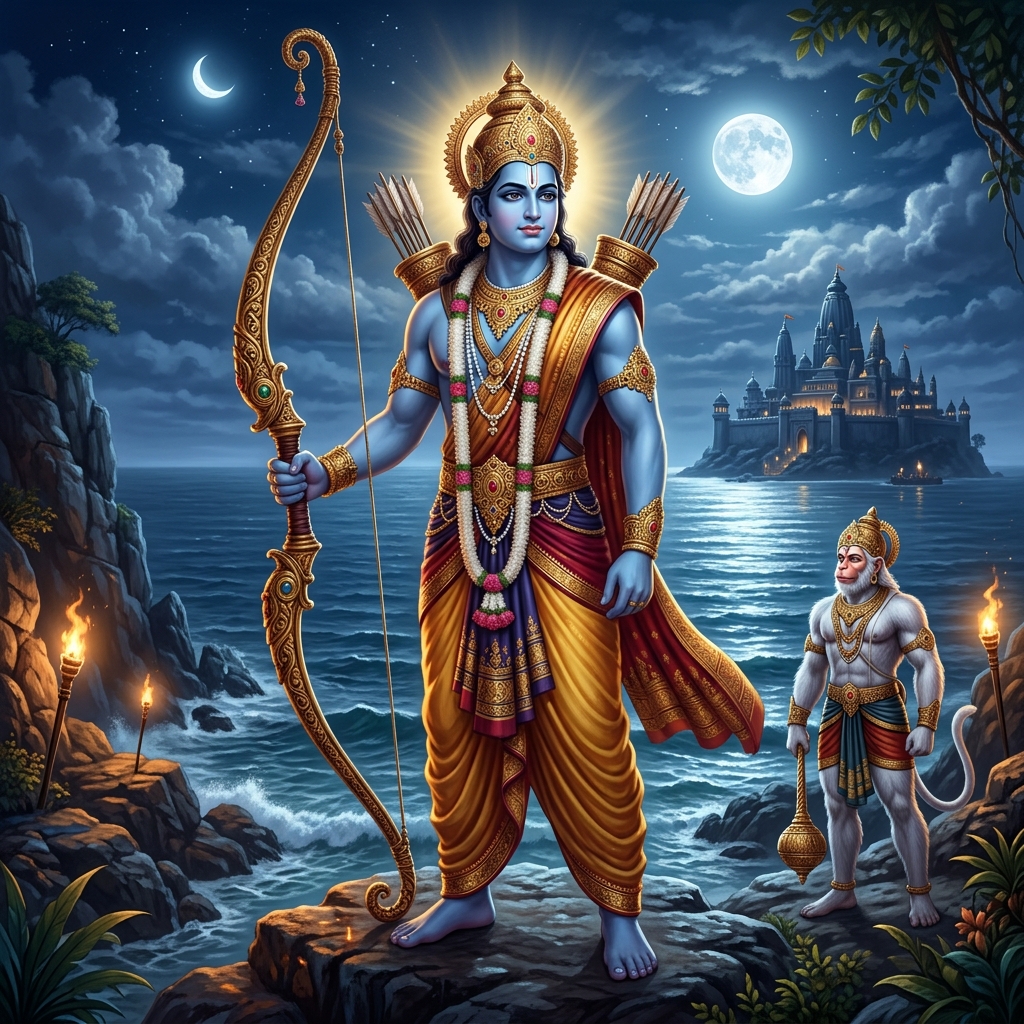
An Island Remembered from Exile
Deep into the years the Pandavas spent driven from their kingdom, wandering the forests with nothing left but each other and their vow to return, the sage Markandeya came to their camp and found Yudhishthira heavy with a grief that would not lift. Here was a king who had lost everything to a rigged game of dice, sitting in exile while his cousins ruled the throne that was rightfully his, and he asked the ancient sage whether any man before him had suffered so complete a fall and risen from it.
Markandeya answered with a story from an age older than the Pandavas' own, a tale of another prince cast out of his birthright by a stepmother's scheme, another wife stolen away by force, another war fought to win back what should never have been lost. He told of Rama, exiled to the forest for fourteen years while his brother Bharata kept the throne only as a trust; he told of Sita, seized and carried across the sea; and he told, at the heart of the story, of an island fortress ruled by the demon king Ravana, its towers rising from the waves at the southern edge of the world, a place called Lanka.
The Pandavas listened as men listen to their own trouble spoken back to them in another's voice, for Ravana's island was, in that telling, not merely a distant kingdom but a mirror held up to their own exile, a promise that dispossession need not be the end of the story.
The Leap and the Burning
Markandeya's telling did not spare its listeners the island's fall. He spoke of Hanuman, the monkey general in Rama's service, who leaped the whole strait of sea between the mainland and Lanka's shore in a single bound to search the fortress for the stolen queen, a feat the sage described with the same wonder the Pandavas themselves would later hear firsthand from Hanuman's own mouth. He spoke of how Hanuman found Sita held captive in a grove of ashoka trees, gave her Rama's ring as proof of rescue to come, and then, seized by Ravana's guards, allowed his own tail to be wrapped in oil-soaked cloth and set alight, only to turn the punishment into a weapon and burn great stretches of the golden city before he returned across the sea unharmed.
Then came the reckoning that gave the story its full weight for a king like Yudhishthira. Rama could not cross the ocean by any leap of his own, and so his army of monkeys and bears built a bridge of stones across the water, each stone said to bear Rama's name so that it would float, until dry land connected the mainland to the enemy's shore. The war that followed broke Ravana's ranks gate by gate, tower by tower, and ended only when Rama himself faced the ten-headed king in single combat and killed him, freeing Sita and restoring, at last, a king to his rightful place.
Markandeya closed the story there, and Yudhishthira understood the sage's purpose. Every exiled king, the tale said, might yet build his own bridge home.
The Southern Campaign Halts at the Shore
Years later, when the Pandavas had returned from exile and Yudhishthira prepared his rajasuya sacrifice to claim the title of emperor, each of his brothers rode out in a different direction to bring the world's kings under his authority. Bhima went east, Arjuna went north, Nakula went west, and Sahadeva took the southern road, marching through kingdom after kingdom of the Deccan until that road ran, in time, all the way to the sea Rama's bridge had once crossed.
By the age of the Pandavas, Lanka was no longer Ravana's demon stronghold. Vibhishana, Ravana's own brother who had turned against him and aided Rama's cause, had been crowned king of the island for his loyalty at the war's end, and his line still held the throne across the generations that followed. Sahadeva, marching south with his army through lands that had once bowed only to Ravana's terror, reached the shore across from Lanka and found not a fortress to storm but a kingdom already bound to the Pandava cause by an old debt of gratitude, one epic's rescued king owing courtesy to the line descended from the very gods who had aided that rescue.
Sahadeva did not attempt the crossing that Rama's army had once needed a bridge of floating stones to make. There was no war left to fight on that shore, no queen to rescue, no tyrant to unseat. Instead he halted his army at the water's edge and sent envoys ahead of him by boat, offering the choice of submission by treaty rather than by conquest, a courtesy Sahadeva extended to few other kingdoms on his long southern march. Vibhishana's court answered with open hands and open storehouses. Where Ravana had needed an army of monkeys and a bridge of stone to humble him, his brother's descendants needed only to be asked.
Gifts for the Rajasuya
What Lanka sent north was tribute freely given rather than tribute seized, and the distinction mattered to a sacrifice meant to prove Yudhishthira's righteousness as much as his power. Ships came up the coast loaded with the island's famous wealth: pearls beyond counting, sandalwood cut from groves no mainland forest could match, gems that caught lamplight the way the old stories said Ravana's own towers once had, bolts of fine cloth and stores of aloe and camphor besides, all carried to Indraprastha to be laid before the fire of the rajasuya alongside the offerings of every other kingdom Sahadeva had brought to peace.
For the priests overseeing the sacrifice, Lanka's gifts carried a weight beyond their price. Here was proof that even the island once ruled by the epic's most notorious tyrant now stood as an ally of dharma, its wealth flowing toward a king who ruled, unlike Ravana, by justice and not by seizure. Vibhishana's honor toward Rama's line had become, a generation on, honor toward the Pandavas as well, a courtesy passed down like an inheritance between two different stories that had somehow come to share a single geography and a single royal debt.
Yudhishthira, who had once sat in the forest hearing Lanka's fall recounted as a lesson in his own possible redemption, now stood at his own sacrifice receiving that same island's wealth as a mark of an empire's peace. The exile who had listened to Markandeya's tale with a heavy heart now presided as emperor over the very kingdom that tale had described, the mirror the old sage had offered him fully closed at last.
The Leap Remembered on Gandhamadana
The island's story reached the Pandavas once more, and this time not through a sage's retelling but through the very figure who had made the leap himself. On the slopes of Gandhamadana, during the later years of their exile, Bhima came upon an aged monkey blocking a narrow mountain path and, unaware whom he addressed, demanded the creature move aside. The monkey answered that he was too old to rise, and asked Bhima instead to lift his tail out of the way if he was in such a hurry.
Bhima's pride would not let the request stand unanswered, and he seized the tail expecting an easy task, only to find he could not budge it by any effort of his strength. Humbled, he asked the monkey's name, and received in answer the truth: this was Hanuman himself, brother to Bhima through their shared father Vayu, the very being whose leap across the strait to Lanka Markandeya had once described to a grieving Yudhishthira in the forest.
Hanuman spoke to Bhima that day of the leap he had made long before, the width of the sea he had crossed to search Ravana's island for a stolen queen, offering his brother not a boastful account but a quiet witness to what devotion and strength together could accomplish. It was Lanka's story once more, now carried not through a sage's voice but through the living memory of the one who had crossed to it, closing a circle the epic had been drawing since the exile began.
Dharma Lesson
Lanka in the Mahabharata is never conquered twice; it is remembered, respected, and left standing. The epic uses another epic's fallen tyrant as a mirror for its own dispossessed king, and shows that true strength, in Sahadeva's restraint and Hanuman's grace, need not repeat every victory it is capable of winning.