Where the Story Had Got To
Markandeya had been telling it for days by then, in the Kamyaka woods, to a man who had just got his own wife back from a chariot and did not yet know what to do with the feeling.
The bridge was built and crossed. The city stood on its hill with its gates shut. Rama had beaten the first sortie back inside the walls, and both armies had drawn off, and the monkey host lay all across the plain in its quarters, sleeping the way an army sleeps after a day it survived, in heaps, with its weapons under its hands.
"Understand what Ravana was that night," said the sage. "He was not yet frightened. He had a brother who commanded his armies, a son who could fight from behind a cloud, another brother who could not be killed by any means the gods had left unblocked, and a city that had never been entered. What he had lost so far was a garden and a gate. He began the way such men always begin, by spending the cheapest thing he owned."
"And what was that?" said Yudhishthira.
"Other people," said Markandeya. "He started small. That night he sent in the little ones."
Yudhishthira had asked for this story himself. He had asked whether there had ever been a man more unfortunate than he was, a king robbed of his kingdom, living in a wood, whose wife had been carried off out of a hermitage by a man who was a guest of the family. And the sage had said yes, there had been such a man, and he had been the son of Dasaratha, and he had lost rather more.
The Ones Who Came In Unseen
While the troops were reposing themselves in their quarters, many little Rakshasas and Pisachas who owned Ravana as their leader penetrated in among them.
They had names, and the names are worth keeping, because they were the sort of thing that is never given a name in the reckoning afterwards: Parvana, Patana, Jambha, Khara, Krodhavasa, Hari, Praruja, Aruja and Praghasa, and others besides. They came in their invisible forms, walking between the sleepers, and no sentry could have stopped them because no sentry could have seen them, and by the hour before dawn there would have been nothing left of the monkey camp but a great quantity of blood on the ground and no explanation for it.
But Vibhishana had the knowledge of that craft.
He had lived his whole life in the house where such things were taught. He knew the mantra that holds the invisibility on, and therefore he knew the one that takes it off, and he went through the sleeping lines and broke the spell over all of them at once.
And once seen, O king, they were seen by the long-leaping monkeys, who woke to find the dark full of shapes that had no business there. Every one of those wicked ones was slain and prostrated upon the earth, deprived of life, before the sun came up.
So Ravana's first stroke cost him a handful of servants and taught the enemy the exact value of the brother he had driven out.
Two Arrays on One Plain
Unable to endure this, Ravana marched out at the head of his troops.
He was, whatever else he was, a master of the rules of warfare, a second Usanas for the disposing of an army, and he came out surrounded by his terrible host of Rakshasas and Pisachas and invested the monkey line in the array that carries Usanas' own name.
And Rama, seeing that array coming toward him across the open ground, disposed his troops in counter array by the mode that Vrihaspati recommends against it, which is the answer the books give and which very few commanders on a real morning have the nerve to use.
Then the two hosts came together, and every warrior went looking through the noise for the man he considered his own match.
Ravana came up quickly and began to fight with Rama. Lakshmana singled out Indrajit. Sugriva singled out Virupakshya. Nikharvata fought with Tara, and Nala with Tunda, and Patusa with Panasa, each relying on the strength of his own arms; and that encounter, which was frightful to timid persons, became terrible and fierce like the encounter between the gods and the Asuras in the days of old.
Ravana covered Rama with a shower of darts and lances and swords, and Rama afflicted Ravana with whetted arrows of iron furnished with the sharpest points. Lakshmana smote Indrajit with arrows made to go into the vital parts, and Indrajit smote Sumitra's son with an arrowy shower of his own.
And in one part of that field, without any regard for each other at all, Vibhishana showered Prahasta and Prahasta showered Vibhishana with a thick downpour of winged arrows, until there came about between them such an encounter of celestial weapons that the three worlds, with all their creatures that move and that do not move, were sorely distressed by it.
The Commander and the Brother
Prahasta had commanded Ravana's armies since before there was a war to command them in. He had stood in the hall while Vibhishana argued for giving the woman back and had watched the youngest brother walk out of the family and across the water. He knew that face better than he knew his own.
Suddenly he advanced right up to Vibhishana, uttering a loud yell, and struck him with his mace.
It was a blow of terrible force and it was meant to end the matter. But the mighty-armed Vibhishana of great wisdom did not waver in the least. He stood still under it as the mountains of Himavat stand.
Then he took up a huge and mighty javelin furnished with a hundred bells, and inspired it with mantras, and hurled it at the head of his adversary.
The weapon went with the force of the thunderbolt, and its impetuosity severed Prahasta's head from his shoulders, and the commander of all the armies of Lanka went down looking like a mighty tree broken by the wind.
A hundred bells is not a quiet weapon. Every rakshasa on that part of the field heard it come, and heard where it stopped, and knew before the dust settled which of the two brothers had put it there.
The Line That Broke and Came Back
Beholding that wanderer of the night thus slain in battle, Dhumraksha rushed with great impetuosity against the monkey host.
His soldiers came on looking like clouds, with a terrible mien on them, and the monkey chiefs, who had been fighting since morning and had just watched a mace come down on Vibhishana's chest, suddenly broke and fled.
Then Hanuman, the son of Pavana, began to advance.
He did nothing clever. He walked forward into the space the army had just vacated and stayed there, on the field, alone, where everyone could see him. And beholding the son of Pavana standing still, the retreating monkeys, O king, one and all quickly rallied, and came back past him, and the line closed up again around the one place it had not given way.
Then great and fearful was the uproar that arose from the warriors of Rama and of Ravana rushing against each other, and the field became miry with blood underfoot. Dhumraksha afflicted the monkeys with volley after volley of winged shafts until Hanuman came through and seized him.
What followed between that monkey and the Rakshasa hero, each desiring to defeat the other, was fierce and terrible, like the fight of Indra and Prahlada in days of yore. The Rakshasa struck with maces and spiked clubs. The monkey struck with the trunks of trees unshorn of their branches. And in great wrath Hanuman slew him at last, and his charioteer with him, and his horses, and broke the chariot itself to pieces.
Beholding Dhumraksha fallen, the monkeys abandoned all fear and went at the Rakshasa army with such valour that the survivors became dispirited, and turned, and fled in fear to Lanka.
Two commanders had gone out of the gate that day and neither had come back. One had been killed by the king's own brother and one by a monkey with a tree in his hands, and the army that had been sent to break the siege was now inside the walls again, sitting on the ground in the courtyards, waiting to be asked what had happened. Somebody had to carry the news up to the hall, and nobody wanted the errand, and in the end the whole surviving wreck of them went up together so that no single man would have to say it alone.
The Drums That Would Not Stop
The surviving wreck of that army reached the city and was brought before the king, and told him everything that had happened; and when he heard from them that Prahasta and the mighty archer Dhumraksha had both been slain, with their armies, by the monkeys, Ravana drew a deep sigh and sprang up from his excellent seat.
"The time is come," he said, "for Kumbhakarna to act."
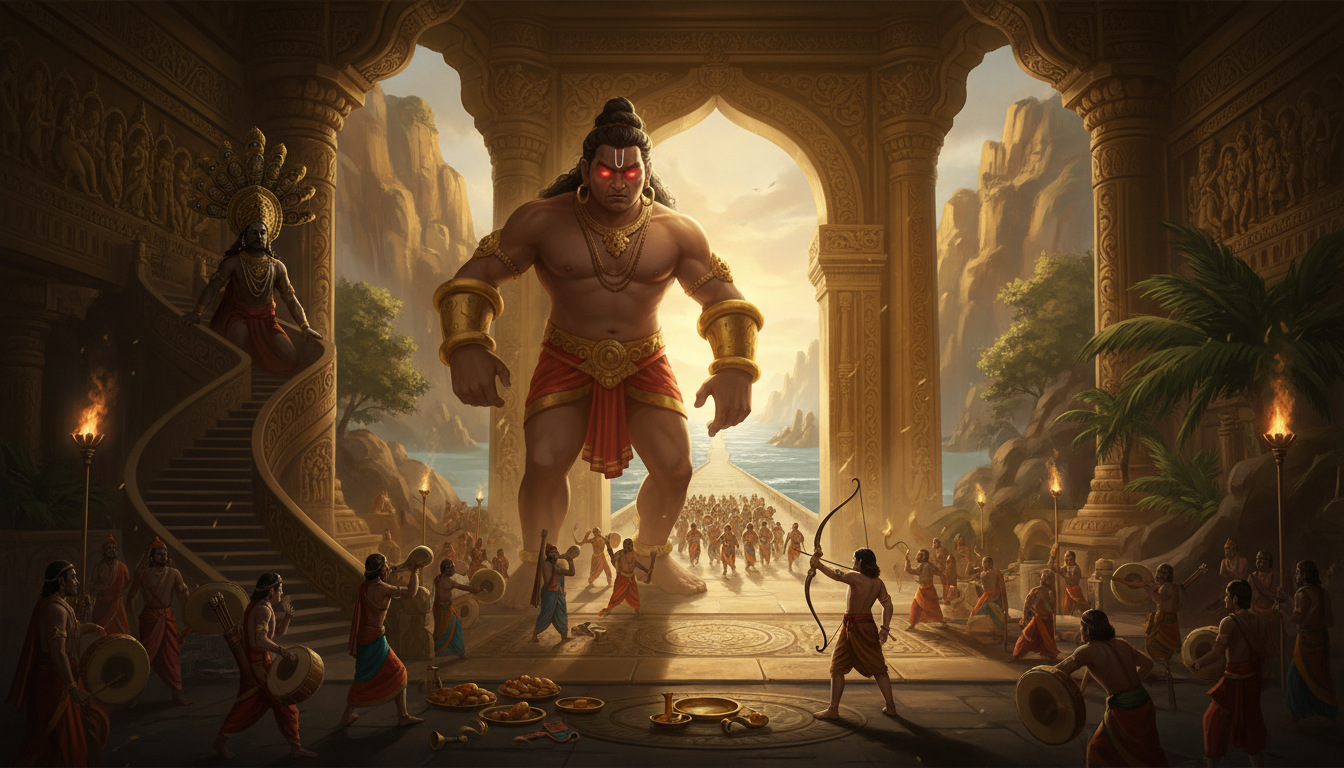
They went and woke him with instruments.
It is not a thing that is done with a hand on the shoulder. Kumbhakarna slept by a boon, and the boon was a mistake he had asked for himself, and it held him down under months at a time the way water holds down a stone. So they brought in every loud-sounding instrument in Lanka and set them going around his bed: drums, conches, and whatever else could be beaten, blown, or dropped, and men shouting in his ears, and it took great efforts and a long while before anything in that mountain of a body changed.
Then he sat up on the bed at his ease, having perfectly recovered his consciousness and his self-possession, in a room full of exhausted musicians, and looked around him with the mild interest of a man who has been asleep and expects to be told why he is not.
And the Rakshasa king, still afflicted with anxiety, sat down beside his brother and told him.
Thou Indeed Art Happy
"Thou indeed art happy, O Kumbhakarna," said Ravana, "who canst enjoy profound and undisturbed repose, unconscious of the terrible calamity that has overtaken us.
"Rama, with his monkey host, has crossed the Ocean by a bridge, and disregarding us all is waging a terrible war against us. I have stealthily brought away his wife Sita, the daughter of Janaka, and it is to recover her that he has come here, after making a bridge over the great Ocean. Our great kinsmen also, Prahasta and others, have already been slain by him. And, O scourge of thy enemies, there is not another person, save thee, that can slay Rama. Therefore, O warrior, put on thy armour and set out this day to vanquish Rama and his followers. The two younger brothers of Dushana, Vajravega and Promathin, will join thee with their forces."
It is a remarkable speech, and Markandeya recited it exactly, because of what is in it and what is not.
He says the war is a calamity that has overtaken us, as though it were weather. He says the theft in one clause, in passing, without a word of defence for it, to a brother who cannot possibly have heard of it before this moment. He tells him that Prahasta is dead in the same breath. And then, having laid out in four sentences that the whole of the trouble is his own doing, he asks the sleeper to go out and die for it today, before he has been awake an hour, before he has eaten, before anyone has asked him what he thinks.
Kumbhakarna did not argue. He accepted his brother's advice, and called for his armour, and the two warlike sons of Dushana's house marched out of the city with their forces behind him.
He Ate as He Walked
Kumbhakarna set out from the city accompanied by his followers, and soon he beheld the victorious monkey troops encamped before him.
He passed them by. He was not interested in them. He was looking for Rama, and he went through the camp the way a man goes through long grass, until he beheld the son of Sumitra standing at his post with his bow in his hand.
Then the monkey warriors came speedily up and surrounded him on all sides. They commenced to strike him with numberless large trees. Many amongst them fearlessly began to tear his body with their nails. They fought with him in the various ways approved by the laws of warfare, and they soon overwhelmed that chief of the Rakshasas with a shower of terrible weapons of every kind that came to hand.
Attacked by them thus, Kumbhakarna laughed at them and began to eat them.
He devoured those foremost of monkeys known by the names of Chala, and Chandachala, and Vajravahu, and did not break stride to do it. Beholding that fearful act, the other monkeys were frightened and set forth a loud wail of fear that went out over the whole plain.
Hearing the screams of those monkey leaders, Sugriva boldly advanced towards Kumbhakarna. That high-souled king of the monkeys came up swiftly and struck him on the head with the trunk of a Sala tree, and the Sala tree broke on his head, and he made no impression on the Rakshasa whatsoever.
Then, as if roused from his torpor by that blow, Kumbhakarna stretched out his arms and seized Sugriva by main force, and carried him off the ground.
The Arrow with Golden Wings
Beholding Sugriva dragged away by the Rakshasa, the heroic son of Sumitra, that delighter of his friends, rushed towards Kumbhakarna, and discharged at him an impetuous and mighty arrow furnished with golden wings.
That arrow cut through his coat of mail, and penetrated into his body, and passed through it outright, and struck into the earth beyond him stained with the Rakshasa's blood.
Kumbhakarna, having his breast thus bored through, let go of the king of the monkeys.
Then he took up a huge mass of stone for a weapon and rushed at the son of Sumitra, aiming it at him as he came. Lakshmana cut off his upraised arms with a couple of keen-edged shafts furnished with heads like razors.
And as soon as the two arms were off, double that number of arms appeared on his person.
Sumitra's son, displaying his skill in weapons, cut off those also with similar arrows, each of them having already seized a mass of stone. And at that the Rakshasa gave up the shape he had been wearing and assumed a form enormously huge, furnished with numerous heads and legs and arms, standing over the field like a range of hills with the daylight behind it.
Then the son of Sumitra rived him with a Brahma weapon.
Rent by that celestial weapon, that Rakshasa fell upon the field of battle like a huge tree with spreading branches suddenly consumed by heaven's thunderbolt. And beholding Kumbhakarna, who was endued with great activity and resembled the Asura Vritra himself, deprived of life and prostrate on the ground, the Rakshasa warriors turned and fled in fear.
What the Waking Cost
Beholding the Rakshasa warriors running away, the younger brother of Dushana rallied them and rushed in great wrath upon the son of Sumitra; and Sumitra's son, with a loud roar, received both those wrathful warriors, Vajravega and Promathin, upon his winged shafts as they came.
The battle that took place between those two and the intelligent Lakshmana was exceedingly furious, and it made the bristles of the spectators stand on end. He overwhelmed them with a perfect shower of arrows and they covered him with an arrowy hail, and it lasted a short while only. Then Hanuman, the son of Pavana, took up a mountain peak and rushed upon one of the brothers and took the life of Vajravega with it; and the mighty monkey Nala, with a large mass of rock, crushed Promathin, the other.
The deadly struggle between the soldiers of Rama and of Ravana did not come to an end even after this, but raged on as before. Hundreds of Rakshasas were slain by the denizens of the forest, and many of the denizens of the forest were slain by the Rakshasas. But the loss in killed among the Rakshasas was far greater than among the monkeys.
Markandeya stopped there, because there was a thing in it he wanted the eldest son of Pandu to have.
"He had a commander, a champion, a sleeping brother and a son," he said, "and he spent them in that order, cheapest first, and he never once considered the one expenditure that would have ended the war on the day it began. The woman was in his garden the whole time. Every man who went out of that gate went out because Ravana would not walk twenty steps and give her back."
Yudhishthira thought of a chariot on a forest road, and of a man he had let go alive, and said nothing at all.
Dharma Lesson
A man who has made his family into instruments discovers their number, and the first one he wakes is the one he has already wasted. Ravana spends a commander, a champion and a brother in order of cheapness, and never once considers the single expenditure that would end the war: twenty steps to the garden, and the woman given back.