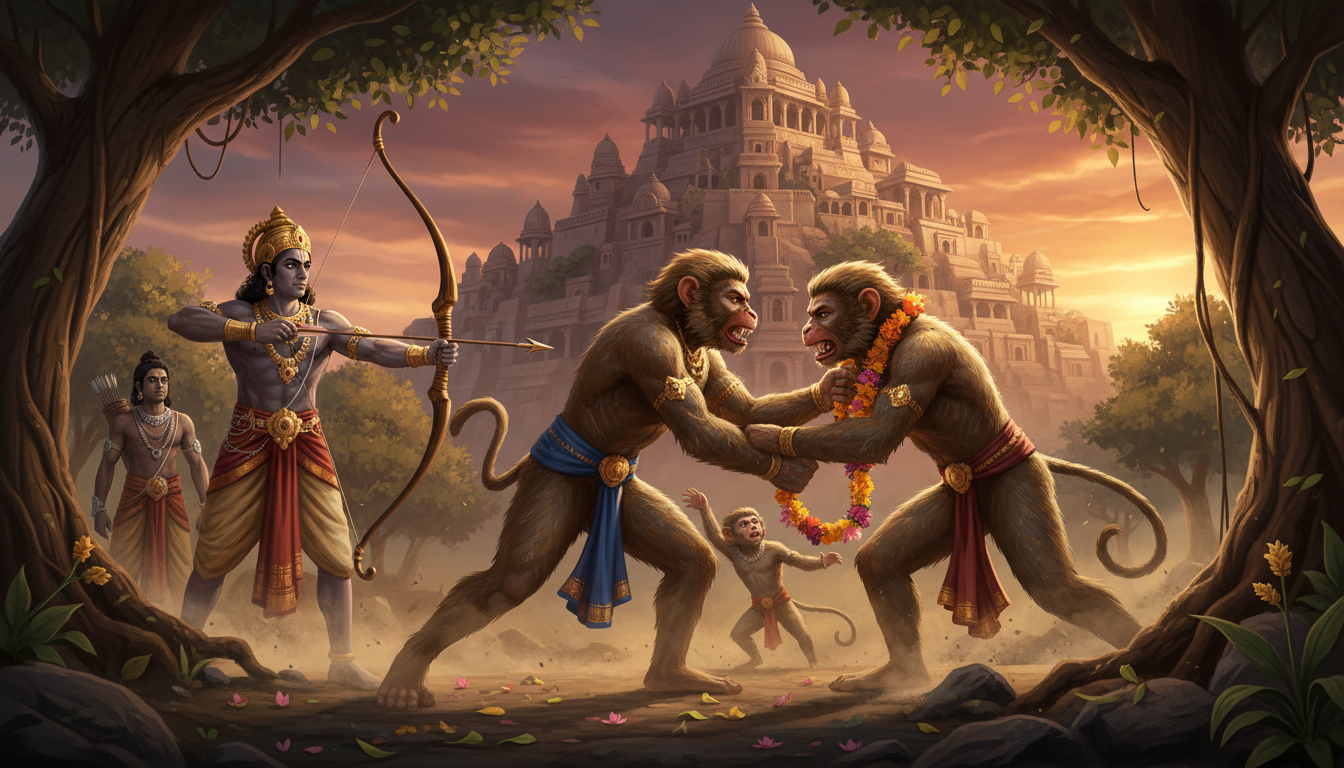
The Arrow From Behind the Tree
A wife who read the omens, and a king who would not listen
A Gandharva Out of a Dead Rakshasa
Yudhishthira had asked whether any man had ever been more unfortunate than himself, and Markandeya had answered him with Rama, and had been telling the story for some days now. In the Kamyaka the fires were lit. Draupadi, who had been carried off and brought back not long before, sat where she could hear.
"They had come out of the worst of it," said Markandeya, "and they were still in the woods."
A headless rakshasa with a mouth in its belly had caught Lakshmana by the hand and begun to draw him in towards that mouth, and Lakshmana, held and helpless, had said the thing a man says when he thinks he is finished.
"Behold my plight. The loss of your kingdom, then the death of our father, then the abduction of Sita, and now this disaster that has overwhelmed me. I shall not see you come back with the princess of Videha to Kosala, and sit on your ancestral throne. Only the fortunate will look at your face after the coronation bath, like the moon coming out of cloud."
"Do not give way to grief, tiger among men," said Rama, who did not lose his footing in danger. "What is this thing, when I am here? Cut off his right arm and I will cut off his left."
He was still speaking when he took the left arm off at the shoulder with a sharp scimitar as if it had been a stalk of tila corn, and Lakshmana, seeing his brother standing in front of him, struck off the right, and then went at the monster under the ribs again and again until the huge headless thing fell down and died.
And out of the body came a person of celestial make, who stood in the air a moment shining like the sun.
"Who are you?" said Rama. "Answer me. How could such a thing happen? All this seems to me exceedingly wonderful."
"I am a Gandharva of the name of Viswavasu," he said, "and it was through a brahmana's curse that I had to wear the form and nature of a rakshasa. As for you, Rama, your Sita was carried away by force by king Ravana, who lives in Lanka. Go to Sugriva; he will give you his friendship. Near the peak of Rishyamuka is the lake called Pampa, of sacred water and cranes, and there Sugriva dwells with four of his counsellors. He is the brother of the monkey-king Vali, who wears a garland of gold. Go to him and tell him your sorrow. He is in a plight very like your own, and he will help you. That is all we can say. You will see the daughter of Janaka without doubt. Ravana and the rest are known to the king of the monkeys."
Then he made himself invisible, and the two brothers stood there and wondered.
The Lake of Lotuses
They did not have far to go. Afflicted as he was with grief at the abduction of Sita, Rama had not walked much further before he came on Pampa, that lake full of lotuses of every kind, with the woods standing round it and the wind coming off the water cool and delicious and full of scent.
And it undid him. He had held together in front of the headless thing with his brother's arm in its grip. He came to a pretty lake on a fine morning with a breeze in it and remembered his wife, and the thought of being parted from her went through him, and Rama sat down by the water and gave way to lamentation.
The son of Sumitra let him get through some of it and then spoke.
"You who give proper respect to those that deserve it," said Lakshmana, "despondency like this should not be allowed to come near you, any more than illness comes near an old man who has lived a regular life. You have got your information about Ravana. You know where the princess of Videha is. Free her now, with exertion and intelligence. Let us go to Sugriva, that foremost of monkeys, who is on the mountain top at this moment. Console yourself, when I, your disciple and your slave and your ally, am standing here."
Rama heard him out, and then heard him out again, because Lakshmana said a good deal more in that vein and did not stop until it had worked. And Rama came back into his own nature and attended to the business in front of him.
Then the two heroic brothers went down and bathed in the water of Pampa, and offered the oblations to their ancestors with that water, and set out for Rishyamuka.
Five Monkeys on a Peak
Rishyamuka when they came to it was full of fruit and roots and trees, and on the top of the mountain peak the brothers saw five monkeys sitting.
That is what an exiled king looks like when he has been driven off everything he owns. Four counsellors and himself, on a rock, on the one hill in that country his brother cannot come to.
Sugriva saw two armed men in bark cloth climbing towards him and did the sensible thing, which was to send somebody down to find out what they were before letting them any nearer. He sent his counsellor Hanuman, the intelligent one, who is huge as the Himavat mountains.
So the first of the monkey-folk that Rama ever spoke to was Hanuman, and the two of them exchanged words on the slope before anything else happened, and what passed between them satisfied both, because after it Hanuman brought the brothers up the mountain and Rama and Sugriva were made friends.
It is worth stopping on that for a moment, because everything afterwards, the crossing of the sea, the burning of Lanka, all of it, comes out of two exiles meeting on a hilltop and recognising one another. Neither of them had anything. One had lost a kingdom, a wife and a father. The other had lost a kingdom and a wife to his own brother. They did not have to explain themselves to each other at any length.
The Scrap of Cloth
Rama told Sugriva what he had come for, and Sugriva got up and fetched something.
While Ravana was carrying her south through the air, Sita had dropped a piece of her cloth, and it had come down among the monkeys, and they had kept it. Sugriva put it into Rama's hands. That is the whole of the evidence: a torn piece of a woman's garment, picked up off a hillside by people who had no idea whose it was and no reason to keep it except that they were the kind who keep things.
Having been given those credentials, Rama did not haggle. He installed Sugriva then and there in the sovereignty of all the monkeys of the earth, and pledged himself to slay Vali in battle.
And Sugriva told him what had been done to him, which he had a right to tell.
"Robbed by him of my wife and my kingdom both," he said afterwards, on the field, in Vali's hearing, "what need have I of life? Know that it is for this that I have come."
So the two of them came to an understanding and placed the fullest confidence in each other, which is the phrase used, and it is worth marking, because what they had just agreed was that one of them would kill the other's brother. There was nothing hidden in the compact and nothing dishonest about it, and every hard thing that was ever said about Rama afterwards was said about the way it was carried out and not about the making of it.
Then they all went to Kishkindha, wanting a battle.
Tara Reads the Roar
At Kishkindha, Sugriva stood outside his brother's city and roared, and the sound of it was as deep as a cataract falling.
Inside, Vali could not bear it and got up to go out, and his wife stood in the doorway.
"He is strong enough by himself," said Tara. "But the way Sugriva is roaring shows me, I think, that he has found assistance. It is not fitting that you go out."
The king of the monkeys, eloquent, with his golden garland on, looked at his wife, whose face is beautiful as the moon, and asked her the right question. He knew exactly what she was.
"You understand the voice of every creature," he said. "Reflect, and tell me whose help this brother in name only of mine has obtained."
Tara reflected for a moment, and then gave him the finest piece of intelligence anybody receives in the whole of that war, complete, accurate, and free.
"Listen, monarch of the monkeys. That foremost of bowmen, endowed with great might, Rama the son of Dasaratha, whose wife has been ravished, has made an alliance offensive and defensive with Sugriva. And his brother, the intelligent Lakshmana of the mighty arms, the unvanquished son of Sumitra, stands beside him for the success of Sugriva's object. And Mainda and Dwivida, and Hanuman the son of Pavana, and Jambavan the king of the bears, are beside Sugriva as his counsellors. All these are illustrious and endowed with great strength and intelligence. And all of them, depending on the might and energy of Rama, are prepared for your destruction."
She had heard one shout through a wall and named five allies and a foreign prince out of it, and she was right about every one of them.
The King Who Would Not Listen
Vali heard all of it. The words were for his benefit and he disregarded them altogether.
And then he did the thing that is worse than not listening. He filled up with jealousy and worked out a reason why the warning had been given, and the reason he arrived at was that his wife had set her heart on Sugriva. That is the shape of it: she gave him the truth, and because the truth was inconvenient he decided that the person handing it to him was on the other side.
He said hard words to her. Anyone who has watched a proud man be told a thing he cannot afford to believe knows the sound of what was said in that cave. Then he went out past her, and she let him go, because there was nothing else she could do that she had not already done.
Sugriva was waiting by the side of the mountains of Malyavat, and Vali came up to him and opened with contempt, because he had beaten this brother before and expected to do it again.
"Frequently vanquished by me before, and fond as you are of life, you are allowed by me to escape with your life on account of your relationship to me. What has made you wish for death so soon?"
And Sugriva answered him. But he did not answer him as a brother. He pitched it as though he were reporting to Rama, telling the man in the trees what had happened and why this was being done, and his words were grave and short.
"O king, robbed by you of my wife and my kingdom also, what need have I of life? Know that it is for this that I have come."
Two Brothers Nobody Could Tell Apart
Then they rushed at each other.
They fought with sala trees and with tala trees and with stones, tearing them up out of the hillside and swinging them, and they struck each other down onto the earth, and got up, and leaped high into the air and hit each other with their fists coming down. They mangled each other with nails and with teeth until both of them were covered with blood, and two of them glistening red on a hillside look like a pair of kinshuka trees in flower, which is what anyone watching would have thought before he remembered what he was watching.
And as they fought, no difference could be observed between them.
That is the crux of it, and it was nobody's fault. They were brothers of the same stock, the same size, the same colouring, locked together and rolling, both of them bleeding, neither of them wearing anything a bowman fifty paces off in the trees could use. Rama had promised to kill one of them. He had an arrow on the string and he could not tell which one to send it into.
He did not shoot. Whatever else is argued about that morning, he did not shoot blind.
The Garland, and the Arrow
It was Hanuman who solved it. He went in and put a garland of flowers round Sugriva's neck, and stepped back out, and after that Sugriva went on fighting with the flowers on him and shone with them like the huge beautiful peak of Malya with a belt of cloud round it.
Rama, recognising Sugriva by that sign, drew his foremost of huge bows and took Vali for his mark.
The twang of it went across the field like the roar of an engine. Vali, pierced in the heart, trembled with fear, and his heart having been pierced through he began to vomit blood, and then he turned his head and saw, standing where he had not been, Rama with the son of Sumitra beside him.
So the last thing the monkey king did was to reprove the descendant of Kakutstha. He is not given a speech here; he is given the fact of the reproof, which is all that has ever been necessary, and men have been arguing his side of it ever since. He had not been fighting Rama. He had done Rama no injury. He had never been challenged by Rama, never refused him anything, never been given the chance to answer any charge, and he had come out of his own city to fight his own brother in single combat and had been shot by a stranger he could not see.
Then he fell to the ground and lost his senses.
And Tara came out, who had told him precisely this was waiting for him, and found her lord, who had the effulgence of the moon in him, lying on the bare earth.
Four Months on the Hill
After Vali had been slain, Sugriva regained possession of Kishkindha, and along with the city he took Tara also, whose face is beautiful as the moon, and who was now a widow.
Everything Sugriva had lost came back to him in an afternoon: the kingdom, the throne, the queen. And everything Tara had said would happen had happened, and she had said it standing in a doorway trying to stop it, and she woke up the next morning in the same city, in the same rooms, married to the man on whose behalf her husband had been shot.
And Rama, who had bought all of this, went up onto the hill and waited.
The rains had come. Nobody crosses country in that season and no army moves, and so the intelligent Rama dwelt on the beautiful breast of the Malyavat hill for four months, duly worshipped by Sugriva all the while. He was worshipped every day. Food was carried up, and honours, and messages, and there was not one thing in any of it that he wanted. He had traded a killing for an army, and the army was down in the town below him being an army in a place where he could see it and could not use it.
Four months. That is the part of the story nobody tells, and it is the part the arrow bought. He had killed a king he had no quarrel with in order to gain an ally, and now he sat on a wet hillside above that ally's city for a third of a year with nothing to do, while somewhere south of him across water his wife counted the same days.
Meanwhile, in the Ashoka Wood
Ravana, excited by lust, had reached his own city of Lanka and put Sita in a dwelling within a wood of ashoka trees that looked like the pleasure garden of the gods and was arranged like the asylum of ascetics, and there the large-eyed daughter of Janaka passed her days in distress, living on fruits and roots and keeping her observances, and did not know that anything at all had been decided in her favour.
Markandeya let that sit.
"Now," he said to Yudhishthira, "you asked me whether any man was ever more unfortunate than you are. Consider what Rama had to do to get one army. He gave his word to a stranger inside an hour of meeting him, and the word he gave was to kill that stranger's brother. He kept it. And having kept it he was bound by it: he could not afterwards be the man who had merely made a useful arrangement, because he had become the man who shot Vali, and he carried that for the rest of his life, and it is thrown at him still."
"And the wife who warned him?" said Yudhishthira.
"Tara had the best judgment on that field, and she was the only person on it who lost by every outcome," said Markandeya. "Note who her husband suspected the moment she told him the truth. When counsel costs a man his pride, he will look for a reason to think the counsellor is against him, and he will find one, because a proud man can always find one. Vali did not die of Rama's arrow, son of Kunti. He died of the two minutes in which he decided that his wife's warning was her disloyalty."
The fire had gone down. Draupadi got up and went in, and Yudhishthira sat a while longer with his brothers, and none of them said anything about alliances.
Dharma Lesson
An alliance bought with a killing binds the buyer too. Rama gave his word within an hour of meeting Sugriva and kept it, and afterwards could never again be simply the man who had made a useful arrangement. And the counsel most worth hearing is the counsel that costs the hearer his pride: Tara named every one of her husband's enemies correctly, and Vali answered by deciding that a wife who warns him must be against him.