The Bird With the Burnt Wings
A search that ended at a cliff, and the brother of Jatayu
The Man on the Malyavat Hill
"You have told me she is in the grove and that the rakshasa women guard her," said Yudhishthira. "Trijata comforts her, and Avindhya sends her word, and Ravana comes and goes. What I want to know is how anybody on the other side of the water ever found out where she was."
"By a bird with no wings," said Markandeya, "and by one monkey who stopped calculating. I will tell it in order."
Rama and his brother were living then on the breast of the Malyavat hill, hospitably treated by Sugriva, looking at a clear blue sky every day and doing nothing. One night, gazing from the mountain top at the bright moon in a cloudless sky, surrounded by planets and stars, with the cold breezes coming up fragrant with lily and lotus, that slayer of foes was suddenly woken to the remembrance of his wife in a rakshasa's house, and there was no more sleep in him at all.
In the morning he was angry, and being unable to reach the person he was angry with, he was angry at the nearest ally.
"Go, Lakshmana, and seek in Kishkindha that ungrateful king of the monkeys who understands his own interest so well and is even now indulging in dissipations. That foolish wretch of his race, whom I installed on a throne, to whom all apes and monkeys and bears owe allegiance, for whose sake, O mighty-armed perpetuator of Raghu's race, Vali was slain by me with your help in the wood of Kishkindha, has now forgotten me, who am sunk in this distress. I think he is unwilling to fulfil his pledge, disregarding, from dullness of understanding, one who has done him such services.
"If you find him lukewarm and rolling in sensual joys, then send him by the path that Vali has been made to follow, to the common goal of all creatures. But if you see that foremost of monkeys delighting in our cause, bring him here with you. Be quick, and do not delay."
Five Nights Wanting
Lakshmana, who was always attentive to the behests of his superiors, took up his handsome bow with its string and his arrows and went, and reaching the gates of Kishkindha he entered the city unchallenged. Nobody stops a man carrying that bow with that face on him.
The monkey-king knew he was angry before he was in the door. Sugriva came out to receive him with his wife beside him, humble of heart, and gave him honours he had not asked for. Then the dauntless son of Sumitra told him what Rama had said, all of it, including the part about the path Vali had been made to follow.
Sugriva heard it out to the end, and then joined his hands, and answered cheerfully, which took some doing.
"I am, O Lakshmana, neither wicked, nor ungrateful, nor destitute of virtue. Hear what efforts I have made for finding out Sita's place of captivity. I have despatched diligent monkeys in all directions. All of them have stipulated to return within a month. They will search the whole earth, hero, with her forests and her hills and her seas, her villages and her towns and her cities and her mines.
"Only five nights are wanting to complete that month. And then you will hear, with Rama, tidings of great joy."
There was nothing to answer. The king had done the thing before he was asked for it, and had done it on a scale that made Rama's suspicion look small. The high-souled Lakshmana became appeased, and then, being the man he was, went further than appeasement and worshipped Sugriva where he stood. And accompanied by the monkey-king he went back up to the Malyavat hill, and told his brother what beginning had been made.
Three Quarters Come Back Empty
Soon the monkey-chiefs began to come in by thousands, having carefully searched three quarters of the earth: the north, the east and the west.
They had nothing. They came before Rama and told him so plainly, that although they had searched the whole earth with her belt of seas, they could not find either the princess of Videha or Ravana. Whole nations had been walked through and turned over, and there was no sign of a woman and no sign of the man who had taken her.
That descendant of Kakutstha, afflicted at heart, managed to go on living, and the thing he lived on was that the fourth party had not reported. The great monkeys who had gone toward the south had simply not come back. He rested his hopes on that silence, which is a thin diet, and he was on it for two months.
Then certain monkeys came in haste to Sugriva with what sounded like a complaint.
"O king, that foremost of monkeys, the son of Pavana, and Angada the son of Vali, and the other great monkeys whom you despatched to search the southern region, have come back. And they are pillaging that great and excellent orchard called Madhuvana, which was always guarded by Vali, and which has been well guarded by you also after him."
Sugriva did not send anyone to stop them. He began to smile instead, because he had been a servant himself and knew the sign.
"Only servants who have been crowned with success act in that way," he said, and he communicated his suspicion to Rama, who did the same arithmetic and reached the same end, that the princess of Mithila had been seen.
So Hanuman and the others, having refreshed themselves thoroughly in a garden that did not belong to them, came at last to their king, who was sitting with Rama and Lakshmana. And Rama, observing the gait of Hanuman and the colour of his face as he came up the slope, was confirmed in his belief before a word had been said.
Will You Impart Life to Me?
The successful monkeys, with Hanuman at their head, bowed to Rama and to Lakshmana and to Sugriva.
And then Rama, who had been living on nothing for two months, did a strange thing. He took up his bow and his quiver before he asked the question, as though the answer might require them within the minute.
"Have you been successful? Will you impart life to me? Will you once more enable me to reign in Ayodhya, after having slain my enemy in battle and rescued the daughter of Janaka? With the princess of Videha unrescued, and the foe unslain in battle, I dare not live, robbed of wife and honour."
Hanuman did not make a speech of it. He gave him the one sentence first, the way a man hands over water to someone who has been in the sun.
"I bring you good news, O Rama. For Janaka's daughter has been seen by me."
Nobody afterwards could agree on what happened on that hillside in the next moment. Some said Rama sat down. Some said he did not move at all.
"Tell me how," he said.
And the son of Pavana told him how, which took a long time, because the road to that sentence had gone under a mountain and out to the edge of the world and had ended, for a while, in a decision by a party of picked soldiers to sit down on a rock and starve.
It is worth saying what the southern party had been given, since the other three quarters had reported and gone home. South of the monkey country the maps stopped. There were no roads and no report of roads, and the men who went that way had been told to search the whole earth with her forests and hills and seas, her villages and towns and cities and mines, and to be back inside a month. They had been out for three.
The Cavern and the Woman Inside It
"Having searched the southern region with all its hills and forests and mines for some time," said Hanuman, "we became very weary. At length we beheld a great cavern, and having beheld it, we entered it.
"It extended over many yojanas. It was dark and deep and overgrown with trees and infested by worms. We went a great way through it. There was no water we could trust and no light, and we walked in it long enough to stop counting days, and then we came upon sunshine, inside the mountain, and beheld a beautiful palace.
"It was, O Raghava, the abode of the Daitya Maya. And there we beheld a female ascetic named Prabhavati, engaged in ascetic austerities. She gave us food and drink of various kinds. We had come into her country uninvited, filthy, armed, in numbers, out of a hole, and she fed us. And having refreshed ourselves with what she gave and regained our strength, we proceeded along the way that she showed us.
"At last we came out of the cavern, and beheld the briny sea, and on its shores the Sahya and the Malaya and the great Dardura mountains."
"How long were you under the hill?" said Rama.
"Long enough that when we came out into the light we could not use our eyes for a while, and had to stand still and be told what was in front of us," said Hanuman. "Angada was the first to make it out. He said, 'There is more of it than there is of the land,' and he was right."
He stopped there for a moment, because he had come to the part of the account that he had not yet worked out how to tell.
"We had crossed under a mountain range to reach the end of the land," he said. "It took everything we had. And what was waiting at the other end of it was the sea."
The Resolution to Die There
"Ascending the mountains of Malaya, we beheld before us the vast ocean, and beholding it we were sorely grieved in mind.
"Consider what we were, O Rama. We were the party that had been given the quarter nobody else could finish. We had been two months in the field. We were dejected in spirits, afflicted with pain, and famishing with hunger, and we despaired of returning with our lives. And there in front of us was the great ocean, extending over many hundreds of yojanas, abounding in whales and alligators and other creatures of the water, with no road in it and no end to it that any of us could see.
"So we sat down together, and we resolved to die there of starvation."
Sugriva, who had sent them, did not look up.
"There is a rule about it," Hanuman went on, "and every one of us knew the rule. A servant who returns having failed has failed twice. We had eaten Sugriva's fruit and taken Sugriva's orders, and we had come back with nothing to the one man on earth who had a debt to pay you. It seemed to us on that beach that the cleanest of the things available was to be finished on the sand."
He said it without any excuse in his voice.
"It was not cowardice. It was arithmetic. We could not cross, and we would not go back to Kishkindha to say that the southern quarter had failed, and a soldier who can do neither of two things sits down. So we sat on the shore and waited to be finished, and we talked, as men do at such a time, of those who had gone before us.
"And in the course of that conversation we happened to speak of the vulture Jatayu, who had gone up alone against Ravana's car and had been cut down for it, and whose body Rama himself had burned."
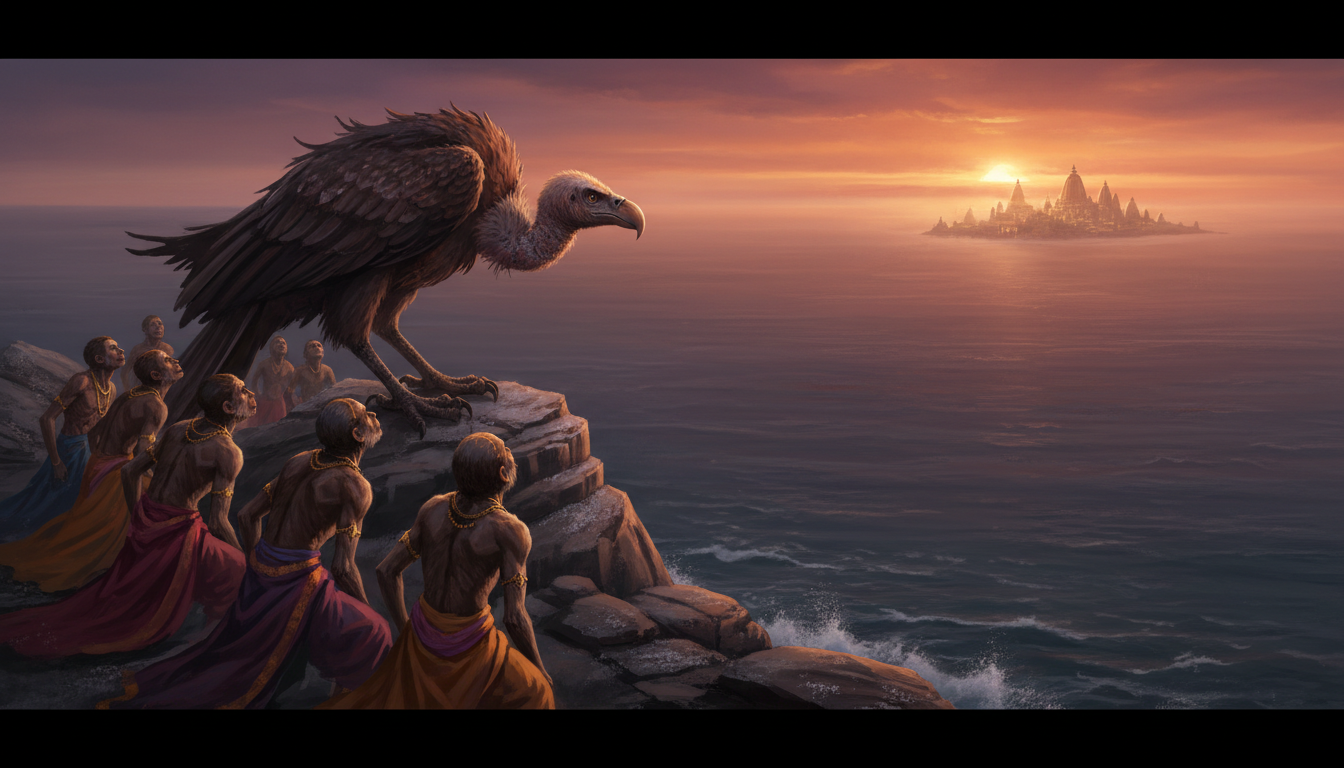
The Bird With the Burnt Wings
"And just then," said Hanuman, "we saw a bird huge as a mountain, of frightful form, inspiring terror into every heart, like a second son of Vinata. He came upon us unawares, for the purpose of devouring us, and he spoke first.
"'Who are you that are speaking thus of my brother Jatayu? I am his elder brother, by name Sampati, and I am the king of birds. Once upon a time we two, with the desire of outstripping each other, flew towards the sun. My wings got burnt, but those of Jatayu were not. That was the last time I saw my beloved brother, the king of vultures. My wings burnt, I fell down upon the top of this great mountain, where I still am.'
"We told him in a few words that his brother was dead, and how, and we told him of this calamity that has befallen you. And the powerful Sampati, hearing that unpleasant news from us, was greatly afflicted, and enquired of us again.
"'Who is this Rama? And why was Sita carried off? And how was Jatayu slain? You foremost of monkeys, I wish to hear everything in detail.'
"So we told him everything about your calamity, and about the reason for our vow of starvation. And that king of birds then urged us to give the vow up, with these words.
"'Ravana is, indeed, known to me. Lanka is his capital. I beheld it on the other side of the sea, in a valley of the Trikuta hills. Sita must be there. I have little doubt of this.'
"O Rama, we had walked the southern half of the world and found nothing, and the thing that ended the search was a crippled bird sitting on a rock where he had fallen an age ago, who could still remember what he had seen from that height on the last day he ever flew. Hearing his words we rose up quickly, and began to take counsel with one another for crossing the ocean."
A Hundred Yojanas
"And none dared to cross it," said Hanuman.
He left that where it was, because it was the truth. Every one of them was a great monkey, a chief, a warrior with a name, and the counsel went round the circle on that beach and came back with nothing in it. Some could go twenty yojanas. Some thirty. The best of them could go eighty and drown at the eighty-first, and eighty yojanas of a hundred is the same as none.
"So I, having recourse to my father, crossed the great ocean, which is a hundred yojanas in width."
That is the whole of the account he gave of it. The son of the Wind, who had been arguing arithmetic on the shore with everyone else, went to the one place in himself where arithmetic did not apply, and then he was over the water, and rakshasa women rose out of the waves to take him on the way and he slew them and went on.
"And I saw the chaste Sita within Ravana's harem, observing ascetic austerities, eager to behold her lord, with matted locks on her head, and her body besmeared with filth, and lean, and melancholy, and helpless. I recognised her as Sita by those unusual signs."
He waited until Rama could hear the next part.
"I approached that worshipful lady while she was alone, and I said to her: 'I am, O Sita, an emissary of Rama, and a monkey begotten by Pavana. Desirous of having a sight of you, hither have I come travelling through the skies. Protected by Sugriva, that monarch of all the monkeys, the royal brothers Rama and Lakshmana are in peace. And Rama, O lady, with Sumitra's son, has enquired of your welfare. And Sugriva also, on account of his friendship, enquires of your welfare. Followed by all the monkeys, your husband will soon be here. Confide in me, O adorable lady. I am a monkey and not a rakshasa.'"
The Jewel and the Crow
"She seemed to meditate for a moment," said Hanuman, "and then she replied to me.
"'From the words of Avindhya I know that you are Hanuman. O mighty-armed one, Avindhya is an old and respected rakshasa. He told me that Sugriva is surrounded by counsellors like you. You may depart now.'
"She had been in that grove for months with nobody on her side but an old rakshasa who spoke to her kindly, and she had kept what he told her, and she used it to check me before she gave me anything. Then she gave me this."
And he put into Rama's hand a jewel, and said the thing about it that mattered.
"It was by means of this jewel that she had been able to support her existence."
Rama held it and did not speak.
"And the daughter of Janaka further told me a token, to prove that I had truly met her and that she was really the princess of Videha. She said that once, upon the breast of the mighty hill known by the name of Chitrakuta, a blade of grass was inspired with mantras and thus converted into a fatal weapon, and was shot by you at a crow."
A blade of grass. A crow. An idle afternoon on a hill in the early days of the exile, with nobody present but the two of them, before any of this. Of all the things she might have sent as proof, she sent the smallest one, because it was the one that could only have come from her.
"I then caused myself to be seized by Ravana's soldiers," Hanuman finished, "and then set fire to the city of Lanka."
Markandeya stopped there, and the fire in the Kamyaka camp went on burning.
"The road ends at the water for everybody, son of Pandu," he said. "The chiefs on that beach were not cowards and their reckoning was correct. What got the message across was not the one with the best reckoning. It was the one who left off reckoning whether he could, and went."
Dharma Lesson
The road ends at the water for everyone, and the chiefs who sat down on that beach were not cowards; their reckoning was exact. What carried the message across was not the best reckoning but the one who stopped calculating whether he could. And the search itself was ended not by any of the strong, but by a crippled bird who still remembered what he had seen on the last day he could fly.