The Boons of Visrava's Sons
Three brothers ask Brahma for different things
Whose Son Was Ravana?
The fire in the Kamyaka wood had burned down to coals, and Markandeya was speaking of a grief older than the one the Pandavas were carrying.
"Even Rama suffered a misery without parallel," the sage said. "The evil-minded Ravana, king of the Rakshasas, overpowered the vulture Jatayu by deceit and carried away his wife Sita by force out of a hermitage in the woods. Rama brought her back. He made a friend of Sugriva, he built a bridge across the sea, and he burned Lanka with his keen-edged arrows. He brought her back. But he brought her back late."
Yudhishthira sat with his chin on his fist. Draupadi sat near him, and the dust of Jayadratha's chariot was hardly off her yet.
"In what race was Rama born," the king asked, "and what was the measure of his might and his prowess? And whose son was Ravana? What was the quarrel between the two of them in the beginning? Tell me the whole of it in detail, illustrious one. I have heard the end of that story since I was a boy. Nobody has ever told me how it began."
"Listen, then, exactly as it happened," said Markandeya. "There was a great king named Aja, sprung from the race of Ikshwaku, and his son was Dasaratha, who studied the Vedas and was pure all his days. Dasaratha had four sons, all of them conversant with morality and profit: Rama, Lakshmana, Shatrughna, and the mighty Bharata. Rama's mother was Kausalya. Janaka was king of Videha, and Sita was his daughter, and Tvashtri made her with his own hands, intending her from the first to be the beloved wife of Rama. That is the husband, and that is the wife.
"Now hear where the third one came from. A man's destruction is usually older than the day he goes out and earns it."
The Son Who Went to His Grandfather
The grandfather of Ravana (said Markandeya) was the Self-create himself, the Lord of all creatures, the Creator of the Universe. That is how high the line begins, and you should hold that in your mind while I tell you where it went.
Pulastya had a mighty son called Vaisravana, begotten of a cow. But the son would not stay with the father. He left Pulastya and went up to his grandfather, and attached himself there, and prospered there. Pulastya, angered at being passed over by his own child, did a thing that only a great ascetic can do: he created a second self out of himself. With half of his own soul that regenerate one was born as Visrava, and he was born for one purpose only, which was to take vengeance upon Vaisravana.
Meanwhile the Grandsire, who was pleased with Vaisravana, heaped upon him everything a being can be given short of nothing at all. He gave him immortality. He gave him sovereignty over all the wealth of the universe, so that no treasure anywhere was outside his keeping. He made him guardian of one of the cardinal points of the world. He gave him the friendship of Isana. He gave him a son named Nalakuvera. He gave him for his capital the island city of Lanka, guarded by hosts of Rakshasas, and he gave him the chariot called Pushpaka, which went everywhere according to the will of the rider. And he gave him the kingship of the Yakshas and lordship over lords.
So Kuvera sat in Lanka with the wealth of the worlds around him, borne through his own streets upon the shoulders of men, and his father sat elsewhere in a fit of passion, looking at him with great anger, and half of that anger had already been given a body and a name.
Three Attendants for an Angry Father
Kuvera knew that his father was angry with him, and being a dutiful son in his fashion he always sought some way to please him. What he sent was not an apology. He sent three Rakshasa women to wait upon the sage.
Their names were Pushpotkata, Raka and Malini. They were skilled in singing and in dancing, and they were assiduous in their attentions upon that high-souled Rishi, and those slender-waisted ladies vied with one another in gratifying him. The adorable being was pleased with them. Being pleased, he granted them boons, and to every one of them he gave princely sons, each according to her own desire.
To Pushpotkata were born two sons, foremost among Rakshasas and unequalled on earth in prowess: Kumbhakarna, and the Ten-headed one, Ravana. To Malini was born a single son, Vibhishana. To Raka were born twins, Khara and Surpanakha.
"Consider what has happened here," Markandeya said. "A rich son sends singing women to soothe an angry father, and the angry father, soothed, fathers upon them the destruction of the son's own city. Kuvera bought his peace with his father and paid for it with Lanka, though it took him some years to learn the price. There is no gift so safe that a grudge cannot be got out of it."
The five children grew up together in the Gandhamadana, in their father's hermitage on the mountain, learned in the Vedas and diligent in the ceremonial rites, and there was nothing in their childhood to say which of them would be crowned and which of them would be burned.
Five Children on the Mountain
Vibhishana surpassed them all in beauty. He was very pious, and he performed all the religious rites assiduously, without being asked and without being watched, which is the only way anyone ever finds out what a person is.
The Ten-headed one was the eldest of them all, and he too was religious, and he was energetic, and he was possessed of great strength and prowess. Kumbhakarna was the most powerful of them in battle, fierce and terrible, and a thorough master of the arts of illusion. Khara was proficient in archery, hostile to the Brahmanas, and subsisted upon flesh. The fierce Surpanakha was a constant source of trouble to the ascetics of the mountain, and no hermit within a day's walk of her was ever quite at rest.
They lived there with their father, and they were content, until the day Vaisravana came up the mountain to visit the old sage.
He came possessed of riches and borne upon the shoulders of men. He sat down beside their father. The brothers stood at the edge of the clearing and looked at the palanquin, and at the men under it, and at the ornaments, and at their half-brother's easy face, and at their own father sitting with him in perfect friendliness, and something entered into all of them at once.
They said nothing to Vaisravana. They said nothing to their father. Seized with jealousy, the five of them went away and resolved among themselves upon a course of penances, and the penances they chose were of the most severe kind that has ever been described, because the thing they wanted was not a boon. It was a rearrangement of the world in which their brother was carried and they walked.
A Thousand Years Standing on One Leg
They gratified Brahma, and this is how they did it.
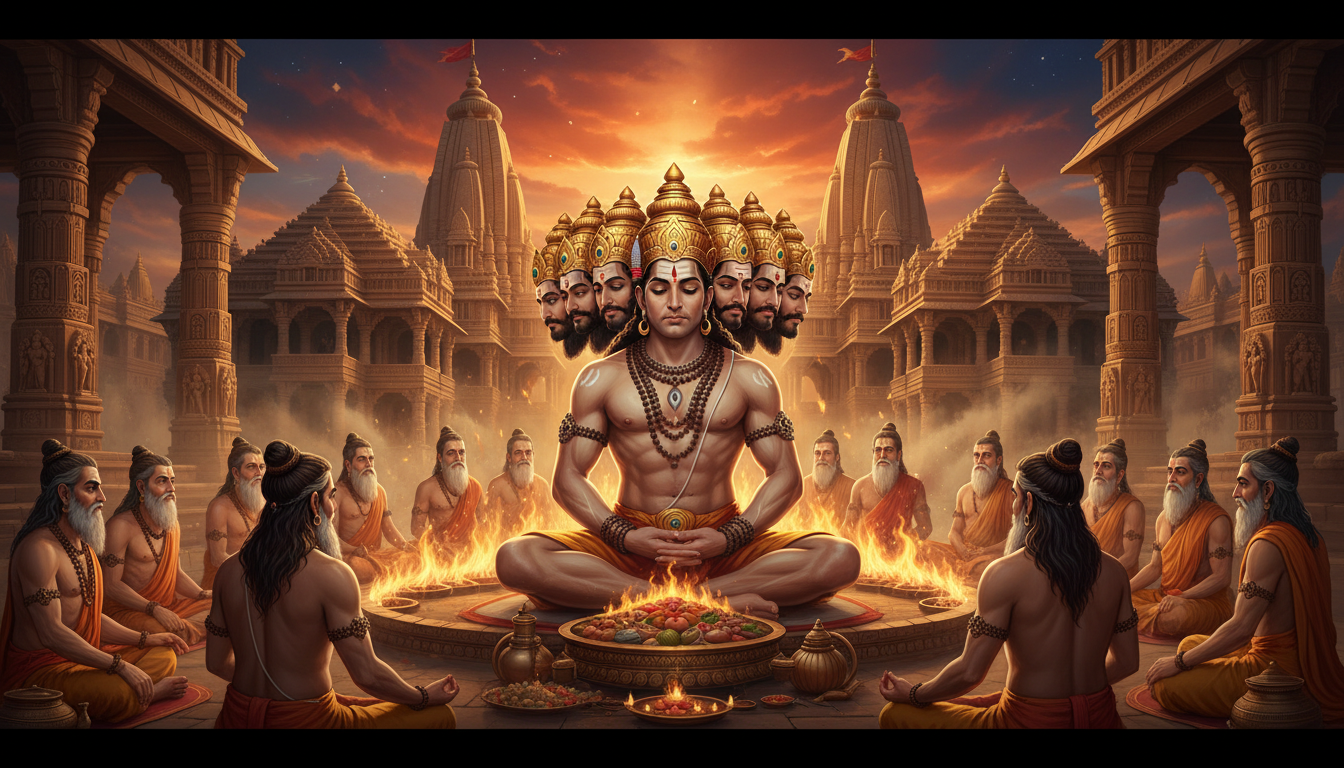
The Ten-headed Ravana supported life by means of air alone. He surrounded himself with the five sacred fires and stood absorbed in meditation upon one leg, and he stood so for a thousand years. Kumbhakarna took his stand with his head downwards and his diet restricted, and he was constant in that austerity and did not break it. The wise and magnanimous Vibhishana observed fasts, and subsisted only on dry leaves, and remained engaged in meditation, and practised severe austerities for a very long period.
Khara and Surpanakha performed no penance at all. With cheerful hearts the twins protected their brothers and attended upon them the whole of that thousand years, standing guard over three motionless bodies while the seasons went over them. Markandeya did not pass this by. "Remember them," he said. "Nobody remembers them. Every great austerity in the world has somebody beside it keeping the fire alight and driving off the beasts, and no boon is ever granted to that person."
At the close of the thousand years, the invincible Ten-headed one made his last offering. He cut off his own heads, one after another, and gave them into the sacred fire as the oblation. He had nothing else left to give; he had already given the food and the sleep and the ten centuries. And at this act of his the Lord of the Universe was pleased at last, and came down personally to the mountain where three brothers were destroying themselves and two were standing watch.
The One Exception
"I am pleased with you, my sons," said Brahma. "Cease now from these austerities, and ask boons of me. Whatever your desires may be, they will be fulfilled, with a single exception: I will not give immortality. And as thou hast offered thy heads to the fire out of great ambition, they shall adorn thy body again as before, according to thy desire, and thy body shall not be disfigured, and thou shalt be able to assume any form thou pleasest, and thou shalt be the conqueror of thy foes in battle. There is no doubt of this."
The heads came back. The Ten-headed one stood whole in front of the Grandsire and asked for what he had spent a thousand years deciding to ask for.
"May I never experience defeat," he said, "at the hands of Gandharvas, Celestials, Kinnaras, Asuras, Yakshas, Rakshasas, Serpents, and all other creatures."
He had listed everything he was afraid of, and it was a long list, and he had thought about it for ten centuries, and he had left one thing off it.
"From those that thou hast named," said Brahma, "thou shalt never have cause of fear. Except from men. From men thou shalt have occasion for fear. Good betide thee. So hath it been ordained by me."
And the Ten-headed one was highly gratified. He was not troubled by the exception. He did not go back and ask to have it closed, and he could have asked. On account of his perverted understanding the man-eating one slighted human beings; they were his food, and a man does not ask a boon against his dinner. He bowed, and thanked the Grandsire, and walked away carrying the one door he had left open in the wall he had spent a thousand years building.
What the Other Two Asked For
Then the great Grandsire turned to Kumbhakarna and addressed him as before, and told him to name what he wanted.
Kumbhakarna's reason was clouded by darkness. Out of that darkness, with the whole universe available to him and the Creator standing in front of him waiting, he asked for long-lasting sleep.
"It shall be so," said Brahma, and it was so, and the strongest fighter of that whole race was put away inside his own boon for most of the rest of his life.
"O my son, I am much pleased with thee," Brahma said to Vibhishana. "Ask any boon thou pleasest."
And Vibhishana said: "Even in great danger, may I never swerve from the path of righteousness. And though I am ignorant, may I be illumined with the light of divine knowledge."
He asked for nothing that would keep him alive. He asked to be kept straight, and to be given light, and he asked for the first of those two in the exact circumstance where a man ordinarily gives it up, which is great danger.
"O scourge of thy enemies," said Brahma, "as thy soul inclines not to unrighteousness although thou wert born in the Rakshasa race, I grant thee immortality."
So the one brother who had not asked to be spared was the one who was spared. "Three requests were made on that mountain in one hour," said Markandeya, "and no one refused any of them, and by the end of the hour anyone standing there knew exactly what those three were and what would become of each of them. What a man asks for when nothing can be denied him is the truest description of him that will ever be made."
The Chariot That Would Not Carry Him
Having obtained his boon, the Ten-headed Rakshasa went straight down to the sea and did the thing he had wanted since the day he saw the palanquin. He defeated Kuvera in battle and took from him the sovereignty of Lanka.
That adorable Being, the lord of wealth, left the city without a war of reconquest. Followed by Gandharvas, Yakshas, Rakshasas and Kinnaras, he went away to live upon mount Gandhamadana, in the country of his father, and would have let it end there. But Ravana came after him and forcibly took from him the celestial chariot Pushpaka as well, and that was one thing more than a brother will bear.
Vaisravana cursed him. "This chariot shall never carry thee," he said. "It shall bear him who will slay thee in battle. And as thou hast insulted me, thy elder brother, thou shalt soon die."
Ravana kept the chariot. He rode in it for years. He did not once notice that it never carried him anywhere he had not already conquered, and he was not there to see it carry a man of Ikshwaku's line home across the sea with a rescued wife aboard.
The pious Vibhishana, treading the path followed by the virtuous, went with Kuvera. He did not argue with his brother and he did not stay to profit by him; he simply followed the wronged one out of the city. The Lord of wealth, highly pleased with his younger brother, invested him with the command of the Yaksha and Raksha hosts.
And in Lanka the man-eating Rakshasas and the Pisachas assembled together and invested the Ten-headed Ravana with their sovereignty. Capable of assuming any form at will, terrible in prowess, able to pass through the air, he attacked the gods and the Daityas and wrested from them all their valuable possessions. He terrified every creature that lived, and it is from that terror that men gave him the name he is remembered by. He was called Ravana because of the cry he made others make. Mustering any measure of might he pleased, he inspired the very gods with fear.
The Petition of the Fire
Then the Brahmarshis and the Siddhas and the Devarshis came together and sought the protection of Brahma, and they put Havyavaha at their head to speak for them, because fire can go anywhere and is not easily silenced.
"That powerful son of Visrava, the Ten-headed, cannot be slain," said Agni, "and he cannot be slain on account of thy boon. Endued with great might, he oppresses the creatures of the earth in every possible way. Protect us, adorable one. There is none else save thee to protect us."
It was as direct an accusation as gods dare to make. You gave him this. You take it back.
"O Agni," said Brahma, "he cannot be conquered in battle by either the gods or the Asuras." He let that stand a moment. "I have already ordained that which is needful for that purpose. Indeed, his death is near. Urged by me, the four-headed God hath already been incarnate for that object. Even Vishnu, that foremost of smiters, will achieve it."
The answer had been in motion before the petition was written. The exception left open on the Gandhamadana had not been an oversight of the Grandsire's; it had been the whole of the design, and the Ten-headed one had chosen it himself, freely, out of contempt, and that is the way such things are generally arranged.
Then the Grandsire turned to Sakra, there in front of all of them, and gave the order that would fill the forests of the south.
"Be thou, with all the celestials, born on earth. And beget ye upon monkeys and bears heroic sons, possessed of great strength and capable of assuming any form at will, as allies of Vishnu."
The Hunchback and the Bears
The gods, the Gandharvas and the Danavas assembled quickly and took counsel among themselves as to how they should be born on earth, each according to his own part, for a war that no one on earth had yet imagined.
And in their presence the boon-giving god commanded a Gandharvi named Dundubhi. "Go there," he said, "for the accomplishing of this object." Dundubhi heard the words of the Grandsire and was born in the world of men as the hunchbacked Manthara. Brahma instructed her as to what she would have to do, and quick as thought she understood all of it, and went down, and went hither and thither ever engaged in fomenting quarrels.
"Mark that," said Markandeya. "Before Rama was born there was already a crooked woman walking toward the women's apartments of Ayodhya, and she had been sent. The exile in the forest, the fourteen years, the two brothers and the wife walking south out of a kingdom that was theirs: all of it was the first move against Lanka, and it was made by heaven."
And Sakra and the principal celestials begot offspring upon the wives of the foremost of the monkeys and the bears. Those sons equalled their sires in strength and in fame. They were capable of splitting the peaks of mountains, and their weapons were stones and trees of the Sala and the Tala species. Their bodies were hard as adamant. They were all skilled in war and could muster any measure of energy at will, and each of them was equal in might to a thousand elephants, and in speed they resembled the wind. Some of them lived wherever they liked and some lived in the forests, and they grew up in the south with no idea at all why they were so strong.
Yudhishthira sat looking at the coals. "So the answer was in the world before the injury was," he said.
"It usually is," said Markandeya. "It is very seldom in the world before the boon is."
Dharma Lesson
What a person asks for when nothing can be refused him is the truest description of him that will ever be made. Ravana spent a thousand years listing everything he feared and left men off the list out of contempt, and the exception he chose himself became the whole design of his death. Vibhishana asked only to be kept straight in danger, and was the one who was spared.