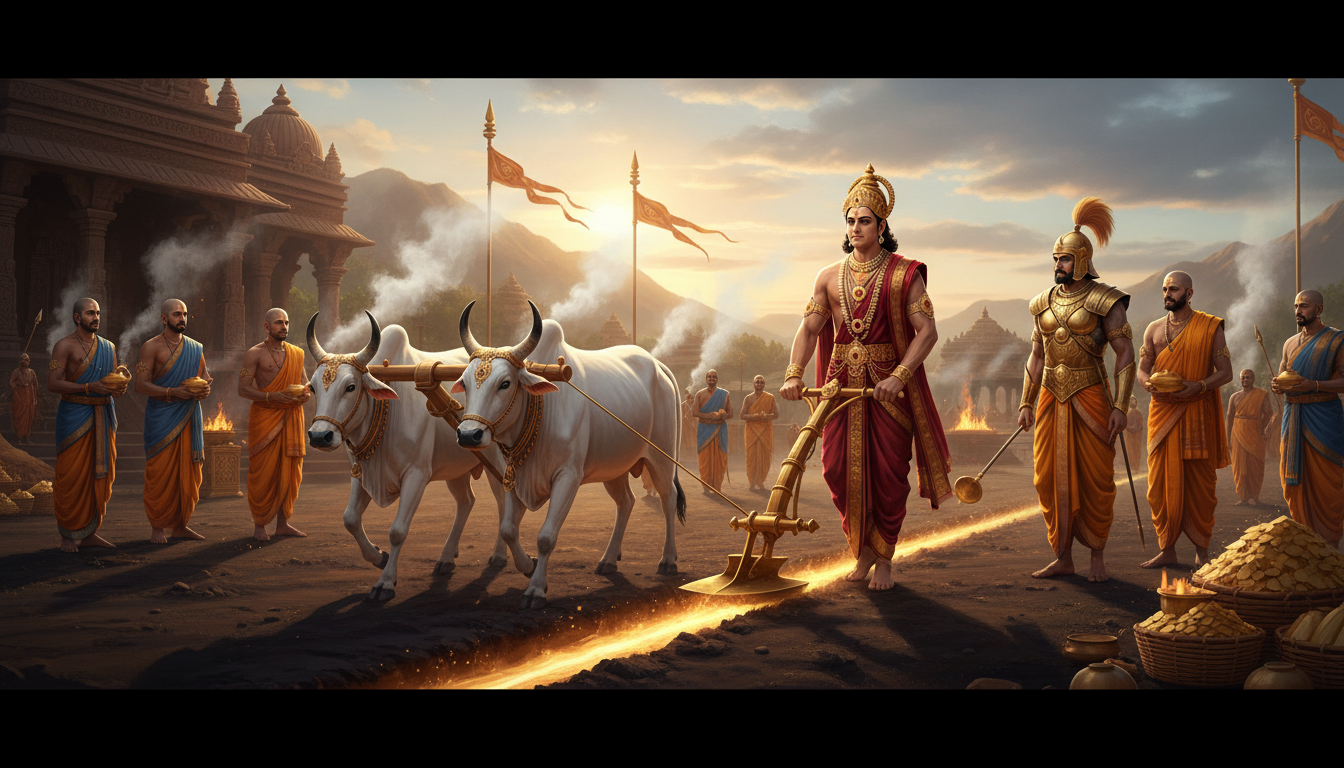
The Golden Plough
The sacrifice a king held because the one he wanted was forbidden him
The Return of the Suta's Son
Vaishampayana said: Hear now, O Janamejaya, what your ancestors were doing in Hastinapura while the sons of Pandu were living on roots in the woods of Dwaita.
Karna came home at the head of a year's tribute. He had gone out with no ally and no partner in the glory, and he had reduced the Angas and the Bangas and the Kalingas and the Magadhas, and after them the Avasiras and the Yodhyas and the Ahikshatras. He had taken Vatsabhumi, and then Kevali and Mrittikavati and Mohana and Patrana and Tripura and Kosala, and made every one of them pay. In the south he had met Rukmi, and after they had fought dreadfully Rukmi lowered his bow and said, 'O foremost of monarchs, I am pleased with thy might and thy prowess. I shall not do thee wrong. I have only fulfilled the vow of a Kshatriya. Gladly will I give thee as many gold coins as thou desirest.' He had gone on to Pandya and to the mountain Sri, and made Karala pay, and king Nila, and the son of Venudari. He had beaten the son of Shishupala and taken the neighbouring rulers with him. He had made peace with the Avantis, met the Vrishnis, and turned west, and in the quarter of Varuna the Yavana and the Varvara kings paid him too, and after them the Bhadras and the Rohitakas and the Agneyas and the Malavas, and the mighty charioteers headed by the Nagnajitas, and the Sasakas.
Then he came back to Hastinapura, and Duryodhana went out to meet him with his father and his brothers and his friends, and paid him homage in the road.
"What I have not received from Bhishma," the king proclaimed, so that the crowd could hear it, "nor from Drona, nor from Kripa, nor from Bahlika, I have received from thee. What need is there of speaking at length? In thee, O tiger among men, I have my refuge. All the Pandavas and all the other kings crowned with prosperity come not to a sixteenth part of thee."
A clamour went up in the city at that, and sounds of Oh and Alas, and some of the kings present praised him, and some censured him, and some said nothing at all. Karna went on into the palace and found Dhritarashtra with Gandhari, and took hold of the blind king's feet as a son does, and Dhritarashtra embraced him with affection and dismissed him. From that day Duryodhana and Shakuni the son of Suvala considered that the sons of Pritha had already been defeated in battle.
Rule Her Like Sakra
"O Kaurava Duryodhana," Karna said, when the road dust had been washed off him and the two of them were alone, "lay unto thy heart the words that I shall tell thee, and after having heard them it behoveth thee to act accordingly in every way. The earth has been rid of thy foes. Do thou rule her even like the mighty-minded Sakra himself, when his enemies have been destroyed."
The king did not answer at once. When he did, it was not about ruling.
"Nothing whatever is unattainable to him who has thee for his refuge," he said, "and to whom thou art attached, and on whose welfare thou art entirely intent. So I will tell thee a purpose I have, and do thou listen to it truly. I have beheld that foremost of sacrifices, the mighty Rajasuya, performed by the Pandavas. I stood in that hall and watched a man of my own blood take the water of the imperial consecration while I held nothing. A desire has sprung up in me. Do thou, O son of a Suta, fulfil this desire of mine."
Karna took it the way a soldier takes an order, by turning it immediately into a list of things to be procured.
"All the rulers of the earth have been brought under thy subjection," he said. "Then summon the principal Brahmanas, and, O best of the Kurus, duly procure the articles required for the sacrifice. Let Ritwijas versed in the Vedas celebrate thy rites according to the ordinance. Let thy great sacrifice commence, abounding in meats and drinks, and grand in all its parts. There is no king living who can refuse thee the tribute it will cost. I have seen to that myself."
So it was settled between them in an afternoon, as easily as a hunt is settled, and neither of them thought to ask a priest first whether the thing they had agreed upon was a thing that could lawfully be done.
While Yudhishthira Is Living
Dhritarashtra's son summoned the family priest and told him what he wanted, in the tone of a man ordering a chariot.
"Do thou duly, and in proper order, celebrate for me that best of sacrifices, the Rajasuya, furnished with excellent Dakshinas. Let the gifts to the brahmanas be such that no one who receives them will ever be able to say he has seen better."
That best of brahmanas heard him out, and then answered him without softening any of it.
"O foremost of the Kauravas, while Yudhishthira is living, that best of sacrifices cannot be performed in thy family. O prince of kings, it cannot. And further, O monarch, thy father Dhritarashtra, endued with long life, liveth. For this reason also, O best of kings, this sacrifice cannot be undertaken by thee."
There it was, laid on the floor of the room in two sentences. The Rajasuya is not held twice in one house while the first celebrant breathes, and it is not held by a son over the head of a living father. Duryodhana had conquered the whole earth by proxy and could not buy the one rite he wanted, because of a man eating forest fruit five hundred miles away and a blind man sitting in the next hall.
He did not shout. Those who were in the room afterward said that what was frightening about him in that moment was how reasonable he stayed.
"Then you tell me," he said, "what a king in my position may lawfully have."
The Rite No One Has Held Since Vishnu
"There is, O lord, another great sacrifice, resembling the Rajasuya," the priest said. "Do thou, O foremost of kings, celebrate that one. Listen to these words of mine.
"All these rulers of the earth who have become tributary to thee will pay thee tribute in gold, both pure and impure. Of that gold, O best of monarchs, do thou now make the sacrificial plough. And with it, O Bharata, do thou plough the sacrificial compound thyself. At that spot let there commence, with due rites and without any disturbance, the sacrifice sanctified with mantras and abounding in edibles. The name of that sacrifice, which is worthy of virtuous persons, is Vaishnava. No person save the ancient Vishnu hath performed it before thee. This mighty sacrifice vies with that best of sacrifices, the Rajasuya itself. It pleases us, and it is also for thy welfare. And, moreover, it is capable of being celebrated without any disturbance. By undertaking it, thy desire will be fulfilled."
He said that last part twice, without any disturbance, and everyone in the room understood the courtesy in it. The Rajasuya is a rite of challenge. It summons every king on earth to come and either bow or refuse, and a hall full of kings who have been beaten within the year is a hall in which something is likely to happen. The Vaishnava summons nobody. It has no tribute-taking at its heart, only tribute already taken, melted down and beaten into a share.
Duryodhana turned to Karna, and to his brothers, and to the son of Suvala.
"Beyond doubt the words of the Brahmanas are entirely liked by me," he said. "If they are relished by you also, express it without delay."
"So be it," they said, all of them together, and no one asked what it meant that Vishnu was the last man to need this particular rite.
Then the king appointed persons one by one to their several tasks, and desired all the artisans to construct the plough. And everything that had been commanded to be done was gradually executed.
The Golden Plough
The artisans came at last, with the principal counsellors, and with them came Vidura, who was the wisest man in that city and the least listened to.
"All the preparations for the excellent sacrifice have been made, O king," they said, "and the time also has come, O Bharata. And the exceedingly precious golden plough has been constructed."
It lay on cloth to be looked at before it was used. It was made of the tribute, pure gold and impure together, and the men who had brought the metal in could still identify their own portions of it: Anga and Kalinga in the beam, Rukmi's coins somewhere in the share, the payments of the Yavana kings and the Varvara kings drawn out into the long curve of the handle. A plough is a farmer's tool and this one weighed what a year of the world's fear weighs, and it had never turned a furrow and never would again after that morning.
Duryodhana commanded that prime among sacrifices to be commenced. The mantras began. The son of Gandhari was duly initiated according to the ordinance, and took the plough in his two hands and walked the sacrificial compound behind it, opening the ground of the rite with the gold of every kingdom Karna had frightened.
And Dhritarashtra was delighted, and Vidura, and Bhishma and Drona and Kripa, and Karna, and the celebrated Gandhari, all of them experienced great delight. It was the first thing in a long time that the whole house had been able to be glad about at once.
Then Duryodhana despatched swift messengers to invite the princes and the Brahmanas, and mounting fleet vehicles they went out to the directions assigned to them, each with his list of houses.
The Errand to Dwaita
To one messenger who was on the point of setting out, Dushasana gave a separate instruction, and he gave it where his brother could hear it.
"Go thou speedily to the woods of Dwaita," he said, "and in that forest duly invite the Brahmanas, and those wicked persons, the Pandavas."
So the man rode south and west out of the tribute-fed city and into a country with no roads in it, and came at last to a clearing by the lake in Dvaitavana where five men in bark and deerskin were sitting with a woman among them, and the fires of brahmanas were burning under the trees all around. Whatever he had been told to expect, he bowed down to all the Pandavas before he spoke, because a man raised in that court knows a king when he is standing in front of one, whatever the king is wearing.
"Having acquired immense wealth by his native prowess," he said, "that best of kings and foremost of the Kurus, Duryodhana, O monarch, is celebrating a sacrifice. Thither are going, from various directions, the kings and the Brahmanas. I have been sent by the high-souled Kaurava. That king and lord of men, the son of Dhritarashtra, invites you. It behoveth you, therefore, to come and witness the delightful sacrifice of that monarch."
There was a silence in the clearing of the kind that has weather in it.
Then Yudhishthira the just answered him, and answered him pleasantly.
"By good luck it is," he said, "that that enhancer of the glory of his ancestors, king Suyodhana, is celebrating this best of sacrifices. We should certainly repair thither. But we cannot do so now. Until the completion of the thirteenth year we have a vow to observe. Tell him that we wish his rite well, and tell him truly that it was courteously asked."
The Clarified Butter of His Anger
Bhima had been sitting with his back against a tree through all of it, and he stood up before the messenger could take his leave.
"King Yudhishthira the just will go thither," he said. "He will go on the day when he casts that man into the fire kindled by weapons. Do thou say this to Suyodhana, and say it in the words I give thee. When, after the expiration of the thirteenth year, that lord of men, the son of Pandu, shall in the sacrifice of battle pour upon the sons of Dhritarashtra the clarified butter of his anger, then will I come."
It was a whole rite laid out in one sentence, and every man there knew how to read it: the war itself would be the offering, the Kurus themselves the oblation poured into it, and Bhima would attend as a guest attends, when the fire was properly lit.
The other Pandavas said nothing unpleasant. They did not need to.
The messenger rode back the way he had come, and when he stood again in Hastinapura he related to Dhritarashtra's son everything exactly as it had fallen out, the courtesy and the vow and the promise about the butter, leaving none of it out, because he had been trained by Vidura's office and it did not occur to him to edit a king's words for a king's comfort.
Duryodhana heard it and did not have the man punished, and did not answer it either. There was a sacrifice to finish. The gates were already full of arriving chariots.
What Vidura Did With the Guests
They came in from everywhere, foremost of men, lords of various countries, and highly virtuous brahmanas by the thousand, and each was received in his order according to the ordinance, and they all experienced great delight and were well pleased. Dhritarashtra sat surrounded by the Kauravas at the height of his joy, and it is worth saying plainly that the old man was happy that week in a way he had not been happy for years, because for once his son had done a thing that filled the house with priests instead of quarrels.
"Do thou, O Kshatta," he said to Vidura, "speedily so act that all persons in the sacrificial compound may be served with food, and be refreshed, and be satisfied."
Vidura assented to that order and did it cheerfully, and did it better than anyone else in that kingdom could have. He entertained all the orders in proper measure, meats and beverages to eat and drink, fragrant garlands, attire of various kinds, each according to what was due to him and none slighted. He had pavilions constructed for their accommodation. He entertained the princes and the brahmanas by thousands, bestowed wealth of many kinds upon them, and bade them farewell.
So the Vaishnava sacrifice of Duryodhana was completed, without any disturbance, exactly as the priest had promised. Nobody was killed in the hall. Nobody stood up to object. No king refused a seat. When the last of them had gone the ground was trampled and the gold plough was carried away to a treasury, and Duryodhana entered Hastinapura surrounded by his brothers, with Karna on one side of him and the son of Suvala on the other.
Not a Sixteenth Part
As he entered the city the panegyrists went before him and eulogized the prince of unfailing prowess, and others took it up and praised that mighty bowman and foremost of kings. The citizens sprinkled fried paddy and sandal paste over him from the housetops.
"By good luck it is, O king," they called down, "that thy sacrifice hath been completed without obstruction."
And then, from somewhere in that crowd, other voices. Some men there were reckless of speech, and being reckless of speech they were also reckless of consequences, and what they said to the king's face, in his own street, on the day of his triumph, was this:
"Surely this thy sacrifice cannot be compared with Yudhishthira's. Nor doth this come up to a sixteenth part of that one."
A sixteenth part. It was the very measure Duryodhana himself had used in the road a season before, when he told Karna that all the Pandavas and all the kings of the earth did not come to a sixteenth part of him. The city handed it back to him with the same coin still warm.
His friends closed round him and talked over it at once, loudly.
"This sacrifice of thine hath surpassed all others," they said. "Yayati and Nahusha, and Mandhata and Bharata, having been sanctified by celebrating such a sacrifice, have all gone to heaven."
Hearing such agreeable words from his friends, the monarch was well pleased, and entered the city and at last his own abode. There he worshipped the feet of his father and his mother, and of the elders headed by Bhishma and Drona and Kripa, and of the wise Vidura; and was worshipped in turn by his younger brothers; and that delighter of his brothers sat down upon an excellent seat with them all around him. Four men had told him the truth in the street and he had walked on past them, and everyone in the procession knew which sentence he had taken home.
The Asura Vow
Then the Suta's son rose in that room full of brothers.
"By good luck it is, O foremost of the Bharata race, that this mighty sacrifice of thine hath been brought to a close," Karna said. "When, however, the sons of Pritha shall have been slain in battle, and thou wilt have completed the Rajasuya sacrifice, then once again, O lord of men, shall I honour thee thus."
"Truly hath this been spoken by thee," the king answered. "When the wicked-minded Pandavas have been slain, and when the grand Rajasuya hath been celebrated by me, then thou shalt again, O hero, honour me thus." He embraced Karna, and from that hour he began to think about the Rajasuya the way a man thinks about a woman he has been refused. He said aloud to the Kurus around him, "When shall I, ye Kauravas, having slain all the Pandavas, celebrate that costly and foremost of sacrifices, the Rajasuya?"
And Karna answered him with the thing he had been carrying since the road.
"Hear me, O elephant among kings. So long as I do not slay Arjuna, I shall not allow any one to wash my feet, nor shall I taste meat. And I shall observe the Asura vow: whoever may solicit me for anything, I shall never say to him, I have it not."
The sons of Dhritarashtra, mighty charioteers and bowmen, sent up a loud cheer at that, and they thought the Pandavas already conquered. Duryodhana left them and went into his own apartments like Kuvera entering the garden of Chitraratha, and all those mighty bowmen went to their quarters.
In the forest it landed differently. The Pandavas had been uneasy since the messenger left, and then the spies came in with the rest of it, the vow about the feet and the meat and Vijaya's name in it. Dharma's son considered Karna of the impenetrable mail, and remembered every one of their woes, and knew no peace. He was so filled with anxiety that he made up his mind to leave the woods about Dvaitavana altogether, with their thickets full of ferocious animals, and to go elsewhere.
And Duryodhana ruled the earth, with his heroic brothers, and with Bhishma and Drona and Kripa, and with the Suta's son crowned in martial glory beside him; and he was intent upon the welfare of the rulers of the earth, and worshipped the foremost of brahmanas with sacrifices and profuse gifts, and was engaged in doing good to his brothers. For he had concluded, and had concluded it for certain in his own mind, that giving and enjoying are the only use that riches have.
Dharma Lesson
Honours that must be improvised because the real one is out of reach announce the very lack they were meant to hide. A rite chosen for being incapable of disturbance buys quiet at the price of meaning, and the men in the street can tell the difference even when the king cannot.