The Thunderbolt and the Seizers of Children
What came out of the wound, and the bargain that followed
The Council That Wanted Him Killed
"The child was four days old," said Markandeya, "when the gods first discussed killing him."
Yudhishthira had asked for the rest of it. The Kamyaka fire had been fed again; the recitation was long over; the sage had told them how Skanda came out of the golden lake on the White Mountain with six faces and how the mountains had run away from him and come back.
The celestials went to Vasava in a body.
"O Sakra," they said, "kill Skanda without delay. His prowess is unbearable. If you do not exterminate him he will conquer the three worlds and ourselves with them, and he will overpower you and become the mighty lord of the celestials himself."
Indra, who had been thinking about nothing else, gave them an honest answer.
"This child is endowed with great prowess," he said. "Putting forth his might in battle he could destroy the Creator of the universe. I do not venture to do away with him."
"There is no manliness in you," said the gods, "that you should talk in this manner. Let the great Mothers of the universe go to Skanda today. They can master any degree of energy at will. Let them kill this child."
"It shall be so," said the Mothers, and went.
They looked at him and their nerve went out of them. He was four days old and he was invincible, and standing in front of him the Mothers of the universe stopped being an execution party and became something else entirely. They took shelter with him instead.
"Become our adopted son, mighty being," they said. "We are full of affection for you and we want to give you suck. Look, the milk is oozing from our breasts."
He was pleased to be asked. He received them with due respect and accepted, and one of them, a lady born of Anger with a spike in her hand, took up station over him and kept watch like a mother guarding her own; and the irascible red daughter of the Sea, who lives on blood, took him against her breast and nursed him. And Agni his father came up the mountain to see him, and was honoured by his son, and stayed with the Mothers to tend him, and turned himself into a trader with a goat's mouth followed by a crowd of children, and sat there gratifying the boy with toys.
Airavata Goes Out
So the assassination failed and turned into an adoption, and Indra was left with the original problem and no proxy to hand it to.
He went himself.
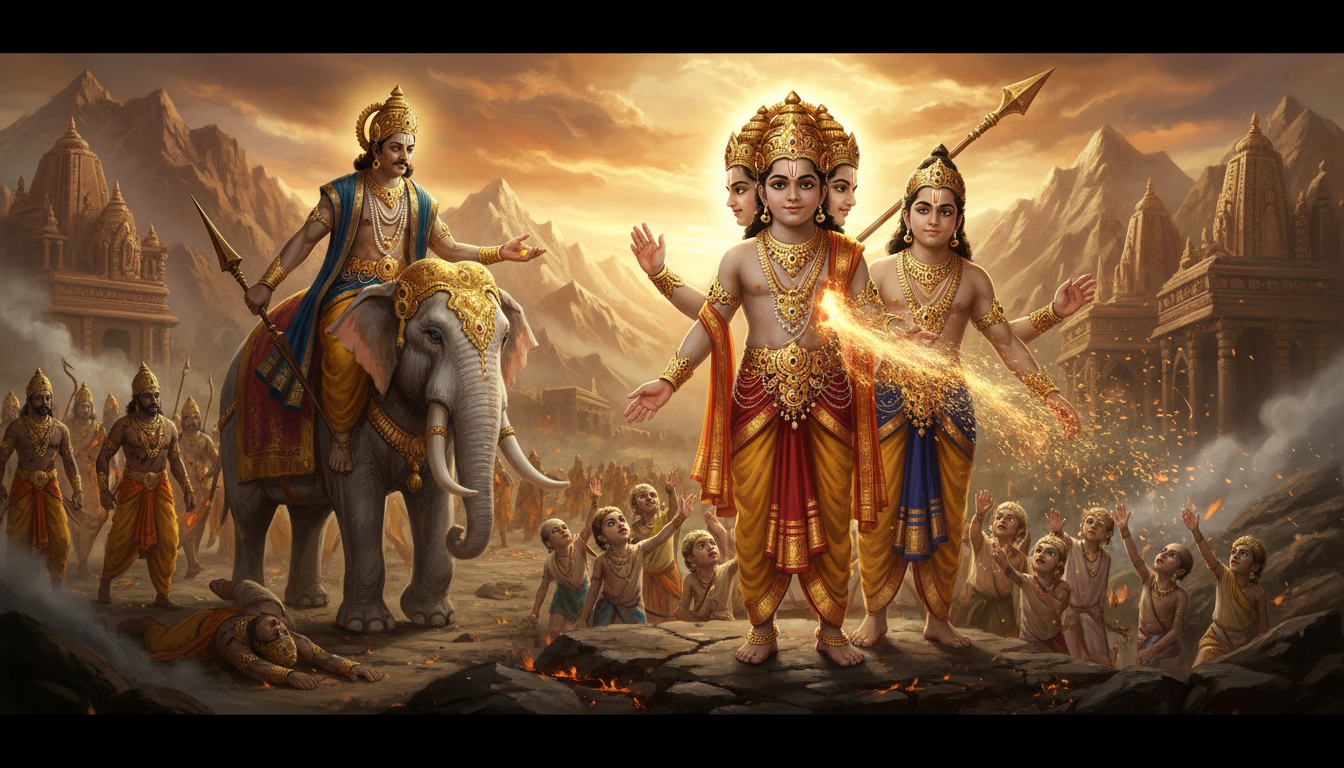
He mounted Airavata and he dressed for it, in his best clothes, with the thunderbolt in his hand, and behind him came the whole celestial army: the planets with their satellites, the standards of every division, warriors in every kind of armour with every kind of bow, riding on every kind of animal that heaven keeps. They sounded the shrill war cry as they came, and the Rishis and the Tridasas praised him as he went, and it was as fine a host as had ever been put in the field, and its purpose was to kill a boy of four days who was playing on a hilltop with a cock and a conch.
Skanda saw the gloriously decked Sakra coming up the mountain with the determination of slaying him, and went out to meet him.
Indra shouted, to encourage his own men.
Guha answered. It was not a shout. It was a noise like the sea coming in, and it went through the celestial army the way a swell goes through water, and the army heaved and then stood absolutely still, stunned, fixed to the ground where it had halted. Nobody in it moved. They had marched up there in perfect order and now they could not remember what they had come for.
The Army Changes Sides
The son of Pavaka looked at the gods coming to kill him and grew angry, and opened one of his six mouths, and what came out of it was fire.
The flames went along the ground and through the celestial forces where they struggled to stand, and heads burned, and bodies, and arms, and the animals they were riding, all at once, so that the whole host looked from below like stars knocked out of their proper spheres and falling.
And then the thing happened that decides the battle, and it is not a blow.
The gods, burning, renounced their allegiance to the thunderbolt. They walked out of Indra's army in the middle of the field and went over and took the protection of the son of Pavaka, and once they had done it there was peace on that hilltop, because there was no longer anybody left on the other side.
Except one. Sakra stood where his army had been, forsaken by his own, holding the weapon that had never failed him and that no longer had anything behind it. He was the king of the gods with no gods. And he did the thing that a man in that position does, which is not the wisest thing available but is the only one he can still perform without help.
He threw the thunderbolt.
What Came Out of the Wound
It struck. It pierced Skanda on the right side and passed clean through the body of that high-souled being, and for one moment Indra had what he had come for.
Then the wound opened and a second person walked out of it.
He was a youth with a club in his hand and a celestial amulet on him, complete, grown, armed, and he had been made by the piercing of the thunderbolt, and because of that they named him Visakha. He looked, standing there, like the fierce destroying fire-god, and he was standing between Indra and the thing Indra had just failed to kill.
Sakra was frightened out of his wits. There was no army, there was no weapon left in his hand, and the one blow he had landed in the whole engagement had produced a second opponent out of the body of the first. He put his palms together and begged Skanda for protection.
And Skanda, four days old, with a hole through his right side, put out his arm and told the king of the gods not to be afraid.
The gods, watching, were transported with joy and struck their hands together, which is the sound that heaven makes when a war it should never have started ends without anybody it loves being destroyed.
The Children Born From the Wound
Visakha was not the only thing that came out of that wound.
When Skanda was struck by the thunderbolt a number of male children came into being, and they were terrible to look at, and their nature was fixed from the first instant: they steal little children, those already born and those still in the womb. And a number of female children of great strength were born with them, of the same kind. All of them took Visakha for their father, and he took them.
So the dexterous Bhadrasakha, who has a face like a goat, stood on that battlefield surrounded by his sons and daughters, guarding them carefully in the presence of the great Mothers, and this is the reason the people of this earth call Skanda the father of Kumaras, the father of little children. It is a name with two edges in it, and both of them are meant. Those who want sons born to them worship the powerful Rudra in the form of the fire-god, and Uma in the form of Swaha, and by that means they are blessed with sons.
The daughters begotten by the fire-god Tapa came to Skanda and he asked them what he could do for them.
"Do us this favour," they said. "By your blessing, may we become the good and respected mothers of all the world."
"Be it so," he said, and then he said the thing that governs them, and he said it over and over. "You shall be divided into Siva and Asiva. The kindly and the unkindly."
The mothers went away having first established his sonship. Kaki, Halima, Malini, Vrinhila, Arya, Palala and Vaimitra, these were the seven mothers of Sisu, and they had by Skanda's blessing a powerful, red-eyed, terrific and very turbulent son named Sisu, reputed as the eighth hero born of the mothers of Skanda, or the ninth if the one with the goat's face is counted in. That sixth face of Skanda is the goat's face; it sits in the middle of the six, and it is the face the mothers look at, and the head by which Bhadrasakha created the divine energy is held to be the best of all his heads.
All of that happened on the fifth day of the bright half of the month. On the sixth there was a very fierce and terrible battle fought in that same place.
The Offer of the Three Worlds
When it was over, the Maharshis came to the boy with a proposal.
"O you who were born of the golden egg," they said, "though you were born only six nights ago, the whole world has already owned allegiance to you and you have already allayed its fears. Become the Indra of the three worlds, then, and remove their cause of apprehension."
Skanda, who had been alive for six days, asked what the office actually involved.
"You gentlemen of great ascetic wealth, tell me. What does Indra do with the three worlds? How does that sovereign of the celestials protect the hosts of the gods without remission?"
"Indra is the giver of strength and power and children and happiness to all creatures," the Rishis said. "Propitiated, he bestows on all of them the objects of their desire. He destroys the wicked and fulfils the desires of the righteous, and he assigns to every creature its various duties. Where there is no sun and no moon he officiates for the sun and the moon. When occasion requires it he serves the purposes of fire, of air, of earth, of water. These are the duties of Indra, and his capacities are immense. You too are mighty. Therefore, great hero, become our Indra."
"Mighty being, make us happy by becoming our lord," said Sakra himself. "You are worthy of the honour. We shall anoint you this very day."
"Continue to rule the three worlds yourself," Skanda answered, "with self-possession and with your heart bent on conquest. I shall remain your humble servant. I do not covet your sovereignty."
Indra would not have it, and his reason was not modesty. It was arithmetic.
"Your prowess is unrivalled, and people have been struck with wonder at it," he said. "More particularly, I have been bereft of my prowess and defeated by you. If I were now to go on acting as Indra I should not command the respect of any creature. They would busy themselves making dissension between us. They would form themselves into two factions, one for you and one for me, and out of that defection there would be war again exactly as before, and in that war you would defeat me without difficulty and become lord of all the worlds anyway."
Skanda considered it. "You are my sovereign, Sakra, and the sovereign of the three worlds," he said. "May you prosper. Tell me if there is any command of yours I can obey."
"At your bidding I shall continue to act as Indra," said the king of the gods. "And if you meant that in earnest, then hear how you can gratify your wish to serve me. Take the leadership of the celestial forces."
"Anoint me as leader, then," said Skanda, "for the destruction of the Danavas, for the good of the celestials, and for the well-being of cows and brahmanas."
The Anointing on the Sixth Day
So the god who had come to kill him anointed him instead, with all the other gods, and the Maharshis honoured him.
They held a golden umbrella over his head and it looked like a halo of blazing fire. The conqueror of Tripura fastened round his neck with his own hands the celestial wreath of gold that Vishvakarma had made. Rudra had come there beforehand with Parvati, and he honoured the boy with a glad heart, and because the brahmanas call the fire-god Rudra, and because Rudra's action had entered into the constitution of the fire-god, and because all the dwellers of heaven saw Rudra heaping honours on Guha that day, Skanda has been reputed the son of Rudra from that time to this.
He was dressed in a pair of clean red cloths and looked like the sun coming out from behind red cloud. The red cock his father had given him was set on the top of his chariot for an ensign and looked like the image of the all-destroying fire. Beauty, strength, piety, power, might, truthfulness, rectitude, devotion to brahmanas, freedom from perplexity, the protection of followers, the destruction of foes, and care for all creatures: these are the inborn virtues of Skanda, and every one of them had been in the field the day before.
The Vedic hymns were chanted, the celestial band played, the gods and the Gandharvas sang, the Apsaras and the happy-looking Pisachas came in their best, and to the dwellers of heaven the anointed Mahasena looked like the sun rising after darkness has been put out. And the celestial forces, in their thousands, surrounded their leader on all sides.
Then the Performer of a thousand sacrifices remembered Devasena, whom he had rescued long before and for whom he had never been able to find a husband, and he had her brought and dressed in her best.
"Foremost of gods," said the vanquisher of Vala, "this lady was destined to be your bride by the Self-existent Being before you were born. Take her beautiful right hand duly, with the marital hymns."
So Skanda married her, and Brihaspati, who knows the hymns, performed the prayers and the oblations. She is called Shashthi, and Lakshmi, and Asa, and Sukhaprada, and Sinivali, and Kuhu, and Saivritti, and Aparajita, and among men she is known as Devasena, the wife of Skanda. He attained celebrity on the fifth lunar day, which is why that day is called Sripanchami, and he attained his object on the sixth, which is why the sixth is a day of great moment.
The Mothers Come to the Camp
Then the great Mothers came to him in his camp, and asked for something that no one else in the story had dared to ask for.
"We have been described by the learned as the mothers of all creatures," they said. "But we desire to be your mothers. Honour us."
"You are all as mothers to me, and I am your son," said Skanda. "Tell me what I can do to please you."
"The ladies Brahmi and Maheswari and the rest were appointed mothers of the world in ages gone by. We desire, great god, that they be dispossessed of that dignity and that we be installed in their place, and that we, and not they, be worshipped by the world. And restore to us the progeny of which we have been deprived by them on your account."
"What has once been given away you shall not recover," said Skanda. "But I can give you other offspring, if you like."
And then they said it plainly, and it is a cold thing to hear said out loud in a camp full of gods.
"We desire that, living with you and assuming different shapes, we may be able to eat up the progeny of those mothers and their guardians. Grant us this favour."
There was a pause. What Skanda said next is not a refusal and it is not an agreement, and it is worth hearing carefully, because the whole nursery of the world hangs on it.
"I can grant you progeny," he said, "but this topic on which you have just now dilated is a very painful one. May you be prosperous. All honour to you, ladies. Vouchsafe to them your protecting care."
He would not make them harmless, because he could not; they were what they were, and he had the sense not to pretend otherwise. What he did instead was put a second clause into the same contract. If you must be in the room, then be in the room as protectors also.
"We shall protect them, O Skanda, as you desire," the Mothers said. "May you be prosperous. But mighty being, we wish to live with you always."
"So long as children of the human kind do not attain the youthful state in the sixteenth year of their age," said Skanda, "you shall afflict them with your various forms. And I shall confer on you a fierce and inexhaustible spirit, and with that you shall live happily, worshipped by all."
A boundary, a term of years, a name in the liturgy, and an obligation of protection running the other way. That is the whole bargain, and it is the reason a frightened household has something to do at midnight besides be frightened.
The Naming of the Seizers
When he had said it, a fiery powerful being came out of Skanda's own body for the purpose of devouring the progeny of mortals, and fell on the ground senseless and hungry; and at Skanda's bidding that genius of evil took a terrific form, and good brahmanas know it by the name of Skandapasmara.
And then, one by one, Markandeya named them, because a thing with a name can be addressed and a thing without one cannot.
Vinata is the terrible Sakuni graha. She whom the learned call Putana Rakshasi is the graha Putana. That fierce and hideous rakshasa is also called the pisacha Sita Putana, and she is the cause of abortion in women. Aditi is also known as Revati, and her evil spirit is called Raivata, and that terrible graha also afflicts children. Diti, the mother of the Daityas, is also called Muhkamandika, and that terrible creature is very fond of the flesh of little children. The male and female children begotten by Skanda are spirits of evil and destroy the foetus in the womb, and they are the husbands of those very ladies, and children are seized unawares by these cruel spirits. Surabhi, whom the wise call the mother of the bovine kind, is ridden by the evil spirit Sakuni, and in her company he devours children on this earth. Sarama, the mother of dogs, habitually kills human beings while they are still in the womb. Kadru enters in a subtle form into the body of a pregnant woman and destroys the foetus there, and the mother gives birth to a Naga. The mother of the Gandharvas takes away the foetus, and for that reason a conception turns out to be abortive; the mother of the Apsaras removes it from the womb, and for that reason the learned call such conceptions stationary. The daughter of the Divinity of the Red Sea, who nursed Skanda, is worshipped under the name Lohitayani on Kadamba trees. Arya acts among female beings the part that Rudra acts among male ones; she is the mother of all children and is worshipped distinctly for their welfare.
And one of them is not to be feared at all. She who is the mother of all trees has her abode in a karanja tree, and she grants boons, and her countenance is placid, and she is always favourably disposed towards every creature; and those who desire children bow down to her where she sits in that tree.
These eighteen spirits, and others of the same kind, are fond of meat and wine, and they take up their abode in the lying-in room for ten days without fail. They are propitiated with burnt offerings, with ablutions, with unguents, with sacrifices and other offerings, and above all by the worship of Skanda; and when they are honoured and worshipped with due reverence they bestow on men what is good for them, and valour, and long life. Until the sixteenth year they exercise their influence for evil. After that, they exercise it for good.
The Bells of Airavata
There was one piece of property still to be disposed of, and Indra disposed of it himself.
Airavata had carried two bells called Vaijayanti. The keen-witted Sakra had them brought down and gave them with his own hands to Guha, and Visakha took one of them and Skanda the other, and the standards of Kartikeya and of Visakha were both of them red. So the last thing the elephant of the god who had come up the mountain to kill the child carried down again was a present.
Brahma came and told him to go and see his father Mahadeva, and explained to him where his own followers had come from, and Mahasena went with a son's affection and honoured Maheswara.
And then that mighty god, pleased with the toys the gods had given him, sat down on the Golden Mountain surrounded by hosts of gods and Pisachas, and the mountain looked well in his company, the way Mandara looks when the sun gets into its caves. The White Mountain was covered with woodland in blossom, with Santanaka flowers, with forests of Karavira and Parijata and Asoka, with wild tracts of Kadamba trees, with herds of celestial deer and flocks of celestial birds; and the clouds rumbled like instruments, like the murmur of an agitated sea, and the Gandharvas and the Apsaras danced, and every creature there made a great sound of joy.
Markandeya stopped.
"Note what he did not do," the old sage said to Yudhishthira. "He did not destroy the thing that eats children. He could have burned the Mothers off the field as easily as he burned Sakra's army, and it would have changed nothing, because what they are does not depend on their being there. What he did instead was give them names, and a boundary at the sixteenth year, and a share of the offerings, and a duty of protection binding them the other way. He turned a terror into a party to an agreement."
"And Indra?" said Yudhishthira.
"Indra came with an army to kill a rival and went home with a general," said Markandeya. "He is the only one in the story who understood, before anyone made him, that a power you cannot beat is better placed under your standard than left outside it. He said so out loud in front of his own court, which took more courage than the thunderbolt did."
Dharma Lesson
A power that cannot be destroyed can sometimes be given a name, a boundary and an offering. Skanda could have burned the Mothers off the field as easily as he burned Indra's army, and it would have changed nothing, because what they are does not depend on their standing there. He made them parties to an agreement instead, with a term of years and a duty of protection running back the other way, and that is how the terrors of an infant's first years were turned into something a household can address.