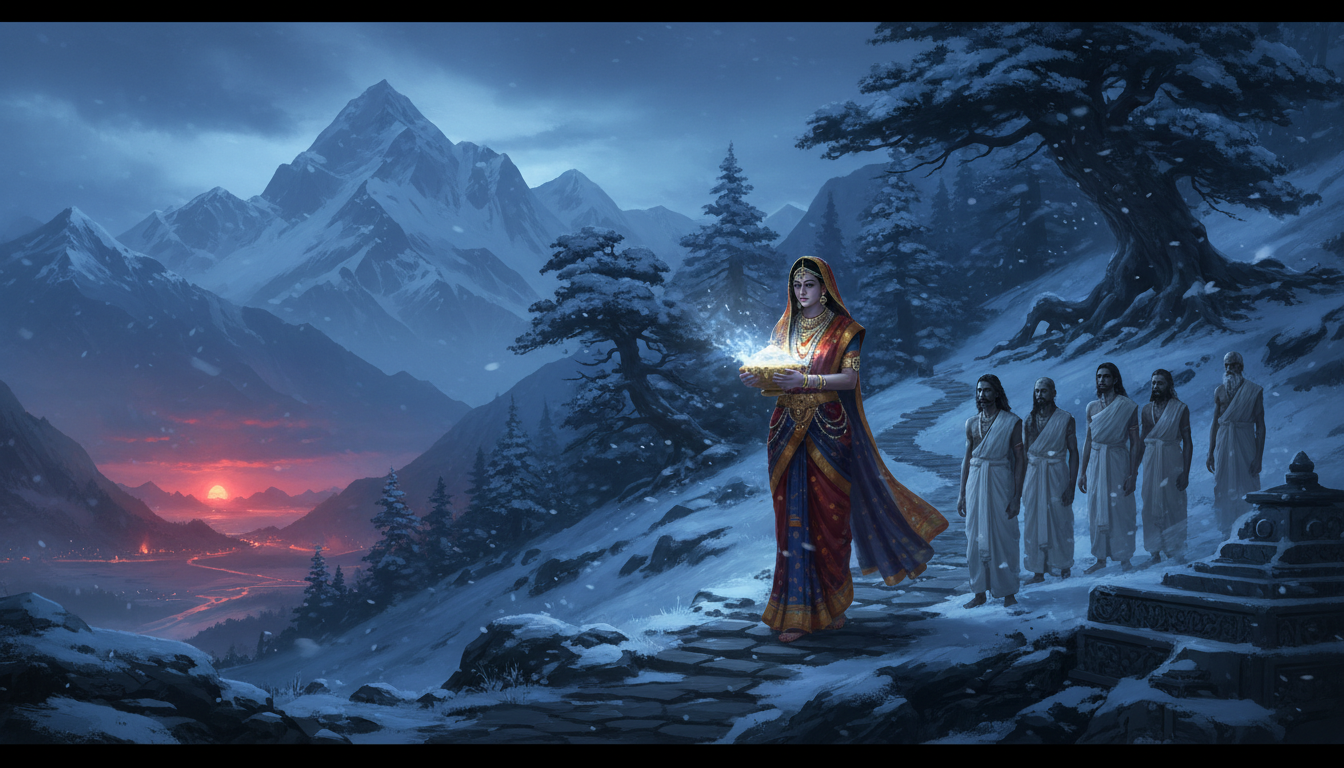
Swaha and the Six Disguises
The wives who were punished for a child that was never theirs
Whose Son Is the War-God
In the Kamyaka forest, on an evening when the fires had been fed and the brahmanas had finished the recitation, Yudhishthira put to Markandeya a question that had troubled him since he first heard the war-god's names sung at a sacrifice.
"They call him the son of Agni," he said, "and they call him the son of Rudra. They call him the son of the Krittikas, and in the same breath they name the six wives of the seven Rishis as his mothers, and then they name Swaha. Holy one, whose child is he? A man is content with one father. This one seems to have four, and six mothers besides."
"He has all of them," said Markandeya, "and the reason he has all of them is a story about a fire that fell in love with women it would not touch, and about six wives who lost their homes for a thing they never did. Listen from the beginning, son of Pandu, because the beginning is not where you think."
It begins, he said, with Indra standing on a hillside at dawn with a girl beside him and no husband to give her. Devasena had been rescued by him from an Asura, and she had asked for a lord who could not be beaten by gods or Danavas or Rakshasas, and Indra had searched the worlds and found no such person living. Then, brooding, he looked up.
It was the day of the new moon. The sun was climbing the eastern hill and the moon was sliding into the sun's disc, and at that fierce hour Indra saw the gods and the Asuras fighting on the sunrise hill, and the morning twilight stained with red clouds, and the house of Varuna gone blood-red, and the Sindhu running with a current of fresh blood, and jackals with fire in their faces crying up at the sun. And he saw Agni carrying into the disc of the sun the oblations that Bhrigu and Angiras and the rest had offered with their hymns.
"This conjunction promises a battle tomorrow," Indra said to himself. "But it promises something else. If Soma begets a son at such a moment, that son could be this lady's husband. And Agni stands in the same conjunction, and Agni too is a god."
He took Devasena to the Grandsire and asked him plainly to appoint a renowned warrior as her husband, and Brahma said, "It shall be as you have already worked it out. The issue of that union will be mighty. He will be this lady's husband, and he will lead your armies with you."
What the Fire Saw Going Home
The gods, wanting their share of the soma, went down to the sacrifices of the celestial Rishis, to Vasishtha and the others, and the Rishis lit the bright blazing fire and poured the offerings with the proper hymns. Then, as the ritual required, they invited the Adbhuta fire by mantra.
He came out of the disc of the sun, keeping silence as the rule of that office demands, and entered the kindled fire, and took up everything that had been offered into it, and carried the whole of it to the dwellers of heaven. That was his work and he did it faultlessly.
It was on the way back that it happened.
The wives of those high-souled brahmanas were asleep in the hermitage, each at her ease on her own bed, and Agni passing above them looked down. Their colour was the colour of a golden altar. They were spotless as moonbeams. They lay like flames lying still, like stars that had been set down in a row on the ground, and the god who had just carried fire from one world to another stood there and could not move.
He knew at once what had happened to him, and he argued with himself about it, which is more than most do.
"These are the wives of great brahmanas," he said. "They are chaste and faithful and no other man's desire has any business reaching them. I am filled with the wish to possess them. I may not lawfully so much as let my eyes rest on them, and I may never touch them while they do not wish it. Very well. I shall gratify myself in the one way that is permitted to me. I shall become their household fire, and look at them every day."
So the Adbhuta fire made himself into the Garhapatya, the fire of the hearth that a household keeps burning from the day of its founding, and took up residence in those six houses. He warmed their cooking. He lit their evening. He touched them with his flames when they came near to feed him, which is the only touch a hearth is allowed, and he gave them his whole heart, and he stayed a long while.
The God Who Went to the Forest to Burn
It did not work. A man may keep a rule and still be destroyed by keeping it. Agni had baffled every effort of his own to win those women, because he had forbidden himself every means of trying, and love that is refused any outlet does not stop; it turns inward and eats. In the end the fire-god left the six hearths cold behind him and went off into the forest, and his purpose in going was to destroy himself.
There was someone who had been watching him for years.
Swaha, the daughter of Daksha, had given him her love long before, and had never been able to give him anything else. She had studied him the way a hunter studies a wall of thorn, looking for the one gap. She was patient about it. But she found nothing: the fire-god was calm, collected, and entirely closed, and the blameless lady got no further in all that time than the doorway of his attention.
Now she heard where he had gone and why.
"He is tortured with love," she thought, "and so am I. He is in the forest for the sake of six women he will not approach. Then I shall go to him in the shape of those women, one after another. He will be gratified, and my own desire will be satisfied at last."
It is worth saying plainly what she chose, because the whole misfortune that follows comes out of it. She did not go to him as herself and ask. She had tried that road for years and found it closed. She went as somebody else.
Siva, Wife of Angiras
The first shape she took was that of Siva, the wife of Angiras, a beautiful woman of great virtue and an unspotted character. In that shape she came into the clearing where Agni sat, and she did not waste time.
"O Agni," she said, "I am tortured with love for you. Think it fit to woo me. And if you will not, then know that I shall destroy myself. I am Siva, the wife of Angiras. I have come here on the advice of the wives of the other Rishis, who sent me after due deliberation."
Agni looked up at her, and the first thing he said was the question of a man who has kept a secret carefully and cannot understand how it got out.
"How did you know that I was tortured with love?" he said. "And how could the others, the beloved wives of the seven Rishis, of whom you speak, know it?"
"You are always a favourite with us," she answered, "but we are afraid of you. Now, having read your mind by the well-known signs, they have sent me into your presence. I have come to gratify my desire. Be quick, O Agni, and take what you want, for my sisters-in-law are waiting for me and I must go back soon."
That was all it took. The god who had held himself off from six women for years, because they had not wished it, was told in eight sentences that they had wished it all along, and there was nothing left of his restraint. Filled with joy and delight he married her in the guise of Siva, and she dallied with him gladly, and when it was over she held his seed in her two hands and did not let it fall.
The Bird and the Golden Lake
Standing there with her hands full, Swaha thought ahead, and what she thought of first was the reputation of the women whose face she was wearing.
"If anyone in this forest sees me in this shape now," she said to herself, "he will put an unmerited slur on the conduct of those brahmana ladies, and it will be fastened to Agni's name and theirs. I must not be seen leaving as a woman."
So she took the form of a bird and went up over the trees, and flew north until she reached the White Mountain, a place fenced about with clumps of heath and strange trees, patrolled by seven-headed serpents that carried poison in their very look, and full of rakshasas and pisachas of both sexes, terrible spirits, and birds and beasts of kinds not seen lower down. She climbed a peak of that range in one flight, and there was a lake at the top of it whose water was gold, and into that lake she threw what she carried.
Then she went back, and went back again.
Six times on that first lunar day she came to the fire-god, and each time she wore a different face. She was the wife of Angiras, and then another of the six, and then another, going through them one by one, and each time she carried what she gained to the White Mountain and cast it into the golden lake. Only one of the seven she could not counterfeit. She tried and the shape would not hold, because the ascetic merit of Arundhati was too great and her devotion to her husband Vasishtha too complete for any other woman to be able to wear her, even for an hour. So Arundhati stayed out of it, and did not know she had been spared anything, and later that accident would be the only thing that saved her.
The Child Called Cast-Off
What lay in the golden lake produced a male child of enormous power, and because the Rishis afterwards spoke of it as a thing cast off, the child born from it was named Skanda, which means exactly that.
He had six faces and twelve ears and twelve eyes, twelve hands and twelve feet, one neck and one stomach. He took a form on the second lunar day. On the third he had grown to the size of a small child. On the fourth the limbs of Guha were complete, and he sat in a bank of red cloud shot through with lightning and shone out of it like the sun rising in red weather.
On the fifth he reached for a weapon, and the weapon he took up was the terrible bow that the destroyer of Tripura had used against the enemies of the gods, and he roared. The three worlds, the moving and the unmoving both, went rigid with fear at the sound. Down in the deep the great Nagas, Chitra and Airavata, shook so badly that the child reached out and steadied them, one in each hand, and went on holding them while he found more hands for other things: a dart in one, a stout red-crested cock gripped fast in another, a conch in two more, which he set to one of his six mouths and blew until the strongest creatures alive were terrified. With his two remaining hands he beat the air, and he played about on that hilltop turning his six faces one after another to all the quarters of the sky, looking at everything there was, roaring again whenever he pleased.
Creatures of every order fell down where they stood and then came crawling to him for protection, and those who came that day are the brahmana followers he keeps to this hour. He raised them up and told them not to be afraid. Then he drew the bow.
His arrows tore open the hill Krauncha, the son of Himavat, and that is why the swans and the vultures have gone over to the Sumeru range ever since. Krauncha came down groaning, and the other hills began to scream, and the boy heard them and was not moved at all; he lifted his mace instead, yelled his war cry, and split one peak of the White Mountain in two. At that the White Mountain came loose from the earth and fled, and the rest of the ranges went with it, and the earth was left flat and ruined and stripped of her ornaments. She went in her distress to Skanda, and he gave her back her light, and the mountains bowed to him and came home and set themselves into her again. That is why all creatures keep the worship of Skanda on the fifth day of the lunar month.
The Forest Decides Who Is Guilty
Everywhere else the world had gone wrong at his birth. The nature of male and female was reversed, and so were heat and cold, and every other pair of opposites men rely on to tell one thing from another. The planets and the quarters and the whole firmament blazed with a light nobody had asked for, and the earth rumbled continuously. The Rishis, who wanted the world to go on, sat down anxiously in the middle of these prodigies and set about restoring some order to it.
And the people who lived in the Chitraratha forest, watching all this, arrived at an explanation before the day was out.
"This wretched condition of ours," they said, "has been brought about by Agni cohabiting with the six wives of the seven Rishis."
Others, who had actually seen a bird go over with something in its claws, said, "No. This evil has been brought about by a bird."
Not one person in that forest imagined Swaha. She had been in love with Agni for years in full view of everyone and had been invisible the whole time, and she was invisible now, when it would have cost her nothing to be seen.
When she heard that the child on the White Mountain was being spoken of as hers, she went up to him and told him, slowly and by degrees, that she was his mother. Then she came down and said it to the seven Rishis, and she said it more than once.
"Ascetics, this child is mine. Your wives are not his mother."
They had already acted. Hearing that a son of great power had been born to their household, and having the whole population of the forest at their gate insisting that the six women had brought him forth, the seven Rishis divorced their wives. All six of them. The adorable Arundhati alone was excepted, because no rumour had ever attached to her, for the one reason that Swaha had not been able to wear her face.
The One Man Who Had Seen It
There had been a witness the whole time, and he had said nothing yet.
When the sacrifices of the seven Rishis were over, the great Muni Vishvamitra had noticed the state the fire-god was in and had followed him, unseen, out of simple attention. He had watched Agni go to the forest to die. He had watched a woman come to him wearing another woman's face, and come back wearing a second, and a third. He knew everything, exactly as it happened, and he was the first person in the three worlds to go to Mahasena and take shelter with him.
He offered the divine prayers over the child. He performed all thirteen of the auspicious rites that belong to childhood, the natal ceremony and the rest, with his own hands, for a boy who had no household to do it for him. He set out for the good of the world the virtues of the six-faced Skanda, and he established the observances due to the cock, and to the goddess Sakti, and to the first followers of Skanda, and for all of this the celestial youth loved him better than anyone.
Then Vishvamitra went to the seven Rishis and told them what he had seen. He told them of the transformations of Swaha, that it was she in the forest and never their wives, that the six women had been at home asleep and knew nothing of any of it, and that they were perfectly innocent.
The seven Rishis heard him out. Then they abandoned their wives unconditionally.
That is the sentence in the story that Markandeya said slowly, and Yudhishthira, who had watched a queen dragged into a hall and had heard men reason about it afterwards, understood it without further explanation. The evidence had arrived. It changed nothing. What had convicted the six was not evidence in the first place, and so evidence could not acquit them.
Six Women and a Place in the Sky
By the time the six came looking for the boy, the world had turned over. Skanda had been anointed leader of the celestial forces, and his camp on the White Mountain was full of gods. The six walked into it as the only homeless women in creation.
"We have been cast out by our god-like husbands, O son," they said, "and without any cause. People spread a rumour that we gave birth to you. Believing it, our husbands were greatly indignant, and we have been banished from our own sacred places. It rests with you now to save us from this infamy. We wish to adopt you as our son, so that by that favour we may be secured eternal bliss. Repay in this way what you owe us."
"Ladies of faultless character," Skanda said, "become my mothers accordingly. I am your son, and you shall have every object of your desire."
There was still the matter of where they were to live, since no household would take them and the sacred places were shut. It was Indra, of all people, who opened the door, and he opened it while asking about something else entirely.
"Abhijit, the younger sister of Rohini," he said, "has gone off to the woods to perform austerities, being jealous about her seniority, and I cannot find a substitute for the fallen star. Consult the Grandsire about filling that room."
Brahma had made Dhanishtha and the other asterisms and the count had been full, with Rohini serving as one of them; now there was a gap in the sky. So on Indra's advice the Krittika was given that place in the heavens, and the star that Agni presides over shines there as though it had seven heads, and the six women who could not be taken back into any house on earth were put where no rumour could reach them and no husband could turn them out.
Vinata came too, and asked for a smaller thing. "You are as a son to me," she said, "and entitled to offer me the funeral cakes. I wish to live with you always." And Skanda said, "Be it so, and all honour to you. Guide me with a mother's affection, and you shall live with me, honoured by your daughter-in-law."
What Swaha Asked For
Last of all, when the boons had been given out and the mothers settled, Swaha came and stood in front of her son.
"You are my natural son," she said. "I want you to grant me an exquisite happiness."
"What sort of happiness do you wish to enjoy?" said Skanda.
"I am the favourite daughter of Daksha, and my name is Swaha," she said, "and from my youth I have been in love with Hutasana, the eater of oblations. And that god, my son, does not understand my feelings. I wish to live with him for ever."
She had taken six faces to reach him and had never once been able to reach him with her own, and after all of it the thing she asked for was still not to be loved but simply to be attached to him permanently, by any means available.
"From this day," Skanda said, "whatever oblation men of virtuous character who do not swerve from the path offer to their gods or to their ancestors, with purifying hymns recited by brahmanas, shall be offered through Agni coupled with your name. In that way, excellent lady, you will always be joined with the god of fire."
And so it is. There is no oblation poured anywhere in the world that does not end with her name spoken aloud over the flame, and Agni cannot receive one without it. She got what she wanted, and she got it in a form that everybody says out loud every day without ever thinking of the woman it belongs to.
Markandeya stopped there. The fires in the Kamyaka had burned low.
"That is why he has four fathers and six mothers and a seventh who claims him," the old sage said. "Rudra entering into the fire-god, and Uma into Swaha, and Swaha into six borrowed faces, and the six who never touched him made his mothers at the end because that was the only redress left for them. Mark the shape of it, son of Kunti. A rumour was raised by people who had seen half of one night. Six women lost their husbands and their homes and their standing to it in a single day. The one man who had seen the whole thing came and testified, in full, to their innocence, and they were divorced anyway. Their names could not be cleared on earth, so they were taken off the earth and set in the sky, where you may look at them tonight."
Yudhishthira looked up through the sal trees at the seven-headed star, and said nothing for a while.
Dharma Lesson
Rumour convicts faster than evidence acquits. Six women lost their husbands and their sacred places in a single day for something they never did, and when the one witness who had seen everything came and swore they were innocent, the seven Rishis abandoned them anyway. What convicts by suspicion cannot be undone by proof, and the six had to be made into stars because no household on earth would take them back.