Devasena and the Husband Not Yet Born
A rescue on the Manasa hills and a promise the gods had to invent someone to keep
A Question About Generals
"I have described to you the various branches of the race of Agni," said Markandeya, sitting in the Kamyaka forest with the exiles around him. "Listen now to the story of the birth of the intelligent Kartikeya. I shall tell you of that wonderful and famous and highly energetic son of the Adbhuta fire, begotten of the wives of the Brahmarshis."
Yudhishthira, who was at that time a commander of nothing at all, asked him to begin.
"In ancient times," said the sage, "the gods and the Asuras were very busy destroying one another. And the terrible Asuras always succeeded in defeating the gods."
That is where the story starts, and it is worth noticing where it does not start. It does not start with a hero. It starts with Purandara standing on a field looking at what was left of the celestial host after another engagement, counting his losses, and thinking a thought that any defeated commander has thought.
"I must find out a mighty person," Indra said to himself, "who, when he observes the ranks of the celestial army shattered by the Danavas, will be able to reorganize it with vigour."
He had no candidate. He had a specification and no candidate, which is the worst position a commander can be in, and so he did what men in that position do: he went somewhere quiet to think. He repaired to the Manasa mountains, and there he sat, deeply absorbed.
And while he was absorbed, he heard a woman screaming.
Rescue Me, or Give Me a Husband
The words came up out of the rocks, and they were not the words anyone would have predicted.
"May someone come quickly and rescue me," the voice cried, "and either indicate a husband for me, or be my husband himself."
It is a strange thing to shout while you are being carried off. It is the cry of a woman who has understood, in the middle of her own abduction, that being rescued once solves nothing, and that what she actually needs is a permanent arrangement.
"Do not be afraid, lady," Indra called, and went toward the sound.
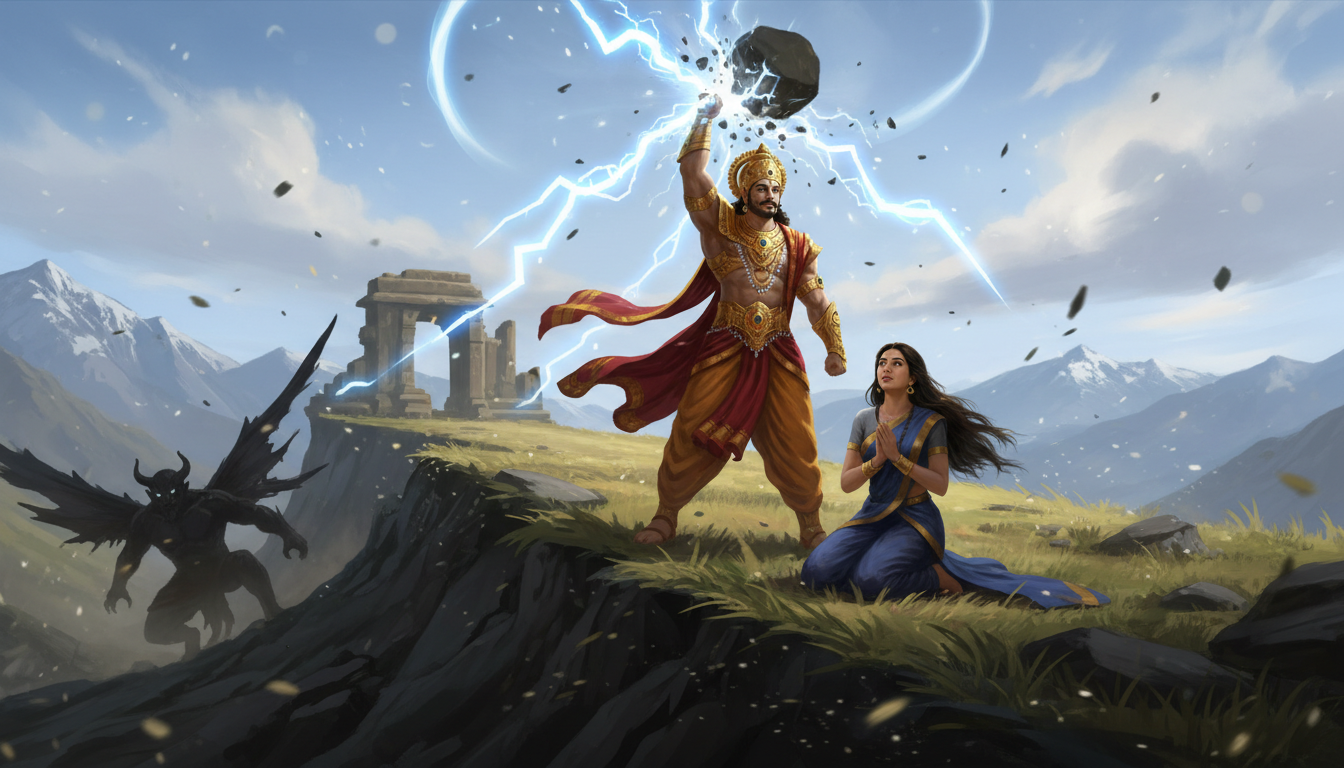
He saw them at a distance: an Asura adorned with a crown, a mace in his hand, standing like a hill of metals, and a woman held fast by the wrist. The Asura's name was Kesin.
"Why are you bent on behaving insolently to this lady?" Vasava said. "Know that I am the god who wields the thunderbolt. Refrain from doing any violence to her."
Kesin did not let go of the wrist.
"Leave her alone, Sakra. I desire to possess her. Do you think, slayer of Paka, that you are going to return home with your life?"
And he hurled the mace.
The Mace and the Rock
Vasava cut the mace apart in the middle of its flight with the thunderbolt, and the two halves went past him into the rocks.
Then Kesin, furious, tore up a huge mass of rock and threw that. He of a hundred sacrifices rent it asunder in the air, and it came down in pieces on the ground; and one of those pieces, falling, struck the Asura who had thrown it.
So Kesin was wounded by his own stone, and being sorely afflicted he fled, and he left the lady where she stood.
When the Asura was gone Indra came over to her, and instead of accepting thanks he asked the only question that interested him.
"Who are you, and whose wife are you, lady of the beautiful face, and what has brought you here?"
She did not weep and she did not fall at his feet. She answered him like a person giving evidence.
"I am a daughter of Prajapati, the lord of all creatures, and my name is Devasena. My sister Daityasena has already been carried off by Kesin. We two sisters used to come to these Manasa mountains with our maids for our pleasure, having the permission of Prajapati to do so. And the great Asura Kesin used to pay his court to us here, day after day. Daityasena, O conqueror of Paka, listened to him. I did not. Daityasena was therefore taken away by him willingly, and I was taken away by force, and you have rescued me with your might.
"And now, lord of the celestials, I desire that you should select an invincible husband for me."
I Am Weak, But My Husband Must Be Powerful
Indra looked at her more carefully then, and worked out the relation.
"You are a cousin of mine," he said. "Your mother is a sister of my mother Dakshayani. Now I wish to hear you relate your own prowess."
It was a fair question and a hard one, because the honest answer was that she had none.
"O hero with long arms," she said, "I am Avala. I am the weak one. That is my name and it is accurate. But my husband must be powerful, and by the potency of my father's boon he will be respected by gods and Asuras alike."
"O blameless creature," said Indra, "I wish to hear from you what sort of power you wish your husband to possess."
Here she could have been modest. A daughter of Prajapati, rescued on a mountainside by the king of the gods, standing there with the bruises of an Asura's grip still on her wrist, might reasonably have said that she would be content with someone who could keep her safe.
What she said was this.
"That manly and famous and powerful being, devoted to Brahma, who is able to conquer all the celestials, and the Asuras, and the Yakshas, and the Kinnaras, and the Uragas, and the Rakshasas, and the evil-minded Daityas, and to subdue all the worlds together with you: he shall be my husband."
Together with you. She had asked, standing in front of Indra, for a husband who could defeat Indra, and she had not blinked while asking it.
She had her reasons, and they were not vanity. She had just watched what happens to a daughter of Prajapati who is guarded by nobody in particular. Her sister had gone with Kesin because Kesin was there every day and there was no one else; she herself had been carried off the same hillside by the same hands. A husband who was merely strong would keep her until somebody stronger came up the mountain. What she was asking for was not a hero. It was an end to the whole question, and the only thing that ends the question is a man whom nothing in the three worlds can outrank.
There Is No Such Person
On hearing her speech Indra was grieved, and thought deeply within himself, and the substance of his thought was very simple.
"There is no husband for this lady answering to her own description."
He was not being modest either. He had just come from a battlefield where his own army was being cut to pieces. He knew the roster of the three worlds by heart, because it was his business to know it, and there was no name on it that met her terms. What she had asked for did not exist.
And then that god, adorned with sun-like effulgence, happened to look east, and saw the Sun rising over the Udaya hill, and the great Soma sliding into the Sun.
It was the day of the new moon. At the Raudra moment he saw the gods and the Asuras fighting on the sunrise hill. He saw the morning twilight tinged with red clouds. He saw the abode of Varuna gone blood-red. He saw Agni carrying oblations, offered with various hymns by Bhrigu and Angiras and the rest, and entering with them into the disc of the Sun. He saw the twenty-four Parvas adorning the Sun, and the terrible Soma present there in the middle of it. Below, the river Sindhu was running with a current of fresh blood, and the jackals with their fiery faces were crying at the sun.
The king of the gods stood on the mountainside and read the sky like a page.
"This terrific conjunction of the Sun and the Moon forebodes a fearful battle tomorrow. This union of Soma with the Sun and with Agni is very wonderful.
"If Soma begets a son now, that son may become the husband of this lady. And Agni also has similar surroundings about him now, and he too is a god. If the two beget a son, that son may become the husband of this lady."
It was not a prophecy. It was a guess made by a tired commander who wanted something to be true.
The Grandsire Is Asked to Provide
So the illustrious celestial went up to the regions of Brahma, taking Devasena with him, and saluted the Grandsire, and made the request in one sentence.
"Do you fix a renowned warrior as the husband of this lady."
It is worth pausing on what was actually being asked. Indra was not requesting a match from the existing stock. He had already established that the existing stock contained nothing suitable. He was asking the Creator to create a person to a specification supplied by a woman who had been screaming on a hillside that morning.
And the Grandsire agreed.
"O slayer of Asuras, it shall be as you have intended. The issue of that union will be mighty and powerful accordingly. That powerful being will be the husband of this lady, and he will be the joint leader of your forces along with you."
Two things had been granted in one breath, and Indra had only asked for one of them. He had come for a bridegroom and he was going away with a commander as well. The general he could not find and the husband who did not exist turned out to be the same missing person, and the woman who had refused to lower her requirement was the reason anyone had gone looking.
Then the lord of the celestials and the lady bowed to him and went away, and Devasena was told to wait.
Nothing in the text says how long. Only that the gods, desirous of drinking the Soma beverage, went off to the sacrifices of Vasistha and the other celestial Rishis to receive their shares of the offerings, and that the whole matter passed out of everyone's hands, including hers.
The Fire That Would Not Touch Them
This is how the missing person came to be made, and it took a long time and it was nobody's plan.
The Adbhuta fire, that carrier of oblations, was invited with mantras to the sacrifice of those great Rishis, and he came out of the solar disc and went there, restraining his speech, and took up the offerings made with the recitation of hymns and carried them to the dwellers of heaven.
And while he was returning from that place, he saw the wives of those high-souled Rishis lying asleep at their ease on their beds. Their complexions were beautiful like an altar of gold, spotless like moonbeams, resembling fiery flames, looking like blazing stars. And seeing them with eager eyes his mind was agitated, and he was smitten.
He restrained his heart, and considered it improper for him to be agitated in that way, and reasoned with himself.
"The wives of these great brahmanas are chaste and faithful and beyond the reach of other people's desires. I am filled with the desire to possess them. I cannot lawfully cast my eyes upon them, nor ever touch them when they are not filled with desire. I shall therefore gratify myself daily with only looking at them, by becoming their household fire."
So the god who could have taken anything took the one thing that was permitted, and became the Garhapatya fire on those hearths, and lived there a long time gratified with seeing those gold-complexioned ladies and touching them with his flames and nothing else. And baffled in all his efforts and tortured in his own heart, he went away at last into a forest with the settled object of destroying himself.
There Swaha the daughter of Daksha, who had loved him for a long time and had never once found a weak moment in that calm and collected god, saw her chance. And what she did next, and the six disguises she wore, and the golden pot on the White Mountain, is another story, and out of it came a child.
The Anointing of Mahasena
Years later, on the day the gods made that child their commander, the son of the Fire-god stood among them clad in a pair of clean red cloths, and he looked grand and resplendent like the Sun peeping out from behind a mass of red clouds.
The red cock the Fire-god had given him was his ensign, and when it was perched on the top of his chariot it looked like the image of the all-destroying fire. Before him advanced the presiding deity of the power that leads to victory, which directs the exertions of all creatures and is their glory, their prop and their refuge. And a mysterious charm entered into his constitution, the charm that shows its power on a battlefield.
Beauty, strength, piety, power, might, truthfulness, rectitude, devotion to brahmanas, freedom from illusion or perplexity, protection of followers, destruction of foes, and care of all creatures: these, said Markandeya, are the inborn virtues of Skanda.
Anointed by all the gods he looked pleased and complacent, and dressed in his best he looked beautiful as the moon at the full. The recitation of Vedic hymns and the music of the celestial band and the songs of the gods and Gandharvas rang out on every side, and surrounded by the well-dressed Apsaras and by many gay and happy-looking Pisachas and hosts of gods, that anointed son of Pavaka disported himself in all his grandeur. To the dwellers of heaven he appeared like the Sun rising after the extinction of darkness.
And the celestial forces, looking on him as their leader, surrounded him on all sides in thousands. He assumed command over all of them, and was praised and honoured by them, and he encouraged them in return.
The specification had at last been met. There was now a person in the three worlds who answered to every word of it.
The Performer of a Thousand Sacrifices Remembers
And then, in the middle of his own triumph, the performer of a thousand sacrifices thought of Devasena, whom he had rescued long before.
He considered that this being was undoubtedly destined to be the husband of that lady by Brahma himself. So he had her brought there, and dressed in the best apparel, and he brought her forward in front of the newly anointed commander of the celestial host.
"O foremost of gods," said the vanquisher of Vala, "this lady was destined to be your bride by the Self-existent Being even before you were born. Therefore accept her beautiful lotus-like right hand duly, with the invocation of the marital hymns."
Thus told, Skanda married her. Brihaspati, who is learned in hymns, performed the necessary prayers and oblations, and the fire that had made the bridegroom burned for the wedding.
She who is called Shashthi, and Lakshmi, and Asa, and Sukhaprada, and Sinivali, and Kuhu, and Saivritti, and Aparajita, is known among men as Devasena, the wife of Skanda. When Skanda was united to her in indissoluble bonds, the goddess of prosperity in her own personal embodiment began to serve him with diligence.
Because Skanda attained celebrity on the fifth lunar day, that day is called Sripanchami, the auspicious fifth. And because he attained his object on the sixth, that lunar day is held to be of great moment ever afterwards; and every household in the land that keeps the sixth day for a newborn child is keeping, without knowing it, the day a woman on a mountainside finally got what she had asked for.
What Yudhishthira Heard in It
Markandeya stopped, and the fire in the Kamyaka clearing had burned down while he talked.
Yudhishthira had been listening to a story about the birth of a war-god, and had heard something else inside it, the way a man in the eleventh year of an exile hears things.
A woman is dragged off a mountain. She is not asked what she wants. When she is asked, she names a condition that the king of the gods knows for a fact cannot be satisfied by anybody alive. And she does not amend it. She does not say that she will settle for a strong Gandharva, or for the protection of the god standing in front of her, or for being returned safely to her father's garden. She holds the requirement, and because she holds it, the Creator is applied to, and a person is brought into existence who did not exist, and the celestial army gets the general it had been unable to find, and the Asuras who had been winning every engagement stop winning.
The waiting between the promise and the wedding is not described in the story. It is simply missing, and the reader is left to notice that it was borne by her and not by Indra, who went away and got on with his affairs.
"She is called the weak one," said Markandeya, getting up, "and she says so herself, and the name is not a lie. She had no prowess to relate. What she had was a refusal to lower a demand, and that turned out to be sufficient to reorganize heaven."
Yudhishthira, who was being urged daily by his wife and his brothers to lower his own terms and take the kingdom early, sat by the dead fire for some time after the sage had gone.
Dharma Lesson
A woman who refuses to lower her requirement forces the world to produce what it said could not exist, and the waiting is not weakness. Devasena has no prowess of her own and says so; what she has is a condition she will not amend. Heaven reorganizes itself around that refusal, and gets the commander it could not find as a by-product.