The Lake in the Wilderness
West of Kamyaka, where the land grew drier still and a broad lake gathered what water the country could spare, lay the forest of Dvaitavana. It was not empty ground the Pandavas came to when they moved there; whole colonies of hermits had already made their homes around the lake's edge long before any exiled king arrived, drawn by its water in a country where water was scarce and by the quiet its remoteness afforded ascetic life. Into this settled world of sages the Pandavas came seeking the same quiet, and stayed longer here than in any other forest of their wandering.
Of all the stops in twelve years of exile, Dvaitavana became their true home in the sense that mattered most: not the briefest shelter but the place where the family's daily life, its rituals and its arguments and its long idle afternoons, took on something like a settled shape. Yudhishthira kept the sacred fires here as a householder would, received brahmins as a king still received them even without a throne, and let the lake's stillness set the pace of years that could not be hurried past.
It was here, more than in any forest before or after, that the exile stopped being a single ordeal to be endured and became instead a slow, grinding way of life, one that tested character not through sudden danger but through the much harder discipline of patience stretched over years. Dvaitavana would earn its place in memory less for any one dramatic event than for everything that happened, quietly, in between them.
The Grinding of the Years
The stillness of the lake did nothing to still what burned in Draupadi. Through the long, uneventful stretches at Dvaitavana, her grief over the dice hall and her fury at watching Duryodhana prosper unpunished found voice again and again, pressed hardest against the one person who could least easily answer it: her own husband. She argued that a king wronged as Yudhishthira had been wronged owed it to his brothers, to his wife, and to dharma itself to take up arms and reclaim by force what had been stolen by trickery, and that patience carried past its use became not virtue but weakness dressed in virtue's clothes.
Yudhishthira answered her every time with the same unmoved insistence that a vow was a vow, that the exile's term had been sworn and must be served whole, and that a kingdom won by breaking one's word was a kingdom built on the same rot that had lost it in the first place. He did not deny her grief or ask her to set it aside; he simply would not let it move him from the terms he had accepted, even when Bhima, listening nearby, made no secret of finding his brother's patience harder to bear with each passing season.
Neither of them yielded, through Dvaitavana's slow years, and the argument itself became a kind of fixture of the place, renewed with every fresh reminder of Hastinapura's comfort and their own privation. It was not resolved so much as endured, the way the lake endured the dry seasons around it, waiting.
Duryodhana's Camp of Cattle
Word of where the Pandavas had settled reached Hastinapura as it always did, and Duryodhana, unable to resist the temptation to see his rivals in their reduced state with his own eyes, arranged an elaborate excuse to travel near Dvaitavana. He called it a ghosha yatra, a journey to inspect his own grazing herds and cattle stations in the region, and set out with a camp large enough to announce itself for miles: tents of fine cloth, retinues of servants, and every comfort a king could carry into the wilderness, calculated to make the contrast with his cousins' bark garments as painful as possible.
Duryodhana made camp near the very lake the Pandavas called home, intending to parade his wealth before them and savor their humiliation at close range. He got a humiliation, but not the one he had planned. A dispute broke out between his men and the gandharva king Chitrasena, who was encamped nearby with his own celestial retinue and had no patience for Kuru soldiers crowding his chosen ground, and the argument became a battle that Duryodhana's mortal army could not win against gandharva strength. Duryodhana himself, along with his brothers and much of his court, was seized and bound.
Word of the capture reached the Pandavas' hermitage before Duryodhana's own men could organize a rescue, and the news arrived as a bitter kind of gift: the cousin who had come to gloat over their misery now needed exactly the strength they still possessed to save him from a worse fate than any humiliation he had planned.
Captured and Freed
Bhima, hearing that Duryodhana had been taken, was in no hurry to move, and said so plainly, arguing that a man who had tried to burn them alive and had dragged Draupadi by her hair deserved to learn what it was to sit bound and helpless for a while. It was Yudhishthira who insisted otherwise, reminding his brothers that a kinsman in danger from an outside enemy was owed protection whatever the private grievance, and that the family's dharma toward its own blood could not bend to fit the shape of an old grudge, however deserved that grudge might feel.
At Yudhishthira's word, the Pandavas moved against Chitrasena's forces and won back what Duryodhana's own army could not: Bhima broke through the gandharva lines by main strength, and between the brothers together, Duryodhana and his captured kinsmen were freed and returned to their own camp rather than carried off. The rescue was as complete as the humiliation that preceded it had been intended to be, only reversed in direction.
Duryodhana could not meet his cousins' eyes afterward. He had ridden out to make a spectacle of their poverty and returned owing his freedom, and very possibly his life, to the very men he had come to mock, and the shame of that debt sat on him more heavily than any battlefield defeat would have, though he swallowed it in silence and rode back to Hastinapura without a word of thanks. The lake had shown, in a single episode, exactly the difference between the two branches of the family it would soon watch go to war.
The Voice Over Still Water
Dvaitavana's long, quiet years did not end all at once. Yudhishthira grew troubled by a dream in which the forest's deer, thinned by years of hunting to feed the household and the guests who passed through it, appeared before him and begged to be allowed to recover their numbers before any more of them were taken. He read the dream as the forest's own request rather than mere fancy, and moved the family onward, back toward Kamyaka and the other stations of their wandering, giving Dvaitavana's herds the rest the dream had asked for.
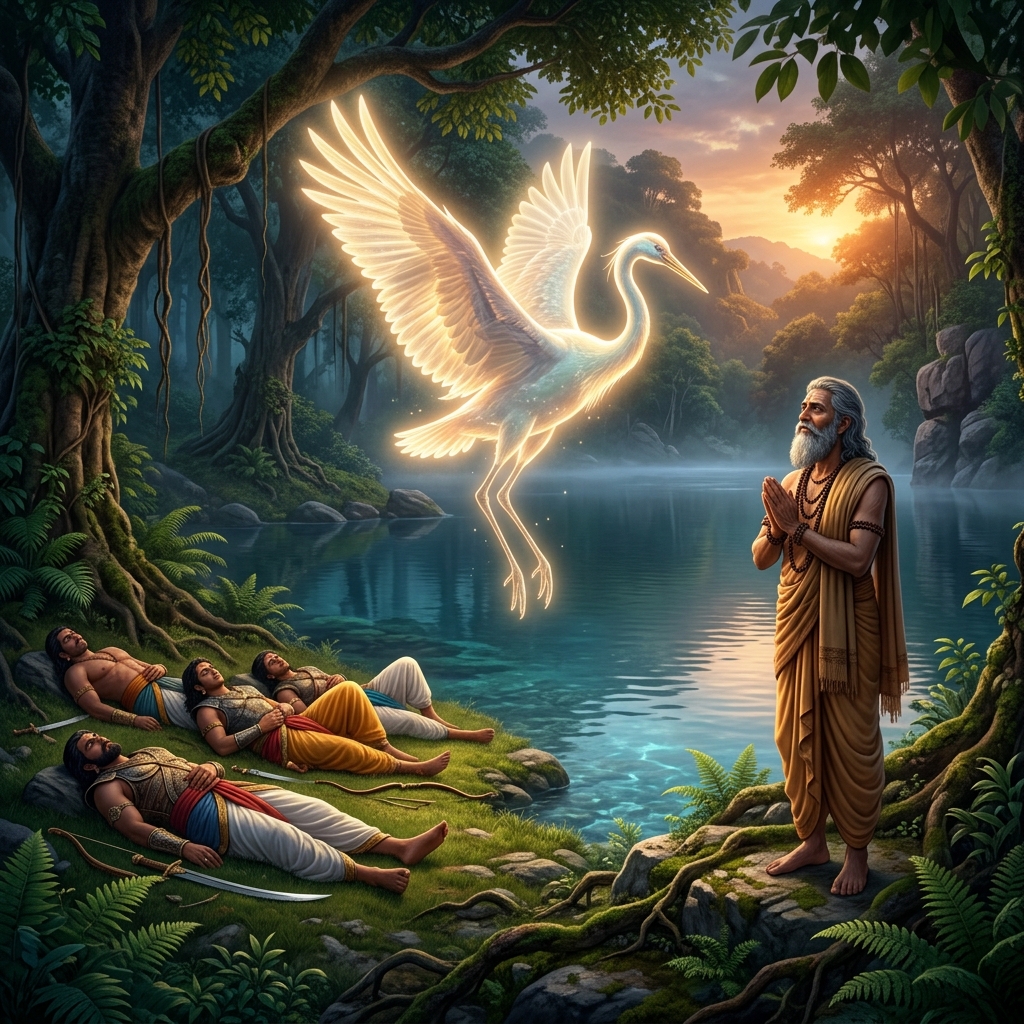
But before that final departure, the lake gave the forest its truest name. Bhima, searching for water during a moment of the family's greatest exhaustion, came to Dvaitavana's still surface and was met, before he could drink, by a voice rising from the water itself, a yaksha who would not let any of the brothers touch the lake until each had answered what was asked of him. One by one the Pandavas fell to that unseen questioner before Yudhishthira came last and answered every riddle put to him, questions about the nature of the world and of dharma more searching than anything a human teacher had asked him yet.
It was that exchange, more than any hermit's blessing or any rescued cousin's silence, that gave Dvaitavana its lasting name among the exile's forests: not merely a lake in dry country where the family had waited out its longest years, but the forest of questions, where the whole meaning of the twelve years finally found words spoken back to the one man who had borne them.
Dharma Lesson
Dvaitavana tests dharma not through a single crisis but through years of grinding patience, as Yudhishthira holds to his vow against Draupadi's mounting grief and anger. When Duryodhana, who came only to gloat, is captured by gandharvas, the Pandavas rescue him anyway, proving that duty toward kin outweighs any private grudge. The yaksha's questions at the lake's edge crown the lesson: wisdom is finally measured in how one answers, not merely how one endures.