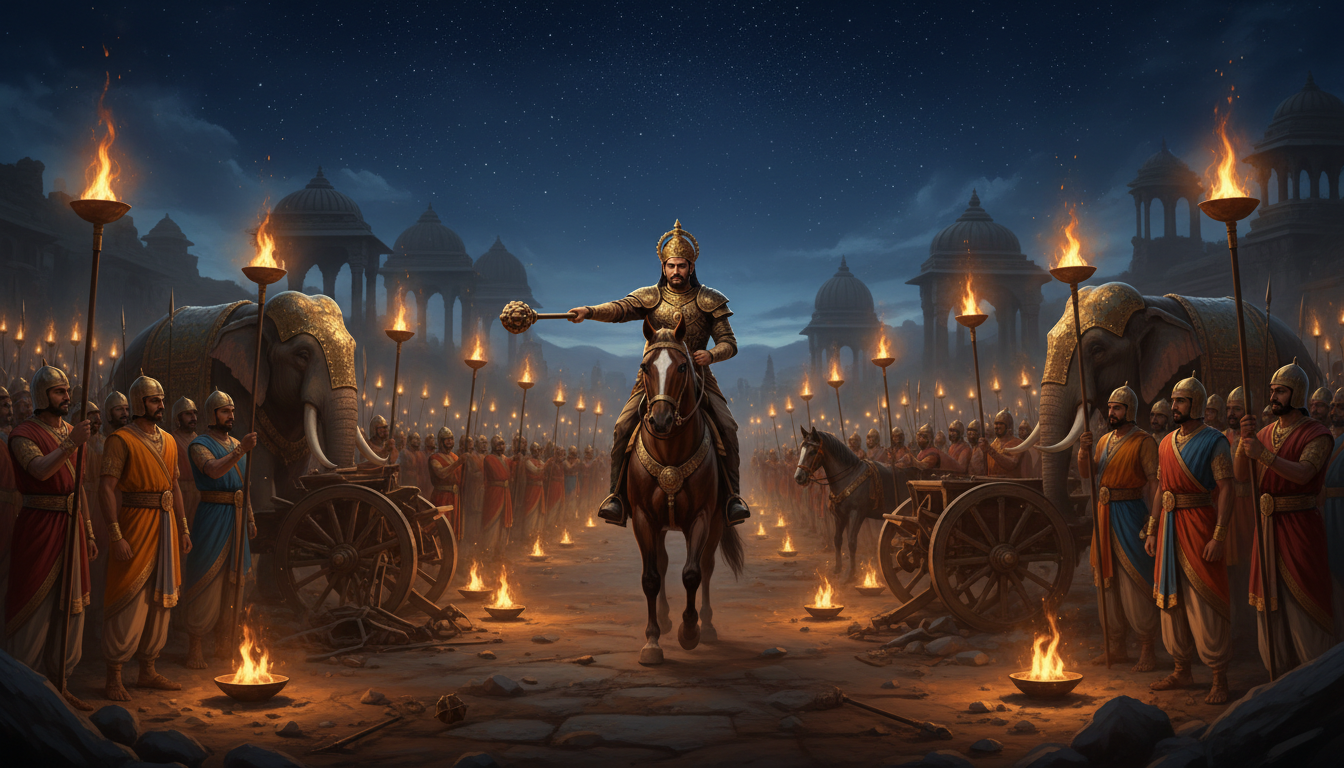
The Night They Lit the Field
Duryodhana's order that turned a battlefield into a lamp-lit hall
Fighting by Name
By the middle of the fourteenth night the dust had gone up into the dark and married it, and the men on that field could not see one another at all.
They went on fighting. That is the thing to hold on to. Nobody called a halt, and the armies did not draw apart, and so an entire war continued to be conducted between men who were working from guesses. They struck at movement. They struck at the sound of a wheel. And because none of that is enough to tell a cousin from a stranger, they began to shout their own names as they came in, which is how it was done from then until dawn: a man announced his family, his father and his house, and swung, and heard a family shouted back at him out of the black, and knew from the name whether to press or to turn away.
It was not a safe system. A name shouted in the dark is only as good as the ear that takes it, and men who had spent fourteen days learning to hate a word could not always stop their arms when they heard it. There were Kurus killed by Kurus that night and Panchalas killed by Panchalas, and no account of it was ever taken, because the men who could have given the account were the men it happened to.
Six men kept moving through it and did not stop. Drona was one, and Karna, and Kripa. On the other side Bhima, and Prishata's son Dhrishtadyumna, and Satyaki of the Satwatas. They afflicted one another and they afflicted the troops of both parties without much distinction, because at that hour nobody could give them any.
The rank and file broke. Oppressed on every side by those car-warriors in the hour of darkness, the combatants of both armies fled in all directions with their hearts perfectly cheerless, and as they fled they were cut down, and thousands of foremost car-warriors slaughtered one another in that battle, unable to see anything, deprived of their senses.
Sanjaya said it plainly when he came to it. All this was the result of the evil counsels of your son.
How Did You See
"What became of the state of your mind then?" said Dhritarashtra. "When you were all afflicted by that darkness and your energy was gone and the Pandavas were furiously agitating you? What is it like, to be in a battle you cannot see?"
He did not wait for an answer to that, because it was not the question he wanted.
"And how, Sanjaya, when everything was enveloped in darkness, did the Pandava troops and mine once more become visible?"
The blind king had asked, in the middle of a report of butchery, how light returned. It was the one thing in the whole account that could not be described to him, and he had gone straight to it.
There was also a complaint. It had been building in him for some nights and it came out here.
"You always speak of my enemies as cool and unvanquished and cheerful and swelling with might in battle. You never speak of mine in such words. On the other hand you describe them to me as slain, and pale, and routed, and you speak of my car-warriors as men deprived of their cars in every battle they fight."
"I speak of what is there," said Sanjaya.
"Then tell me what was there. When Arjuna of the white horses entered our army, who protected Drona? Who guarded the right wheel of his car and who the left? Who were the men behind him? Who went in front of him when he moved forward killing along his road? Tell me, and then tell me how that man met his death."
What Was Left, Put Back in Order
This, then, said Sanjaya, is how the light came.
What remained of your army was got back into a compact array by the leaders, in the dark, by feel and by voice. Drona placed himself at the van. Shalya went to the rear. Drona's son took the right flank and Suvala's son Shakuni the left, and between those four the shape of a host existed again, though no man in it could see more than the length of his own arm.
And king Duryodhana went about all that night personally, from one contingent to the next, protecting the troops. This is worth stating precisely, because so little else in his life will bear it. He did not sit in a tent and send orders. He rode the lines in the dark on the worst night of his war, and he found the foot-soldiers, the men who had no armour worth the name and who had been dying in heaps for six hours without knowing who was killing them, and he cheered them.
Then he gave them the strangest order given on that field in eighteen days.
"Lay aside your great weapons," he said. "All of you. Take blazing lamps in your hands instead."
A man was being told to put down his spear in the middle of a battle. Being told it by the king who had brought him there. It meant standing in the front rank of a night action holding a light in both hands, unarmed, visible from every direction, for the benefit of the men on the chariots above him.
And the foot-soldiers, commanded by that best of kings, joyfully took up burning lamps. Sanjaya used that word and did not take it back. Joyfully. After six hours of being killed by people they could not see, they were being offered the one thing they wanted more than a weapon.
Five on a Car, Three on an Elephant, One on a Horse
The arithmetic of it was fixed and passed down the line, and it was followed exactly, which is the only reason it worked.
On each car, five lamps. On each infuriated elephant, three. And on the back of each horse, one large lamp.
They were in place within a very short time. That detail says everything about what that army still was after fourteen days: somebody worked out the numbers, the numbers went down a broken line in the dark, and the thing was done before the enemy could take advantage of an army standing still.
And then the field came back.
It did not come back grey, the way daylight comes. It came back gold. The oil-fed lamps in the hands of the foot-soldiers threw their light up onto the men above them, and the whole host stood out against the night like clouds in a nocturnal sky lit from inside by lightning.
Drona at the van, in his golden armour, took the light of ten thousand small flames on his breastplate at once and gave it back, and he looked, said Sanjaya, like the midday sun at the height of its blazing, standing in the middle of the fourteenth night and scorching everything around him.
The Sky Takes Up Lamps
What happened next is the part the king made him repeat.
The gods were watching, as they had watched every day of it. So were the rishis, and the gandharvas, and the celestial rishis, and the diverse tribes of the vidyadharas, and the apsaras, and the nagas and the yakshas and the uragas and the kinnaras, all of them stationed in the welkin over that field in their thousands the way people stand on a roof to watch a fire.
And when the foot-soldiers below them lifted their lamps, the sky lifted lamps too. Joyfully. Not one or two of them but all of them at once, so that the roof of the world over Kurukshetra was suddenly a second army holding lights.
Many lamps, filled with sweet-scented oil, were seen to come falling out of the Regents of the cardinal points of the compass and the subsidiary points as well, drifting down over the lines. And from Narada, and from Parvata, particularly and by name and for Duryodhana's sake, many more came, lighting up that darkness.
Whether they came down out of pity or because they wanted a clearer view of what was happening below them, nobody on the ground was in a position to ask. The lamps arrived, and the men took them, and the killing became easier.
It is a strange thing to record and Sanjaya recorded it without comment. The heavens, watching two houses of one family kill each other over a kingdom, did not intervene, and did not weep, and did not turn away. They sent down better lighting.
Everything Made of Metal Became a Lamp
Once the light was there it multiplied itself off everything the men were wearing and carrying, and that army was not a poor one.
The light came off the golden ornaments and off the bright cuirasses and off the bows and off the well-tempered weapons, and every polished surface on that field became a second source. Maces twined about with strings, and bright parighas, and the cars themselves, and the shafts and darts as they coursed through the air, all of them threw the light back, and by their reflection they created myriads of lamps that nobody had lit.
Umbrellas moved, and the light went along their ribs. Yak-tail whisks swung and carried a little of it with them. Scimitars, and blazing brands, and the heavy gold necklaces on the chests of kings, all of these, as they were whirled or moved, caught it and looked exceedingly beautiful.
Weapons red with blood, whirled by heroes, made a blazing effulgence where they went, like lightning in the sky at the end of summer.
And the faces. Sanjaya did not leave out the faces. Men rushing on other men to strike them down, trembling in the ardour of the rush, lit from beneath by the lamps in the hands of their own infantry, looked beautiful, he said, like masses of cloud driven by the wind. As the sun becomes fierce over a forest that is burning, so on that terrible night became the splendour of that fierce and illuminated host.
The Pandavas Answer With More
The Parthas, seeing our host illuminated, did the same thing at once and did it larger.
They stirred up the foot-soldiers throughout their army with great speed, and their count was not ours. On each elephant they placed seven lamps. On each car, ten. On the back of each horse, two. And they did not stop with the fighting animals: they hung lamps on the flanks of the cars and on the rear of them and on the standards, and then along the flanks of the whole host, and on its rear and its van, and all around it, and within it.
Men who were not foot-soldiers stood up in that army holding blazing torches simply to be a source of light, which is a duty no warrior ever asked for and a great many of them took. Nothing was said about who they were. In an account that names the man who guarded the left wheel of a chariot, these are simply others, standing with torches in their hands, and the reason the rest of the night can be described at all is that they did it.
So both armies were lit. The infantry became mingled among the elephants and the cars and the cavalry until no one could say where a formation ended, and with those lamps the Pandava host became fiercely effulgent, like a fire made twice as bright by the rays of the maker of day falling on it.
The splendour of the two of them together overspread the earth, and the welkin, and all the points of the compass, and went on increasing. By that light, said Sanjaya, your army and theirs became distinctly visible to each other, which was the object, and every man on that field could now see precisely who was killing him.
A Second Heaven
The light reached the skies, and it woke people up there.
The gods came. The gandharvas came, and the yakshas, and the rishis crowned with ascetic success, and the apsaras, all of them arriving to look at a thing that had never been done before. And with them, thick over the field, were the spirits of the men killed that day, standing about their own bodies, on the point of going up into the celestial regions and pausing on the way to watch.
Crowded like that, the battlefield looked like a second heaven. Teeming with cars and horses and elephants, brilliantly illuminated, with the wounded animals wandering loose in the light and angry men going at each other under it, that vast host of arrayed warriors looked like the armies of the celestials and the asuras in the old days, which no living man had seen and which every man there now had a fair idea of.
There was a tempest in it, said Sanjaya, if you wanted to name the parts. The rush of the darts was the fierce wind. The great cars were the clouds. The neighing of the horses and the grunting of the elephants were the thunder. The arrows were the rain. And the blood of the warriors and the animals was the flood that came after.
In the middle of it Ashwatthama went through the Pandavas like the noon sun at the end of the rainy season, scorching everything with his rays, and nothing they put in front of him stayed there.
Lamps on Golden Stands
The stands were golden and decked with jewels, and the oil in them was fragrant, and there were thousands of them, and above them burned the more blazing lamps of the gods and the gandharvas.
Under that, the field of battle looked resplendent, like the firmament when it is bespangled with stars. With hundreds upon hundreds of blazing brands along the ground the earth looked exceedingly beautiful, and it also looked as though it were on fire, in the way the world burns at the end of everything. All the points of the compass blazed up with those lamps and looked like trees covered with fire-flies on an evening in the rainy season.
And into this hall, because it was a hall now, with its lamps and its gold and its jewelled stands, the heroic combatants came at one another again, armed with lances and swords, and looked into each other's faces under the light with rage, and could see the rage returned.
Elephant went against elephant. Horseman against horseman. Car-warrior against car-warrior. And they were filled with joy, said Sanjaya, joy, on that fierce night, at the command of your son. The clash of two hosts each of four kinds of forces became terrible.
Then Arjuna began, at great speed, to destroy the Kaurava ranks and to weaken all the kings in them, and the light your son had provided showed him exactly where they were.
Protect the Preceptor
Duryodhana understood that Drona was bent on battle and would not be pulled out of it, and so he spent that night arranging men around an old man who did not want them.
He called his obedient brothers, Vikarna and Chitrasena and Suparsva and Durdharsha and Dirghavahu, and all who followed them.
"You are heroes of great valour and you will struggle with resolution. All of you, protect Drona from the rear. The son of Hridika will protect his right and Sala his left."
Then he put what was left of the brave Trigarta car-warriors at the van, in front, and gave them the reasoning, which was the closest thing to a confession he ever made aloud.
"The preceptor is merciful," he said. "The Pandavas are fighting with great resolution. While he is engaged in slaughtering the foe, protect him well, united together. Drona is mighty in battle, and endued with great lightness of hand, and great valour. He can vanquish the very gods. What need is there to speak of the Pandavas and the Somakas? But all of you, united and struggling in this terrible battle, protect the invincible Drona from Dhrishtadyumna. Except for Dhrishtadyumna I do not see the man among all the warriors of the Pandavas who can vanquish Drona in battle. Therefore I think we should protect the son of Bharadwaja with our whole soul.
"Protected, he is sure to slay the Somakas and the Srinjayas one after another. When all the Srinjayas at the head of their army have been slaughtered, Drona's son will without doubt slay Dhrishtadyumna. Similarly the mighty car-warrior Karna will vanquish Arjuna. As for Bhimasena and the others clad in mail, I will subjugate them all myself. The rest of the Pandavas will be deprived of energy and easily defeated by the warriors. It is evident that my success will then last for ever. For these reasons, protect Drona in battle."
Having said that, on a night of terrible darkness turned to daylight by his own order, your son urged his troops forward. And the battle that took place under those lamps was so terrible and so fierce that neither we nor anyone who went before us had ever seen its like.
Dharma Lesson
Men will spend astonishing ingenuity on being able to see what they are doing and none at all on whether to do it. The lamps were a real solution to a real problem, worked out in the dark by a king riding his own broken lines, and the whole of that intelligence went into making a slaughter more accurate. Cleverness applied to the wrong question is not wisdom; it is only speed in the wrong direction.