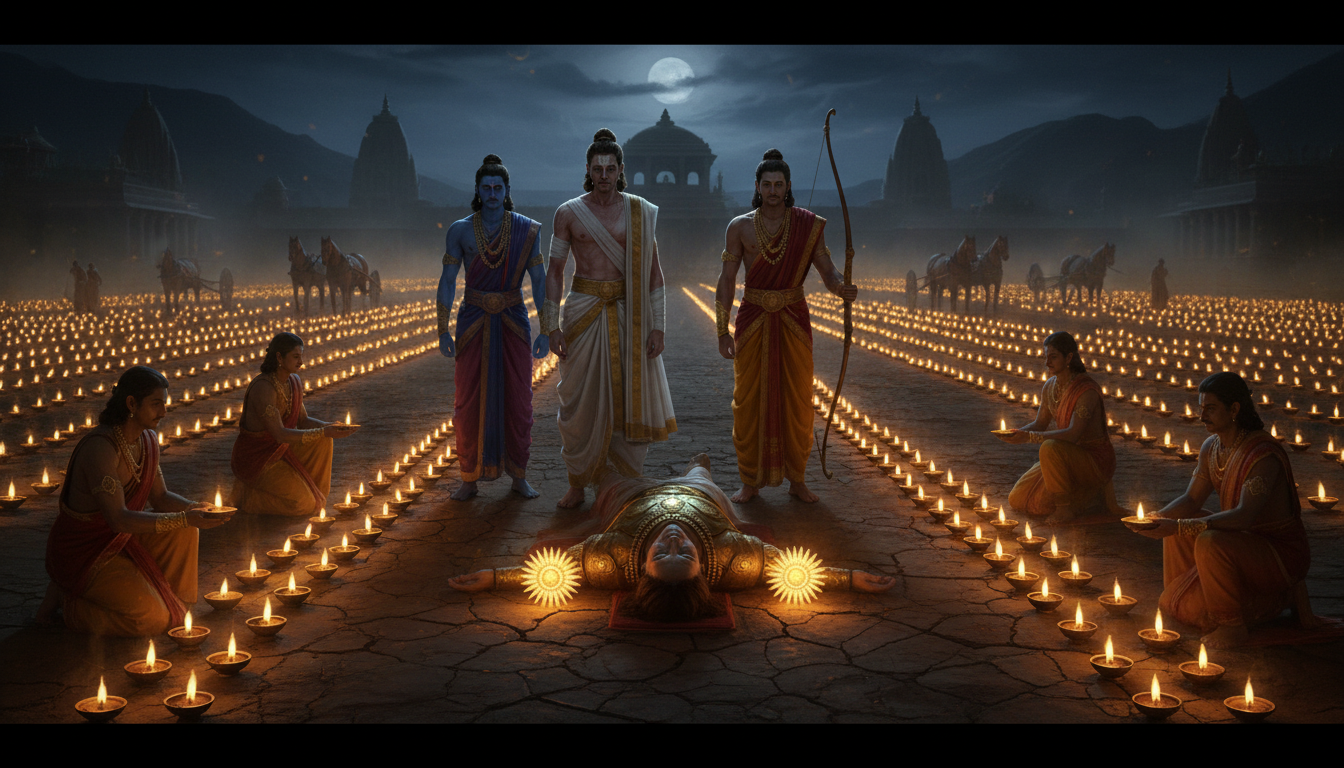
A Thousand Lamps Around Karna
Yudhishthira rises from his bed to look at his enemy
Men Will Say Vritra and Karna in One Breath
"After Karna had thus been slain and the Kaurava troops had fled away," Sanjaya said, "he of Dasharha's race embraced Partha from joy, there on the car, with the dust still coming down over them, and said unto him these words.
"'Vritra was slain by thee. Men will talk in the same breath of the slaughter of Vritra and of Karna in awful battle. Vritra was slain in battle by the deity of great energy with his thunder. Karna hath been slain by thee with bow and sharp arrows.'
"Then he said the other thing, which was not praise.
"'Go, O son of Kunti, and represent unto king Yudhishthira the just this prowess of thine that is capable of procuring thee great fame and that hath become well-known in the world. Having represented unto him this slaughter of Karna in battle, for compassing which thou hadst been endeavouring for a long course of years, thou wilt be freed from the debt thou owest to the king. During the progress of the battle between thyself and Karna, the son of Dharma once came for beholding the field. Having, however, been deeply and exceedingly pierced with arrows, he could not stay in battle. The king, that bull among men, then went back to his tent.'
"Partha answered Keshava, that bull of Yadu's race, saying, 'So be it.' And the latter then cheerfully caused the car of that foremost of car-warriors to turn back."
Stand Here With Care Until We Come Back
"Having said these words unto Arjuna, Krishna addressed the soldiers, saying, 'Blessed be ye, stand all of you carefully, facing the foe.' And unto Dhrishtadyumna and Yudhamanyu and the twin sons of Madri and Vrikodara and Yuyudhana, Govinda said, 'Ye kings, until we come back having informed the king of Karna's slaughter by Arjuna, stand ye here with care.'
"They gave him their permission, and he set out for the quarters of the king.
"Diverse creatures, uniting together, congratulated Dhananjaya, that hero shining resplendent on the field of battle, as also Janardana, those two foremost of men who then looked like a couple of risen suns. Upon the slaughter of Karna, the gods and the gandharvas and the caranas and the great rishis and the yakshas and the great nagas worshipped Krishna and Arjuna with great respect and wished them victory in all things.
"The road they took ran back through the whole of what the day had made. The white steeds went at a walk between the wrecked cars, and the two of them said little. The Pandava soldiers they passed did not cheer them. Many of them were sitting down where they had stopped, in armour, with their weapons across their knees, looking at nothing, the way men do at the end of a thing they have been carrying for seventeen days. Some of them stood up as the car went by. The rattle of it was like the roar of the clouds, and its splendour was like that of the meridian sun of the autumnal sky, and in it rode two men so pierced with Karna's arrows that they looked, both of them, like the bright and many-rayed moon and the sun risen after dispelling a gloom. They were casting off those arrows as they went, plucking them out and dropping them over the rail of the car, the way a man empties his hands before he goes into a house."
The Bed of Gold
"With Partha in his company, Govinda beheld Yudhishthira, that tiger among kings, lying on an excellent bed of gold.
"He had gone out that afternoon to see the field for himself, and Karna's arrows had found him there, and he had not been able to stay. They had brought him back and cut the shafts out of him and bound him and laid him down, and there he had lain through the last of the light, listening. A camp tells a man what is happening if he knows how to listen to it. He had heard the noise change twice, and the second time it did not change back, and he had not been able to read it, and no one who came in would say anything that was not comfort.
"Both of them, with great joy, touched the feet of the king. And beholding their joy, and beholding the extraordinary wounds upon their bodies, Yudhishthira regarded the son of Radha to be dead, and rose quickly from his bed. He did not ask first. He had read it off their faces, which was the one message that had come to him all day that he could trust.
"That chastiser of foes, the mighty-armed monarch, having risen from his bed, repeatedly embraced Vasudeva and Arjuna with affection, and held on to them. Then that descendant of Kuru's race asked Vasudeva the particulars of Karna's death."
Exactly as It Had Happened
"And the sweet-speeched Vasudeva, that descendant of the Yadu race, spoke to him of Karna's death exactly as it had happened.
"How the left wheel of that car had been swallowed by the earth in the afternoon, and how Karna, standing in the churned ground beside it, had called out upon virtue and the rules of fair fight and asked for time. How Vasudeva had answered him from the other car. 'By good luck it is, O son of Radha, that thou rememberest virtue. When at the assembly Shakuni, an adept in dice, vanquished Kunti's son Yudhishthira who was unacquainted with it, whither had this virtue of thine gone? When from the apartment reserved for the females innocent Krishna was dragged, thou didst not interfere. Whither had this virtue of thine gone? Thou saidst to her, in that hall, that the Pandavas were lost and had sunk into eternal hell, and that she should choose another husband, and thou lookedest on the scene with delight. Whither, then, O Karna, had this virtue of thine gone? When many mighty car-warriors, encompassing the boy Abhimanyu in battle, slew him, whither had this virtue of thine then gone? Thou art now for the practice of virtue, O Suta, but thou shalt not escape with life.'
"And how Karna had hung down his head and given no answer, and then had raised his bow with lips quivering in rage and gone on fighting from where he stood. How he had invoked the brahmastra and Arjuna had baffled it with the same. How the fire weapon was quenched with the weapon of Varuna, and the clouds Karna raised, that shrouded all the points of the compass with a darkness such as may be seen on a rainy day, were blown apart by the Vayavya in his very sight. How the terrible shaft came at last from Karna's arms, at whose fixing on the bowstring the earth trembled with her mountains and waters and forests, and how it fell upon Dhananjaya's chest and penetrated it like a mighty snake penetrating an ant-hill, and how Gandiva dropped out of his hand.
"How Karna, seeing that, had jumped down to seize the wheel with his two arms, and could not lift it, though he was strong enough. How Arjuna, recovering his senses, had first cut down the standard bearing the device of the elephant's rope, forged with care by the foremost of artists, adorned with gold and pearls and gems and diamonds, that had always used to fill the Kaurava troops with courage; and how, when it fell, the fame and the pride and the hope of victory of the Kurus fell with it. And how, after that, he took out of his quiver the Anjalika, that measured three cubits and six feet, and said over it, 'If I have ever practised ascetic austerities, gratified my superiors, and listened to the counsels of well-wishers, let this shaft slay my enemy Karna by that Truth.'
"He told him about the light also. That from the body of the fallen Karna a light had passed through the welkin and entered the sun, and that the human warriors had seen it."
By Good Luck, Victory Hath Become Thine
"Then, smiling, Krishna, otherwise called Acyuta, joined his palms and addressed king Yudhishthira, whose foes had been killed, saying these words.
"'By good luck, the wielder of Gandiva, and Vrikodara the son of Pandu, and thyself, and the two sons of Madri, are all safe, having been freed from this battle that has been so destructive of heroes and that made the very hair of the body to stand on end. Do thou those acts, O son of Pandu, which should next be done. The Suta's son Karna, possessed of great might and otherwise called Vaikartana, hath been slain. By good luck, victory hath become thine, O king of kings. By good luck, thou growest, O son of Pandu. The Earth drinketh today the blood of that Suta's son, that wretch among men, who had laughed at the dice-won Krishna. That foe of thine lieth today on the bare ground, pierced all over with arrows. Behold that tiger among men, pierced and mangled with shafts. O thou of mighty arms, rule now, with care, this earth that is divested of all thy foes, and enjoy with us all kinds of enjoyable articles.'
"Having heard these words of the high-souled Keshava, Yudhishthira with great joy worshipped in return that hero of Dasharha's race. 'Good luck, good luck,' were the words that he said. And he added, 'It is not wonderful, O mighty-armed one, O son of Devaki, that Partha, having obtained thee for his charioteer, should achieve feats that are even super-human.'
"Then that righteous son of Pritha took hold of Keshava's right arm, adorned with Angadas, and addressing both Keshava and Arjuna, said, 'Narada told me that ye two are the gods Nara and Narayana, those ancient and best of Rishis, that are ever employed in the preservation of righteousness. Gifted with great intelligence, the master Krishna Dvaipayana, the highly blessed Vyasa, also hath repeatedly told me this celestial history. Through thy influence, O Krishna, this Dhananjaya the son of Pandu, facing his foes, hath vanquished them, without ever turning back from any of them. Victory, and not defeat, we are certain to have, since thou hast accepted the drivership of Partha in battle.'"
Yoke the Car
"And then, having said those words, the king who could not stand upright an hour before called for his chariot.
"They brought it, that car of his adorned with gold, and yoked to it the steeds of ivory white with black tails that were fleet as thought, and he mounted it. Surrounded by many Pandava troops he set out, conversing pleasantly with Krishna and Arjuna along the way, for beholding the field of battle on which thousands of incidents had taken place.
"It was full dark by then. The field between the two camps was not dark, because men were out on it with torches, looking for their own among the heaps; and where a great man had fallen the lamps had been set about him and somebody had been left to keep them alight. They passed the place where the samsaptakas had died in the morning, and the ground where the elephants lay with their housings of gold, and the long wrack of broken cars that marked the line where the two armies had leaned against each other all afternoon. They passed men carrying other men on shields, and a place where the horses that were not dead yet were making a noise nobody went near. Conversing with those two heroes, Madhava and Phalguna, the king went on, and came at last to the place where the Suta's son lay."
A Thousand Golden Lamps
"The king beheld Karna, that bull among men, lying on the field of battle.
"He beheld him pierced all over with arrows, like a Kadamva flower with straight filaments all around its body. And Yudhishthira beheld Karna illuminated by thousands of golden lamps filled with perfumed oil, that had been set in rows upon the ground about him so that he lay in a lake of small steady flames. Though his armour had been cut off with arrows, that beauty of features which the son of Radha possessed had not abandoned him when dead. His body kept the colour of heated gold in that light, as though the metal had been taken out of the fire only a moment before, and it seemed still to be endued with life.
"His son lay beside him, mangled with shafts sped from Gandiva.
"Having beheld him, king Yudhishthira repeatedly looked at him before he could believe his eyes. He looked, and turned away, and looked again, and then got down from the car and stood nearer.
"This was the man on whose account he had not slept. This was the voice that had come across the assembly hall saying the words about the woman in one garment; the archer who had emptied his brothers' hands in a single day and let them walk away; the man who two days before had cut the bow out of his own hands in front of both armies, touched him with the end of it, and told him to go back and live. That had been the worst hour of the war for him, and it had been mercy, and he had not known it. And the thing was lying still now, with the lamps burning all round it, and there was nothing in it to be afraid of, and nothing to be answered, and nothing to be won back."
Tonight We Will Sleep
"Then he applauded those tigers among men, Madhava and Phalguna, saying these words.
"'O Govinda, today I have become king of the earth, with my brothers, in consequence of thyself of great wisdom having become my protector and lord. Hearing of the slaughter of that tiger among men, the proud son of Radha, the wicked-souled son of Dhritarashtra will be filled with despair as regards both life and kingdom. Through thy grace, O bull among men, we have acquired our objects. By good luck, victory hath been thine, O Govinda. By good luck, the enemy hath been slain. By good luck, the wielder of Gandiva, the son of Pandu, hath been crowned with victory.'
"And then he said the last of it, standing over the body in the lamplight, with his own wounds bleeding again from the ride.
"'Thirteen years we have passed in wakefulness and great sorrow. O thou of mighty arms, through thy grace, we will sleep happily this night.'
"He said nothing at all against the dead man. There was no one there to hear it who would have thought it strange if he had, and he did not.
"In this way, O ruler of men, king Yudhishthira the just praised Janardana greatly, as also Arjuna."
Regarded Himself as Reborn
"Beholding Karna with his son slain with Partha's shafts, that perpetuator of Kuru's race, Yudhishthira, regarded himself as reborn.
"The kings in the Pandava army, great car-warriors, all filled with joy, approached Kunti's son Yudhishthira and gladdened him greatly. Nakula and Sahadeva, and Vrikodara the son of Pandu, and Satyaki, that foremost of car-warriors among the Vrishnis, and Dhrishtadyumna, and Shikhandi, and others among the Pandus, the Pancalas, and the Srinjayas, worshipped the son of Kunti at the slaughter of the Suta's son. Extolling king Yudhishthira, those delighters in battle, those effectual smiters, those heroes possessed of sureness of aim and longing for victory, also praised those scorchers of foes, the two Krishnas, with speeches fraught with panegyrics.
"Then those great car-warriors, filled with delight, proceeded towards their own camp, and received all their friends, each according to his age, and were applauded by those friends in return for their incomparable feats.
"The lamps were left burning behind them on the field, and nobody put them out.
"Thus occurred that great carnage, making the hair stand on end, in consequence, O king, of thy evil policy. Why dost thou grieve for it now?"
The Other Hall
Hearing those evil tidings, the Kuru king Dhritarashtra suddenly fell down on the ground from his excellent seat. Similarly, the royal lady Gandhari of great foresight fell down, and she indulged in diverse lamentations for the slaughter of Karna in battle.
Then Vidura and Sanjaya both raised the fallen monarch and began to console him, and the Kuru ladies raised Gandhari. Thinking destiny and necessity to be all powerful, that royal ascetic, under that great grief, seemed to lose his senses. His heart filled with anxiety and sorrow, the king, however, did not again swoon away. Comforted by them, he remained silent, indulging in melancholy musing.
So the night divided itself. On the one side a man who had not slept for thirteen years lay down at last, in a camp where the wounded were being carried past and the lamps were burning out on the field. On the other, in a house that no longer teemed with kinsmen and friends, a blind man sat with nothing further to ask, having been told everything he had spent eighteen days refusing to hear.
He that reads of this great battle, which is like unto a sacrifice, between the high-souled Dhananjaya and Adhiratha's son, and he that hears the account of it read, both obtain the fruit of a great sacrifice duly performed. And that was the end of the Karna Parva.
Dharma Lesson
Relief and grief arrive together at the end of a long enmity, and a man who has to look twice at his enemy's body has already begun to understand what he lost with him. Yudhishthira says he will sleep tonight after thirteen years of wakefulness, and says nothing against the dead man, though everyone present would have let him. Victory is quieter than the hatred that bought it.