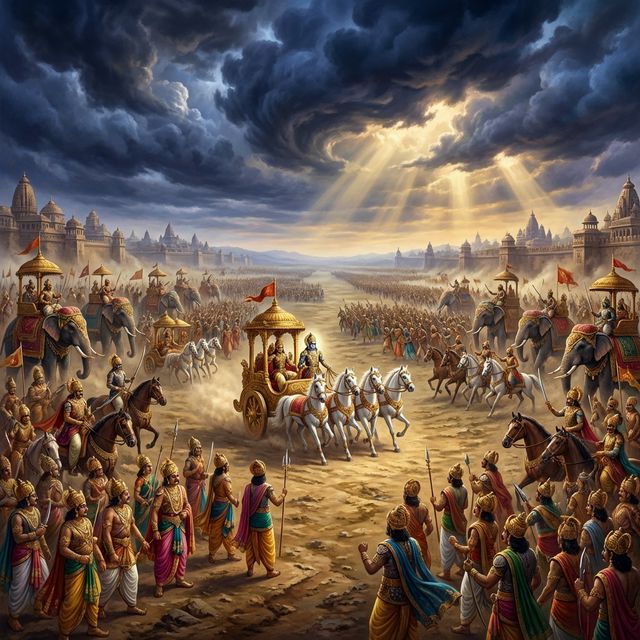
The Duel the Gods Applauded
Ashwatthama and Bhima fight to a standstill and are carried off senseless by their own drivers
The Sixteenth Morning, and Who Faced Whom
On the sixteenth morning of the war Karna took command of the Kaurava host, and Sanjaya, who saw the whole field from the hall at Hastinapura, told the blind king what that day had made of the army.
Karna went into the Pandava ranks with his straight shafts and began to empty them. Elephants struck by him uttered loud cries, lost their strength, became faint, and wandered on all sides. The Pandavas answered in the very sight of Karna, and the battle broke apart into pairs, the way it always did once the great car-warriors found the men they wanted.
Nakula rushed at Karna. Bhima rushed at the son of Drona. Satyaki checked the two Kaikaya princes. Duryodhana went against Yudhishthira the son of Dharma, and Arjuna against the samsaptakas, who had sworn to kill him or die. Dhrishtadyumna proceeded against Kripa. Shikhandi closed with Kritavarma. Sahadeva encountered Dushasana.
And two of Draupadi's sons, boys who had grown up in exile and had come to this field with their fathers, found two kings.
Srutakarman, whom Draupadi bore to Sahadeva, struck Chitrasena, the ruler of the Abhisars, with fifty shafts. Chitrasena answered with nine straight arrows and put five more into the driver. Then Srutakarman, filled with rage, hit him in a vital part with one keen arrow, and the king felt great pain and swooned on the terrace of his car, and while he lay there insensible Srutakarman covered him with ninety arrows more.
Chitrasena came back to himself, cut his enemy's bow with a broad-headed shaft, and pierced him seven times. Srutakarman took up another bow decked with gold, and with wave after wave of arrows he made the king assume a wonderful appearance: adorned all over with them, wearing his garlands still, the young king looked like a well-dressed youth standing in the middle of an assembly.
Chitrasena pierced him through the centre of the chest and said, "Wait, Wait!"
Srutakarman began to shed blood like a mountain shedding streams of liquid red chalk, and bathed in it he shone on the field like a Kinsuka tree in flower.
Two Kings Down, and an Army Running
Bleeding, Srutakarman cut the foe-resisting bow of Chitrasena in two, and then covered him completely with three hundred arrows equipped with goodly wings, and with one more, broad-headed and sharp-edged and keen of point, he took off the head with its head-gear still on it. That blazing head fell to the ground like the moon loosened from the firmament and dropping to the earth at will.
The king's troops saw it and rushed at the man who had done it. He went into them shooting, like Yama filled with fury against all creatures at the hour of the universal dissolution, and they fled on every side like elephants scorched by a forest fire, and he followed them with his keen arrows and looked exceedingly resplendent on his car.
Elsewhere Prativindhya, the son Draupadi bore to Yudhishthira, was fighting the king called Citra. He pierced him with five arrows, his driver with three, his standard with one. Citra struck back at his arms and chest with nine broad-headed shafts winged with gold and plumed with the feathers of the Kanka and the peacock. Prativindhya cut off his bow and put five keen arrows into him.
Then Citra sped at him a terrible dart adorned with golden bells, resembling a flame of fire, and Prativindhya cut it into three fragments with the greatest ease as it came at him like a flashing meteor, and the pieces fell like a thunderbolt at the end of the Yuga, terrifying every creature that saw them.
Citra took up a huge mace netted with gold and threw it. It killed Prativindhya's horses and his driver, crushed the car under him, and drove into the earth. Prativindhya, on foot now, hurled a dart with a golden staff, and Citra caught it out of the air as it came and threw the same weapon back. It went through Prativindhya's right arm and fell to the earth, lighting the whole region as it fell like a blast of lightning.
Then Prativindhya, wanting nothing but that man's death, sent a gold-decked lance at him. It went through the armour and the chest and entered the earth like a snake going into its hole, and the king fell, stretching out two massive arms like a pair of iron clubs.
The Kaurava warriors closed on him from all sides with arrows and with Sataghnis hung with rows of bells, and covered him like clouds covering the sun. He burned them off him and routed them the way Indra routs the Asura host, and the army of Dhritarashtra scattered in all directions like massed clouds dispersed by the wind.
The One Man Who Turned Back
While that whole army was running, one car turned round and came back.
Only Drona's son, singly, rushed with speed against the mighty Bhimasena, and all at once a fierce encounter began between them like the encounter of Vritra and Vasava in the old war between the gods and the Asuras.
They had been matched at the start of the day and had lost each other in the wreck of it, and now they found each other again with the field emptying around them.
Sanjaya took care, telling it, to say what the two of them were. Ashwatthama was a brahmana who had been born to the weapons; his father had taught the Pandavas and had taught him more, and he had a knowledge of every vital point in the human body and the lightness of hand to reach them. Bhima was the son of the wind, the strongest man alive, and had no science that could be set beside Ashwatthama's and had never needed one.
Drona's son pierced him with a single arrow, displaying the lightness of his arms, and then, aiming at all his vital points, because he knew where every one of them lay, he struck him again with ninety shafts.
Pierced all over with those keen arrows, Bhimasena looked in that battle like the sun himself with his rays.
The son of Pandu covered him with a thousand well-directed shafts and uttered a leonine roar.
Ashwatthama baffled the shafts with shafts of his own, and then, as if smiling, put a cloth-yard arrow into the Pandava's forehead.
Bhima bore that arrow standing out of his brow the way the proud rhinoceros in the forest bears its horn. He did not put a hand to it. He looked across at the man who had set it there, and then, as if smiling all the while, he struck the struggling son of Drona on the forehead with three cloth-yard shafts of his own.
With those three arrows sticking in him, the brahmana looked beautiful, said Sanjaya, like a three-peaked mountain washed with water in the season of rains.
Rain Against a Mountain
After that neither of them could move the other at all.
The son of Drona afflicted the Pandava with hundreds of arrows and failed to shake him, as the wind fails to shake a mountain. The son of Pandu, filled with joy, could not shake the son of Drona with his hundreds of keen shafts, as torrents of rain fail to shake a mountain.
That is the sentence Sanjaya used twice, once for each man, and it is the whole of what happened over the next hour.
Shrouding each other with showers of terrible shafts, those two great car-warriors shone on the two foremost of cars, and they looked like two blazing suns risen for the destruction of the world, each scorching the other with rays that were arrows. Each endeavoured with great care to counteract the other's feats. Each matched deed with deed, most fearlessly, and they careered in that combat like a couple of tigers, both invincible, both terrible, arrows for their fangs and their bows for their mouths.
They became invisible under those clouds of arrows, like the sun and the moon in the firmament shrouded by masses of cloud. Then the clouds thinned and the two chastisers of foes blazed out again like Mars and Mercury freed from their screens, and the men who had stopped fighting to watch could see them once more.
Then Drona's son tried the one thing that might have settled it. He drove so that Vrikodara stood on his right, which is the side a bowman covers worst, and from there poured hundreds of fierce arrows on him like clouds pouring rain on a mountain.
Bhima could not brook that indication of his enemy's triumph. He did not wheel away out of the bad ground. From that very station on Ashwatthama's right he began to counteract the same feat against the man who had invented it.
After that their cars would not stay still. They wheeled in diverse ways, advanced and retreated as the exigency required, careered in circular manoeuvres and in paths nobody watching could name, and all the while struck at each other with arrows shot from bows drawn to their fullest stretch, each making the greatest endeavour to compass the destruction of the other, and each wanting most of all to leave the other standing on a broken car with nothing under him.
The Fire the Arrows Made
When the bows had proved useless, Ashwatthama went to the astras.
That car-warrior invoked many mighty weapons, and the son of Pandu, with weapons of his own, counteracted every one of them. Then there took place an awful encounter of weapons, like the terrible encounter of the planets at the time of the universal dissolution.
The shafts they let off met in the air. Where they met they lit all the points of the compass and lit the Kaurava troops standing under them. The welkin, covered with those flights of arrows, took on a terrible aspect, like the sky at the end of all things when it is covered with falling meteors.
And from the clash of shafts, said Sanjaya, fire was generated there, with sparks and blazing flames.
That fire began to consume both armies. Not one army. Both. Men who had no part in the quarrel between a brahmana and the son of the wind stood in the smoke of it on either side and burned, because two men in the middle of the field would not give way to each other.
It was then that the Siddhas came, moving above that place, and began to speak, and Sanjaya repeated what they said as he had heard it.
"O lord, this battle is the foremost of all battles. Any battle fought before does not come up to even a sixteenth part of this. A battle like this will never occur again.
"Both these persons, this brahmana and this kshatriya, are endued with knowledge. Both are possessed of courage, and both are fierce in prowess. Dreadful is the might of Bhima, and wonderful is the skill of the other in weapons. How great is their energy, and how wonderful the skill possessed by both!
"Both of them stand in this battle like two universe-destroying Yamas at the end of the Yuga. They are born like two Rudras, or like two suns. These two tigers among men, both endued with terrible forms, are like two Yamas in this battle."
Such were the words of the Siddhas, heard there every moment, and among the assembled denizens of heaven there arose a leonine roar.
Excellent, O Son of Drona. Excellent, O Bhima.
Beholding the amazing and inconceivable feats of those two warriors, the dense throngs of Siddhas and of Charanas were filled with wonder. The gods and the Siddhas and the great Rishis applauded them both, and what they said was this:
"Excellent, O mighty-armed son of Drona. Excellent, O Bhima."
It is worth stopping on that, because it does not happen often. The heavens have a side in this war and have had one for a long time. Yet here the applause fell on both men at once, in the same breath, praising a Kaurava and a Pandava in one sentence, and it was not offered for anybody's cause. It was offered for the fighting.
The two men in the middle of it were past hearing any of it.
Having done injuries to each other, they glared at each other with eyes rolling in rage. Their eyes were red. Their lips quivered. They ground their teeth in wrath and bit their lips, and then covered each other again with showers of arrows, and looked in doing it like two masses of cloud pouring arrows for rain and gleaming with weapons for lightning.
They pierced each other's standards. They pierced each other's drivers. They pierced each other's steeds, and went on striking after that, and neither would break off, and neither could be made to break.
The gods above them had already said, without meaning it as a warning, exactly what was wrong: two Yamas, two Rudras, two suns. Two of a thing the world is built to hold one of.
There is no room in such a battle for a victory. Everything one man can do the other can do, and the only quantity that changes is what is left of the two of them.
Two Arrows, and Two Drivers
At the end of it, filled with rage, in that dreadful encounter, each of them took up one arrow.
Not a shower and not an astra. One arrow apiece, chosen for the purpose, each man desiring to slay the other with it, and they shot quickly, at the same moment, from their two cars at the head of their two divisions.
Those two blazing arrows were resistless and had the force of thunder in them. They came to the two warriors as they stood, and they struck them both.
Each of the two mighty combatants, deeply struck, sank down on the terrace of his own car.
Then the field was very quiet in that one place. Ashwatthama's driver, understanding that the son of Drona was insensible, took the reins and bore him away out of the battle in the sight of all the troops. Bhima's driver, seeing the son of Pandu falling again and again into a swoon, turned his car in the same way and carried that scorcher of foes off the field.
Two chariots went out of the line in opposite directions, each carrying a man who could not sit up, and nothing had been decided.
Sanjaya, telling it to Dhritarashtra afterwards, did not put a verdict on it, because there was none to put. He had told the king a great many deaths that day and would tell him a great many more before the sun went down on the sixteenth evening, and this was not one of them. It was the one encounter of the whole war that the gods stopped to praise and that ended with both men alive and neither man standing.
Both armies went back to burning. Somewhere ahead of them Arjuna was in the samsaptaka host, and Ashwatthama, when he woke, would go looking for him and ask him for the hospitality of battle.
Dharma Lesson
The gods of this epic almost always take a side, and here, for once, they do not. They praise a Kaurava and a Pandava in the same sentence, because what they are watching is not a cause but a craft carried to its limit by two men who happen to be its equals. The cost of that equality is in the same passage: the fire struck from their meeting arrows burns both armies, and men who had no share in the quarrel stand in the smoke of it. Two matched excellences produce no winner, only damage, and the epic is careful to note that when the two of them were carried off the field, nothing at all had been settled.