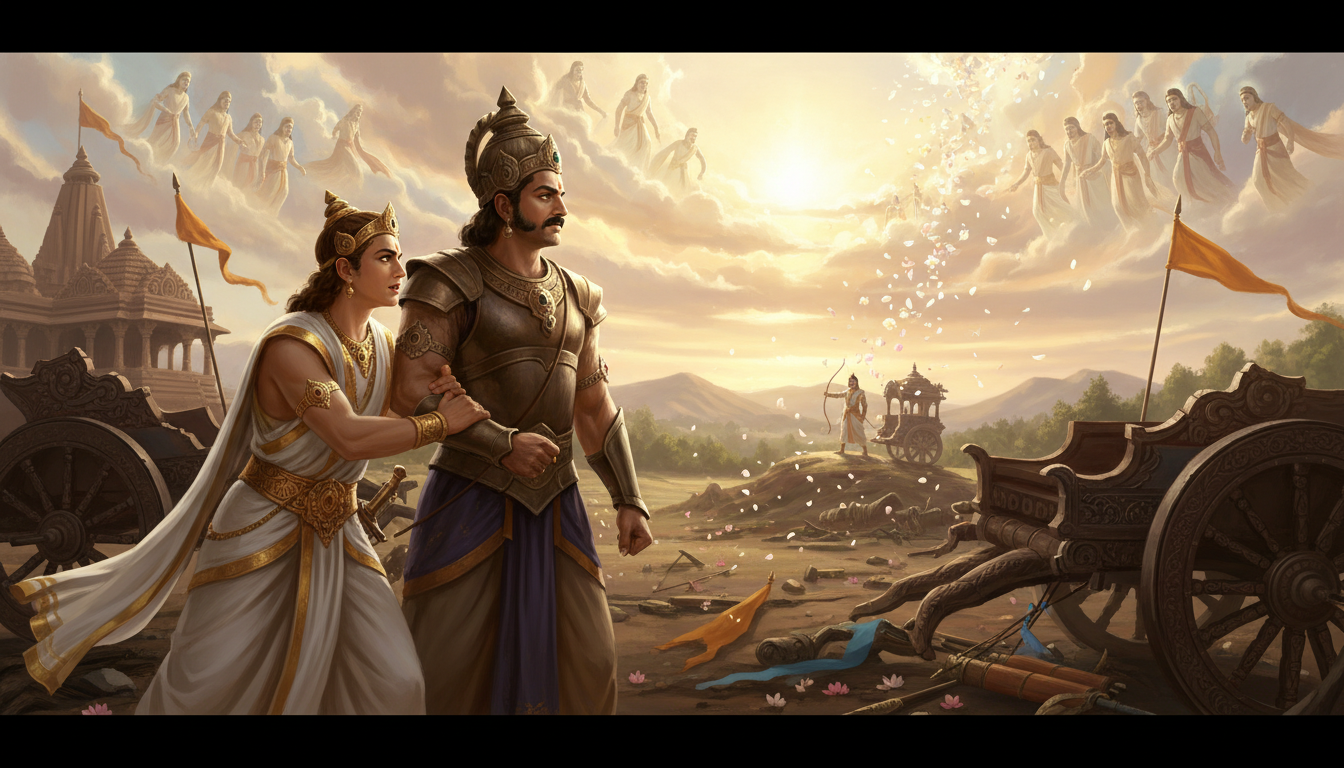
Ashvatthama Asks for Peace
A hand on Duryodhana's wrist while the gods watch
The Sky Comes Down to Watch
"The sky changed before either of them had shot," Sanjaya said. "That is the part I would have you understand first, king, because everything that followed happened underneath it."
Dhritarashtra sat with his hands on his knees and did not interrupt.
"It filled," Sanjaya said. "Gods and Nagas and Asuras. Siddhas and Yakshas. Great bands of Gandharvas, and Rakshasas beside them, and the twice-born sages, and the royal sages who left their thrones long ago, and birds of a plumage no one on the ground could name. They did not hide themselves. Every human being on that field, ours and theirs, looked up and saw them standing in the air. And the air itself was sounding - instruments, and singing, and hymns of praise, and laughter, and dancing, and a dozen other charming noises that have no business over a battlefield."
"They came to see it end," Dhritarashtra said.
"They came to see it," Sanjaya said. "What our men did was cheer. Both hosts, Kaurava and Pandava together, filled with joy at the sight, and they beat their drums and blew their conchs until the earth and all ten points of the compass rang with it, and the lion-roars went up, and then they went back to killing one another."
He let that stand a moment.
"The ground was already past describing. Men and horses and elephants and cars, packed so close that a combatant could not stand where the maces and swords and darts and rapiers were falling. Heroes everywhere, and everywhere bodies with nothing left in them. Crimsoned all over with gore, and I will say the word because it is the true one: it looked splendid. It looked like the old war between the gods and the Asuras that the singers describe. That is what the sky had come to watch."
Two Suns at the End of an Age
"Then the son of Adhiratha and the son of Pandu closed with each other," Sanjaya said, "and it became fierce and awful very quickly."
Both of them were in excellent mail. Both of them shrouded the ten points of the compass and the host in front of them with keen straight arrows, and the arrows made a darkness there, an actual darkness, so that neither your warriors nor the enemy could see anything at all. Men who had been fighting each other for seventeen days stopped and stood still because they had gone blind.
And out of that blindness, Sanjaya said, every man on the field went looking for one of two men. They ran to Karna or they ran to Arjuna the way scattered light in the sky runs back toward the sun or toward the moon. Fear put them there. There was nowhere else to stand.
The two of them baffled each other's weapons. Each shot, and the other's shot met it and undid it, like the east wind and the west wind striking against one another and neither one getting past. Then the arrow-dark broke for a moment and they were visible again, both of them, resplendent, like the sun and the moon coming up together after the clouds have been driven off.
"Do not fly away," the officers were shouting on both sides. "Do not fly away." And the men held, and stood their ground, and made a ring around those two great car-warriors the way the gods and the Asuras once stood around Vasava and Samvara to see which of them would fall.
The drums came in then, and the other instruments, and the lion-roars, and both armies were greeting both men at once, the way roaring clouds gather round and greet the sun and the moon.
"Each of them had a formidable bow drawn to a full circle," Sanjaya said, "like a ring of light around a lamp. Each of them was shooting thousands of arrows for rays. There were two suns over Kurukshetra that afternoon, king, and both of them were the kind that rise at the end of a yuga to burn up everything that moves and everything that does not."
Both invincible. Both capable of exterminating whatever stood in front of them. Each wanting the other dead and each showing the other his whole skill in the wanting, and they closed without any fear at all, like Indra and the Asura Jambha.
Then they began to invoke the mightiest of the weapons, and the ring that had formed to watch them broke. Their terrible shafts were killing men and horses and elephants who had only come near to see, by the hundred, in between the strokes they aimed at each other. Elephants, foot-soldiers, horsemen, car-warriors, ours and theirs without distinction, all of them fled away on every side, the way the animals of a forest go when a lion has come into it.
Five Great Car-Warriors
Neither of them could be got at from the front, so five men went at Arjuna from the side.
"Your son," Sanjaya said. "The chief of the Bhojas. The son of Subala. Kripa. And the son of Sharadvat's daughter. Five great car-warriors, king, and I am naming them because you will want to know afterward who was standing where. They struck at Dhananjaya and at Keshava together, with shafts made to produce the maximum of pain."
What happened next took less time than the naming of them.
Arjuna cut off, at one stroke and at the same moment, the bows of all five, and their quivers, and their horses, and their elephants, and their cars with the drivers still standing in them. He mangled every one of the five with good shafts and left them alive. Then, without pausing, he turned and put a dozen arrows into the Suta's son.
Duryodhana was carless in the churned ground. Kripa was carless. Shakuni was carless. Kritavarma was carless. Ashvatthama, son of Drona, who had been raised in the same courtyard as the man who had just done this, stood among the wreckage of his own equipage and looked at what one archer had done to five in the space of a breath.
"He did not kill them," Dhritarashtra said.
"He did not stop to," Sanjaya said. "He had someone else in front of him."
A Hundred Cars and the Foreign Horse
So they sent everything that was left of the wings against him.
A hundred cars. A hundred elephants. Horsemen of the Sakas and the Tukharas and the Yavanas, riding in the manner of their own countries, and with them some of the foremost fighting men among the Kambojas, who had come a very long way to be on that field. They came at Arjuna all together and all at speed, for one reason, which was to kill him.
"He cut their weapons out of their hands before they arrived," Sanjaya said. "Shafts and razor-headed arrows, and he was using them faster than I can say it. The weapons first, then the heads, then the horses, then the elephants, then the cars. He felled the whole of that contending mass on the field, king, and the ground under his wheels rose to meet them."
Dhritarashtra said nothing.
"Some of them got close enough for their captains to be recognised," Sanjaya said. "That is as close as any of them got. He shot standing, with Keshava holding the horses steady in the middle of it, and he did not change his footing once, and when it was finished there was a bank of dead cavalry lying across the front of one chariot in a curve, like a wave that had come in and not gone out again."
"The Kambojas were said to have the finest horse between the two rivers," Sanjaya said. "They are not said to have it now."
Flowers on One Man's Head
And then, said Sanjaya, the sky answered.
Celestial trumpets were blown in the air by the excellent gods themselves, and mixed in with the blasts of them, clear enough for men on the ground to make out, was praise. Praise of Arjuna, by name. Then the breezes came up gently, and out of that crowded sky fell flowers, fragrant and auspicious, an excellent shower of them, and they fell on Arjuna's head.
Both armies saw it. Gods saw it and men saw it, and every creature there was filled with wonder, because there is no mistaking a thing like that. It is not an omen that requires a reader. It is a verdict, delivered in the open, in front of the losing side.
"Both hosts stopped," Sanjaya said. "You could hear the flowers falling."
"And my son?" Dhritarashtra said.
"Your son and the Suta's son felt neither pain nor wonder," Sanjaya said. "They were of the same opinion about it, as they have been of the same opinion about everything for thirty years. Every other man on that field understood what had just been shown to him. Those two looked up at it and were not moved in either direction. I want you to hold that in your mind, king, because of what happens next. What happens next is that somebody who did understand it took your son by the hand."
The Hand on the Wrist
Drona's son came up out of the wreck of his own chariot and caught hold of Duryodhana's hand, and he did not let go of it while he spoke. He used the voice a man uses to a frightened horse.
"Be gratified, Duryodhana. Make peace with the Pandavas. There is no need for quarrel. Fie on war."
Duryodhana did not pull his hand back.
"The preceptor is slain," Ashvatthama said. "My father, who knew the mightiest of the weapons, who was like Brahma himself in this science. He is dead. And the other bulls among men are dead, headed by Bhishma. Count what is left standing and tell me it is worth what has been spent for it."
"You are still standing," Duryodhana said.
"I am unslayable," said Ashvatthama, "and so is my maternal uncle, and that is exactly why you should listen to me, because I am the one man here who is not asking you for his own life. Rule the kingdom forever. Share it with the sons of Pandu. If I dissuade him, Dhananjaya will abstain. Janardana does not desire hostilities and never did. Yudhishthira is engaged, always, in the good of all creatures, that is simply his nature, you know it as well as I do. Vrikodara is obedient to him. So are the twins. Make peace between yourself and the Parthas and every creature alive is benefited, and it will be said afterward that it was your doing, that you wanted it. Let the kings who are still alive go back to their own houses. Let the troops stand down."
He was still holding the wrist.
"If you do not listen to me, king, you will be struck by your enemies in battle and you will have to sit and burn with grief. I would rather not watch that."
The Four Kinds of Friend
Duryodhana still had not answered, so Ashvatthama kept going, and his argument turned, as arguments do when the man making them is desperate, from the future to the thing they had all just seen with their own eyes.
"You beheld it. The whole universe beheld it. What was achieved out there was achieved by Arjuna single-handed, with his diadem and his garlands on. The slayer of Vala could not have done its like. Nor the Destroyer. Nor Prachetas. Nor the illustrious king of the Yakshas. Measure it by merit and Dhananjaya stands higher than any of them, and I am telling you this as a man who has just been made carless by him along with four others in one stroke."
"You say he will listen to you," Duryodhana said.
"He will never transgress a word I say to him. He will always follow you afterward. Be gratified, king, for the benefit of the universe. You have always honoured me greatly and I bear a great friendship for you, and that is the only reason I am saying any of this. And I will dissuade Karna as well, provided you are inclined to peace."
Then he gave him the reasoning, in the form the teachers give it, because Duryodhana had been raised on that form and would hear it.
"Discerning men say there are four kinds of friend. Those who are so by nature. Those made so by conciliation. Those who become so through wealth. And those brought under subjection by the exercise of power. Now consider. Every one of those four elements you already own with regard to the sons of Pandu. All four. The Pandavas, hero, are your friends naturally, they were born that. Get them back as friends for certain by conciliation, which costs you nothing. And if, upon your being gratified, they agree to be friends, then act in that way, king of kings. Act in that way."
Those were beneficial words, and they were said to him by his friends, and Sanjaya, watching from where the drivers stood, thought for a moment that they had landed.
What Bhima Said Over Duhshasana
Duryodhana reflected for some time.
He drew deep breaths, several of them, and Sanjaya said that his heart was cheerless when at last he spoke, and that he spoke with humility, which was not a thing he did often.
"It is as you have said, friend. Now listen to what I will say to you."
He did not begin with strategy. He began with a voice.
"The wicked-hearted Vrikodara killed Duhshasana today like a tiger killing, and then he spoke words that still dwell in my heart. You heard them too. You were standing where I was standing. He put his foot on my brother's throat and he opened his breast and drank, and then he stood up with the blood on his face and said it was better than his mother's milk, better than honey, better than clarified butter or wine or water or curds or any sweet thing on earth. He said, 'What more can I do to you? Death has rescued you from my hands.' He said, 'Abuse us once more. Say beast, beast, as you did before.' He counted it all out for the whole field to hear. Pramanakoti. The poison in the food. The cobras in the bed. The house of lac. The kingdom taken at dice. The years in the woods. My brother's hand in Draupadi's hair. Virata. Every one of them, he said, came from Duhshasana as its cause, and from Dhritarashtra's wickedness and his son's. And then he said the other thing, and you heard that as well. He said he would set his foot on my head in the presence of the Kauravas, and that then, and only then, he would obtain peace."
He looked at the hand that was still holding his wrist.
"How then can there be peace? Tell me what shape it would take. He has already announced its price and the price is my skull under his heel."
Arjuna Is Tired Today
There was more, and the rest of it was not grief. The rest of it was arithmetic, and it was wrong, and Duryodhana delivered it with perfect calm.
"Arjuna will not be able to bear Karna in battle," he said. "He is a tempest, and a tempest that runs into the mountains of Meru has its force taken out of it. That is all that is happening out there."
"You have just watched him," Ashvatthama said.
"And the sons of Pritha will not have the least confidence in me," Duryodhana went on, "and you know why, and it is not a thing I can undo by being gratified this afternoon. Think of the acts of forceful hostility. Think of how many. Nor does it become you, son of the preceptor, whose glory does not fade, to go to Karna now and say to him, 'Abstain from battle.' Do not go to him with that. Do not put it in front of him."
And then the last of it, said with the same humility, repeated more than once, as a man repeats a thing he needs to be true.
"Phalguna is exceedingly tired today. Karna will slay him soon. Karna will slay him soon."
Ashvatthama let go of his wrist.
Duryodhana turned from him and commanded his own troops, and his voice was not humble any longer. "Armed with arrows, rush against these foes and slay them. Why do you stand inactive?"
"And they went," Sanjaya said to the blind king, in the quiet of the tent, a long while afterward. "That was the last time anyone offered him the whole kingdom back and half a peace. There was still a sun in the sky at the moment he refused it, and a man he trusted with a hand on his arm, and Karna still alive on the field with his bow whole. Every door out of a war stays open a little longer than the men inside it believe. Your son had his hand on the frame of that one. He closed it himself, and he did it politely, and then he told his men to go and die."
Dharma Lesson
Every door out of a war stays open a little longer than the men inside it believe, and it is usually shut by pride rather than by necessity. Duryodhana was offered the whole kingdom back by the one friend who wanted nothing from him, and he answered with grief he could not put down and arithmetic he could not check. A man who has decided how a thing must end will hear an argument out and still not listen to it.