The Field After the Sun Fell
Shalya counts the dead and the Kauravas walk away
The Crowd That Gathered Round the Body
"Beholding the troops crushed with arrows in that encounter between Karna and Arjuna," Sanjaya said, "the ruler of the Madras proceeded, filled with wrath, on that car divested of its equipment. And beholding his army deprived of the Suta's son, and its cars and steeds and elephants destroyed, thy son Duryodhana, with eyes bathed in tears, sighed repeatedly, the very picture of woe.
"Then they came to see him. Men of thy army and men of the enemy's, wanting to look with their own eyes at the heroic Karna pierced with arrows and bathed in blood and stretched upon the earth like the sun dropped from the skies at will, came and stood surrounding the fallen hero. And amongst those that stood there, some showed signs of joy, and some of fear, and some of sorrow, and some of wonder, and some gave themselves up to great grief, according to their respective natures.
"Others amongst the Kauravas, when they heard that Karna of mighty energy had been slain by Dhananjaya, and saw that his armour and his ornaments and his robes and his weapons had all been displaced, fled in fear like a herd of kine afflicted with exceeding fear at losing its bull.
"And Bhimasena began to roar. He caused the welkin to tremble with those awful and tremendous shouts of his, and he slapped his armpits, and jumped, and danced there where the body lay, frightening the Dhartarashtras by those movements. The Somakas and the Srinjayas blew their conchs. All the Kshatriyas embraced one another for joy upon beholding the Suta's son slain at that juncture. Having fought a dreadful battle, Karna was slain by Arjuna like an elephant by a lion, and that bull among men accomplished his vow, and even thus did Partha reach the end of his hostility."
Shalya Brings the Empty Chariot Back
"The ruler of the Madras, with stupefied heart, came quickly to the side of Duryodhana, on that car divested of its standard, and said in sorrow these words.
"'The elephants, the steeds, and the foremost of car-warriors of thy army have been slain. In consequence of those mighty warriors and steeds and elephants huge as hills having been slain after coming into contact with one another, thy host looks like the domains of Yama. Never before, O Bharata, has a battle been fought like that between Karna and Arjuna today. Karna had powerfully assailed the two Krishnas today, and all others who are thy foes. Destiny, however, has certainly flowed, controlled by Partha. It is for this that Destiny is protecting the Pandavas and weakening us. Many are the heroes who, resolved to accomplish thy objects, have been forcibly slain by the enemy. Brave kings, who in energy and courage and might were equal to Kuvera or Yama or Vasava or the Lord of the waters, who were possessed of every merit, who were almost unslayable, and who were desirous of achieving thy object, have in battle been slain by the Pandavas. Do not, O Bharata, grieve for this. This is Destiny. Comfort thyself. Success cannot be always attained.'
"Hearing these words of the ruler of the Madras, and reflecting on his own evil doings, thy son, with a cheerless heart, became almost deprived of his senses, and sighed repeatedly, the very picture of woe."
It Is Me That Vibhatsu Is Pursuing
"What was the aspect of the Kuru host on that awful day," the old king asked, "while it was crushed with arrows and scorched with weapons in that encounter, and while it was flying away from the field?"
"Hear, O king, with attention," Sanjaya said, "how that awful and great carnage of human beings and elephants and steeds occurred.
"When, after Karna's fall, Partha uttered his leonine shouts, a great fright entered the hearts of thy sons. Upon the fall of Karna no warrior of thy army set his heart on rallying the troops or putting forth his prowess. Their refuge having been destroyed by Arjuna, they were like raftless merchants whose vessels have wrecked on the fathomless ocean. Terrified and mangled with shafts, masterless and desirous of protection, they became like a herd of elephants afflicted by lions. Vanquished by Savyasaci on that afternoon, they fled away like bulls with broken horns, or snakes with broken fangs.
"Divested of weapons and armour, no longer able to ascertain which point of the compass was which, they crushed one another in the course of their flight and looked at one another, afflicted with fear. 'It is me that Vibhatsu is pursuing with speed.' 'It is me that Vrikodara is pursuing with speed.' That was what every one among them thought, and they became pale with fear and fell down as they fled. Some on horses, some on cars, some on elephants, and some on foot, mighty car-warriors, endued with great speed, fled away in fear. Cars were broken by elephants, horsemen were crushed by great car-warriors, and bands of foot-soldiers were trodden down by bodies of horsemen, as these fled.
"After the fall of the Suta's son thy warriors became like people without protectors in a forest teeming with beasts of prey and robbers. They were like elephants without riders and men without arms. Afflicted with fear, they looked upon the world as if it were full of Partha."
Urge My Steeds Slowly Behind All the Troops
"Beholding them fly away, and seeing his troops leave the field in thousands, thy son, uttering cries of 'Oh' and 'Alas,' addressed his driver, saying these words.
"'Partha will never be able to transgress me standing bow in hand. Urge my steeds slowly behind all the troops. Without doubt, if I fight standing in the rear of the army, the son of Kunti will never be able to transgress me, even as the vast deep is unable to transgress its continents. Slaying Arjuna and Govinda and the proud Vrikodara and the rest of my foes, I will free myself from the debt I owe to Karna.'
"Hearing these words of the Kuru king, that were so worthy of a hero and an honourable man, the charioteer slowly urged his steeds adorned with trappings of gold, and took him back down the length of that broken host, against the current of it, to stand where the last of his own men were running.
"Then twenty-five thousand warriors on foot, belonging to thy army, without cars and cavalry and elephants among them, prepared for battle. They had nothing left but their feet and what was in their hands. Bhimasena, filled with wrath, and Dhrishtadyumna the son of Prishata, encompassed them with the four kinds of forces and began to strike them with their shafts. In return, those warriors fought with Bhima and Prishata's son, and some amongst them challenged the two heroes by name."
Bhima Gets Down From the Car
"Then Bhimasena became filled with rage. Alighting from his car, mace in hand, he fought with those warriors arrived for battle. Observant of the rules of fair fight, Vrikodara the son of Kunti came down from his car, and relying upon the might of his arms, began to fight on foot with those foes of his that were on foot.
"Taking up his massive mace adorned with gold, he began to slaughter them all, like the Destroyer armed with his bludgeon. The Kaurava warriors on foot, filled with rage and becoming reckless of their lives, rushed against Bhima in that battle like insects upon a blazing fire. Those infuriated combatants, difficult of being defeated in battle, approaching Bhimasena, perished in a trice like living creatures upon seeing the Destroyer. The mighty Bhima, armed with a mace, careered like a hawk, and destroyed all those twenty-five thousand combatants.
"Having slain that division of heroic warriors, Bhima, of prowess incapable of being baffled, once more stood, with Dhrishtadyumna before him. That slayer of foes and mighty bowman, whose car had steeds white as pigeons yoked unto it and whose lofty standard was made of the trunk of a Kovidara tree, appeared exceedingly handsome, and beholding that standard the Kauravas fled away in great fear."
The Rest of the Field
"Meanwhile Dhananjaya, proceeding against thy car-force, twanged his bow Gandiva celebrated over the three worlds. Beholding that car having white steeds yoked unto it and owning Krishna for its driver, and seeing that Arjuna was the warrior standing upon it, thy troops fled away in fear.
"The two sons of Madri, and Satyaki, filled with joy, rushed with speed against Shakuni and slaughtered the troops of Subala's son. Having slain with keen shafts his cavalry and his elephants in that encounter, they rushed impetuously against Shakuni himself, upon which a great battle took place, and having pursued that king of the Gandharas, who was possessed of lightness of hands in the use of weapons, the twins and Satyaki reappeared amid the Pandava ranks.
"Chekitana and Shikhandi and the five sons of Draupadi, having slaughtered thy vast army, blew their conchs. All those heroes, although they saw thy troops flying away with faces turned from the field, still pursued them, like bulls pursuing angry bulls after vanquishing them.
"Then Savyasaci, beholding a remnant of thy army still standing for battle, became filled with wrath, and rushed against that car-force, and suddenly shrouded them with showers of arrows. The dust that was raised darkened the scene, and nothing could any longer be distinguished. When the earth was thus shrouded with dust and when darkness covered everything, thy troops, O king, fled on all sides from fear."
The Speech to Men Who Had Stopped Listening
"When the Kuru army was thus broken, thy son rushed against all his foes advancing against him, and challenged all the Pandavas to battle, like the Asura Vali in days of yore challenging the gods. At this, all the Pandava heroes, uniting together, rushed against the advancing Duryodhana, shooting and hurling at him diverse weapons and upbraiding him repeatedly. Duryodhana, however, filled with rage, fearlessly slaughtered those enemies of his in hundreds and thousands with keen shafts. The prowess that we then beheld of thy son was exceedingly wonderful, for alone and unsupported he fought with all the Pandavas united together.
"Then he beheld his own troops, mangled with arrows and with their hearts set on flight, gone not far from the field. Rallying them, and resolved to maintain his honour, and gladdening those warriors of his, he said these words unto them.
"'I do not see that spot in the earth or on the mountains, whither if ye fly, the Pandavas will not slay you. What use, then, in flying away? Small is the force that the Pandavas now have. The two Krishnas also are exceedingly mangled. If all of us stay for battle, victory will certainly be ours. If we fly in disunion, the sinful Pandavas, pursuing us, will certainly slay all of us. For this, it is better that we should die in battle. Death in battle is fraught with happiness. Fight, observant of the Kshatriya's duty. He that is dead knows no misery. On the other hand, such a one enjoys eternal bliss hereafter. Listen, ye Kshatriyas, all of you that are assembled here. When the destroyer Yama spareth neither the hero nor the coward, who is there so foolish of understanding that would not fight? Would ye place yourselves under the power of the angry foe Bhimasena? It behoveth you not to abandon the duty observed by your sires and grandsires. There is no greater sin for a Kshatriya than flight from battle. There is no more blessed path for heaven, ye Kauravas, than the duty of battle. Slain in battle, ye warriors, enjoy heaven without delay.'
"While even these words were being uttered by thy son, the warriors, exceedingly mangled, fled away on all sides, regardless of that speech."
Behold This Awful Field
"The ruler of the Madras then, beholding thy son employed in rallying the troops, with fear depicted on his countenance and with heart stupefied with grief, said these words unto Duryodhana.
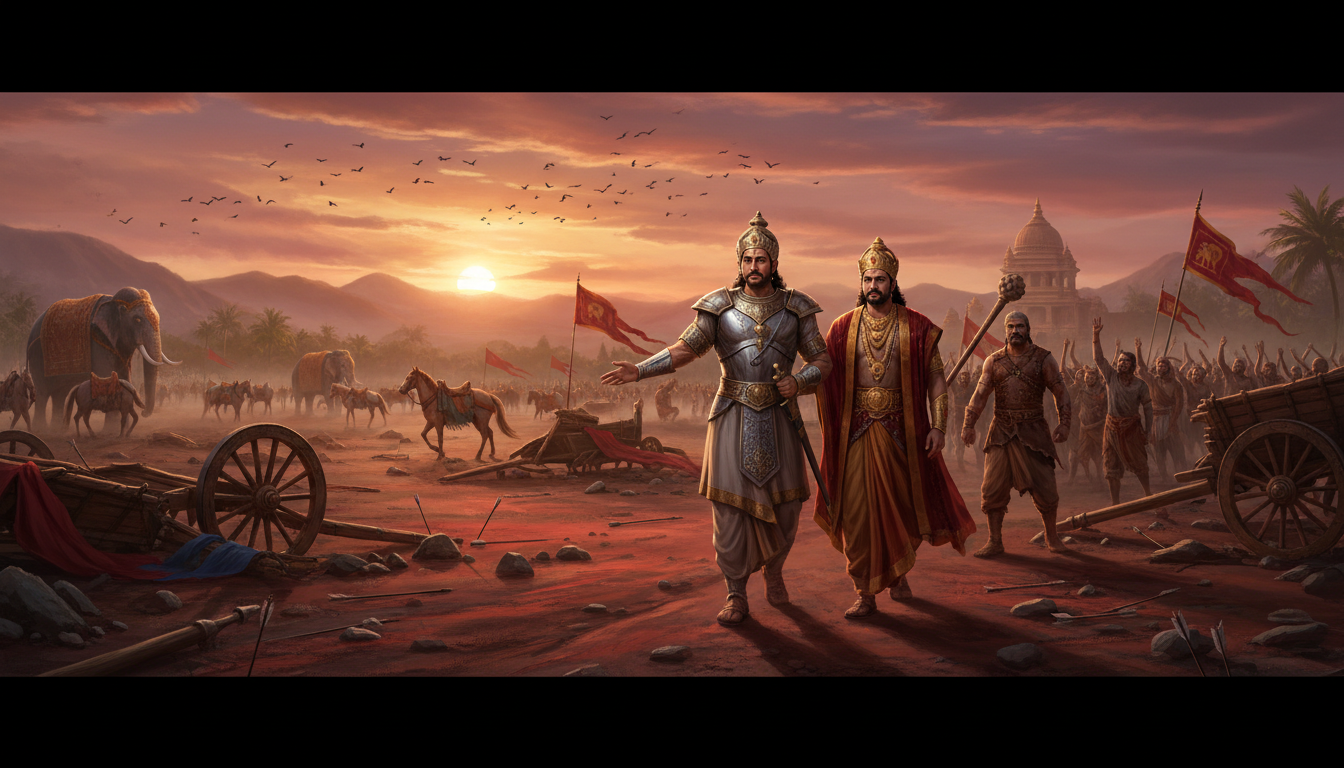
"'Behold this awful field of battle, O hero, covered with heaps of slain men and steeds and elephants. Some tracts are covered with fallen elephants huge as mountains, their vital limbs pierced with shafts, lying helplessly, deprived of life, their armour displaced and the weapons and the shields and the swords with which they were equipped lying scattered about. The bells and iron hooks and lances and standards with which those huge creatures had been equipped are lying on the ground. Adorned with housings of gold, their bodies are now bathed in blood. Some tracts are covered with fallen steeds, mangled with shafts, breathing hard in pain and vomiting blood. Some of them send forth soft wails, some bite the earth with rolling eyes, and some utter piteous neighs. Covered with the corpses of men and steeds and elephants, and with crushed cars, the earth has become awful to look at, like the great Vaitarani.
"'The shafts sped from the arms of Karna and Arjuna, piercing through the bodies of elephants and steeds and men and quickly stilling their lives, have entered the earth like mighty snakes entering their holes with heads bent downwards. The earth has become impassable with the heaps and with the numberless shafts themselves. Cars lie strewn with their traces broken, their joints separated, their axles and yokes and Trivenus reduced to fragments, their wheels loosened, their Anukarsanas cut in pieces, the fastenings of their quivers cut off, and the niches for their drivers broken. Strewn with those vehicles adorned with gems and gold, the earth looks like the firmament overspread with autumnal clouds. Spiked maces with golden bells, battle-axes, sharp lances, heavy clubs, mallets, bright unsheathed swords, and maces covered with cloth of gold, have fallen on the field. Bows decked with ornaments of gold, and shafts equipped with beautiful wings of pure gold, and umbrellas and fans and conchs, and caparisons of elephants, and standards and car fences and diadems, and necklaces and brilliant crowns, and yak-tails lying about, and garlands luminous with corals and pearls, and chaplets for the head, and bracelets for both the wrist and the upper arms, and collars for the neck with strings of gold, and diverse kinds of costly diamonds and gems and pearls, and bodies brought up in great luxury, and heads beautiful as the moon, are lying scattered about.
"'Turn back, O Duryodhana. Let the troops retire. O king, O giver of honours, proceed towards thy camp. There, the Sun is hanging low in the welkin, O lord. Remember, O ruler of men, that thou art the cause of all this.'
"Having said these words, Shalya, with his heart filled with grief, stopped."
Karna, Oh Karna
"Duryodhana, at that time, deeply afflicted and deprived of his senses and with eyes bathed in tears, wept for the Suta's son, saying, 'Karna. Oh Karna.' Then all the kings headed by Drona's son, repeatedly comforting Duryodhana, proceeded towards the camp, frequently looking back at the lofty standard of Arjuna that seemed to be ablaze with his fame.
"At that terrible hour when everything around looked so resplendent, the Kauravas, their features incapable of recognition owing to the blood that covered them, beholding the earth drenched with the blood flowing from the bodies of men and steeds and elephants, looking like a courtesan attired in crimson robes and floral garlands and ornaments of gold, were unable to stand there. Filled with grief at the slaughter of Karna, they indulged in loud lamentations, saying, 'Alas, Karna. Alas, Karna.' Beholding the Sun assume a crimson hue, all of them speedily proceeded towards their camp.
"As regards Karna, though slain and pierced with gold-winged shafts whetted on stone and dyed in blood and sped from gandiva, yet that hero, lying on the ground, looked resplendent like the Sun himself of bright rays. It seemed that the illustrious Surya, ever kind to his worshippers, having touched with his rays the gore-drenched body of Karna, proceeded, with aspect crimson in grief, to the other ocean from desire of a bath. Thinking so, the throngs of celestials and rishis that had come there for witnessing the battle left the scene for their respective abodes.
"Though his armour had been cut off with arrows, and though he had been slain in the course of that dreadful fight, still that beauty of features which the son of Radha possessed did not abandon him when dead. Everyone beheld the body of the hero to resemble heated gold. It seemed to be endued with life and possessed of the effulgence of fire or the sun. All the warriors were inspired with fright at sight of the Suta's son lying dead on the field, like other animals at sight of the lion. Indeed, though dead, that tiger among men seemed ready to utter his commands. Nothing, in that illustrious dead, seemed changed. He lay stretched like a gigantic tree adorned with branches and twigs, like a heap of pure gold, or like a blazing fire extinguished with the water of Partha's shafts. Solicited by suitors he always said, 'I give,' but never the words 'I have not.'
"When Karna fell, the rivers stood still. The Sun set with a pale hue. The planet Mercury, the son of Soma, assuming the hue of fire, appeared to course through the firmament in a slanting direction. The firmament seemed to be rent in twain. The earth uttered loud roars. Violent and awful winds began to blow. The great oceans were agitated. The mountains with their forests began to tremble, and all creatures felt pain. The sky became enveloped in darkness. Meteors of blazing splendour fell."
The Walk Back to Camp
"Then those two foremost of men, filled with joy, took up with their hands their loud-sounding conchs adorned with gold and white as snow, and placing them against their lips, blew simultaneously. The blare of pancajanya and that of devadatta filled the earth, the sky, and heaven. As soon as the Kauravas heard the blare of those conchs, all of them left the field with great speed, deserting the ruler of the Madras and the chief of the Bharatas, thy son Duryodhana.
"Then the leaders, filled with anxiety, desired to withdraw their troops, and thy son, acting according to the advice of Shalya, withdrew the army. Kritavarma, surrounded by the unslaughtered remnant of the Narayana troops, quickly proceeded towards the encampment. Shakuni, surrounded by a thousand gandharvas, beholding the son of Adhiratha slain, proceeded quickly towards the encampment. Sharadvata's son Kripa, surrounded by the large elephant force that resembled a mass of clouds, proceeded quickly towards the encampment. The heroic Ashvatthama, repeatedly drawing deep breaths at the sight of the victory of the Pandavas, proceeded quickly towards the encampment. Susharma also proceeded, surrounded by the unslaughtered remnant of the samsaptakas, casting his eyes on those terrified soldiers. King Duryodhana, deeply afflicted and deprived of everything, proceeded, his heart filled with grief and a prey to many cheerless thoughts. And Shalya, that foremost of car-warriors, proceeded towards the camp on that car deprived of its standard, casting his eyes on all sides.
"The other mighty car-warriors of the Bharata army, still numerous, fled quickly, afflicted with fear, filled with shame, and almost deprived of their senses. Seeing Karna overthrown, they went with voices choked with tears, some of them applauding Arjuna and some of them applauding Karna. Amongst those thousands of warriors of thy army in that great battle, there was not a single person who had still any wish for fight. Upon the fall of Karna, O monarch, the Kauravas became hopeless of life, of kingdom, of wives, and of wealth.
"Guiding them with care, thy son, filled with grief and sorrow, set his heart upon resting them for the night. And those great car-warriors, accepting his orders with bent heads, retired from the field with cheerless hearts and pale faces."
Dharma Lesson
A man who will not hear a warning while it can still be acted on will hear it at last as a description of what he has already done. Duryodhana's speech about the duty of battle is faultless and nobody stays to hear the end of it, because words only hold men who still believe the speaker can win. Authority spent on the wrong cause does not carry over to the hour when it is needed.