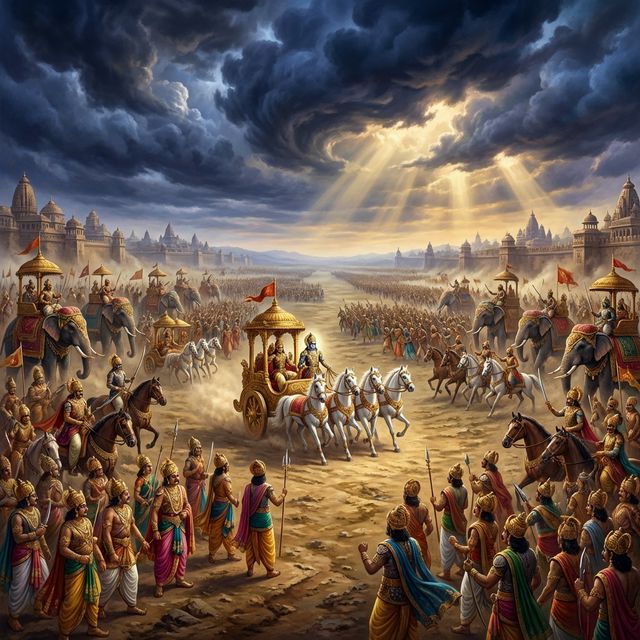
Sahadeva Against Dushasana
The quiet twin puts one arrow through the man Bhima had sworn to kill
The Brother Against the Brother
Sanjaya had been describing the elephants. Whole divisions of them, driven by mleccha riders out of the east and the south, had gone in against the Pancalas that morning, and the sons of Pandu had broken them, and the beasts had gone down like hills in a thunderstorm. Sahadeva had killed eight of them with sixty-four arrows in one stretch of it. Then the Kaurava host had run like a river whose banks have been washed away.
"While Sahadeva, filled with rage, was thus blasting thy host," Sanjaya said to the blind king, "Dushasana, O great king, proceeded against him, the brother against the brother."
That was the sixteenth day. Karna had the command of the Kaurava army by then, and was somewhere else on the field with the sun over him, and the war had reached the stage where the men who met each other were nearly all cousins.
Sahadeva was the youngest of the five, the second of Madri's twins, the one who was said to know what was coming and to be forbidden to say it. He fought at the left of his brothers and was not often written about alone.
Dushasana was Dhritarashtra's second son, the one who had walked into the assembly hall years before with a fistful of Draupadi's hair in his hand. Bhima had a vow out against him that everybody on that field could have recited from memory. But Bhima was not there. It was Sahadeva who was in front of him.
Sanjaya is careful about the phrase. Not the Pandava against the Kaurava. Not the son of Madri against the son of Gandhari. The brother against the brother.
The great car-warriors on both sides saw what was about to happen and stopped what they were doing. They uttered leonine shouts. They took hold of their upper garments and waved them over their heads, the way men do at a contest they have paid to see, and the two chariots came together inside that noise.
Seventy Three Each
Dushasana shot first, and he shot at the chest.
Three arrows, from an angry man with a bow, into the middle of the body of the mighty son of Pandu. It is the opening of somebody who has decided at once that this will not be a long fight.
Sahadeva answered with one arrow. Then, having found his range with it, he put seventy into his cousin, and three more into the man holding the reins beside him.
That is the arithmetic of the whole duel in its first exchange, and it is worth noticing which way it runs. Sahadeva is the quieter brother, the one nobody writes stories about, and against the second son of the blind king he shot seventy-three arrows in the time it takes to say so.
Dushasana did not break. He cut Sahadeva's bow in two in that great battle, and while the son of Madri had nothing in his hands he sent three and seventy arrows into him, into the arms and into the chest.
Seventy-three each. The count is exact and it is the same on both sides, and Sanjaya, who was reporting to a father about his son, did not have to make it come out even.
So they stood level, both of them bleeding, and one of them without a bow.
Then Sahadeva, filled with rage, did a thing that does not belong in a chariot duel at all. He reached down and took up a sword.
A sword is what a man on foot carries. On a car it is the last resort, the weapon you fall back on when the bow is gone and the enemy is close enough to touch. Sahadeva did not wait to be closed with. He whirled the blade around his head in that dreadful conflict, and hurled it, and let it go across the open ground between the two chariots at the car of Dhritarashtra's son.
Two Swords in the Dust
The sword found the bow.
It went through the stave with the string still on it and the arrow still fixed on the string, and cut the whole apparatus out of Dushasana's hands, and then the blade came down and fell on the earth like a snake dropping out of the sky.
That is Sanjaya's image and it is worth holding still for a moment. A thrown sword is not an aimed weapon. It turns over in the air and it goes where it goes. This one crossed the gap between two chariots in the middle of a battle, took a bow at the grip with a shaft already drawn on it, and landed spent in the dust, and the man watching it from the Kaurava car had nothing left in his hands either.
Now they were level again, and both disarmed, and each of them reached for what was nearest.
Sahadeva, valiant, took up another bow and shot a deadly shaft at Dushasana, one arrow, bright as the rod of Death, aimed at a man who had no weapon in his hands to stop it with.
Dushasana stopped it with a sword.
He had drawn his own keen-edged blade, and as that shaft came at him he cut it into two fragments in the air. Then, since the sword was already up and moving and there was nothing else to do with it, he whirled it as his cousin had whirled his, and hurled it back across the same stretch of ground.
Sahadeva had picked up another bow with a shaft on it by then, and he did not have to think about what to do. He cut the flying sword out of the air with his keen arrows, with the greatest ease, Sanjaya says, and dropped it on the field.
Two swords lay in the dust between them, and neither man had been touched by either, and both of them still had bows.
The Shout That Made the Earth Resound
Dushasana went back to what he knew. He sped four and sixty shafts at Sahadeva's car, all of them together, a whole quiver poured out at once at the platform, the horses, the standard, the man.
Sahadeva cut every one of them down with five arrows of his own.
There is no explanation offered for how five shafts intercept sixty-four. It is simply stated, in the flat voice Sanjaya uses when he is reporting something he watched from a hillside, and then the account moves on.
Having checked those mighty shafts sped by thy son, Sanjaya said, Sahadeva in that battle sped a large number of arrows at his foe.
And Dushasana, who had been overmatched twice and disarmed once and was still there, cut off each one of them with three shafts of his.
Then he shouted.
It is the only sound either of them makes in the whole of this encounter, and Sanjaya records it as loudly as he records anything on that day. Thy son uttered a loud shout, making the whole Earth resound with it. He had matched the son of Madri arrow for arrow in front of every car-warrior in both armies, in a duel that the whole field had stopped to watch, and he let them all hear that he knew it.
Nobody had won anything. The shout was for a draw. But Dushasana had spent his life being the second son and the man sent to do the ugly errands, and this was the first hour in eighteen days that anybody had waved a garment for him, and he was not going to let it pass in silence.
Then he went back to work while the noise was still rolling. He pierced Sahadeva again, and he struck the man driving Sahadeva's horses with nine arrows.
That was the mistake. It was the second time he had gone for the driver.
The Shaft Like the Destroyer
The valiant Sahadeva then, filled with rage, fixed one shaft on the bowstring.
Sanjaya describes it before it is loosed, which he does not do for any of the other hundreds of arrows in this fight. A terrible shaft resembling the Destroyer himself. Not like a snake, not like the rod of Yama, not like a fire. Like the thing that comes at the end and takes everybody.
He drew the bow forcibly. There is no speech. Sahadeva does not tell his cousin what the arrow is for, does not name Draupadi, does not name the assembly hall, does not say anything at all in the whole of the section. He is the brother who knows things and does not say them, and what he did instead of speaking was to bend the bow as far as it would go and let one arrow off it.
It went through the strong armour. It went through the body. It came out the other side and kept going and entered the earth behind the chariot, and Sanjaya, who had watched this happen to men all week, reached for the oldest image he had for it: like a snake penetrating into an ant-hill.
Then thy son, that great car-warrior, swooned away.
He did not fall out of the car. He did not cry out. He simply stopped, standing or slumped against the pole with the reins-man beside him and an army watching, and the senses went out of him.
His driver saw it. And that man, whose name is not given anywhere in the account and who had nine arrows in him already, did the one thing that could be done. He took the reins and turned the car and carried Dushasana off the field, out of the range of the bow, while Sahadeva went on striking him all the way with keen arrows, forcibly, the whole length of the withdrawal.
The garments stopped waving. The shouting stopped. The duel had lasted a few minutes and the second son of Dhritarashtra was carried out of it unconscious by a servant.
A Man Crushing Ants
Sahadeva did not follow.
He had beaten the Kuru warrior and that was the end of what he wanted from him, and Bhima's vow was still standing and still unpaid, and there is nothing in Sanjaya's account to say whether the youngest son of Madri thought about that as the car went away from him. He turned his head instead and looked for the next thing.
What he saw was Duryodhana's own division, the eldest brother's household troops, drawn up on that part of the field within reach of him.
Having vanquished the Kuru warrior thus, the son of Pandu, beholding Duryodhana's division, began to crush it on all sides.
Sanjaya gave the blind king one comparison for what followed, and it is not a heroic one. He did not say that Sahadeva went through them like a lion, or like a fire in dry grass, or like Indra among the Danavas, all of which he had used earlier in the same week for other men.
Indeed, O king, as a man excited with wrath crushes a swarm of ants, even so did that son of Pandu begin to crush the Kaurava host.
Ants. A man walking along in a temper, treading on a line of them without breaking stride, not because they are his enemies but because they are underfoot and he is angry about something else.
That is the last picture in the section, and it is the measure of the whole encounter. The duel that both armies stopped to watch, the sword-throws, the sixty-four shafts cut down with five, the shout that made the earth resound, the son of a king carried away senseless by his driver: and the man who had just done all of it walked on into the Kaurava lines in the same mood, and the section ends without giving him a single word to say.
Somewhere ahead of him, out of sight in the same afternoon, Karna was turning to meet his twin.
Dharma Lesson
Bhima's vow made Dushasana his property, and the epic remembers Dushasana as the man Bhima killed. But it was the youngest and quietest brother who beat him, in front of both armies, and then declined to finish him. Sahadeva takes nothing from the victory, says nothing over it, and walks on into the next fight in the same temper. There is a kind of strength that does not need the field to know it was there, and this is the one hour in the war where the epic lets us see it plainly.