The Old Preceptor and the Slayer of Drona
Kripa freezes Dhrishtadyumna until his own driver turns the car and runs
The Sarabha and the Lion
Sanjaya was telling the seventeenth day to a blind man in a hall, and he had come to the part of the field where the Pancalas were pushing forward and one old brahmana stopped them.
"Kripa, O king," he said, "resisted Dhrishtadyumna in battle, like a sarabha in the forest resisting a proud lion."
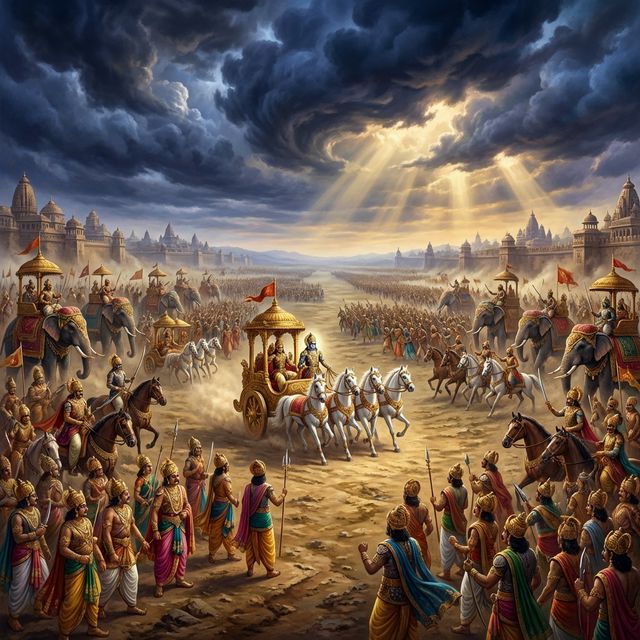
The lion in that image was the son of Prishata. Dhrishtadyumna had been born out of a fire that Drupada lit for one purpose, and he had done the thing he was born for four days earlier, when Drona sat down on the terrace of his car and gave up his weapons and his soul, and Dhrishtadyumna took him by the hair and cut off his head in front of two armies. Nobody on that field had a greater name than his that week. He was the commander of the Pandava host. Men got out of his way.
The sarabha was Kripa, the son of Sharadvata, of the line of Gautama. He was a brahmana who had taught both sets of princes their weapons when they were boys, and he was also Drona's brother-in-law, which is a fact that had not mattered very much for sixteen days and mattered now.
Checked by the mighty son of Gautama, Prishata's son could not advance even one step.
That was the whole of it at first. No wound, no boast. The car of the old preceptor came across the front of the car of the man who had killed his sister's husband, and stayed there, and the Pandava advance in that quarter simply stopped, the way water stops at a stone.
Then the men on both sides looked at what was standing in front of Dhrishtadyumna, and all creatures were inspired with fright, and regarded his destruction to be at hand.
What Both Armies Were Saying
The talking began among the car-warriors and the horsemen, and Sanjaya reported it to Dhritarashtra as he had heard it, because in the middle of a battle men say aloud what they think is about to happen.
They were very cheerless when they said it.
"Without doubt, this foremost of men, Sharadvata's son of mighty energy and great intelligence and versed in celestial weapons, is filled with rage at the death of Drona."
That was the first thing they were sure of, and they were sure of it because they knew what he had been carrying since the day Drona fell. The old man had watched his kinsman die by a stratagem, and had said nothing, and had gone on fighting, and here at last was the man who did it, held in front of him at the length of a bowshot.
"Will Dhrishtadyumna today escape from the hands of Gautama? Will this vast army escape today this great danger? Will not this brahmana slay all of us together?"
That last question is the one that gives the mood of it. They were not asking whether one commander would fall. They were asking whether the whole host was about to be burnt, because a brahmana who has decided to fight is a different creature from a kshatriya who fights for a living, and they had all watched what one such man had done to them from a car for five days running.
"The form that he has assumed today, even like that of the Destroyer himself, shows that he will today act after the manner of Drona himself. The preceptor Gautama, endued with great lightness of hands, is ever victorious in battle. Possessing a knowledge of weapons, he is endued with great energy and filled with rage."
Diverse speeches like these, uttered by the warriors of both the armies, were heard there as those two heroes encountered each other. Both armies. The Kauravas were saying it in hope and the Pandavas were saying it in dread, and the words were the same words.
The Man Who Killed Drona Stood Still
Kripa drew a deep breath in rage, and began.
He afflicted the son of Prishata in all his vital limbs, and Sanjaya adds the clause that makes the passage terrible: while the latter stood inactive.
There is no exchange to describe. This is not a duel where two men cut each other's bows and take up others and the field applauds. The old brahmana shot, with the lightness of hand that men had just been praising, at the throat and the chest and the armpits and every other place where a life can be reached, and the commander of the Pandava army stood up in his car in front of him and did nothing at all.
Struck in that battle by the illustrious Gautama, Dhrishtadyumna, greatly stupefied, knew not what to do.
It is worth stopping on which man this was. A few days before, he had walked up to the greatest living master of weapons while that master sat in meditation, and had ignored the shouting of Arjuna and the protest of the whole army, and had used his sword. He had never been described as afraid of anything. Shikhandi had killed Bhishma and he had killed Drona, and between the two of them the Pandavas had cleared away both of the old men who stood between them and the throne.
Now the brother-in-law of the man he had beheaded was in front of him, and the arrows were coming, and Dhrishtadyumna could not lift his hands.
His driver, who could see the whole of it from a yard away, was the one who spoke.
"It is not all right with thee, O son of Prishata. Never before have I seen such a calamity overtake thee in battle. It is a lucky chance, it seems, that these shafts, capable of penetrating the very vitals, sped by that foremost of brahmanas aiming at thy vital limbs, are not striking thee."
A lucky chance. That was the driver's word for it, and it was the kindest reading available, and both men in that car knew it was not luck that had kept them alive for the last few moments. It was that Kripa had not yet finished.
Proceed Slowly, Charioteer
The charioteer said the rest of it plainly, since there was no time to be delicate about a commander's honour.
"I will presently cause the car to turn back, like the current of a river dashed back by the sea. I think that brahmana, by whom thy prowess hath been annihilated, is incapable of being slain by thee."
Then Dhrishtadyumna answered, and Sanjaya says he answered slowly, and what he said is the most honest speech any Pandava made that afternoon.
"My mind becometh stupefied, O sire, and perspiration covereth my limbs. My body trembles and my hair stands on end."
He did not dress it up. He gave the symptoms one after another the way a man describes a fever, and then he gave the order.
"Avoiding that brahmana in battle, proceed slowly to where Arjuna is, O charioteer. Arrived at the presence of either Arjuna or Bhimasena, prosperity may be mine. Even this is my certain conviction."
Proceed slowly. Even in that state he was trying to keep the retreat from looking like a rout, and it did not help him at all.
The charioteer urged the steeds and drove to the spot where the mighty bowman Bhimasena was battling with the Kaurava troops, and the commander of the Pandava army went across his own front looking for a brother of the king to stand behind.
Kripa saw the car of Dhrishtadyumna speedily moving away from that spot, and followed it.
He shot hundreds of shafts into it as it ran. And that chastiser of foes also repeatedly blew his conch, so that the sound went out over the whole quarter of the field, and every man in both armies who had been asking a moment ago whether Dhrishtadyumna would escape from the hands of Gautama got his answer without having to turn his head.
Indeed, said Sanjaya, he routed the son of Prishata like Indra routing the Danava Namuci.
That is the sentence the old teacher had waited days to have said about him, and it was said of him at the expense of the slayer of Drona, and it cost Kripa nothing but breath.
The Bhoja King Who Kept Smiling
Elsewhere on the same field the other slayer was having the same kind of afternoon.
The invincible Shikhandi, the cause of Bhishma's death, was resisted in that battle by Hridika's son, Kritavarma of the Bhojas, one of the great car-warriors on Duryodhana's side who had come out of Dwaraka and had ridden with Krishna's own people before the war divided them. He fought Shikhandi smiling, and Sanjaya says he smiled repeatedly, all through it.
Shikhandi did not smile. He struck the Bhoja with five keen and broad-headed shafts at the shoulder-joint, and Kritavarma, filled with rage now, pierced him with sixty winged arrows and then cut off his bow with a single arrow, laughing while he did it.
The mighty son of Drupada took up another bow and said the two words that men on that field said when they meant to finish something.
"Wait. Wait."
Then he sped at his foe ninety shafts of great impetuosity, all equipped with golden wings, and every one of them came back off Kritavarma's armour and fell on the ground.
Ninety. Shikhandi looked at his own arrows lying scattered on the surface of the earth around the other man's car, and changed his method. He cut off Kritavarma's bow with a keen razor-headed arrow, and then, while the Bhoja stood there bowless, resembling a hornless bull, he put eighty arrows into his arms and his chest.
Filled with rage but torn and mangled with shafts, Kritavarma vomited blood through his limbs, like a jar disgorging the water with which it is filled.
And Sanjaya, who never let a thing be merely horrible if it could also be beautiful, said this of the man in that condition. Bathed in blood, the Bhoja king looked beautiful like a mountain streaked with streams of liquefied red chalk after a shower.
He was still standing. He reached down and took up another bow, with a string on it and an arrow already fixed, and shot.
A Thousand Circles
That arrow took Shikhandi in the shoulder-joint, where he had put his own first five.
With those shafts sticking to his shoulder-joint, Shikhandi looked resplendent like a lordly tree with its spreading branches and twigs. Having pierced each other, the two combatants were bathed in blood, and resembled a couple of bulls that have gored each other with their horns.
Then they went round. Carefully exerting themselves to slay each other, those two mighty car-warriors moved in a thousand circles with their respective cars on that arena, and there is nothing else to say about that part of it, because that is what it was: two wounded men driving in rings in the dust, each looking for the angle that would end the other, for as long as it took.
Kritavarma found it first.
He pierced Shikhandi with seventy shafts, all of them equipped with wings of gold and whetted on stone. Then the ruler of the Bhojas, that foremost of smiters, sped with great activity a terrible and fatal shaft at his foe.
Struck therewith, Shikhandi quickly swooned away. Overcome with stupefaction, he supported himself by seizing his flag-staff.
He did not fall out of the car. He got hold of the pole that carried his own standard and hung on to it while his senses went, and his driver saw it and did not wait to be told, as Dhrishtadyumna's driver had waited. The driver of that foremost of car-warriors speedily bore him away from the fight, and Shikhandi, scorched with the shaft of Hridika's son, drew breath upon breath repeatedly all the way out.
So both of them went off the field within the same hour. The man who had killed Bhishma, carried away senseless behind his own flag. The man who had killed Drona, running toward Bhima with an old brahmana blowing a conch behind him.
After the defeat of the heroic son of Drupada, said Sanjaya, the Pandava army, slaughtered on all sides, fled away from the field.
Dharma Lesson
Dhrishtadyumna was born to kill Drona and he killed him, and days later he could not lift his hands against Drona's brother-in-law. The epic does not call this cowardice. It lets him list his own symptoms aloud, the sweat and the trembling and the hair standing on end, and lets his driver name the thing plainly. A deed done does not stay done inside the man who did it. What Kripa fired at him that afternoon was grief with a bow behind it, and there is no counter to that in any manual of weapons.