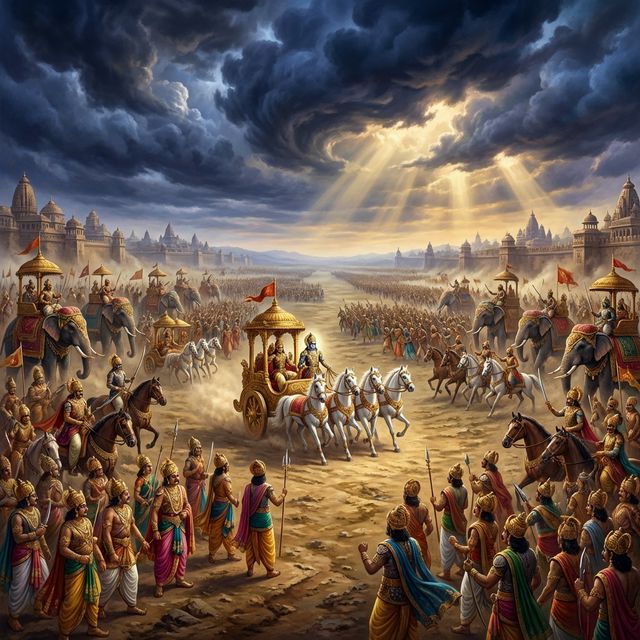
The King Names the Pairs
Yudhishthira assigns each Pandava his enemy as Karna's array comes on
The Question in the Dark Hall
Sanjaya sat in the hall at Hastinapura and went on telling a blind king what his sons were doing on a plain he would never see. The morning he had reached was the seventeenth day of the war and the second day of Karna's command.
On the field, Dhrishtadyumna the son of Drupada, who had led the Pandava army since the first day, had drawn up an array that Sanjaya would not describe modestly. It was unrivalled, he said, and capable of resisting all hostile armies.
Karna looked at it and came on.
He advanced uttering leonine shouts and causing his car to produce a loud rattle, and he made the earth tremble with the din of musical instruments. That chastiser of foes, that hero in battle, seemed to tremble with rage. Then he disposed his own troops in counter-array, and he made a great slaughter of the Pandava forces, as Maghavat slaughters the host of the Asuras. He struck Yudhishthira with many arrows, and placed the eldest son of Pandu to his right.
That last is a car-warrior's phrase and it carries a car-warrior's meaning. To sweep past a man and leave him on your right is what one does with an enemy one has already got the better of. Sanjaya reported it without comment, and the questions came out of the old king in a rush.
"How, O Sanjaya, did the son of Radha dispose his forces in counter-array to all the Pandavas headed by Dhrishtadyumna and protected by Bhimasena, all those great bowmen invincible by the very gods? Who stood in the wings and the further wings of our army? Dividing themselves properly, how were the warriors stationed? How also did the sons of Pandu dispose their army in counter-array to mine? How also did that great and awful battle commence?"
Then the question that was underneath all the others.
"Where was Vibhatsu when Karna proceeded against Yudhishthira? Who could succeed in assailing Yudhishthira in the presence of Arjuna? That Arjuna who had vanquished, single-handed in former days, all creatures at Khandava, who else that is desirous of life, save the son of Radha, would fight with him?"
The Wings and the Further Wings
Sanjaya answered in order.
"Hear now of the formation of the arrays, the manner in which Arjuna came, and how the battle was fought by both sides surrounding their respective kings."
The right wing was given to Sharadvata's son Kripa, the old preceptor who had taught both houses their weapons as boys, and with him the Magadhas endued with great activity, and Kritavarma of the Satwata race. Standing on the right of these were Shakuni and the mighty car-warrior Uluka, his son, accompanied by many fearless Gandhara horsemen armed with bright lances, and many mountaineers difficult to defeat, numerous as flights of locusts and grim-looking as Pishacas. That was the far edge of the Kaurava host: the dice-player of Gandhara, his son, and hill men who fought like ghosts.
The left side was held by thirty-four thousand cars of the samsaptakas. The word means the sworn ones. They were men who had taken an oath before the fighting either to kill Arjuna or to die on his arrows, and having sworn it they could not leave a field while he stood on it. Unreturning, mad with the desire of battle, with Dhritarashtra's sons in their midst and all of them desirous of slaying Krishna and Arjuna, they covered that flank. On their left again stood the Kambojas, the Sakas and the Yavanas, with cars and horse and foot, posted there at the command of the Suta's son, challenging Arjuna and the mighty Keshava.
So both of the far wings of that army had been built around one man, and the whole left half of it was a snare with Arjuna's name written on it.
In the centre, at the head of the host, stood Karna himself, clad in armour with a beautiful coat of mail, adorned with Angadas and garlands, to protect that point. Supported by his own angry sons, that foremost of all wielders of weapons, that hero, shone resplendent at the head of the army as he drew his bow again and again.
The Array That Seemed to Dance
Behind the centre came the rear, and the rear was the royal house itself.
The mighty-armed Dushasana, possessed of the effulgence of the sun or of fire, with tawny eyes and handsome features, rode on the neck of a huge elephant, surrounded by many troops, and stationed at the back of the army he came forward for the fight by degrees. Behind him came Duryodhana, protected by his uterine brothers riding on beautiful steeds and cased in beautiful mail, and guarded besides by the united Madrakas and the Kekayas of exceeding energy. The king, said Sanjaya to the king's father, looked resplendent like Indra of a hundred sacrifices when surrounded by the celestials.
Ashwatthama and the other foremost of mighty car-warriors followed behind that car-force, and with them many ever-infuriate elephants shedding temporal secretions like the very clouds, ridden by brave Mlecchas. Decked with triumphal standards and blazing weapons, those huge creatures, ridden by warriors skilled in fighting from their backs, looked beautiful like hills overgrown with trees. Many thousands of brave and unreturning warriors, armed with axes and swords, walked among their feet as the footguards of those elephants.
Gorgeously decked with horsemen and car-warriors and elephants, that foremost of arrays looked exceedingly beautiful, like the array of the celestials or of the Asuras.
It had been formed according to the scheme of Brihaspati, the preceptor of the gods, whose science of battle-order the commanders of both armies worked from, and it had been formed by a commander well versed in the ways of battle. Sanjaya gave it the one description that a man who has watched armies keeps afterwards. It seemed to dance as it advanced. It struck terror into the hearts of foes.
And out of the wings and the further wings of it, foot-soldiers and horsemen and car-warriors and elephants, longing for battle, began to issue like ever-appearing clouds in the season of the rains.
Behold the Array That Karna Has Made
On the other side of that ground, king Yudhishthira looked across at the head of the hostile army and found Karna standing in it.
He had reason to look for him. Of all the men in that host, this was the one whose name kept the eldest son of Pandu from sleeping, and this was the man who had struck him with arrows an hour ago and gone past him on the right in the sight of both armies.
So he turned to Dhananjaya, that slayer of foes, that one hero in the world, and said these words.
"Behold, O Arjuna, the mighty array formed by Karna in battle. The hostile force looks resplendent with its wings and further wings. At sight of this vast hostile force, let such measures be adopted that it may not vanquish us."
It is worth noticing what the king did not say. He did not say kill him. He did not invoke a vow, or name the insults in the assembly hall, or remind his brother of anything at all. He said that the enemy had made a good array and that measures should be taken about it, and he said it to the one man on the field who could take them.
Arjuna replied with joined hands, which is how a man answers his king even when the king is his brother and the field is a wreck of dead horses.
"Everything will be done as thou sayest. Nothing will be otherwise. I will, O Bharata, do that by which the destruction of the enemy may be compassed. By slaying their foremost of warriors, I will achieve their destruction."
That was the offer, and it was made in the general terms of a man who intends to go wherever the fighting is thickest.
What came back was not general at all. Yudhishthira had been looking at that array longer than his brother had, and he had already taken it apart in his head, name by name.
The King Names the Pairs
"With that view," said Yudhishthira, "do thou proceed against the son of Radha, and let Bhimasena proceed against Suyodhana, Nakula against Vrishasena, Sahadeva against the son of Subala, Satanika against Dushasana, that bull amongst the Sinis, Satyaki, against the son of Hridika, and Pandya against the son of Drona. I myself will fight with Kripa. Let the sons of Draupadi with Shikhandi amongst them proceed against the rest of the Dhartarashtras. Let the other warriors of our army encounter our other foes."
It is a short speech, and it is an entire day of war.
Arjuna to Karna: the commander of the enemy given to the only man the enemy had built two wings to stop.
Bhima to Suyodhana. Yudhishthira used the courteous form of his cousin's name, the one people had used for him since childhood, and handed him to the brother who had spent thirteen years promising in public what he would do to him.
Nakula to Vrishasena, who was Karna's eldest son and a great bowman in his own right. Sahadeva to the son of Subala, which is to say Shakuni, the uncle who had thrown the dice that took their kingdom, matched now with the youngest of the men he had beggared.
Satanika to Dushasana. Satanika was a son of Draupadi, born to her by Nakula, one of the five princes who had grown up in the woods; and Dushasana was the man who had dragged their mother by the hair into a hall full of kings. The pairing needed no speech to explain it and got none.
Satyaki, the bull among the Sinis, to the son of Hridika, which is Kritavarma. They were kinsmen, both of the Vrishni race, and Krishna's own people were divided between the two armies, so the king put the two Yadava bowmen against each other and let that quarrel settle itself.
Pandya to the son of Drona. Pandya was the king out of the Malaya hills in the far south, a proud bowman who had brought his own troops to the war, and Ashwatthama was the fiercest car-warrior the Kauravas still had on the field.
Kripa the king kept for himself: an old preceptor who would not be shamed by being met with less than a king, and who was not likely to kill him.
The rest of Dhritarashtra's sons went to Draupadi's five sons with Shikhandi among them. Everybody else was told to find his own enemy.
Thus addressed by Yudhishthira the just, Dhananjaya said, "So be it," and ordered his troops to do what was needful, and himself went up to the head of the army.
The Car That Came Out of Brahman
The car he rode up on was not an ordinary vehicle, and Sanjaya stopped the battle for a moment to say where it came from.
Agni, the Leader of the universe, who derives his effulgence from Brahman, had become its steeds. It was known among the gods as belonging to Brahman, because it sprang first from Brahman himself. In days of old it had borne Brahman, and then Ishana, and then Indra, and then Varuna, one after another, and now Keshava and Arjuna rode on that primeval car to battle.
Shalya, the king of the Madras, was driving Karna's chariot that day. He had come to the war meaning to fight for his nephews and had been tricked into the Kaurava side, and he had spent that whole morning quarrelling with the man whose reins he held. He saw the car coming and turned round on the terrace and spoke to Adhiratha's son again.
"Yonder comes that car having white steeds yoked unto it and owning Krishna for its driver, that vehicle incapable of being resisted by all the troops, like the inevitable fruit of work. There comes the son of Kunti, slaughtering his foes along the way, he, that is, about whom thou hadst been enquiring."
That last clause has an edge on it. Karna had been asking all day where Arjuna was.
"Since tremendous is the uproar that is being heard, deep as the roar of the clouds, it is, without doubt, those high-souled ones, Vasudeva and Dhananjaya. Yonder ascends a cloud of dust that overspreads the welkin like a canopy. The whole earth, O Karna, seems to tremble, cut deep by the circumference of Arjuna's wheels. These violent winds are blowing on both sides of thy army."
The dust came up. The noise came across the field ahead of the car that made it. And Shalya, who had been forbidden to say anything more about religion and virtue an hour earlier, began instead to read out the sky.
What Shalya Read in the Sky
"These carnivorous creatures are yelling aloud and these animals are uttering fearful cries. Behold, O Karna, the terrible and portentous Ketu of vapoury form, making the hair to stand on end, hath appeared, covering the sun. Behold, diverse kinds of animals, all around in large packs, and many mighty wolves and tigers are looking at the sun. Behold those terrible Kankas and those vultures, assembled together in thousands, sitting with faces towards one another, in seeming discourse."
Then he brought the omens home, off the sky and onto the chariot the two of them were standing on.
"Those coloured yak-tails attached to thy great car are waving unquietly. Thy standard also is trembling. Behold these thy beautiful steeds, of huge limbs and great speed resembling that of soaring birds, are also quivering. From these portents, it is certain that kings, in hundreds and thousands, O Karna, deprived of life, will lie down on the ground for eternal sleep."
He went on to the sound of it. The loud uproar of conchs, making the hair stand on end. The drums and cymbals on all sides, the whizz of diverse kinds of arrows, the din of cars and steeds and men, and under all of it the twang produced by the bowstrings of high-souled warriors.
Then the banners.
"Behold, O Karna, those banners of Arjuna, that are equipped with rows of bells, and decked with golden moons and stars. Made by skilful artists out of cloths embroidered with gold and of diverse hues, they are blazing with resplendence on Arjuna's car as they are shaken by the wind, like flashes of lightning in a mass of clouds. Those car-warriors of the high-souled Pancalas, with flag-decked standards on their vehicles, are looking resplendent, O Karna, like the very gods on their celestial cars."
And on the top of Partha's standard, that terrible ape, that foremost of apes, that enhancer of the fears of foes, attracting the gaze of warriors from every side.
"The discus, the mace, the bow called Saranga and the conch of the intelligent Krishna, as also his gem Kaustubha, look exceedingly beautiful in him. Yonder twangs Gandiva, drawn by Savyasaci."
Who Would Slay Varuna With Water
Then Shalya described what Gandiva was doing, and he described it as a man describes a thing he can see.
The earth strewn with the heads of unretreating kings, faces beautiful as the full moon, decked with large eyes of coppery hue. Arms like spiked maces, weapons still in their grasp, smeared with excellent perfumes, falling. Steeds falling with their riders. Elephants huge as mountain summits torn and pierced by Partha, going down like veritable hills. Cars with their royal riders slain, dropping like the celestial cars of heaven's denizens when their merits are exhausted. The army agitated by the diadem-decked Arjuna like herds of countless cattle by a maned lion. And Partha himself no longer visible in it, shrouded by dust and weapons like the sun shrouded by clouds, with only the top of his standard showing.
"If, O son of Radha, thou succeedest in slaying him that hath Keshava for his driver and Gandiva for his bow, then thou shalt be our king. Challenged by the samsaptakas, Partha now proceedeth against them."
Karna answered in rage.
"Behold, Partha is assailed on all sides by the angry samsaptakas. Like the sun shrouded by the clouds, Partha is no longer visible. Plunged into that ocean of warriors, O Shalya, Arjuna is sure to perish."
"Who is there," said Shalya, "that would slay Varuna with water, or quench fire with fuel? Who is there that would seize the wind, or drink off the ocean? I regard thy act of afflicting Partha to be even such. He that would uplift this earth on his two arms, or burn all creatures in wrath, or hurl the gods from heaven, may vanquish Arjuna in battle."
Then, having named the man who could not be beaten, the driver went on and named the rest of them, and it came out as a mirror of the speech Yudhishthira had made an hour before.
There stood Bhima, never fatigued with exertion, mighty-armed, standing like another Meru, with his wrath ever kindled and his injuries remembered. There stood Yudhishthira the just, difficult of being resisted in battle. There stood the two tigers among men, the twin Ashvinis, Nakula and Sahadeva. There were the five sons of Krishna, with the features of Pancala princes, every one of them equal to Arjuna in battle. There were the sons of Drupada headed by Dhrishtadyumna, swelling with pride and energy. And there was Satyaki, foremost among the Satwatas, irresistible like Indra, coming on from desire of fight like the destroyer himself in wrath before their eyes.
While those two lions among men were addressing each other, the two armies mingled fiercely in battle, like the currents of the Ganga and the Yamuna.
Dharma Lesson
Yudhishthira is the least gifted fighter on that field and the most useful man on it that morning, because the work he does is not fighting. He looks at an array built to swallow one man and answers it by giving every man he has the enemy that is properly his, taking for himself the opponent nobody else could meet without dishonour. Command in the epic is rarely a matter of prowess; it is the ability to see a whole field at once and to place people where their history, their skill and their vows already point them.