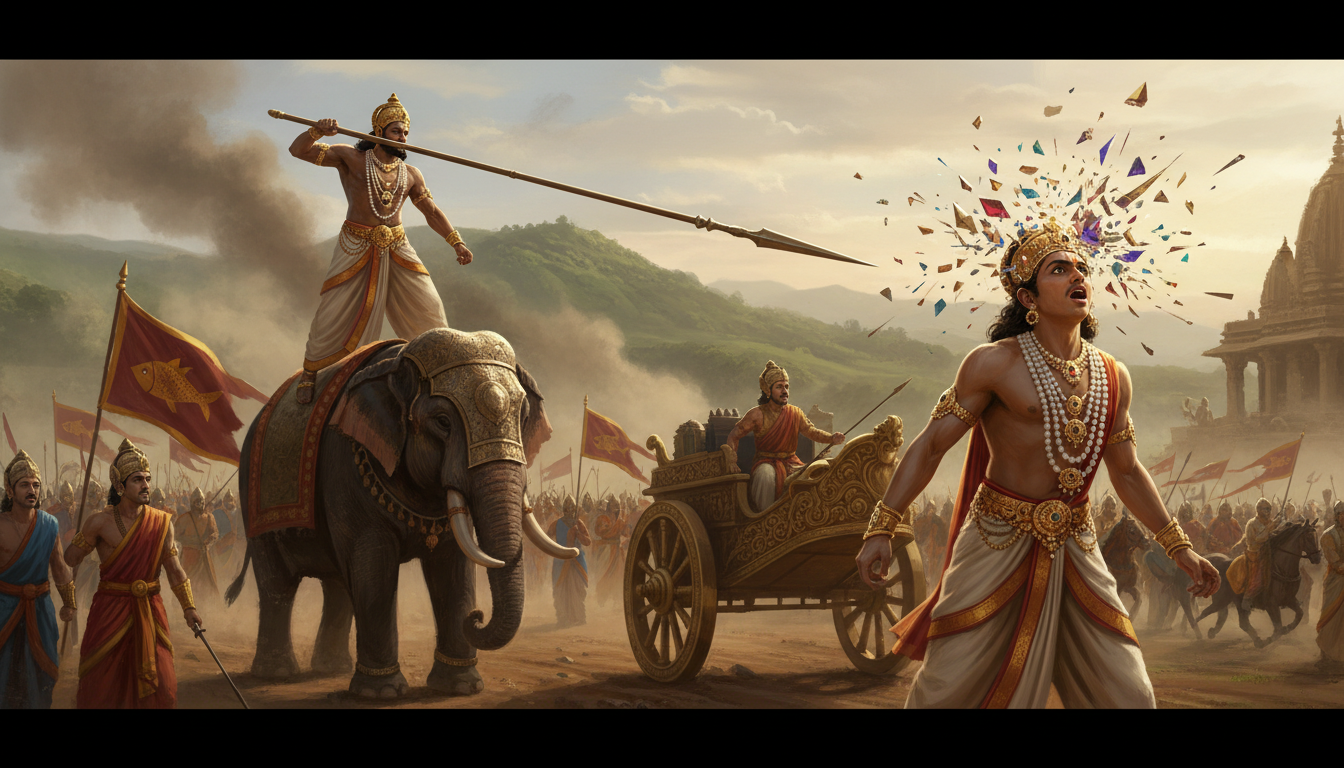
Pandya of the Malaya Hills
The southern king who thought himself greater than Bhishma
A Name Said Twice and Never Explained
Dhritarashtra stopped him in the middle of the day's report.
"You have mentioned Pandya to me before," he said. "More than once. You have used his name the way a man uses the name of somebody everyone is supposed to know, and then you have gone on to something else. His feats in battle you have never once narrated. Tell me today, in detail, about the prowess of that great hero. His skill. His spirit. His energy. The measure of his might."
He paused.
"And his pride," he said. "Tell me about his pride."
Sanjaya, who had been about to describe an entirely different quarter of the field, put the report down. Outside the tent the criers were still going along the lines with the day's list of the dead, and the name they were about to reach was one the king had asked after.
"You are right to ask," he said. "I have been careless with him, and I think I know why. He was on our side of the line and he fought as though he were on nobody's side, and men like that are difficult to fit into a report. Let me begin with the thing you asked for last, king, because with Pandya it is not last. With Pandya it comes first, and everything else in him grows out of it."
The Measure He Took of Himself
"Name the men you consider the foremost car-warriors alive," Sanjaya said. "You have named them to me often enough. Bhishma. Drona. Kripa. Drona's son. Karna. Arjuna. Janardana. Thorough masters of the science of weapons, every one of them, and you set them above all others."
"I do."
"Pandya regarded himself as superior in energy to all of them," Sanjaya said. "Not equal. Superior. He never once admitted, in his own mind, that he was the equal of Karna or of Bhishma, because to be their equal would have been to come down. He did not concede that he was in any respect inferior to Vasudeva or to Arjuna. He looked at the whole roll of kings on both sides of this war and found no one on it he considered his match."
"And was he right?" Dhritarashtra asked.
"He was never tested," Sanjaya said. "That is the answer, and it is the only answer anyone had for forty years. He came up out of the south, from the Malaya hills, where the sandal grows, and his standard carried the device of that mountain and was smeared with sandal-paste and other perfumed unguents, so that men downwind of him on a battlefield smelled his country before they saw his banner. He had beaten everybody a southern king ever gets the chance to beat. Nobody in that whole country was in a position to tell him what he was, and so he told himself, and he was believed, first by himself and then by everyone else."
The Potter's Wheel
"On that day," Sanjaya said, "he was filled with rage like the Destroyer himself, and he was slaughtering the army of Karna."
He wanted Dhritarashtra to hear that clearly. Not the Pandava army. Karna's own force, the great mass of cars and horses and the best of the foot, swelling and confident, the division that had been given to the new commander on the morning of his consecration. Pandya struck into it, and the whole of it began to turn round on itself like a potter's wheel, and could not find the direction he was coming from.
He was shooting the whole time and every arrow was placed. Like a wind taking a mass of gathered cloud apart, he took that force apart: horses first, then drivers, then standards, then the cars themselves, and the weapons went out of men's hands and the elephants came down. He was a splitter of mountains striking down mountains with thunder. He would cut the standard and the banner off an elephant, then the weapons of the men riding it, then the foot-soldiers guarding its legs, and only then bring the beast and its riders over together.
The horsemen he cut down with their own darts and lances still in the quivers.
And Sanjaya named the peoples he was mangling, because they had come a long way to die under a southern king's arrows: the Pulindas and the Khasas, the Bahlikas, the Nishadas, the Andhakas, the Tanganas, the Southerners, and the Bhojas. Great courage in all of them. Unyielding and obstinate in battle, all of them. He divested them of their weapons and their coats of mail and then he took their lives.
"That is the man," Sanjaya said, "whom the son of Drona saw from across the field and rode toward, fearlessly, and without hurrying."
The Politest Challenge on the Field
Pandya was dancing on his car, which is the word Sanjaya used and would not take back. Ashvatthama came up in front of him and did not shoot. He smiled and he addressed him in sweet words, as one smiter addressing another, and he took his time about it.
"King. You with the eyes like the petals of the lotus. Your birth is noble and your learning is great. Your might and your prowess are celebrated. You resemble Indra himself. When you stretch those two massive arms and the great string comes back into your grasp, you look like a mass of gathered clouds pouring impetuous shafts on your enemies in thick showers, and I have been watching you do it for some while."
Pandya let him speak.
"I do not see anybody except myself who can be a match for you in battle," Ashvatthama said. "Alone, you are crushing numbers of cars and elephants and foot-soldiers and horse, the way a fearless lion of terrible might crushes herds of deer in a forest. You make the sky and the earth resound with the clatter of your wheels and you look splendid doing it, like an autumn cloud that comes over loud and takes the crop with it. So take out your keen shafts, the ones like snakes of virulent poison, and fight with me only. Fight with me the way Andhaka fought with the three-eyed god."
It was flattery and it was not flattery. Every word of it was true and Ashvatthama knew it was true, and inside the true words he had buried the only sentence that mattered, which was that there was exactly one man on the field who could be his match, and it was the man saying so.
"So be it," Pandya answered. That was the whole of his reply.
"Strike," said Drona's son, and went at him with vigour.
Nine Shafts, Then Four, Then One
Malayadhwaja opened by putting a barbed arrow into him.
Ashvatthama, smiling, answered with fierce arrows made for the vitals, the kind that go in like flames of fire. Then he sped some other large arrows with keen points, also for the vitals, and made them course through the air with all ten of the different motions a master can put into a shaft, so that they did not come at the man in a way any ordinary archer could read.
Pandya cut all of them out of the air with nine shafts of his own.
With four more he afflicted the four horses of Drona's son, and they went down and died where they stood. Then, having cut off every arrow that had been sent at him, he found the bowstring of Ashvatthama, which had the splendour of the sun on it, and cut that too.
"He was not hurried," Sanjaya said. "That is what I keep coming back to. A man who is frightened shoots to keep his enemy off him. Pandya shot to take an enemy apart in a particular order, and he had chosen the order before the fighting started. The arrows first, because arrows in the air are the immediate thing. Then the horses, because a car without horses is a platform. Then the string, because a bow without a string is a stick. He never once shot at Ashvatthama himself in that opening. He did not think he needed to."
"He had unstrung the son of Drona and unhorsed him in the space of perhaps twenty breaths," Sanjaya said. "I want you to hold on to that, king. Not everything I have to tell you about this man is about pride. Some of it is about a level of skill I have not seen bettered on this field by anyone at all, and I have been watching Arjuna for seventeen days."
Eight Carts Drawn by Eight Bullocks
Ashvatthama strung his unstrung bow. His men had already got fresh horses into the yoke, good ones, and he saw them settle and then he began to shoot in earnest.
He sped thousands of arrows. He filled the whole sky and all ten points of the compass with them. Sanjaya gave the count the way the men who keep such counts give it: in the eighth part of a day, Drona's son shot as many arrows as would be carried on eight carts, each cart drawn by eight bullocks.
Pandya knew, as everyone there knew, that the shafts of that high-souled man were in practice inexhaustible. He cut them into pieces anyway. Every one that came at him. And while he was doing that he found time to kill both of the warriors protecting Ashvatthama's car wheels.
Men who looked at Ashvatthama in that hour lost their senses. He had the appearance of the Destroyer filled with rage, or, Sanjaya said, of the Destroyer of the Destroyer, and almost nobody who saw it could keep hold of himself. He poured his arrowy shower down on the hostile force the way a cloud at the close of summer drenches the earth with her mountains and her trees.
And Pandya baffled the whole of that unbearable shower with the Vayavya weapon, which is the wind, and roared with joy while he did it.
"The Ashvatthama-cloud," Sanjaya said, "and the Pandya-wind. That is how it looked from where I stood, and the wind was winning."
The Standard with the Mountain on It
Then Drona's son stopped answering the wind and went to work on the machine that carried it.
He cut the standard first, the one with the device of the Malaya mountain on it, smeared with sandal-paste and perfumed unguents, and it came down off the roaring king's car. Then the four horses. Then, with a single shaft, the driver. Then, with a crescent-shaped arrow, the bow itself, whose twang men had been comparing all afternoon to the roar of the clouds. Then the car, which he cut into small fragments while the king was still standing in it.
And having checked every weapon his enemy had with a weapon of his own, and cut away all of them, and got the opportunity to do the crowning evil and finish him, Ashvatthama did not take it.
"He did not slay him," Sanjaya said. "He had him and he let the moment go by. From desire of battling with him for some time more. That is the whole reason, king, and it is the reason a man gives when he has finally found somebody worth spending an afternoon on."
Some way off, Karna had rushed against the great elephant force of the Pandavas and begun to rout and destroy it, taking car-warriors out of their cars and striking down elephants and horses and men with innumerable straight shafts. Neither of the two men in that duel appeared to notice. The mighty bowman Drona's son had made Pandya carless and would not kill him, and Pandya stood on the ground in the wreckage of the finest chariot in the south and looked around him for something to fight from.
The Riderless Elephant
What came was an elephant.
It was huge, with large tusks, equipped with all the utensils of war and no man on it. Ashvatthama's shafts had struck it somewhere and it was coming on at speed, quick to go at anything, roaring the way a bull elephant roars at a rival, and it came toward Pandya like a cloven mountain summit walking.
Pandya was a man of the hills and knew the way of fighting from the neck of an elephant as well as he knew the way of fighting from a car. He went up its side and onto its neck the way a lion springs onto a mountain summit, with a loud roar, and had the hook in his hand before he was seated.
Then the lord of the prince of mountains struck the beast with the hook and put it into its charge, and, inspired with rage but with that cool care in the hurling of weapons for which he was known in his own country, he sped a lance at the son of the preceptor. It went bright as the rays of Surya, and he shouted while it flew.
"You are slain," he was shouting. "You are slain."
It did not kill Ashvatthama. It struck the diadem on his head and crushed it to pieces. That diadem was made of the foremost of jewels and diamonds of the first water and the best kind of gold, with excellent cloth and strings of pearls worked into it, and it had the splendour of the sun and the moon and the planets and fire together. Under the violence of that stroke it came apart and fell, split into fragments, like a mountain summit riven by Indra's thunder, and it hit the earth with a great noise.
Every man near enough to see it saw the son of Drona standing bareheaded.
Fourteen Arrows, Ten Pieces
Ashvatthama blazed up with rage like a prince of snakes that somebody has stepped on.
He took up fourteen shafts. Each of them was capable of inflicting great pain and each of them, Sanjaya said, resembled the rod of the Destroyer, and he had them all in his hand at once and he did not shoot them at random. He had already divided them.
With five he cut off the four feet and the trunk of the elephant.
With three he cut off the two arms and the head of the king.
With six he killed the six mighty car-warriors of great effulgence who had followed Pandya into the fight and were still with him.
Those long well-rounded arms came down on the earth, smeared with excellent sandal-paste and covered with gold and pearls and gems and diamonds, and they writhed there like a pair of snakes killed by Garuda. The head fell with them. It had a bright face like the full moon, a prominent nose, a pair of large eyes red as copper with rage, and earrings, and lying on the ground it looked resplendent, like the moon himself set between two bright constellations.
The elephant lay cut into six pieces by five arrows and the king into four pieces by three, and Sanjaya counted them together for the blind man who could not see the field: ten pieces, laid out on the earth like the sacrificial butter divided into the ten portions intended for the ten deities.
"He had cut a great many men and horses and elephants into pieces himself that day, and offered them to the Rakshasas as food," Sanjaya said. "He was quieted at last by Drona's son with those shafts, the way a fire blazing in a crematorium is put out with water, after it has received its libation in the shape of a lifeless body."
The King Comes to Say Thank You
Then your son came, Sanjaya said, with his brothers around him, and they got down and approached the preceptor's son and worshipped him with great respect, the way the chief of the celestials joyfully worships Vishnu after the subjugation of the Asura Vali. Duryodhana honoured him as a complete master of the science of arms, and he did it in front of the whole surviving host, and he did it only after the thing was done, when the task Ashvatthama had undertaken was finished and there was no longer any doubt about the outcome.
Dhritarashtra sat with that for a while.
"He thought he was greater than Bhishma," the old king said.
"He thought he was greater than all seven of them," said Sanjaya, "and I have told you what he did to the second-best archer in the Kuru host in the first twenty breaths of a fight, and I would not swear that he was wrong. That is what makes it hard. It is easy to say pride goes before a fall when the proud man is a fool. Pandya was not a fool. He was very nearly what he thought he was, and nearly is the whole of the story. The Malaya hills never sent anybody north who could tell him where the edge of his skill was, so he put it where he liked. Then a courteous man rode up and asked him, very politely, for a turn."
"And no one in the south will ever hear it," Dhritarashtra said.
"No one anywhere will hear it," Sanjaya said. "He is a name in the middle of a long report about a bigger man's day. That is what the field does with them, king. It takes the ones who were nearly the greatest and it puts them in a list."
Dharma Lesson
Pride that has never been tested reads like greatness until the one man who can measure it asks politely for a turn. Pandya was very nearly what he believed himself to be, and nearly is the whole of the story. A reputation built where no one is qualified to contradict it is not a reputation at all, only an untested claim waiting for the field that will price it.