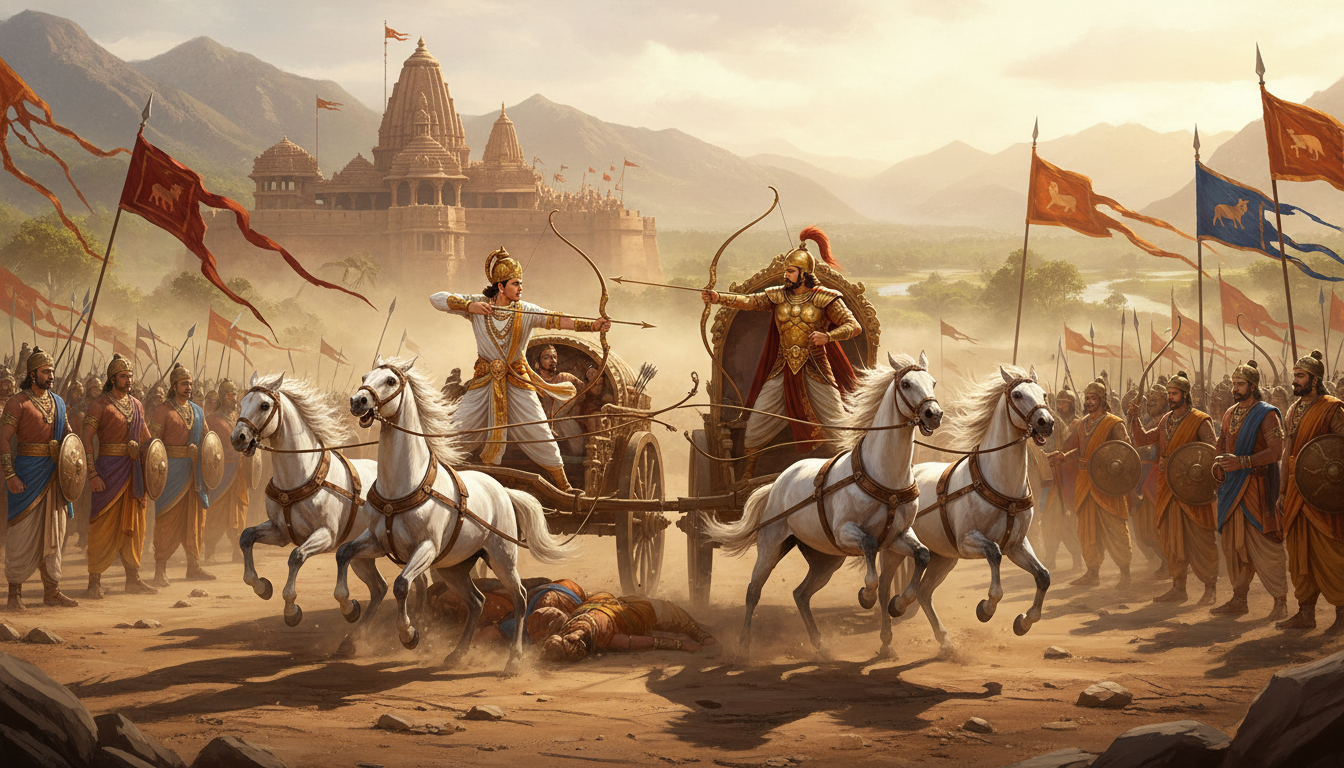
Arjuna Against the Preceptor's Son
The duel Ashvatthama could not win twice
The Guest Who Asked for Hospitality
"Describe to me the battle of Arjuna with the samsaptakas," the old king said, "and narrate to me also the battle of Arjuna with Ashvatthama."
"Listen, O king," Sanjaya said, "as I speak to thee of the battle which was destructive of bodies, sins, and lives.
"Partha, penetrating into the samsaptaka force that resembled the ocean, agitated it exceedingly, like a tempest agitating the vast deep. Cutting off with broad-headed arrows of keen edges the heads of brave warriors that were decked with faces possessed of the splendour of the full moon and with beautiful eyes and eyebrows and teeth, Dhananjaya speedily caused the Earth to be strewn there as if with lotuses plucked off their stalks. And with his razor-headed shafts he cut off the arms of his foes, that were all well rounded, large and massive, and smeared with sandal-paste and other perfumes, with weapons in their grasp and leathern gloves casing their fingers, and looking like five-headed snakes.
"Crowds of Siddhas and celestial Rishis and Charanas all applauded him. Celestial kettle-drums sounded, and floral showers fell upon the heads of Keshava and Arjuna. And an incorporeal voice said, 'These two heroes always possess the beauty of the moon, the splendour of fire, the force of the wind and the radiance of the sun. Stationed on the same car these two heroes are invincible even like Brahman and Isana. These two heroes, the foremost of all creatures, are Nara and Narayana.'
"Hearing and beholding these wonderful things, O Bharata, Ashvatthama, with great care and resolution, rushed against Krishna and Arjuna in that battle. With the arm that held an arrow in its grasp, the son of Drona hailed the Pandava, shooting shafts equipped with foe-slaying heads, and smilingly told him these words.
"'If, O hero, thou regardest me a worthy guest arrived before thee, then give me today, with the whole heart, the hospitality of battle.'"
To Which of These Duties Should I First Turn
"Thus summoned by the preceptor's son from desire of battle, Arjuna regarded himself highly honoured, and addressing Janardana said these words.
"'The samsaptakas should be slain by me, but Drona's son again is summoning me. Tell me, O Madhava, to which of these duties should I first turn? First let the services of hospitality be offered, if thou thinkest that to be proper.'
"Thus addressed, Krishna bore Partha, who had been summoned according to the rules of triumphant challenge, to the vicinity of Drona's son, like Vayu bearing Indra to the sacrifice. And saluting Drona's son, whose mind was fixed upon one thing, Keshava said unto him these words.
"'O Ashvatthama, be cool, and without losing a moment strike and bear. The time has come for those that are dependent on others to repay their obligation to their masters. The disputes between brahmanas are subtle. The consequences, however, of the disputes of kshatriyas are palpable, being either victory or defeat. For obtaining those excellent rites of hospitality that from folly thou solicitest at the hands of Partha, fight coolly now with the son of Pandu.'
"It was said to him kindly, and every word of it was a knife. He was the son of a brahmana who had hired himself out for a house and a herd of cattle and had died on this field for it. He was standing in that army because of a debt, and Keshava had just named the debt in front of him and told him to go and pay it.
"Thus addressed by Vasudeva, that foremost of regenerate ones replied, saying, 'So be it,' and pierced Keshava with sixty shafts and Arjuna with three."
Arrows Out of the Pores of His Body
"Arjuna then, filled with rage, cut off Ashvatthama's bow with three shafts. Drona's son took up another bow that was still more formidable, and stringing it within the twinkling of an eye, he pierced Keshava with three hundred arrows and Arjuna with a thousand.
"And then Drona's son, with good care, stupefying Arjuna in that battle, shot thousands and tens of thousands and millions of arrows. From the quivers, the bow, the bow-string, the fingers, the arms, the hands, the chest, the face, the nose, the eyes, the ears, the heads, the limbs, the pores of the body, the armour on his person, the car, and the standard of that utterer of Brahma, arrows began to issue. Piercing Madhava and the son of Pandu with that thick arrowy shower, Drona's son, filled with joy, roared aloud like a vast mass of congregated clouds.
"Hearing that roar of his, the son of Pandu said unto Keshava these words. 'Behold, O Madhava, this wickedness towards me of the preceptor's son. He regardeth us to be slain, having shrouded us with his dense arrowy shower. I will presently, however, by my training and might, baffle his purpose.'
"Cutting off every one of those arrows shot by Ashvatthama into three fragments, that foremost one of Bharata's race destroyed them all, like the Sun destroying a thick fog.
"After this the son of Pandu once more pierced the samsaptakas with their steeds and drivers and cars and elephants and standards and foot-soldiers, and then turned back, and the son of Pandu proffered unto Ashvatthama, that desirable guest, quivers upon quivers of arrows, like a charitable person offering everything in his house unto a guest. Leaving the samsaptakas then, the son of Pandu rushed towards Drona's son, like a donor abandoning unworthy guests for proceeding towards one that is worthy."
Shukra and Brihaspati in One Constellation
"Then occurred that battle between Arjuna and Ashvatthama resembling the planets Shukra and Brihaspati in splendour, like the battle between Shukra and Brihaspati in the firmament for entering the same constellation. Afflicting each other with blazing shafts that constituted their rays, those terrifiers of the world stood like two planets both deviating from their orbits.
"Then Arjuna deeply pierced Ashvatthama with a shaft in the midst of his eyebrows, and with that shaft standing out of his forehead the son of Drona looked resplendent like the Sun with upward rays. The two Krishnas, also deeply afflicted by Ashvatthama with hundreds of arrows, looked like two Suns at the end of the Yuga.
"Then when Vasudeva seemed to be stupefied, Arjuna shot a weapon from which issued torrents of shafts on all sides, and struck the son of Drona with innumerable shafts, each resembling the thunder or fire or the sceptre of Death. Endued with mighty energy, that achiever of fierce feats then pierced both Keshava and Arjuna with well-shot shafts inspired with great impetuosity, struck with which Death himself would feel pain.
"Then Drona's son, without losing a moment, aimed ten foremost of arrows and sped them quickly as if they formed only one arrow. Shot with great force, five of these pierced Arjuna and the other five pierced Vasudeva. Struck with those arrows, those two foremost of men became bathed in blood, and all the people there regarded those two heroes as slain by Ashvatthama, the warrior who had completely mastered the science of arms."
Why Errest Thou in Sparing Him
"Then the chief of the Dasharhas addressed Arjuna and said these words.
"'Why errest thou in thus sparing Ashvatthama? Slay this warrior. If treated with indifference, even this one will be the cause of great woe, like a disease not sought to be put down by treatment.'
"There was a truth in it that neither of them said out loud on that car. Arjuna had grown up in the same yard as this man. They had been taught by the same hands, out of the same quiver, and every counter that Ashvatthama was using against him had been put into the boy's hands by the boy's father in Arjuna's hearing. It is one thing to kill a stranger who knows your art. It is another to kill the only other man alive who was taught it beside you.
"Replying unto Keshava of unfading glory with the words 'So be it,' Arjuna of unclouded understanding began, with good care, to mangle the son of Drona with his shafts. Filled with rage, he quickly pierced the massive arms smeared with sandal-paste, and the chest, the head, and the unrivalled thighs of his antagonist, with shafts equipped with heads like goats' ears and shot with great force from gandiva.
"Then, cutting off the traces of Ashvatthama's steeds, Arjuna began to pierce the steeds themselves, whereat the latter bore Ashvatthama away to a great distance from the field.
"Borne away by those steeds endued with the speed of the wind, the intelligent son of Drona, deeply afflicted with the shafts of Partha, reflected for some time, and wished not to go back and renew the fight with Partha. Knowing that victory is ever with the chief of the Vrishnis and with Dhananjaya, that foremost one of Angirasa's race, deprived of hope and with his shafts and weapons almost exhausted, restrained his steeds, and having comforted himself a little, entered the force of Karna, teeming with cars and steeds and men. He had been removed from the field by his own horses, like a disease removed from the body by incantations and medicines."
The Second Day, and the Weapons That Would Not Take
"On the next day, while Karna was seeking Yudhishthira across the field, Drona's son, surrounded by a large car-force, suddenly proceeded to that spot where Partha was.
"Like the continent withstanding the surging ocean, the heroic Partha, having Saurin for his help-mate, withstood the impetuously rushing Ashvatthama. Then the valiant son of Drona, filled with rage, covered both Arjuna and Vasudeva with his shafts, and beholding the two Krishnas shrouded with arrows, the great car-warriors of the Pandava army, as also the Kurus that witnessed it, wondered exceedingly.
"Then Arjuna, as if smiling, invoked into existence a celestial weapon.
"The brahmana Ashvatthama baffled that weapon in that battle. Indeed, all those weapons that Arjuna sped from desire of slaying the son of Drona were baffled by the latter, that great bowman, in that encounter. Arjuna called them up one after another, and one after another the son of his preceptor took them out of the air as a man takes a thrown thing out of the air with his hand, and did not appear to hurry.
"During the progress of that awful encounter of weapons, O king, we beheld the son of Drona to resemble the Destroyer himself, with gaping mouth. Having covered all the points of the compass, cardinal and subsidiary, with straight arrows, he pierced Vasudeva with three arrows in the right arm."
Two Rivers of Blood
"Then Arjuna, slaying all the steeds of his high-souled assailant, caused the Earth in that battle to be covered with a river of blood that was exceedingly awful, that led towards the other world, and that had diverse kinds of creatures floating on it. All the spectators beheld a large number of car-warriors along with their cars, belonging to the division of Ashvatthama, slain and destroyed by means of the arrows sped from Partha's bow.
"Ashvatthama also, slaying his enemies, caused a terrible river of blood to flow there that led to Yama's domains.
"During the progress of that fierce and awful battle between Drona's son and Partha, the combatants fought without showing any regard for one another, and rushed hither and thither. In consequence of cars having their steeds and drivers slain, and steeds having their riders slain, and elephants having their riders and guides slain, an awful carnage was made by Partha in that battle. Car-warriors, deprived of life with shafts sped from Partha's bow, fell down, and steeds freed from their trappings ran hither and thither.
"Beholding those feats of Partha, that valiant son of Drona quickly approached him, shook his formidable bow decked with gold, and pierced him from every side with many sharp arrows. Once more bending the bow, the son of Drona cruelly struck Arjuna, aiming at the chest, with a winged arrow. Deeply pierced, the wielder of gandiva forcibly covered the son of Drona with showers of arrows, and then cut off his bow.
"His bow cut off, Drona's son then took up a spiked mace whose touch resembled that of thunder's, and hurled it, in that encounter, at the diadem-decked Arjuna. The son of Pandu, however, as if smiling the while, suddenly cut off that spiked mace decked with gold as it advanced towards him. Thus cut off with Partha's shafts, it fell down on the Earth like a mountain broken into pieces, struck with the thunderbolt."
The Reins in His Own Hands
"Filled with rage at this, Drona's son began to cover Vibhatsu, aided by the energy of the aindra weapon. Beholding that shower of arrows spread over the welkin through the aindra weapon, Partha, taking up his bow gandiva and fixing on his bowstring a mighty weapon created by Indra, destroyed that aindra shower of arrows, and then soon covered the car of Drona's son with his own arrows.
"The son of Drona, however, overwhelmed with Partha's shafts, penetrated through that shower of arrows shot by the son of Pandu, and approaching the latter, invoked a mighty weapon and suddenly pierced Krishna with a hundred shafts and Arjuna with three hundred small arrows.
"Then Arjuna pierced the son of his preceptor with a hundred arrows in all his vital limbs. And then he poured many arrows on the steeds and the driver and the bowstring of Drona's son, in the very sight of thy warriors, and felled his adversary's driver from the car-niche with a broad-headed arrow.
"Drona's son, however, himself taking up the reins, covered Krishna with many arrows.
"The activity of prowess that we then beheld in Drona's son was exceedingly wonderful, since he guided his steeds while he fought with Phalguni. That feat of his in battle, O king, was applauded by all the warriors. Men on both sides of that field stopped what they were doing to watch one man do with the reins in one hand what other men cannot do with two hands free, and the shout that went up for it came from the Pandava line as much as from ours.
"Then Vibhatsu, otherwise called Jaya, smiling the while, quickly cut off the traces of Ashvatthama's steeds in that battle with a razor-faced arrow. Already afflicted by the energy of Arjuna's shafts, the steeds of Drona's son thereupon ran away, and a loud noise arose from thy troops, O Bharata."
The Army That Would Not Stay
"Meanwhile the Pandavas, having obtained the victory and desiring to improve it, rushed against thy troops, shooting from all sides sharp arrows at them. The vast Dhartarashtra host was then repeatedly broken by the heroic Pandavas inspired with desire of victory, in the very sight of thy sons, conversant with all modes of warfare, and of Shakuni the son of Subala, and of Karna.
"Though sought to be stopped by thy sons, that great army, afflicted on all sides, stayed not on the field. A confusion set in among the vast terrified host of thy son, in consequence of many warriors flying away on all sides. The Suta's son loudly cried out, saying, 'Stay, stay,' but thy army, slaughtered by many high-souled warriors, did not stay on the field. Loud shouts were uttered by the Pandavas on beholding the Dhartarashtra host flying away.
"Then Duryodhana, addressing Karna from affection, said, 'Behold, O Karna, how our army, exceedingly afflicted by the Pandavas, though thou art here, is flying away from battle. Knowing this, O thou of mighty arms, do that which is suited to the hour. Thousands of our warriors, routed by the Pandavas, are calling after thee only, O best of men.'
"Hearing these grave words of Duryodhana, the son of Radha, as if smiling, said these words unto the ruler of the Madras. 'Behold the prowess of my arms and the energy of my weapons, O ruler of men. Today I will slay all the Pancalas and the Pandavas in battle. Cause the steeds to proceed with my car, O tiger among men. Without doubt, everything will be as I have said.'
"And having said these words, the Suta's son of great valour took up his ancient and foremost of bows, and the day went on towards its afternoon."
The One Who Was Never Beaten
So it stood at the end of those two days.
Of all the men who had taken the field for Duryodhana, the son of Drona was the one whom nobody could fault. He had baffled every celestial weapon Arjuna could call up. He had put three arrows into the right arm of Krishna, which no other archer in that war managed. He had fought while driving his own horses and been applauded for it by the men he was trying to kill. He had never once, in eighteen days, been beaten on skill.
And twice within two days his own horses had carried him off the field with his weapons almost exhausted, because his traces were cut, and both times he came back to a camp that was losing, and both times there was nothing waiting for him there but the next morning.
He was the last thing his father left behind, and he was serving a debt his father had contracted and could not get out of. Sanjaya told the blind king all of this in order, the astras and the reins and the flight, and did not say the obvious thing, which was that skill answers for itself and not for the cause a man is hired into, and that a flawless craftsman on the wrong side simply takes longer to lose.
What that man would do about it, in the dark, after everything else had been lost, belonged to a later night and another parva.
Dharma Lesson
A man can be flawless at his craft and still lose, because skill answers only for itself and not for the cause it was hired to serve. Ashvatthama is never beaten on technique in either encounter, and twice his own horses carry him off the field to a camp that is losing anyway. What a man is good at does not decide what he is worth; what he serves with it does.