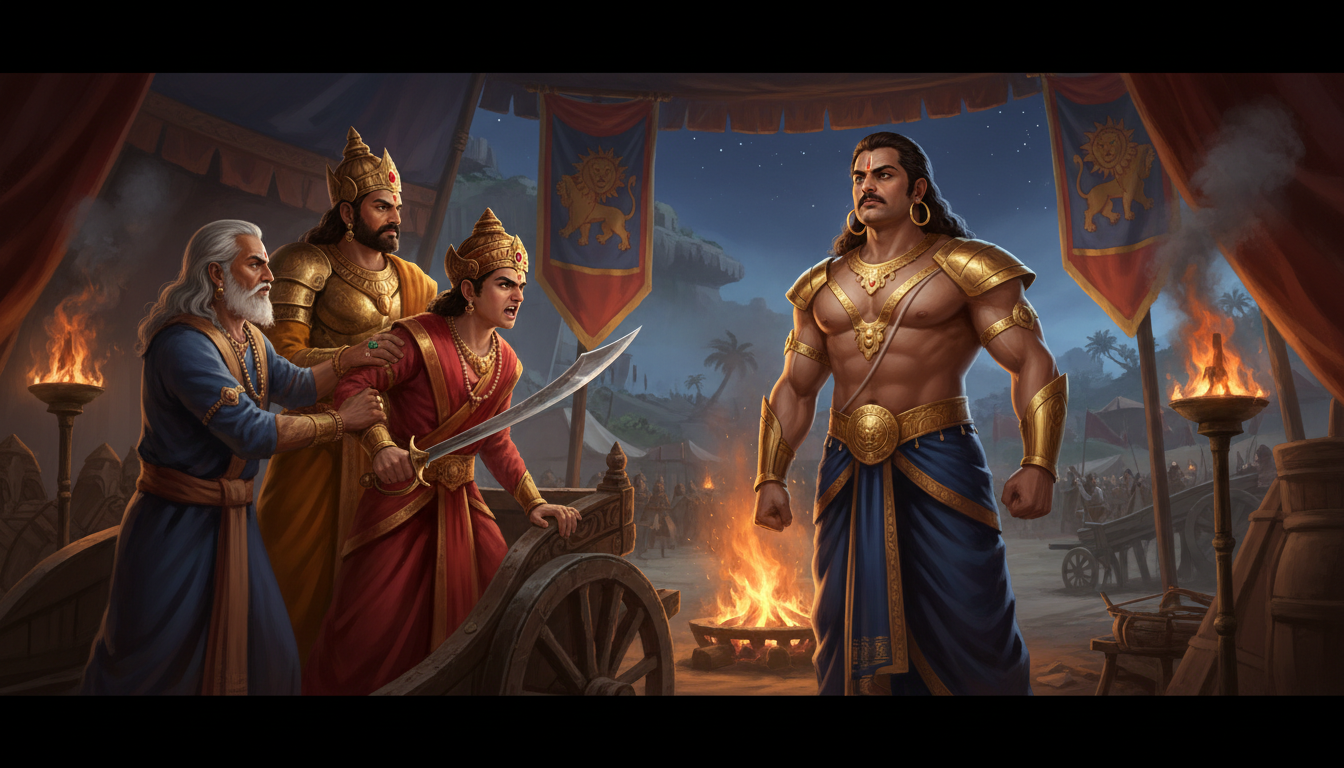
Three Men and a Drawn Sword
Karna boasts, Kripa answers, and Ashwatthama draws on his own side
The Hour Has Come in Respect of Thy Friends
The sun had gone down on the ruler of the Sindhus with his head off, and the fighting had not stopped for it. Nobody on that field had ever fought at night before. The Panchalas were roaring somewhere out in the dark and the sound was coming from three directions at once.
Duryodhana found Karna in the middle of it and did not bother with any preamble.
"O you that are devoted to friends, that hour has now come in respect of your friends. Save all my warriors in battle. Our men are encompassed on every side by the Panchalas, the Kaikeyas, the Matsyas, and the car-warriors of the Pandavas, all of them filled with rage and hissing like snakes. Listen to them. They are roaring in joy over there because they think they have won. That car-force of the Panchalas has the prowess of Sakra himself in it."
He had said the same thing in one form or another after Bhishma fell, and again after Drona failed to take Yudhishthira alive, and both times it had been the beginning of a plan. This time he had nothing behind it but the asking.
Karna answered at once, the way he always answered, without leaving a pause in which anything could be doubted.
"If Purandara himself came here to save Partha, I would vanquish even him quickly and then kill that son of Pandu. I tell you truly. Be cheered, O Bharata. I will slay the son of Pandu and all the assembled Panchalas. I will give you victory as Pavaka's son gave victory to Vasava.
"Among all the Parthas, Phalguna is the strongest. At him I will hurl the fatal dart of Sakra's workmanship. When that great bowman falls, his brothers will either surrender themselves to you or go back into the forest. While I am alive, Kauravya, never indulge in any grief. I will make porcupines of the whole of them with my arrowy showers and give you the earth."
It was, taken purely as a speech, exactly what the king had come to hear.
Castles in the Air
Kripa had been standing near enough to hear all of it. He was old, and a brahmana, and the maternal uncle of Drona's son, and he had been in that army since before there was a quarrel to be in it. He smiled while Karna was still speaking, and then began, mildly, in the voice of a man who has decided to say the whole thing while he has the floor.
"Your speech is fair, Karna. If words alone could lead to success, then with you as its protector this bull among men would be safe. But your prowess is seldom witnessed, nor indeed any result of your boastful speeches.
"Many a time have we seen you meet the sons of Pandu in battle. On every one of those occasions, Suta's son, you have been vanquished by them. While Dhritarashtra's son was being carried off a prisoner by the Gandharvas, every man in this army fought on that occasion except your single self. You were the first to fly away. In Virata's city also, all the Kauravas united, yourself and your younger brother included, were beaten by Partha in one afternoon.
"You are not a match for even one of the sons of Pandu, and that one is Phalguna. How then do you venture to vanquish all of them with Krishna at their head? You indulge in too much brag. Engage yourself in battle without saying anything. To put forth prowess without brag is the duty of good men.
"You roar like a dry cloud in autumn, and show yourself without substance, and the king does not understand it. You roar, son of Radha, as long as you do not see the son of Pritha. These roars disappear when you see Partha near. You roar as long as you are out of the range of Phalguna's shafts, and the roars go out of you when you are pierced with them.
"Kshatriyas evince their eminence by means of their arms. Brahmanas, by means of speech. Arjuna evinces his by means of the bow. But Karna, by the castles he builds in the air. Who is there that will resist that Partha who gratified Rudra himself in battle?"
Heroes Roar Like Clouds in the Rains
Karna answered without raising his voice at all.
"Heroes always roar like clouds in the season of rains, and like seed put in the soil they quickly yield fruit. I see no fault in heroes who take great burdens on their shoulders and speak boastfully on a field of battle. When a person mentally resolves to bear a burden, Destiny itself aids him in the execution. Wishing in my heart to bear a great burden, I always summon sufficient resolution.
"If, slaying the sons of Pandu with Krishna and the Satwatas, I indulge in such roars, what is it to you, brahmana? Men who are heroes never roar fruitlessly like autumnal clouds. Conscious of their own might, the wise indulge in roars. In my heart I am determined to vanquish Krishna and Partha united today. It is for that that I roar, son of Gotama. Behold the fruit of these roars."
"Little do I reckon these delirious sayings of yours," Kripa said, "which discover your thoughts and not your deeds. You always speak in depreciation of the two Krishnas and of Yudhishthira the just. He is certain to have the victory who has those two on his side."
And then, because he had evidently been keeping a list, he read it out. Dhrishtadyumna. Sikhandin. Janamejaya the son of Durmukha. Chandrasena and Madrasena. Dhruva and Dhara and Vasuchandra and Sutejana. The sons of Drupada and Drupada himself, conversant with high and mighty weapons. The king of the Matsyas with his younger brothers, and the handsome brothers of Virata. Gajanika and Virabhadra and Sudarsana and Srutadhwaja and Valanika and Jayanika and Jayaswa and Kamaratha. The twins. The five sons of Draupadi. The Rakshasa Ghatotkacha.
"Yudhishthira reverences the Pitris and the deities and is skilled in weapons besides. His brothers are devoted to their seniors and righteous in their practices. Bhima and Phalguna between them could annihilate the universe with the celestials in it, and Yudhishthira could consume the world with his angry eyes alone. How do you venture to vanquish men for whom Sauri of immeasurable might has clad himself in mail? This is a great folly on your part."
I Shall Cut Out Thy Tongue
Karna smiled at that, and did the one thing Kripa had not prepared for. He agreed.
"The words you have spoken about the Pandavas, brahmana, are all true. These and many other virtues are to be seen in the sons of Pandu. It is true also that the Parthas cannot be vanquished by the gods with Vasava at their head, nor by the Daityas, the Yakshas and the Rakshasas."
He let the concession sit there a moment.
"For all that, I will vanquish them with the help of the dart given me by Vasava. You know, brahmana, that the dart given by Sakra cannot be baffled. With that I will kill Savyasachin. Upon Arjuna's fall, Krishna and the uterine brothers of Arjuna will never be able to enjoy the sovereignty of the earth without him, and all of them will perish, and this earth with her seas will remain subject to the chief of the Kurus without costing him any effort. In this world everything becomes attainable by policy. Knowing this, I indulge in these roars."
And then, having won the argument, he ruined it.
"As for yourself, you are old, a brahmana by birth, and unskilled in battle. You bear much love for the Pandavas. It is for that that you insult me. If you tell me such words again, then I shall draw out my scimitar and cut off your tongue, wretch. You wish to applaud the Pandavas in order to frighten the troops and the Kauravas, you of wretched understanding.
"Listen. Duryodhana is here, and Drona, and Sakuni, and Durmukha, and Jaya, and Duhsasana, and Vrishasena, and the ruler of the Madras, and yourself too, and Somadatta, and Drona's son, and Vivinsati, all clad in mail. What foe endued with even the prowess of Sakra would beat these?
"And yet. When Bhishma lies pierced with a hundred arrows, and Vikarna, and Jayadratha, and Bhurisravas, and Jaya, and Jalasandha, and Sudakshina, and Sala that foremost of car-warriors, and Bhagadatta of great energy, men not easily vanquished by the gods themselves, men mightier than the Pandavas, all lying on the field slain by them, what do you think it is, wretch among men, if it is not destiny? Both armies are diminishing. I do not see the prowess of the Pandavas in it. Victory depends on destiny. I shall strive to the utmost of my might for Duryodhana's good."
The Scimitar Comes Off the Car
Ashwatthama had heard his uncle called a wretch of wretched understanding and threatened with the loss of his tongue, in the middle of a battle, in front of the king.
He came off his car with the scimitar already up and went at Karna like a lion at an infuriated elephant.
"O lowest of men," he said, "Kripa was speaking of virtues truly possessed by Arjuna. Of wicked understanding as you are, you rebuke my brave uncle out of malice. Possessed with pride and insolence, you brag today of your prowess and regard none of the world's bowmen.
"Where was your prowess and where were your weapons when the wielder of Gandiva, having vanquished you in battle, slew Jayadratha in your very sight? Vainly do you nourish the hope of beating a man who once contended with Mahadeva himself. The gods and the Asuras together with Indra at their head failed to vanquish Arjuna when he had Krishna only for his ally. How then do you hope, aided by these kings, to beat him?
"Behold what I do to you today. O wretched understanding, I shall presently sever your head from your trunk."
He was three steps away when the king of the Kurus and the old brahmana got hold of him, one at each arm, and held him there.
Karna did not step back and did not draw.
"This wretch of a brahmana thinks himself brave and boasts of his prowess in battle," he said. "Set him at liberty, chief of the Kurus. Let him come in contact with my might."
"Son of a Suta, of wicked understanding," Ashwatthama said, still held, "this fault of yours is pardoned by us. Phalguna, however, will quell this risen pride of yours."
"Quell your wrath," Duryodhana said to him. "It behoves you, giver of honours, to forgive. You should not be angry with the Suta's son. On you and Karna and Kripa and Drona and the ruler of the Madras and Suvala's son rests a great burden. Drive away your wrath, best of brahmanas. Yonder, all the Pandava troops are coming, and they are coming for Radha's son. Listen to them. They are challenging us all."
Ashwatthama put the scimitar away. And Kripa, who was of a quiet disposition and mild temper, came back a little later to say one sentence and then be finished with it.
"Suta's son of wicked heart, this fault of yours is pardoned by us. Phalguna, however, will quell this pride."
It was, word for word, what his nephew had said. Neither of them was in any hurry to invent a new one.
Where Is Karna in This Fierce Battle
The Pandavas and the Panchalas came up out of the dark in thousands, shouting, and what they were shouting was a name.
"There is Karna." "Where is Karna in this fierce battle?" "O you of wicked understanding, O lowest of men, fight with us."
And others, catching sight of him: "Let this arrogant wretch of little understanding, this son of a Suta, be slain by the allied kings. He has no need to live. This sinful man is always hostile to the Parthas. Obedient to the counsels of Duryodhana, this one is the root of all these evils. Slay him."
So the quarrel that had just been settled inside the Kaurava lines was continued from outside them in almost the same words.
Karna, seeing that wonderful sea of troops advancing on him like Death himself, did not tremble and showed no fear. He stood where he was with his bow drawn, surrounded by the foremost of the Kuru warriors, and began to resist that force on all sides with clouds of shafts.
What we saw then, Sanjaya said, was the lightness of his arm, which was wonderful in the extreme, since all those foes fighting resolutely could not strike him even once. He shot terrible arrows marked with his own name, cut into the shaft, so that men would know afterwards who had killed them, and he put them into the yokes and the shafts and the umbrellas and the cars and the horses of kings.
The kings lost their coolness and began to wander about the field like a herd of cattle afflicted with cold. Steeds and elephants and car-warriors dropped where they stood. The ground was strewn with the heads and the arms of men who had not turned back, and with the dead and the dying and the ones who were still shouting, and it took on the aspect of Yama's own country.
Duryodhana watched that for a while and then went and found Ashwatthama again.
"Behold, Karna, clad in mail, is engaged with all the hostile kings. Behold their army routed by his arrows like the Asura army overwhelmed by Kartikeya. And yonder comes Vibhatsu, seeing his army beaten, from desire of slaying the Suta's son. Let such steps be taken as may prevent the son of Pandu from killing that mighty car-warrior in the very sight of us all."
The Man They Had All Been Quarrelling About
So Drona's son, and Kripa, and Shalya, and Kritavarma, all of them, went out to protect the man whose head one of them had offered to cut off an hour before.
It did no good.
Dhritarashtra, hearing it read out in his hall long afterwards, stopped Sanjaya to ask about exactly this moment.
"Beholding Phalguna excited with fury and looking like the Destroyer at the end of the yuga, what did Vikartana's son Karna do next? He had always challenged Partha. He had always said he was competent to vanquish the terrible Vibhatsu. What then did that warrior do when he suddenly met his ever deadly foe?"
And Sanjaya, who had been standing near enough to see it, told him.
Karna went fearlessly to meet him. Arjuna covered him with straight shafts winged with gold, and Karna covered Vijaya, and Arjuna shrouded him again, and Karna, filled with rage, pierced him with three. Then Arjuna, unable to brook the lightness of Karna's hand, shot thirty shafts whetted on stone with blazing points, and then, smiling, put one long arrow through the wrist of Karna's left arm.
The bow fell out of that arm onto the floor of the car.
Karna had it up again within the twinkling of an eye and was shooting before anybody had seen him bend, which was the thing about him that no amount of Kripa's arithmetic could explain away. They came close and covered each other and could not be told apart, like two wild elephants fighting over a she-elephant in her season.
Then Partha cut his bow off at the handle, sent his four horses to Yama's abode with broad-headed shafts, took his driver's head off the trunk, and put four arrows into the bowless, steedless, driverless man standing in the wreck.
Karna jumped down off that car and got up onto Kripa's.
He rode out of it on the chariot of the old brahmana he had promised to mutilate, and behind him the whole Kaurava host, seeing Radha's son beaten in front of them, broke and ran away in every direction at once.
The King Decides to Do It Himself
Duryodhana got in front of the running men and stopped them with his own body and his own voice.
"Do not fly away. Stay in battle, bulls among Kshatriyas. I myself will now advance to kill Partha. I myself will slay him with the assembled Panchalas. While I fight the wielder of Gandiva today, Partha shall behold my prowess resemble that of the Destroyer at the end of the yuga. Today the Parthas shall see my shafts shot in thousands like flights of locusts. Stay, heroes, and put away your fear of Phalguna. Encountering my prowess, Phalguna shall not be able to bear it, as the ocean, the abode of makaras, cannot overcome the continents."
Then he turned his car, with his eyes red, and went, and a large force went with him.
Kripa watched the king of the Kurus drive off toward Arjuna and came straight to Ashwatthama.
"Yonder the mighty-armed Duryodhana, deprived of his senses by wrath, desires to fight with Phalguna, like an insect desiring to rush into a blazing fire. Before this foremost of kings lays down his life in our very sight, prevent him. The brave Kuru king can remain alive in battle only as long as he does not place himself within the range of Partha's shafts. Let him be stopped before he is consumed to ashes by shafts that resemble snakes just freed from their sloughs. When we are here, it is highly improper that the king should go himself, as if he had nobody to fight for him. His life will be in great danger, like that of an elephant contending with a tiger."
So Ashwatthama, who an hour earlier had been calling the king's champion the lowest of men, drove after the king to stop him fighting.
"When I am alive, son of Gandhari, it does not behove you to engage yourself in battle disregarding me. I am ever desirous of your good. You need not be at all anxious about vanquishing Partha. I will check Partha. Stand here, Suyodhana."
What the King Really Thought
And Duryodhana, standing in his chariot with the fight going on around him, said the thing that had been under everything all day.
"The preceptor always protects the sons of Pandu as if they were his own sons. You also never interfere with those my foes. Or it may be due to my misfortune that your prowess never becomes fierce in battle. This may be due also to your affection for Yudhishthira, or for Draupadi. I myself am ignorant of the true reason.
"Fie on my covetous self, for whose sake all my friends, desirous of making me happy, are themselves vanquished and plunged into grief. Except you, son of Gotama's daughter, what wielder of weapons is there, what warrior equal to Mahadeva himself in battle, who would not destroy the foe though competent to do it? Be pleased with me, Ashwatthama, and destroy my enemies."
Ashwatthama heard his loyalty questioned by a man he had just ridden out to save, and answered him in front of whoever was near.
"It is even so as you say, descendant of Kuru. The Pandavas are always dear to both myself and my father, and we are dear to them. Not so, however, in battle. We will contend fearlessly to the measure of our might, reckless of our lives.
"Myself, Karna, Salya, Kripa and Hridika's son could destroy the Pandava host within the twinkling of an eye. The Pandavas also could destroy the Kaurava host within the twinkling of an eye if we were not present in it. We fight to the best of our might and so do they. Energy encountering energy is being neutralised, Bharata. Their army cannot be vanquished while the sons of Pandu are alive, and they are fighting for their own sake. Why should they not be able to slay your troops?
"You, however, king, are exceedingly covetous. You are deceitful. You are vainglorious and suspicious of everything, and for this you suspect even us. I think you are wicked, of sinful soul, and an embodiment of sin. Mean and of sinful thoughts, you doubt us and others.
"As regards myself, fighting with resolution for your sake, I am prepared to lay down my life. I will go to battle now, and I will slay a large number of the enemy, and I will do it for you."
Strike Ye All at My Body
Then he went out and did it, which was the part nobody in that camp could argue with.
He rode up in front of the Panchalas and the Kaikeyas and told them where to aim.
"Mighty car-warriors, strike all of you at my body. Display your lightness in the use of arms. Fight with me coolly."
They poured weapons on him like clouds pouring rain, and he baffled the shower and killed ten of their bravest in the sight of Dhrishtadyumna and the sons of Pandu, and the rest of them abandoned him and fled in all directions.
Dhrishtadyumna came through his own running men with a hundred cars behind him.
"O foolish son of the preceptor, what is the use of slaying vulgar combatants? If you are a hero, fight with me. I will slay you. Wait a moment without flying away."
His arrows went into Ashwatthama's body like bees going into a flowering tree in search of honey. Ashwatthama, swelling with rage like a trodden snake, arrow in hand, told him to wait where he was and be sent to Yama's abode.
And the son of Prishata answered him with the sentence that fixed the shape of the next morning.
"You know nothing of my origin, brahmana, or of my vow. I will not slay you today while Drona is still alive. When this night passes away and brings in the fair dawn, I shall first slay your sire in battle, and then despatch you also to the region of spirits. Even this is the wish entertained by me. Stand before me until then and display the hatred you bear the Parthas. You shall not escape me with life. A brahmana who abandons the practices of a brahmana and devotes himself to the practices of a kshatriya becomes slayable by all kshatriyas, even as you are."
They fought until neither army could see them, filling the sky and every point of the compass with shafts and making a gloom inside the gloom, and the Siddhas and the Charanas overhead applauded, and both hosts stood still and beat drums for them as though it were an exhibition.
That was the Kaurava camp on the night after Jayadratha died. Four of its commanders had accused one another of cowardice, treachery, boasting and sin inside a single hour, a scimitar had been drawn on their own side, and every one of them had then gone out and fought like a man who expected to be dead by morning.
Dharma Lesson
An alliance held together only by a shared enemy starts eating itself the first hour it stops winning. Every charge these men throw at one another is true, which is exactly why none of it helps: truth spoken to wound is not counsel. What saves them from disgrace is not the argument but what follows it, when each of them goes out and fights for the man he has just insulted.