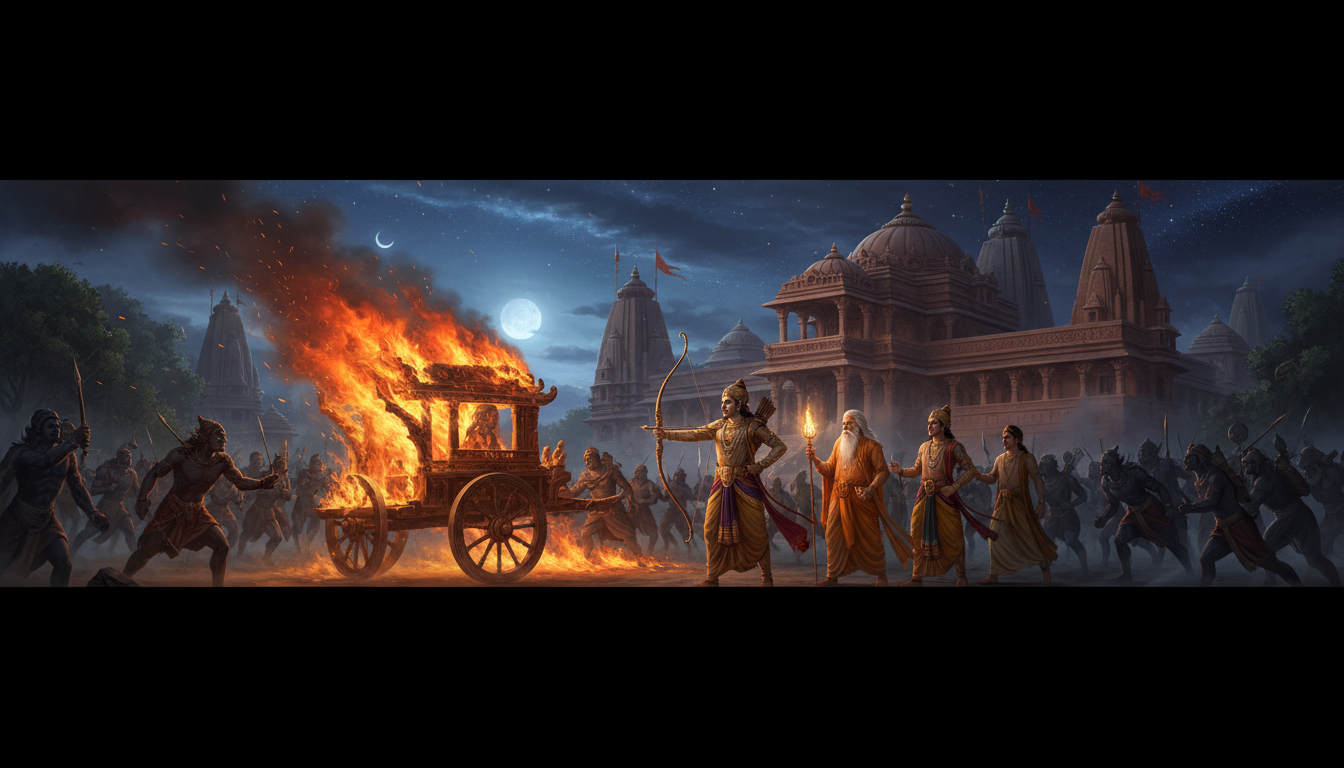
One Man Against an Army of the Night
Ashwatthama burns a full akshauhini of Ghatotkacha's rakshasas
Nobody Had Called a Halt
It was the only night of that war in which nobody called a halt.
The fourteenth day had run over into darkness because Arjuna's vow had eaten the whole of it, and when the sun went down the armies simply went on. Torches were tied to the cars and to the tusks of the elephants and to the shafts of the standards, and men fought by that light, and by the time the night was properly old they were fighting men they could not see.
Old Somadatta had spent it looking for Satyaki. His son Bhurishravas had been sitting on the ground in praya that afternoon, fasting toward death with his sword arm cut off, when Satyaki came and took his head, and the old man had sworn by his two sons and by all his meritorious acts that if he did not kill the Vrishni before this night passed he would sink into hell.
"Whether I fight with you or with others," Satyaki told him, "I never in my heart experience the slightest fear. You cannot frighten me with words that smack of battle. If you wish to fight me today, be cruel, and strike me with keen shafts, and I will strike you."
They were still at it when Drona came through and scattered the Pandavas around them like fire in a heap of cotton, and Arjuna turned to meet him, and Bhima turned after Arjuna, and the whole centre of that night collapsed into one place.
And Drona's son, seeing Satyaki in the middle of it, and remembering how the son of Somadatta had died, went for him in a rage.
The Car of Black Iron
He did not reach him. Something came across his path first.
Bhimasena's son, the rakshasa Ghatotkacha, rode a car made of black iron and covered over with the skins of bears. It measured thirty nalwas high and thirty across, and there were machines set into it in their proper places, and its rattle was the rattle of a mass of clouds. No horses were yoked to it and no elephants either, but beings that looked like elephants. On the tall standard a prince of vultures perched with its wings and feet spread and its eyes wide, shrieking. Red flags hung on it and the entrails of animals were looped along its sides. It ran on eight wheels.
And around it came a full akshauhini of rakshasas, armed with lances and heavy clubs and rocks and whole trees.
The man riding it looked like a mountain summit. He had terrible teeth and a fierce face, ears like arrowheads, high cheekbones, hair standing up off his scalp, awful eyes, a sunken belly, a blazing mouth as wide as a chasm, and a diadem on his head. Every creature that saw him was meant to be frightened, and most of them were.
Duryodhana's host became agitated like the current of the Ganga when the wind twists it into eddies. Elephants ejected urine where they stood. Kings began to tremble.
Then the rakshasas, who grow stronger as the night grows older, threw a thick shower of stones down onto that field, and after the stones a ceaseless fall of iron wheels and Bhundis and darts and lances and spears and Sataghnis and axes.
The kings ran. Duryodhana's brothers ran. Karna, in great pain, ran with them.
One man on that side of the field did not move, and it was the one who was always boastful about his own arms, and on that night he turned out to have been telling the truth.
The Wheel With a Thousand Spokes
Ashwatthama dispelled the illusion first, quickly, the way a man puts out a lamp he does not need, and then the two of them settled down to it.
Ghatotkacha put ten shafts fierce as poison into his chest, and the arrows went through Drona's son and came out dyed with blood and entered the earth like snakes going into an ant-hill. Ashwatthama, light-handed, answered with ten of his own into the rakshasa's vitals.
Then Ghatotkacha, in real pain, took up the wheel.
It had a thousand spokes and an edge sharp as a razor, and it was resplendent as the rising sun, and it was decked all over with gems and diamonds. He whirled it and let it go at the son of Drona.
Ashwatthama cut it into fragments with his shafts while it was still in the air, and it came down on the earth like the hope cherished by an unfortunate man.
Then Ghatotkacha's own son came into it. Anjanaparvan, grandson of Bhima and of Hidimbi, dark as a mass of antimony, checked the advance of Drona's son the way Meru checks the wind, and covered him with shafts until Ashwatthama looked like the mountain taking a rain-cloud on its shoulders.
He took the boy apart in the order a master does it. One shaft for the standard. Two for the two drivers. Three for the Trivenuka. One arrow for the bow, four for the four horses. Anjanaparvan, carless, took up a scimitar decked with golden stars, and it was cut in two in his hand. He whirled a gold-adorned mace and it was struck out of the air. He went up into the sky and roared like a cloud and threw trees down out of the darkness, and Drona's son pierced him in the air with his shafts the way the sun pierces a cloud with rays. He came down again onto his gold-decked car, and stood there, beautiful, like a hill of antimony on the surface of the earth.
Then the son of Drona killed him, cased as he was in his iron mail, as Mahadeva long ago killed the Asura Andhaka.
Sire and Son
Ghatotkacha came for him then, past his own dead child, and called out to him across the ground.
"Wait. Wait, son of Drona. You will not escape me with your life. I will kill you today as Agni's son killed Krauncha."
And Ashwatthama, who was at that moment burning the Pandava troops like a forest fire, answered him in a way that nobody expected and that is worth setting down exactly.
"Go, my son, and fight with others, you who have the prowess of a celestial. It is not proper that a sire should battle with a son. I cherish no grudge against you at all, son of Hidimva. But when a man's anger has been excited he may kill even his own self, so go."
It was refused, of course. It was always going to be refused. But the two of them stood there in the dark, on the worst night of that war, over the body of a boy one of them had just killed, and one of them offered the other a way out on the grounds of a kinship neither army recognised.
"Am I a coward in battle, son of Drona," Ghatotkacha said, "like some vulgar person, that you frighten me with words? Your words are improper. I was begotten by Bhima in the celebrated race of the Kurus. I am a son of the Pandavas, those heroes who never retreat. I am the king of the rakshasas, equal in might to the Ten-necked one. Wait. Wait, son of Drona. You will not escape me with your life. Today, on this field, I will put out your desire to fight."
And he came on like a lion at a prince of elephants, and began to pour down shafts as thick as the axle of a battle car, and the sparks where the two showers met made the sky over them look as if it were full of flies.
The Mountain and the Blue Cloud
Seeing his arrows checked in the air, Ghatotkacha made himself invisible and went back to what rakshasas are for.
He became a mountain. A high one, crowded with cliffs and with trees growing out of them, and it had fountains in it, and what flowed ceaselessly out of those fountains was spears and lances and swords and heavy clubs.
Drona's son looked up at that mass of antimony pouring weapons onto him and was not moved at all. He invoked the Vajra weapon, and the prince of mountains was struck with it and destroyed at once.
Then the rakshasa became a mass of blue clouds in the firmament with a rainbow across it, and began to throw down stones and rocks, and Ashwatthama aimed the Vayavya weapon at it and took the sky apart, and the cloud went out.
Then, covering all the points of the compass with his shafts, he killed a hundred thousand car-warriors.
After that he saw Ghatotkacha coming at him again without any illusion at all, bow bent, at the head of a great number of rakshasas riding elephants and cars and horses, Paulastyas and Yatudhanas both, with frightful faces and heads and necks, armed with every kind of weapon and cased in every kind of armour, swelling with rage. Their prowess was Indra's own. They were not creatures anyone defeats easily.
Duryodhana, looking at them, became exceedingly cheerless, and Drona's son said to him: "Wait, Duryodhana. You need have no fear. Stand aside with these your heroic brothers and these lords of earth. I will kill your foes. You shall not have defeat. I tell you truly. Meanwhile, reassure your troops."
"I do not regard what you say as at all wonderful," Duryodhana said, "since your heart is large, and your regard for us is great."
Then he sent his uncle Shakuni off with sixty thousand cars to deal with Arjuna, and stood aside, as instructed, and watched.
Vessels of Boiling Treacle
Ghatotkacha gave the order, and it was obeyed by rakshasas with bright teeth and large faces and long tongues and eyes blazing with wrath, who filled the earth with their roaring.
"Slay the son of Drona."
What they threw at his head, on that night, is worth listing in full, because it was aimed at one man standing in one car.
Hundreds and thousands of darts. Sataghnis. Spiked maces. Asanis. Long lances. Axes. Scimitars. Maces again. Short arrows and heavy clubs and battle-axes and spears and swords and lances and polished Kampanas and Kunapas and Hulas. Rockets. Stones. Vessels of boiling treacle. Thunas made of black iron. Mallets. All of them of terrible form and every one of them made to destroy a man.
The Kuru warriors watching that shower come down on Drona's son were much pained, which is to say they had already decided he was finished.
He destroyed the whole of it in the air with whetted shafts that had the force of the thunder in them. Then, with other arrows, equipped with golden wings and inspired with mantras, he began to kill the throwers.
He burned the akshauhini. All of it. Alone and unsupported, in the sight of the prince of the rakshasas who had brought it, he consumed that entire division with blazing shafts, and when it was done he stood in his car looking like the adorable Agni at the end of a Yuga, or like Maheswara in heaven after the burning of the triple city.
Among all those thousands of kings, and among the Pandavas too, there was not one man except Ghatotkacha himself who was able even to look at him.
The Asani With Eight Bells
The rakshasa struck his palms together, biting his lower lip, his eyes rolling, and told his driver to take him to the son of Drona.
When he was close enough he whirled and hurled a thing of celestial workmanship: an Asani, a thunderbolt, hung about with eight bells, which rang while it came.
Ashwatthama put his bow down on the floor of his car and jumped to the ground.
He caught it. He caught the falling thunderbolt out of the air with his hands, and turned, and threw it back at Ghatotkacha.
The rakshasa had already got down. That Asani of dazzling effulgence went past him and struck his car instead, and reduced it to ashes with its steeds and its drivers and its shrieking vulture standard, and then went into the ground and pierced the earth through.
Every creature watching applauded it, on both sides, without distinction.
Ghatotkacha went on foot to Dhrishtadyumna's car, and took up a bow there that resembled Indra's own, and the two of them fought Drona's son together, and Bhimasena arrived at that spot with a thousand cars and three hundred elephants and six thousand horses to help them do it.
And the son of Drona, who by then had been fighting without a break since the middle of the afternoon, went on as though he had begun a moment before, and fatigue never once appeared in him.
The Sons of Drupada, the Sons of Kuntibhoja
Then he began to take the Pandava princes off the field by name.
Suratha, son of Drupada. Satrunjaya, Suratha's younger brother. Valanika. Jayanika. Jaya. Then Prishdhra, and the proud Chandrasena. Then, with ten arrows, the ten sons of Kuntibhoja, one after another, in the order they came at him. Then Srutayus. Then the mighty Satrunjaya, with three keen shafts equipped with beautiful wings and red eyes, to the region of Sakra.
He caused a river to flow there. The blood of elephants and horses and men was its water; tall standards were its frogs and drums its great tortoises; umbrellas made its rows of swans and yak-tails its foam; kankas and vultures were the crocodiles in it and weapons the fish; dead elephants were the stones on its banks and the cars its broad unstable shores, and banners its beautiful rows of trees. It had marrow and flesh for mire and trunkless bodies floating for rafts and human hair for moss, and the ocean it flowed toward was the abode of Yama.
And then, with a fierce straight arrow drawn back to his ear, the rod of Death itself, he shot Ghatotkacha through the chest, and the shaft went through the rakshasa and through the earth beyond him, and the king of the rakshasas fell down on the floor of his car.
Dhrishtadyumna believed he was dead. He took him away out of the presence of Drona's son and had him laid on another car, and Yudhishthira's whole car-force turned away from that fight.
The earth around the son of Drona was strewn with fallen rakshasas pierced and mangled with hundreds of arrows, so thickly that it could not be walked over, as though someone had scattered mountain summits across it.
And the Siddhas and the Gandharvas and the Pisachas and the Nagas, and the birds, and the Pitris, and the ravens, and the cannibals and the ghosts, and the Apsaras and the celestials, all of them together applauded the son of Drona, which is not an audience any man on either side had drawn before.
It Took Four of Them
Seeing the sons of Drupada dead, and the sons of Kuntibhoja, and rakshasas in thousands, Yudhishthira and Bhimasena and Dhrishtadyumna the son of Prishata and Yuyudhana united together and set their hearts firmly on battle.
It took all four of them.
Old Somadatta came back at Satyaki in that press, still hunting him, and Bhima fought on Satyaki's side, and a parigha thrown by Bhima and a shaft loosed by Satyaki fell on the old man's body at the same moment and put him down. Valhika came at them for his son and Bhima's mace took his head off, and he fell like a tree struck by lightning. Ten of Dhritarashtra's sons attacked for that, and Bhima killed all ten, aiming at each one in turn, striking each in a vital part.
And Yudhishthira, in a rage, went into the Kuru ranks and cut down the Amvashthas and the Malavas and the Trigartas and the Sivis, and after them the Abhishahas and the Surasenas and the Valhikas and the Vasatis, until the earth around his car was miry, and around him men were shouting slay, seize, capture, pierce, cut into pieces.
Drona came for him, and the two of them held a conversation in weapons: the Vayavya, and the Varuna, and the Yamya, and the Agneya, the Tvashtra, the Savitra, and each one baffled as it arrived. Then the Aindra, and the Prajapatya, and Yudhishthira answered with the Mahendra. Then Drona invoked the Brahma weapon and a thick gloom came down over all of us so that we could not see what was happening, and every creature there was frightened, and the son of Kunti baffled that too with a Brahma weapon of his own, and the foremost warriors on both sides stopped to applaud the pair of them.
And after all of that, the thing that finally broke that battle was not a weapon.
The Bharata host, slaughtered by the diadem-decked Arjuna and overcome with sleep and with darkness, began to come apart. Drona tried to rally them. Duryodhana tried. It could not be done. Men who have been awake and fighting for a day and most of a night cannot be checked in their flight by anybody, and the night belongs, in the end, to whoever is least afraid of what it hides, and on that field it had not been the man-eaters.
Dharma Lesson
The night belongs to whoever is least afraid of what it hides, and on that field it was not the man-eaters. Ashwatthama stands where kings and Karna have already run, and offers his enemy a way out on the grounds of kinship before killing him. Courage of that kind is real and it is not the same thing as being right, and this war spends the whole of his on the wrong side.