The Arrows He Did Not Want to Shoot
Arjuna, Kripa, and a lesson in arms turned back on its teacher
Two Preceptors at Once
The head of the ruler of the Sindhus had just gone up off the field and come down in his father's lap, and the sun that everyone had believed was set was standing in the sky again, and for a moment nobody on either side seemed able to think of what to do next.
Kripa, the son of Saradwat, thought of something.
He came at Arjuna under the influence of wrath and covered him with a dense shower of arrows, and while that shower was still falling Drona's son rushed up on his own car from the other side, and the two of them began to shoot at the son of Pandu from opposite directions.
They were both very good. That was the difficulty. Arjuna, afflicted by those two arrowy showers coming at him at once from left and right, felt real pain, and there was nothing wrong with his archery and nothing wrong with theirs.
It should have taken him a short time to end. He had killed the two brothers of Avanti that same afternoon in about the time it takes to describe it, and he had gone through Kritavarman and Sudakshina and the Kamboja horse and the whole of the wheel-and-lotus array without stopping to think about any of it.
He looked across at the two cars and knew exactly who was in each of them.
In one was the man who had taught him, as a boy in Hastinapura, how to stand and how to hold and how to breathe out before the loose. In the other was the son of the man who had taught him everything after that.
And there was nowhere on that field to go. He could not withdraw, because the army behind him was fighting for its life in the last hour of the worst day it had had. He could not stand still and be shot from two sides by two men who did not miss. And the third option, which any other archer alive would have taken without a second's thought, was to kill them both, which would have taken him rather less time than it takes to say so.
Acting Like a Preceptor in Arms
Not wishing to kill his preceptor, and not wishing to kill the son of his other preceptor, Dhananjaya began to act like a preceptor in arms himself.
It is a particular thing that master archers do, and Kripa had been the first man to show him how it is done. You do not shoot to end the exchange. You shoot to answer. You take the weapon coming at you and you baffle it with your own, shaft against shaft, and you send back something that will make your opponent's position untenable without making him dead, and if it is done well the other man understands, and stops, and the thing ends the way a lesson ends.
So he baffled the weapons of both Ashwatthama and Kripa with his own, and then he sped at them shafts that coursed mildly.
That is the phrase Sanjaya used for it afterwards in the blind king's hall, and it is worth stopping on. He weakened them deliberately. He drew short. He put them out with less than his arm had in it, at two men who were shooting at his throat with everything they had, and he did it in the fifteenth hour of the fourteenth day of a war in which his son had been killed by six men in a circle the afternoon before.
He did it for a while. Long enough for the men watching to see what he was doing and to understand why.
It did not work.
A lesson only ends when the pupil agrees it has ended, and neither of the men in front of him had any intention of agreeing to anything. Kripa had stood in the Kuru line every day since the first morning without once being driven off it. Ashwatthama had been one of the six inside the wheel formation the previous afternoon when Abhimanyu was killed, and knew what the man opposite him had sworn about it. They were not going to notice a courtesy and stop.
The Number of Them
Those shafts were shot mildly. In consequence of their number, they struck the two with great force.
That is the whole mechanism of it and it is worth naming plainly, because it is the thing that happens to people who try to hold back inside an act that does not permit holding back. One weakened arrow does no harm. Two hundred weakened arrows arriving inside a minute do the work of two hundred arrows. He had drawn every one of them short and he had loosed a great many of them, and Gandiva shoots faster than the eye can follow the hand, and the arithmetic did not care what he had intended.
Great pain came to Kripa and to his sister's son.
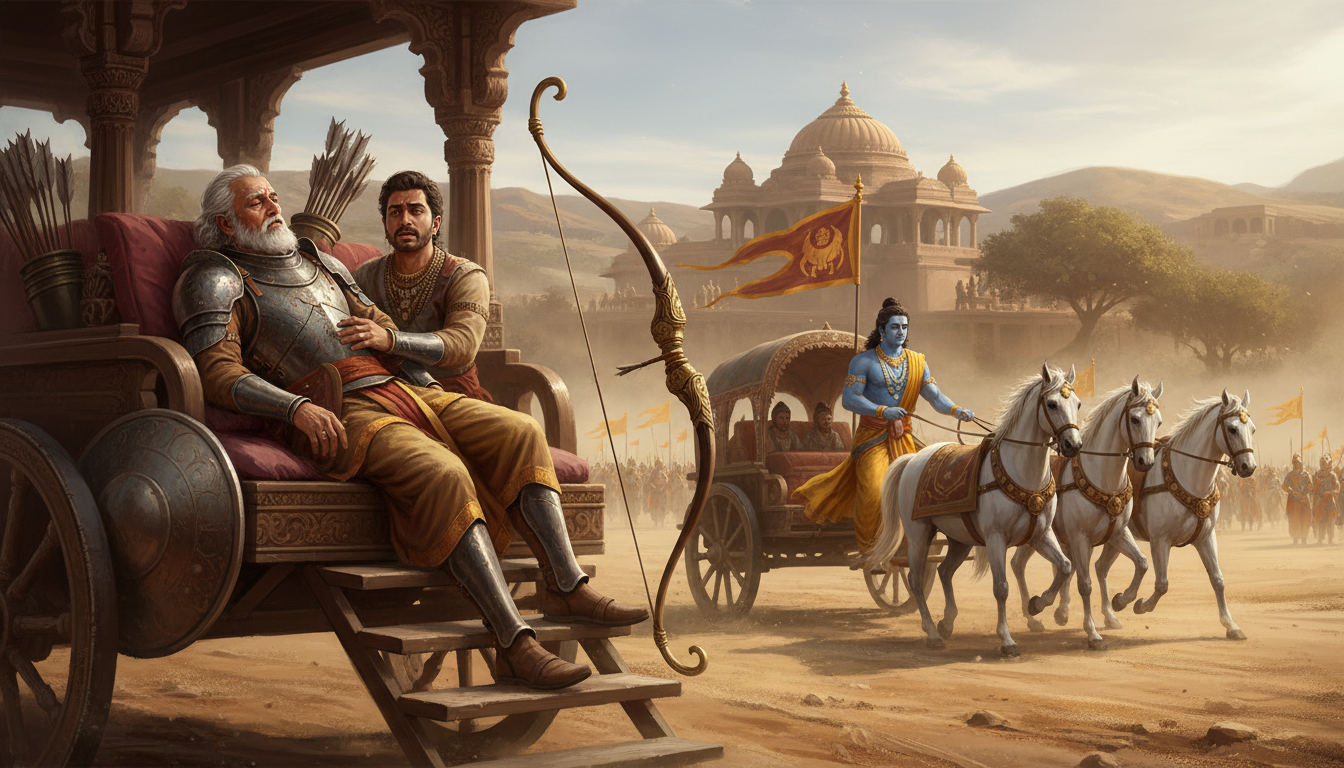
And then the son of Saradwat, afflicted with the arrows of Arjuna, lost all his strength. He was an old man by that stage of the war, born out of a clump of heath where his father had dropped the seed of him, raised in Bhishma's house, preceptor to every Kaurava and every Pandava alive; and he sat down on the terrace of his own car in the middle of a battle and his hands came off the bow, and he swooned away.
His charioteer, seeing his master struck with shafts and deprived of his senses, took him for dead. That is what a driver is supposed to conclude at that moment, and what he is supposed to do about it is not open to argument either. He turned the horses and bore Kripa out of the fight.
And Ashwatthama, watching the car go, and looking then at the man who had emptied it, was afraid of him for the first time in his life, and fled away from the son of Pandu.
Fie on the Practices of Kshatriya
The mighty bowman Partha stood in his car and watched the car of Saradwat's son go away across the field with a man lying in the bottom of it, and then he began to lament, out loud, with a tearful face, in front of everybody.
"When the wretched Suyodhana was born," he said, "Vidura, who is wise, saw all of this in his mind, and said to Dhritarashtra, 'Let this wretch of his race be killed at once. Owing to him a great calamity will overtake the foremost ones of Kuru's race.' Those were the words of a truth-telling man and they have come true. It is for him that I am looking at my preceptor today lying on a bed of arrows.
"Fie on the practices of Kshatriya. Fie on my might. Fie on my prowess.
"Who else but me would fight with a brahmana, who is besides his own preceptor? Kripa is the son of a Rishi. He is my teacher. He is the dear friend of Drona. And there he lies, stretched out on the terrace of his car, afflicted with my arrows.
"I did not wish it. I have still been the means of crushing him with my shafts. Lying senseless on the floor of his own vehicle, he pains my heart more than I can say.
"Even though he afflicted me with shafts, I should have only looked at that warrior of dazzling splendour and not struck him at all. I should have stood here and taken them. Struck with my arrows, he has gone the way of all creatures, and by that he has given me more pain than the slaughter of my own son gave me."
Krishna held the reins and let him say it. There were two armies within earshot and one of them was the enemy, and he did not tell him to lower his voice.
The Man Who Taught Me Not To
"Look at him, Krishna," Arjuna said. "Look at what he has been reduced to, lying there miserably and senseless on his own car.
"Those bulls among men who obtain knowledge from their preceptors and then give their preceptors the things they desire, those men attain to godhead. And those lowest of mortals who obtain knowledge from their preceptors and then strike them, those wicked men go to hell. Without any doubt at all, this act of mine will take me there. I have deeply pierced my own teacher on his car with showers of arrows.
"And I will tell you what he said to me. While I was studying the science of arms at his feet, Kripa told me, in those days, 'Do not, O you of Kuru's race, ever strike your preceptor.'
"That was the command of a righteous and high-souled teacher, and I have not obeyed it. I have struck the very man who gave it to me, with my shafts, today, in front of these armies.
"I bow to that worshipful son of Gotama. I bow to that hero who has never retreated from anything. Fie on me, O you of Vrishni's race, since I have struck even him."
There was no answer available to that and Krishna did not attempt one. The grief was accurate. Arjuna was not exaggerating his position and he was not looking for comfort; he was stating, correctly, that a thing had happened which could not be undone and for which the excuse was not sufficient.
It is the honest response, and it is worth noticing that it is the response of the best archer of the age to the discovery that skill is no protection at all against being made to do the unforgivable. There is no clean way to fight the people who made you. He did not pretend there was.
Karna Comes Across the Field
While Savyasachin was still lamenting for Kripa, the son of Radha saw that the ruler of the Sindhus was dead, and came.
He was not coming for Arjuna. He was coming for Satyaki, because Satyaki had killed Bhurishravas that afternoon while the man sat in praya with his arm cut off, and Karna could not bear it. Seeing him come, the two Panchala princes and Satyaki rushed out to meet him.
Arjuna saw the direction of it and smiled, and the smile had the whole of the last two days in it.
"There comes the son of Adhiratha against the car of Satyaki," he said to the son of Devaki. "He cannot bear the slaughter of Bhurishravas. Urge my steeds toward the spot where Karna is going. Do not let Vrisha send the Satwata hero after Bhurishravas."
Krishna did not turn the horses.
"The mighty-armed Satyaki is singly a match for Karna, son of Pandu," he said. "How much more will this bull among the Satwatas be, when he has the two sons of Drupada with him? For the present it is not proper for you to fight with Karna. He has that blazing dart with him, the one like a fierce meteor that Vasava gave him. He has kept it for your sake, and he worships it with reverence.
"Let Karna go freely against the Satwata hero. I know this wicked wight's hour, son of Kunti, and I know when it will come, and you will throw him down from his car with keen shafts on that day and not on this one."
The Car That Was Ordered the Night Before
In Hastinapura the blind king interrupted.
"Tell me how the battle went between the heroic Karna and Satyaki of the Vrishni race," Dhritarashtra said. "Satyaki had been made carless. What car was he mounted on? And how did the two protectors of Arjuna's wheels fight?"
"Listen patiently," Sanjaya said, "to the consequences of your own conduct.
"Before that encounter ever happened, Krishna knew in his heart that Satyaki would be overcome by the stake-bannered Bhurishravas. Janardana knows the past and he knows the future. So he had summoned his own charioteer, Daruka, and had commanded him: 'Let my car be kept equipped tomorrow.' That was the command of that mighty one, given the day before it was needed.
"So when Madhava saw Satyaki carless and Karna ready for battle, he blew his conch in the Rishabha note, once. Daruka heard it, understood what it meant, and brought that car with its lofty golden standard to where Kesava was, and with Kesava's permission the grandson of Sini went up into it.
"Four horses were yoked to it, going anywhere at will: Saivya, Sugriva, Meghapushpa, Valahaka, in trappings of gold. Riding in Krishna's own car, Satyaki went at the son of Radha scattering arrows without number, and Yudhamanyu and Uttamaujas left Arjuna's wheels and went with him."
The Whole Field Stopped to Watch
The battle that took place between them was of a kind nobody had heard of on earth or in heaven, between gods or Gandharvas or Asuras or Uragas or Rakshasas.
The entire host, cars and horses and men and elephants, stopped fighting to look at it. They watched the two warriors and they watched Daruka, who drove that car forward and backward and sidelong, now wheeling it in circles and now stopping it dead, and even the men who had been trying to kill Satyaki all afternoon were amazed at the driving.
Karna ground the grandson of Sini with his arrowy downpours, sighing like a great snake, casting angry glances at him as though he could burn him with looking, rushing at him again and again. Satyaki pierced him in return the way one elephant puts its tusks into another. Then, with shafts made entirely of iron, he struck Karna in all his limbs, and brought down Karna's charioteer out of his niche with a broad-headed arrow, and killed the four white horses, and cut the standard into a hundred pieces with a hundred arrows, and made Karna carless in the sight of Duryodhana.
Cries of Oh and Alas went up through the Kuru army. Karna, weakened and bleeding, climbed up into Duryodhana's car, breathing hard, remembering his friendship with that man from their childhood and the promise about sovereignty he had made and meant to keep.
And Dussasana and the other sons of Dhritarashtra came at Satyaki after that, and he made every one of them carless and did not kill one of them, because Bhima had sworn to kill them himself and Arjuna had sworn at the second game of dice to kill Karna, and Satyaki would not falsify another man's vow to decorate his own afternoon.
Drona's son came at him, and Kritavarman, and hundreds of the foremost Kshatriyas in that army, and he beat all of them with one bow, smiling while he did it, wanting nothing out of the day except the good of king Yudhishthira and, after that, heaven. There are three mighty bowmen in this world, Sanjaya told the old king that night, and they are Krishna and Partha and Satyaki, and there is no fourth to be seen.
Daruka's younger brother brought Satyaki another car when the fighting moved on, shafts lashed to it with chains of iron and gold and bands of silk, a thousand stars worked into it, a lion on the standard, horses fleet as wind in gold trappings, and a rattle in the wheels deep as thunder. A new car was brought for Karna too, four steeds of the best breed yoked to it, white as conchs or milk, its frame and standard gold, banners and machines on it and every kind of weapon stowed in it, and a good driver. Both men mounted and went back in. That is how that war worked. Nothing was ever finished, only re-equipped.
The Man He Wept For Was Not Dead
Kripa did not die that day.
His charioteer had believed it, and Ashwatthama had believed it, and Arjuna had believed it enough to say out loud in front of two armies that he was going to hell for it. But the son of Saradwat had only been driven out of his senses by the sheer count of the arrows, and he woke, and he was helped up, and within the day he was back at the front of the Kuru line, where he stayed until there was no line left. Of all the great names in that army he is one of three men who walked off the field at the end of everything.
So the grief was, in the narrow sense, mistaken. It was not wrong.
What Arjuna said standing in his car with tears on his face was the correct account of what he had done, and the fact that the old man happened to survive it does not amend a word of it. He had been taught by Kripa never to strike a teacher. He had spent an hour trying to obey that instruction inside a battle, drawing every shaft short so that it would not kill, and the battle had taken the compromise and turned it into two hundred arrows in an old man's body, which is what battles do to compromises.
There is no clean way to fight the people who made you. There is only the choice of what to say about it afterwards, and the honest thing to say is not that it was necessary, though it was, and not that he had no choice, though he had none. The honest thing is what he said: fie on me, since I have struck even him.
Then he wiped his face, and Krishna took up the reins, and the fighting went on into the dark.
Dharma Lesson
There is no clean way to fight the people who made you. Arjuna draws every shaft short so that it will not kill, and the battle takes his compromise and turns it into two hundred arrows in an old man's body. When that happens, the honest answer is grief and not justification, and he gives the honest answer in front of both armies.