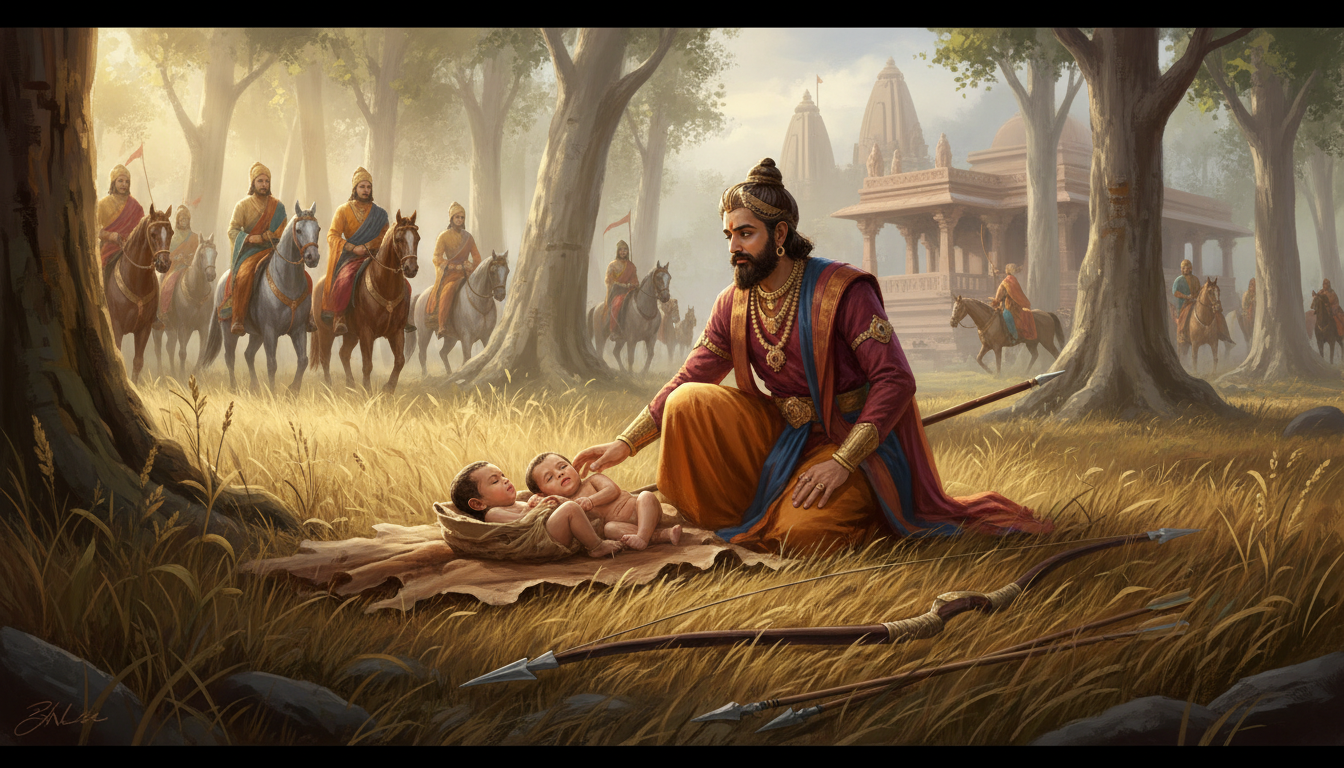
The Twins in the Heath
Indra's dancer, a sage's dropped bow, and the children a king carried home
A Preceptor for Idle Princes
The boys had reached the age at which a prince either learns a discipline or becomes a danger, and Dhritarashtra, who could not see them but who heard everything, had concluded that his hundred sons and his brother's five were well on their way to the second. They quarrelled in the courtyards. Bhima had already been tied and rolled into the Ganga while he slept and had come back out of the water stronger than he went in. Duryodhana had already put poison in his food a second time, fresh and virulent, and Bhima had swallowed it and digested it and said nothing, because Vidura had advised the sons of Kunti to keep their anger to themselves. The palace went on pretending that none of this was happening.
So the blind king did the one useful thing available to him. He sent for a teacher, and the teacher he sent for was a brahmana of his own city, learned in the Vedas, whom everyone called Gautama and everyone knew as Kripa. It was under him that the sons of Dhritarashtra and the sons of Pandu first took a bow into their hands and were told where to put their feet.
Generations later, at the great sacrifice, King Janamejaya raised a hand and stopped the recitation exactly there.
"O Brahmana," he said, "it behoves you to relate to me everything about the birth of Kripa. How did he spring from a clump of heath? Whence also did he obtain his weapons?"
Vaishampayana was pleased, because it was the right question and almost nobody asked it. Every court in the land could recite how Drona was born in a vessel and how Karna came down a river in a basket, and no one ever wondered about the quiet old man who had taught them all first.
"O king," he said, "the great sage Gautama had a son named Sharadvan. Hold the names lightly, for they tangle. The father was Gautama; the son was Gautama after him; and the son's son was Gautama in his turn, so that when a man in Hastinapura said Gautama he might mean an ascetic in a forest or a boy teaching princes how to string a bow. But the son's own name was Sharadvan, and he was born holding arrows."
Born Holding Arrows
He came out of his mother with arrows in his hands. That is the whole of what is recorded of Sharadvan's infancy, and it turned out to be the whole of his character as well.
His father put the hymns in front of him, as a brahmana father must, and Sharadvan learned them the way a man learns a road he does not intend to travel. He had no aptitude for the other sciences and no appetite for them either. Grammar slid off him. The chants he could repeat and could not love. But show him a bow and the boy became someone else entirely, patient past all reason, standing in one posture through the heat of a whole afternoon to feel how the string sat against three fingers.
What is strange is how he got his weapons, because he did not get them the way a warrior does. He never went to a master. He never stood in a line of students on a practice ground. He acquired every weapon he possessed by austerities - by the same fasting and silence and burning discipline through which brahmanas in their student years acquire the Vedas. He sat, and he starved, and he kept vows in the heat and the cold, and what came to him out of that furnace was not scripture. It was the science of arms, whole, with its invocations and its withdrawals and its mysteries, arriving in his mind as the hymns arrive in the minds of other men.
So he grew into a thing the world had not quite seen before: an ascetic whose accumulated merit had all gone into weapons. He wanted nothing. He asked for nothing. He owned a bow, a quiver, and a deerskin to sit on. He lived alone in a charming asylum in the woods with the tapas of a lifetime banked in him like a fire under ash, and he could have burned a city with it and had no intention of burning anything at all.
That last part was precisely the trouble. A man who wants heaven can be bought with heaven. Nobody had yet worked out what to offer a man who wanted nothing.
The Fear in Heaven
In Amaravati the news travelled the way such news always travels among the gods, as a rumour first and then as a calculation.
Indra had unseated no one and had been unseated often enough in his imagination to know the shape of it. He had watched ascetics climb toward him all his long reign, and he had a settled method for them: they wanted something, and heaven was made of everything anyone could want. A sage who has sat for a thousand years wants a throne, or a woman, or a son, or to be praised in the assembly of the gods, and the moment he wants it he is manageable.
Sharadvan wanted nothing, and he could shoot.
"He has taken the discipline that makes a brahmana," Indra said, "and he has spent all of it on arms. Consider what that means. The merit is a sage's and the hand is an archer's. There is no petition in him to grant, and nothing he has failed to obtain, and therefore nothing I hold that he needs. And every day he sits there the store of it grows."
So the chief of the gods sent for a celestial damsel named Janapadi, who was a dancer of the courts of heaven and had never been asked for anything harder than a dance.
"Go to the asylum of Gautama's son," he told her. "Do your best to disturb his austerities."
She did not argue. There is no record that she was consulted about the risk, no record that she asked for the wind or the god of love to go with her as a protection, no record that she asked anything at all. She was the first of the celestials, she was told to go, and she went; and the whole of what heaven required of her fitted into a single sentence.
So she came down out of the sky to the woods where the ascetic sat, alone, in a single piece of cloth, with the fire of a thousand mornings burning quietly a few paces in front of her.
The Bow Slips
She found him equipped as he always was, bow in hand and arrows beside him, sitting in the charming asylum he had made for himself where nothing came but deer and the noise of water.
Janapadi began to tempt him, and she did it the way her kind did it, without haste. There was no one else in those woods. There was no crowd for her to perform to and no rival to outshine. There was one man on a deerskin and a woman of a beauty that had no equal on earth, clad in one piece of cloth, moving in front of him among the trees.
Sharadvan looked up.
What happened in him at that moment is set down with an honesty that the later poets never improved on. His eyes expanded with delight. The bow and the arrows slipped out of his hand and lay in the grass. His whole frame shook.
And then the fortitude he had built with a lifetime of austerity took hold of him, and it held. That is the part usually forgotten. He was not overthrown. He did not rise and go to her. Possessed of ascetic strength of soul, he mustered patience enough to bear up against the temptation, and he bore it, and he did not touch her.
But the mind had already been shaken, and the body does not wait for permission. The suddenness of the agitation caused an emission of his vital fluid that he neither willed nor could prevent - the whole long discipline undone not by consent but by a single instant of surprise.
He understood what had happened at once, and what he did then tells you everything about the man. He did not curse her. He did not blast the woods, or the messenger, or the god who had sent her, though he had power enough in him to do all three.
He stood up and ran.
What He Left in the Grass
He left the bow. He left the arrows. He left the deerskin he had sat on for years, and he went away out of that asylum flying from the apsara, and he did not go back for any of it.
Janapadi had done what she was sent to do. Heaven says nothing further about her. She had been the instrument of the one hour that broke a man's vow, and there is no line anywhere recording what Indra gave her, or whether she asked for anything, or what she thought as she stood in an empty clearing looking at an abandoned bow. She goes back up into the sky and out of the story, and that silence is its own kind of testimony about what such errands cost the ones who run them.
And on the ground, where the sage's vital fluid had fallen upon a clump of heath, something was happening that nobody had intended and nobody was there to see.
It divided. It fell in two parts among the reeds, and out of the two parts came two children, twins, a boy and a girl, lying in the heath a few feet from a bow their father had dropped and would never pick up again.
They had a father who had run from the place of their making and did not know they existed. They had no mother at all. They had, for an inheritance, one bow, one quiver of arrows and one deerskin, laid out beside them in the grass as neatly as if someone had meant it as a message.
And nothing came for them. No beast, no bird. They lay in the clump of heath in the middle of a forest and waited, without knowing they were waiting, for whoever the world would send.
A Soldier Out Hunting
What the world sent was a soldier, on foot, in attendance upon King Shantanu of the Kurus, who was out hunting in those woods that day and had gone on ahead with the rest.
The man heard them before he saw them. He came through the heath expecting a fawn and found instead two infants lying in the reeds, and beside the infants a bow, a sheaf of arrows and a deerskin.
He was a soldier, so he read the ground the way soldiers do. He crouched and turned the bow over and looked at the wear on it, and he looked at the deerskin, and he did his thinking out loud, as men alone in forests often do.
"A deerskin means a brahmana," he said. "A bow like this one means a man who knows the science of arms as well as any kshatriya in the king's service. Both together mean one thing only. These are the children of some brahmana who was proficient in weapons, and he has left them here."
He did not go looking for the father. It was not his business to, and there was no one in that forest to find. He gathered up the two infants in the crook of his arms, and then, because it seemed to him wrong to leave them, he took the bow and the arrows too. Then he went and found the king.
Shantanu had spent his life among unaccountable things. He had married a goddess who drowned seven of his sons and walked away with the eighth; he had bargained his own throne away for a fisherman's daughter and watched his firstborn take a vow that ended the line. He was not a man easily astonished. But he looked at what the soldier was holding, two children in a hunting party's arms in the middle of a wood, with a stranger's weapons stacked beside them, and something in him gave way.
Named for Pity
"Let these become my children," said Shantanu.
He said it standing in a forest, with no counsellor near him and no assembly to approve it, and it was the sort of decision he had made before. Then he carried them home. That first of men, the son of Pratipa, brought Gautama's twins into his own house in Hastinapura and performed for them the usual rites of religion, exactly as they were performed for children of the blood: the ceremonies at the proper hours, the fire, the giving of the names.
And for the names he did a thing that was either very simple or very deep, depending on how long you look at it. He did not call them after a grandfather or a star or a virtue he hoped they would grow into. He called them after the reason they were alive.
Kripa means pity. He had brought them up out of pity, and so the boy was Kripa and the girl was Kripi, and every time anyone in the palace spoke to either of them for the rest of their lives, the word they used was the word for the mercy of a stranger.
They grew up in the Kuru house. Kripi would be given in time to Drona, that other child of a broken austerity, and would bear him Ashwatthama, so that the two most celebrated accidents of the Adi Parva ended by founding a family between them. Kripa would become what his blood made him.
But for now they were two foundlings in a royal nursery, and there was one thing they did not have, which was the science of arms. A bow had been carried in from the forest with them and set aside somewhere in the armoury. Nobody in Hastinapura yet knew whose it had been.
The Father Comes to the Gate
Sharadvan, meanwhile, had not stopped.
He had left his old asylum and never returned to it, and in whatever new place he settled he took up the study of the science of arms again in right earnest - not to recover what he had lost, which cannot be recovered, but because it was the only thing he had ever been able to do. And in the course of that discipline his spiritual insight came back to him, and one day it showed him a room he had never entered, in a city he had never visited, and two children in it who had his own face.
He went to Hastinapura and asked to be brought before the king.
What he said there was short. He did not explain himself, and he offered no apology to anyone, and he never once used the name of the woman.
"I am Sharadvan, son of Gautama," he said. "Those two children in your house are mine. I will tell you my lineage and you may test it against anything you know."
And he set it all out, the whole descent, plainly, the way a man reads out an inventory.
Then he asked for one thing, and it was not the children. He did not ask Shantanu to give them back. They had been named by a king, raised in a palace, given the rites; whatever they were now, they were that because of the pity of the house of Kuru, and Sharadvan appears never to have disputed it.
He asked to teach his son.
So the boy Kripa was put into the hands of the father who had run away before he was born, and Sharadvan gave him everything he had: the science of arms in all four of its branches, and the other branches of knowledge besides, with all their mysteries and their most recondite details, holding nothing back. It was the only form in which that man knew how to say anything, and he said all of it.
The First Teacher of the Kuru House
In a short time Kripa became an eminent professor of the science of arms, and after that the boys came.
The hundred sons of Dhritarashtra came. The five sons of Pandu came. The Yadavas came and the Vrishnis came, and princes from various lands whose fathers had heard that there was a man in Hastinapura who taught the whole science and not merely the parts of it that showed well in a tournament. They stood in his lines and held their bows the way he told them to hold them, and every one of them, on both sides, learned the first thing he ever knew about killing from the same quiet brahmana.
Afterwards Bhishma looked for a greater teacher still and found Drona at the mouth of a well, and Drona took the princes further than Kripa could. But Kripa was there first, and Kripa was there last. He taught Arjuna and he taught Duryodhana. He fought on the Kaurava side out of the debt of a lifetime's salt, and when the war had eaten Bhishma and Drona and Karna and every one of the hundred, he was one of three men left standing in the whole Kaurava host, and he lived on into a new age to teach Parikshit, the grandson of his own pupils.
"So he sprang from a clump of heath," said Vaishampayana, "as you asked, O king. And his weapons came to him out of his father, who had them out of austerities, who lost those austerities in a single instant to a woman sent by a frightened god."
Janamejaya sat with it a moment.
A vow had been broken. That was not undone and never would be. But out of the breaking came two children a king pitied, and out of the pity came a teacher, and out of the teacher came every archer who would stand on that field one day and shoot at his own cousins. Sharadvan never meant to make a single life. He made two, and between them they armed an entire age.
Dharma Lesson
A vow broken by one instant of surprise is still broken, and Sharadvan neither excused it nor cursed the woman sent to break it. But the accident bore fruit that served the world: the two lives he never meant to make became the teacher of every prince on both sides of the war, and the mercy of a passing king turned an abandoned pair into a lineage.