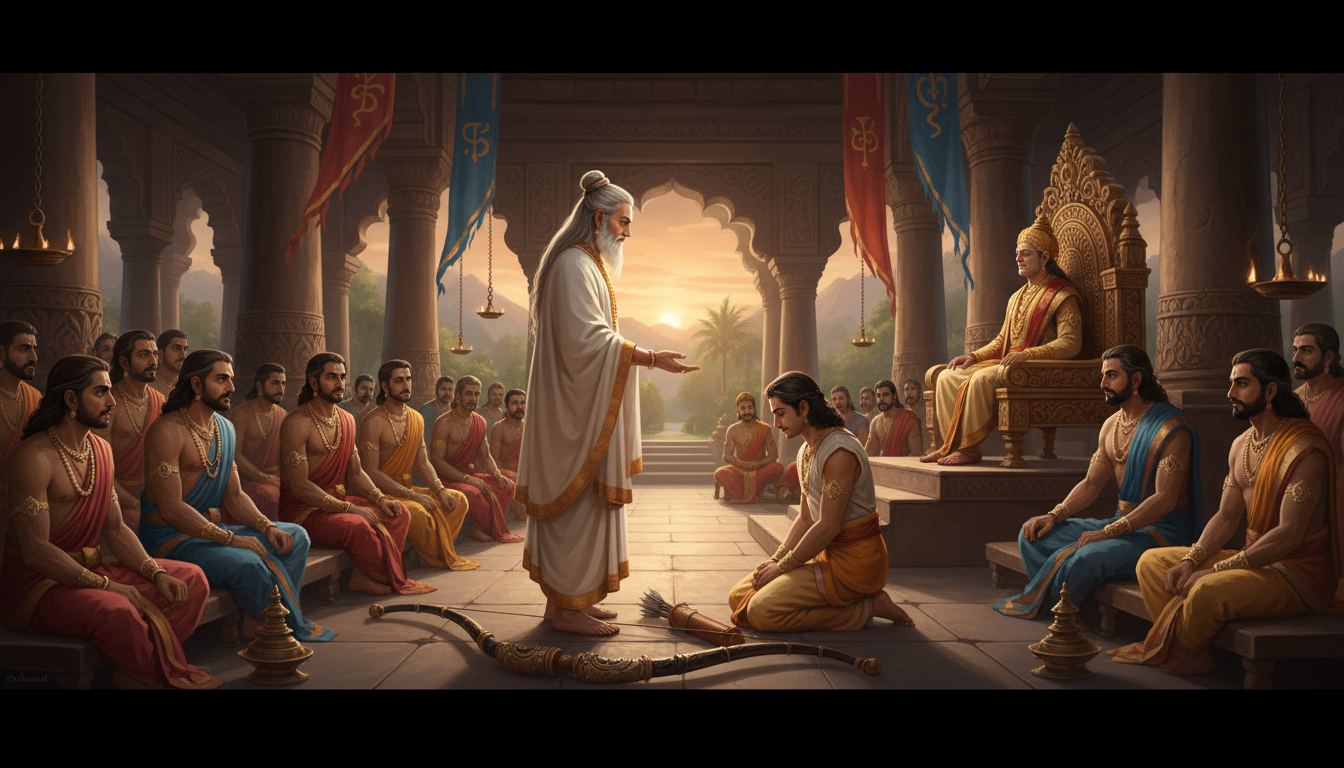
The Heir Apparent
A crown promised, a second fee demanded, and the conquests that frightened a blind king
A Year After the Arena
After the expiration of a year from all that (said Vaishampayana), king Dhritarashtra, moved by kindness for the people, installed Yudhishthira the son of Pandu as heir apparent of the kingdom.
Understand the year, O Janamejaya. The dust of the tournament ground had been swept up. Karna had a kingdom in Anga and a friend in Duryodhana. Drupada was a defeated man in half a realm, and the boys who had defeated him were no longer boys. The city had spent twelve months deciding, in the way cities decide such things, without a vote and without a herald, whose son it wanted.
And the blind king, who heard everything precisely because he saw nothing, heard what the people had decided, and did the thing they wanted before they could ask him for it.
They made the installation in the hall of the Kurus with the whole house present. Water was poured. The old formulas were spoken. Yudhishthira, the eldest son of a dead man, stood up from the seat of a prince and sat down in the seat of the heir apparent of the Kuru kingdom, and the shout that went up from the courtyard was not a courteous shout.
Dhritarashtra sat through it with his hands on the arms of his throne and his face composed. He had a hundred sons. The eldest of them was standing four paces away, watching a cousin be given the thing he had been raised from birth to expect.
Nothing whatever was said about it that day. Nothing needed to be.
And it should be said, O king, that Dhritarashtra was not pretending. The account is careful about his motive and gives it in three words: moved by kindness for the people. He had watched the city through a year of quiet argument and had concluded that the people would be better governed by his brother's son than by his own, and he acted on that conclusion at the cost of everything he privately wanted. Very few men in this history do a thing so plainly against themselves. It is the last unambiguously generous act recorded of him, and he had the rest of his long life to think about it.
The Qualities They Counted
It is worth saying why they chose him, O king, because the reasons were listed at the time and they are not the reasons men usually give for a crown.
He was installed on account of his firmness. On account of his fortitude, which is a different thing and rarer. On account of his patience, his benevolence, his frankness, and his unswerving honesty of heart. Not his bow. Not his birth, which was contested in whispers anyway. Not his mother's family. Six qualities, and every one of them a quality of temper rather than of arms.
And within a short time Yudhishthira the son of Kunti, by his good behaviour, his manners, and his close application to business, overshadowed the deeds of his father.
That sentence is easy to read past. Do not read past it. It means that men who came to the hall with a boundary dispute or a grain levy or a widow's claim began to come at the hour when the young man sat, and not at the other hour. It means that the officers who kept the accounts found that the heir apparent had read them. It means that when the name Pandu was spoken in Hastinapura it began, quietly and then not so quietly, to be spoken as the name of the father of somebody rather than as the name of a king.
There is a particular sort of ruin in being outshone by a young man who is not trying to outshine you. Yudhishthira was not campaigning. He answered what he was asked, took the work that was put in front of him, and gave the credit away, and the effect of that on his standing was worse than any amount of ambition would have been, because there was nothing in it anyone could object to out loud.
Pandu had been dead for years and could not be injured by it. There was another man in that palace who could.
Bhima and the Ploughman's Brother
The second Pandava, Vrikodara, was in the meantime receiving continued lessons from Sankarshana.
Balarama came to Hastinapura for it, the elder brother of Vasudeva, the man with the plough and the pestle, the first mace-fighter of the age and the only teacher living who could give Bhima anything he did not already have. He taught him three things and taught them for years: encounters with the sword, encounters with the mace, and the handling of a chariot.
The mace was the heart of it. Bhima had always been able to break a man with one; what Balarama gave him was the difference between breaking a man and choosing where. The circling. The change of grip. The moment of standing perfectly still that comes before the only blow that will be thrown. There were mornings on the practice ground when the two of them worked for an hour and did not strike once.
"You have strength enough for three men," the teacher told him. "Every fool on this field knows it, including you. Strength that everyone can see is a strength anyone can plan for."
When his education was finished Bhima had become in strength like Dyumatsena himself, and he continued to live in harmony with his brothers, and began to exert his prowess.
That last is the part I would have you mark, O Janamejaya. Living in harmony with his brothers was recorded as an achievement of the same order as the mace. In that household, with that temper, it was one.
The Twins Take Their Portions
The sons of Madri took what was theirs, and what they took tells you what they were.
Sahadeva, the youngest, obtained the whole science of morality and duties from Vrihaspati, the spiritual chief of the celestials. Consider who that preceptor is. Not a weapons master. The teacher of the gods themselves, the priest of Indra's court, and the boy sat before him and received the entire body of what may be done and what may not be done and why, root and branch, the science that kings pay brahmanas to remember for them.
And having received it, he continued to live under the control of his brothers. He said nothing. For the rest of his life the youngest of the five would know the answer to almost any question of duty that could be put to him, and would wait, in nearly every case, to be asked.
Nakula, the favourite of his brothers, was taught by Drona, and became known as a skilful warrior and a great car-warrior, an Ati-ratha, which is to say a man reckoned able to hold his chariot against ten thousand ordinary fighters at once. He was the handsomest man in the palace and the best horseman in it, and the rank came to him without noise.
So the house stood: the eldest given the kingdom for his honesty, the second given the mace by Rama's own hand, the twins given morals and horses and rated among the great chariot-fighters of the age.
And the third, O king, was another matter altogether.
What Drona Certified
Arjuna in those years became celebrated for four things, and men who had spent their lives on the practice ground argued about which of them was the greater.
The first was the firmness of his grasp: the bow did not move in his hand, not at the loose, not at the shock, not when the string came back along his arm. The second was the lightness of his motion, so that no watcher could say at what instant the arm had gone to the quiver and returned. The third was the precision of his aim, which had long since stopped being remarkable and had become a thing simply assumed of him, the way one assumes water is wet. The fourth was range: he was proficient with the Kshura and the Naracha, with the Vala and the Vipatha, and with all weapons whatsoever, whether straight or crooked or heavy, and there was no shape of iron that had to be explained to him twice.
And Drona certified it. That is the word for it, O Janamejaya, and it should be understood as a formal act. The preceptor of the Kuru house, who had taught every prince in it and had reason to be tactful about all of them, stated publicly that there was none in the world equal to Arjuna in lightness of hand and general proficiency.
A hundred and five young men heard their teacher say it. Some of them had been on the field with Arjuna that morning. Drona did not soften it, and did not add a name beside his, and did not look at Duryodhana while he said it.
The History of the Brahmasira
One day Drona called Arjuna before him with the Kaurava princes assembled all around, and did not begin with a lesson. He began with a history, which in that house was always the more dangerous thing.
"There was a disciple of Agastya in the science of arms," he said, "called Agnivesa. He was my preceptor and I was his disciple. By ascetic merit I obtained from him a weapon called Brahmasira, which can never be futile, which is like unto thunder itself, and which is capable of consuming the whole earth."
Nobody in the circle moved. They had heard the name. None of them had ever heard him say out loud that he had it.
"That weapon," said Drona, "from what I have done, may now pass from disciple to disciple. And when he imparted it to me my preceptor said this: 'O son of Bharadwaja, never should you hurl this weapon at any human being, and least of all at one who is of poor energy.'"
He let that stand a moment before he went on.
"You have obtained that celestial weapon, hero. None else deserves it. But obey the command of the rishi."
So it was done in the open, in front of the sons of Dhritarashtra, and every one of them understood exactly what had just been given and to whom, and that it had not been offered to any of them. Duryodhana stood in that circle and heard his own teacher hand the fire that consumes the earth to the son of Kunti, with a warning attached to it that assumed the receiver would be tempted to use it on somebody weaker.
And Drona was not finished.
The Second Fee
"And look here, Arjuna," said the preceptor. "Give me now the preceptorial fee, in the presence of these your cousins and your relatives."
There had been a fee once already. The whole house remembered it: Drupada's kingdom, taken by these same students and laid at this same teacher's feet, the debt of a lifetime's teaching discharged in a single campaign. Nobody had expected a second demand, and nobody had ever heard of a preceptor taking his fee twice.
Arjuna did not hesitate for the length of a breath.
"Ask," he said, "and I pledge my word that I will give whatever the preceptor demands."
And Drona said: "O sinless one, you must fight with me when I fight with you."
Say it over, O Janamejaya, because it is a small sentence and it is the hinge of everything that came after. Not that you may fight me. Not that you shall be permitted to defend yourself. You must. The old man had looked far enough down the road to see the day when he would stand on one side of a field and this boy on the other, and he had decided, in advance, in public, that he would not have his best pupil hanging back out of tenderness and getting himself killed for it, and that he would not himself be spared.
That bull among the Kuru princes pledged his word to Drona. Then he bent and touched his teacher's feet, and rose, and went away northward, and neither of them said anything more about it for the rest of their lives.
Years afterward, on the fifteenth day at Kurukshetra, the fee was called in and paid in full.
The Shout That Covered the Earth
Then there arose a shout, and it covered the whole earth bounded by her belt of seas: that there was no bowman in the entire world like unto Arjuna.
It did not come from Hastinapura. That is the thing about it. It came back to Hastinapura, the way weather comes, from the trade roads and the river ferries and the courts of kings who had never seen the young man and had no interest in the Kuru succession. A merchant repeated it in Kashi because he had heard it in the west. A charioteer repeated it in the south because it had been told to him as a fact about the world, like the height of the Himavat.
And it was earned in the only currency such shouts are earned in. In encounters with the mace, with the sword, on the chariot, and above all with the bow, Dhananjaya acquired a proficiency that men who had held weapons for forty years described as wonderful, using that word and no other, because they had run out of the ordinary ones.
In the hall of the Kurus the reports arrived and were read aloud, as reports are. The heir apparent listened to them with pleasure. Bhima listened to them with pleasure. Dhritarashtra listened to them from a throne he had been given because his elder brother was born with eyes, and said, each time, that it was excellent news for the house, and meant it, and went on sitting there afterwards for a long while.
The King Pandu Could Not Subdue
And then the Pandava princes became so powerful that they went out and took the country the old king had failed to take.
They slew in battle the great Sauvira, a man who had performed a sacrifice extending over three full years and had gone on with it undaunted by the raids of the gandharvas, which is to say a man whom the celestial powers themselves had harassed and not moved. He was killed by boys.
The king of the Yavanas, whom the powerful Pandu even had failed to bring under subjection, was brought under control by Arjuna. Mark the phrasing, O king. The chroniclers did not say conquered. They said that what Pandu had attempted and left unfinished, his son finished, and they set the two names in the same sentence so that nobody could miss it.
Vipula, king of the Sauviras, endued with great prowess, who had always shown an open disregard for the Kurus, was made by the intelligent Arjuna to feel the edge of his power. Sumitra of Sauvira, also known by the name of Dattamitra, who had resolutely sought an encounter with Arjuna and had said so where it would be repeated, was repressed by means of arrows and did not seek another.
Then the third of the Pandava princes, assisted by Bhima, on a single car, subjugated all the kings of the East, and the kings of the East were backed by ten thousand cars. And having conquered the whole of the south, again on a single car, Dhananjaya sent home to the kingdom of the Kurus a very large booty.
So did those foremost of men extend the limits of their own kingdom by conquering the territories of other kings. The treasury filled. The maps were redrawn. The Kuru house had not been so safe in three generations.
The King Who Could Not Sleep
But beholding the great prowess and the strength of those mighty bowmen, the sentiments of king Dhritarashtra towards the Pandavas became suddenly poisoned.
Suddenly, O Janamejaya. Not gradually. There was a day. Something was carried in and read to him, another kingdom, another shout, another wagon train of tribute coming up the road from the south with his nephew's name on it, and the man who had spent a year being kind to the people and had installed the best of the boys as heir apparent because it was right listened to it, and the taste in his mouth changed, and did not change back.
And from that day the monarch became so anxious that he could hardly sleep.
That is all the account says of it, and it says it in the same flat voice it uses for the lists of weapons. A blind man lying awake at night in a palace that was safer and richer than it had ever been, listening to the watch called on the walls his nephews had made secure, doing sums about his own hundred sons.
Everything after this comes out of those nights. The counsel of Kanika comes out of them. Varanavata and the house of lac come out of them. When you hear, later, that the king wept and said he had been unable to prevent it, remember that the poison went in here, in a year of victories, when nobody had wronged him and nothing had gone wrong.
The same excellence that had made his house safe was the thing that taught him to be afraid of it. There is no remedy recorded for that, in this book or in any other.
Dharma Lesson
A promise given to a teacher out of gratitude can become the instrument of his death, and a good man should look hard at what he is pledging before he pledges it. The same excellence that makes a house safe is what teaches the frightened to fear it, and no victory ever cured a mind that had already decided to be afraid.