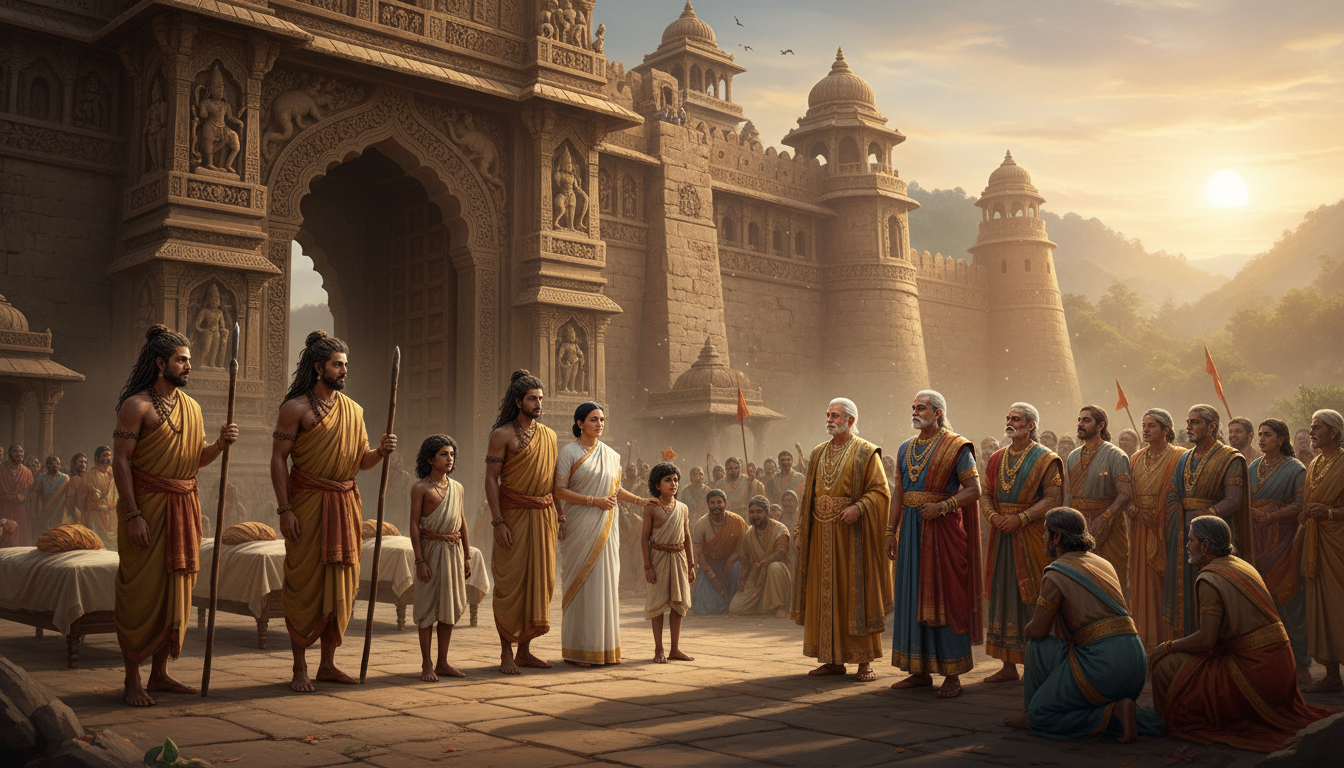
A Trust Left in Our Hands
On the mountain of a hundred peaks the ashes had gone cold, and the godlike Rishis who lived there met to decide what to do about a widow and five boys.
They were Siddhas and Charanas, wise in counsels, crowned with ascetic success, and none of them had ever had to think about a problem of this kind before. They dealt in penances and in the movement of the seasons. They did not deal in inheritance.
"The virtuous and renowned king Pandu," one of them said, "abandoned both sovereignty and kingdom and came here to practise ascetic austerities, and resigned himself to the ascetics dwelling on this mountain. He has ascended to heaven from here, leaving his wife and his infant sons as a trust in our hands."
That was the word they settled on. A trust. Not orphans, not refugees, not a burden: a thing deposited with them by a man who had trusted them, which they were now obliged to deliver.
"Our duty now is to repair to his kingdom with these his offspring, and his wife."
There was no argument recorded. They summoned one another, the whole community of them, and resolved to go to Hastinapura with Pandu's children walking ahead of them, so that everyone on the road would see who was being brought and in what order. They meant to place the boys into the hands of Bhishma and Dhritarashtra themselves, and not into the hands of anybody's servant.
And they set out that very moment. They did not wait for a better season. They took the children, and they took Kunti, and they took the two dead bodies, which had been burnt on the mountain but not consumed, and they went down.
The Road Down
Kunti had not walked a hard road in her life.
She was a king's daughter twice over, born to the Yadavas and given away to Kuntibhoja, married into the greatest house in the land, and even the years on the mountain had been a retreat rather than a hardship, with ascetics to feed them and no distance to cover that could not be covered before dark. Now she came down out of the Himavat on foot, over passes and along river courses, in company with a moving forest of matted-haired sages, with two bodies carried behind her and five children in front.
The eldest of those children was a boy. The youngest two could barely keep the pace. Yudhishthira had been born on that mountain and had never seen a city; Nakula and Sahadeva had never seen anything but a hermitage and the woman who had chosen to burn rather than come with them.
And the journey, which was very long, seemed to Kunti very short.
That is the line the story gives, and it does not explain itself, and it does not need to. She was walking toward the house that had sent her husband away, carrying his ashes and his sons, to stand at a gate and ask a court to acknowledge five boys whose fathers, she alone knew, were not the man in the bier. Every step of that road was one step nearer to the moment when someone would ask her a question she had no proof to answer. Unused to toil all her life, she now regarded as very short the really long journey she had to perform.
At the Principal Gate
They came into Kurujangala within a short time, and the illustrious Kunti presented herself at the principal gate of Hastinapura.
She did not send a rider ahead. She did not go around to a side entrance and ask for Vidura quietly, which she could have done and which would have been easier for everyone. She stood at the main gate of the capital, in whatever clothes she had walked down the mountain in, with her sons around her, in front of a wall of thousands of ascetics.
The ascetics charged the porters to inform the king of their arrival.
The men carried that message into the court in a trice, because it was not the kind of message a porter walks with. The court had been told, seventeen days before, nothing at all. As far as Hastinapura knew that morning, Pandu was alive on his mountain, as he had been for years, and the whole matter of the succession was a thing that could go on being postponed.
And then the news went out into the city, and the city did not stay in its houses. Word ran through the wards that thousands of Charanas and Munis were standing outside the walls, and the citizens were filled with wonder, because such a thing had not happened in living memory. Ascetics came to Hastinapura one at a time, if they came at all. They did not come as a nation.
So the people began to come out to see them, with their wives and their children, and it was soon after sunrise.
The City Comes Out
They came out in thousands, in every kind of car and conveyance the city owned.
Vast numbers of Kshatriyas came with their wives. Brahmanas came with theirs. The concourse of Vaisyas and Sudras was as large as either, and nobody sorted anybody, and there was no procession and no precedence, because it had all happened too fast for anyone to arrange it.
And the vast assemblage was very peaceful. That is the detail worth holding on to. Take twenty thousand people out of a city at sunrise with no warning and put them on open ground, and you should get a crush and a riot and thieves working the edges. What Hastinapura got was quiet. Every heart there was inclined to piety that morning, and the crowd stood the way a crowd stands in a temple.
They were looking at the sages. They did not yet know what the sages had brought.
Somewhere in the middle of that ground, in front of the whole assembled body of the ascetics, stood a woman nobody had seen for years and five boys nobody in the city had ever seen at all: one of about sixteen, one enormous, one who looked at everything, and two small ones holding hands. Behind them, covered, lay two bodies.
Then the gates of the palace opened, and the house of Kuru came out to meet them.
The House of Kuru Sits Down on the Ground
Bhishma came, the son of Shantanu, who had given up a throne and a marriage and had been holding this family together for three generations by the sheer weight of a vow.
Somadatta came, and Bahlika. The royal sage Dhritarashtra came, blind and endued with the vision of knowledge, on someone's arm. Vidura came. The venerable Satyavati came, who had been a fisherman's daughter and had outlived her sons and was now watching her line be carried in from a mountain by strangers. The illustrious princess of Kosala came, Ambalika, who was Pandu's mother. Gandhari came with the other ladies of the royal household, her eyes bound as they had been since her wedding day. And the hundred sons of Dhritarashtra came out too, decked in various ornaments, dressed that morning for a spectacle, to look at the five who had arrived.
Then the Kauravas, with their family priest, saluted the Rishis by lowering their heads, and took their seats in front of them.
That is not a small sentence. The ruling house of the Kurus sat down on the ground, in the open, in front of a body of forest ascetics, in the sight of every citizen who had come out to watch. The citizens saluted the ascetics too, and bowed with their heads touching the earth, and took their seats.
Bhishma set that whole vast concourse perfectly still. Then he worshipped the ascetics as a host must, with water for their feet and the customary arghya, and he began to speak to them of the sovereignty and the kingdom, because he did not yet know why they had come and he assumed it must be about the state.
And the oldest of the ascetics stood up.
The Oldest Ascetic Names the Fathers
He had matted locks on his head and an animal skin about his loins, and he spoke with the concurrence of every other Rishi standing behind him, and what he said was a legal instrument.
"You all know," he began, "that the possessor of the sovereignty of the Kurus who was called king Pandu had, after abandoning the pleasures of the world, repaired hence to dwell on the mountain of a hundred peaks. He adopted the Brahmacharya mode of life."
He said it plainly, in front of everybody, because everybody would work out the arithmetic sooner or later and it was better done here. Pandu was celibate. Pandu was under a curse and could not touch a woman and had not. Therefore the five boys standing in front of you were not begotten by him, and here is how each one came.
"But for some inscrutable purpose the gods have in view, this his eldest son, Yudhishthira, was born there, begotten by Dharma himself.
"Then that illustrious king obtained from Vayu this other son, the foremost of all mighty men, called Bhima.
"This other son, begotten upon Kunti by Indra, is Dhananjaya, whose achievements will humble all bowmen in the world.
"Look here again at these tigers among men, mighty in the use of the bow: the twin children begotten upon Madri by the twin Ashwins."
Five boys, five fathers, each named aloud with the mother named beside him, in front of the grandsire, the blind king, the queen mother, the hundred cousins and the entire population of the capital. There would be no version of this story circulating afterwards in the markets that the court could deny, and no version the court could invent.
"Leading in righteousness the life of a Vanaprastha in the woods," the old man finished, "illustrious Pandu has thus revived the almost extinct line of his grandfather. The birth, the growth and the Vedic studies of these children of Pandu will, no doubt, give you great pleasure."
Seventeen Days Ago
Only then, having established who the boys were, did the ascetic tell the court that Pandu was dead.
"Steadily adhering to the path of the virtuous and the wise, and leaving behind him these children, Pandu departed hence seventeen days ago."
Seventeen days. That is how long the news had been on the road, and how long a queen mother in Hastinapura had gone on not knowing that her son was ashes.
"His wife Madri, beholding him placed on the funeral pyre and about to be consumed, herself ascended the same pyre, and sacrificing her life has gone with her lord to the region reserved for chaste wives."
Then he came to the practical business, which was why they had carried the burden down a mountain instead of finishing it up there.
"Accomplish now whatever rites should be performed for their benefit. These are the unburnt portions of their bodies. Here also are their children, these oppressors of foes, with their mother. Let these be now received with due honours. And after the completion of the first rites in honour of the dead, let the virtuous Pandu, who had all along been the supporter of the dignity of the Kurus, have the first annual Sraddha performed, with a view to installing him formally among the Pitris."
He had brought them the body, the widow, the heirs and the ritual calendar, and he had certified all of it in public. There was nothing left to hand over.
And then, having said this to the Kurus, the ascetics with the Guhyakas instantly disappeared in the very sight of the people.
The whole assembly of them, the thousands. Gone between one breath and the next, like vapoury forms that appear in the sky and are not there. The citizens, filled with wonder, went back to their homes; and every single one of them had witnessed, with their own eyes, exactly who those five boys were and who had vouched for them.
The Blind King Gives Orders
What was left on that ground when the sages vanished was a family with a funeral to arrange, and Dhritarashtra, who could not see any of it, began giving instructions.
"O Vidura," he said, "celebrate the funeral ceremonies of that lion among kings, Pandu, and of Madri also, in right royal style. For the good of their souls, distribute cattle, cloths, gems and diverse kinds of wealth, every one receiving as much as he asks for."
Every one receiving as much as he asks for. It is an extravagant order and he meant it to be. His brother had left the throne to him and had died in a forest, and the only thing left that Dhritarashtra could still give him was scale.
"Make arrangements also for Kunti's performing the last rites of Madri, in such a style as pleases her."
That clause is Kunti's alone. The second queen, the one who had claimed the pyre and handed over her sons, would be sent on by the first, in whatever manner the first thought right, and no man of the house would arrange it for her.
"And let Madri's body be so carefully wrapped that neither the Sun nor Vayu may behold it."
Then the blind king said the thing that had to be said out loud before anyone could move.
"Lament not for the sinless Pandu. He was a worthy king, and he has left behind him five heroic sons, equal to the celestials themselves."
And Vidura said, "So be it," and went out with Bhishma to fix upon a sacred spot for the rites. The family priests left the city without loss of time, carrying the blazing sacred fire in front of them, fed with clarified butter and made fragrant with it.
The Procession to the River
They wrapped the body of the monarch in cloth and decked it with the flowers of the season, and sprinkled various excellent perfumes over it, and dressed the hearse itself with garlands and rich hangings. Then they placed the covered body of the king, and that of his queen, on that bier, and men carried it out on their shoulders.
The white umbrella of state went over the hearse, held above a dead man as it had been held above a living one. Waving yak-tails went beside it. Musical instruments sounded the whole length of the road. Hundreds of people walked along the route distributing gems into the crowd, and more beautiful robes and more white umbrellas and larger yak-tails were brought up for the ceremony as it went. The priests, clad in white, walked at the head of the whole procession, pouring libations of clarified butter into the sacred fire that blazed in its ornamental vessel.
And behind them came the city. Brahmanas and Kshatriyas and Vaisyas and Sudras, by thousands, following the deceased king and wailing aloud as they went, and what they cried was not a formula.
"O prince, where do you go, leaving us behind, and making us forlorn and wretched for ever?"
Bhishma wept. Vidura wept. The five boys walking behind their father's bier through a city they had entered that same morning wept with them.
At last they came to a beautiful wood on the banks of the Ganga, and there they set the hearse down. They brought water in many golden vessels and washed the prince's body, which had been smeared with fragrant pastes, and smeared it again with sandal, and dressed it in a white dress made of the fabrics of his own country. And with the new suit on him, the king looked as if he were living, and only sleeping on a costly bed.
Twelve Days on the Bare Ground
When the other ceremonies had been finished in accordance with the directions of the priests, the Kauravas set fire to the bodies of the king and the queen, bringing lotuses and sandal paste and other fragrant substances to the pyre.
And seeing the bodies take the flame, Kausalya, who was Ambalika, princess of Kosala, mother of Pandu, cried out.
"O my son, my son!"
And fell senseless on the ground.
She had been given to a dead man's brother by her mother-in-law's arrangement and had shut her eyes in terror at the sight of the sage who came to her, and had borne a pale son for it, and had been told all her life that his pallor was her own fault for closing her eyes. She had let him go to the forest. She had waited seventeen days without knowing. And now she was watching him burn on a riverbank with his second wife beside him, and there was nothing left in the woman that could stand up.
The citizens saw her go down, and the people from the provinces saw it, and they began to wail from grief and affection for their king. And the birds of the air and the beasts of the field were touched by the lamentations of Kunti, which is the only report anyone gives of what Kunti did that day.
Then Bhishma and Vidura and Dhritarashtra and the Pandavas and all the ladies of the Kurus performed the watery ceremony of the king.
Afterwards the people, sorrowful themselves, tried to console the bereaved sons of Pandu. And the Pandavas, with their friends, began to sleep on the ground.
Seeing this, the Brahmanas and the other citizens gave up their beds too. The whole city lay down on the earth because five boys had. Young and old, all of them grieved for the sons of king Pandu, and passed twelve days in mourning with the weeping Pandavas.
They had arrived at the gate at sunrise as five strangers from a mountain. Twelve nights later there was not a household in Hastinapura that had not slept on the floor for them.
Dharma Lesson
Legitimacy is not a private fact but something a community has to be made to witness. The sages could have left five boys at a gate and gone home; instead they stood in front of an entire city, said each child's parentage aloud where it could never afterwards be denied, and only then vanished. A claim spoken in public before thousands cannot be quietly rewritten later.