The Price of a Princess
On the shoulder of Shatashringa, years later, with a bark cloth on her shoulders and snow in the passes above her, Madri would sometimes think of the sound the gold had made going into the scales.
She had been the sister of the king of Madra, in the dry bright country beyond the five rivers, and she had been famous for her beauty in the way that a country is famous for its horses: something the kingdom owned and mentioned to visitors. When the regent of the Kurus came to ask for her, he came for his nephew Pandu, who had just conquered the earth in every direction and had one wife already.
Shalya received Bhishma with every courtesy and then said the thing that made his sister a purchase.
"There is a usage in our house," he said, "kept from ancestor to ancestor, and neither good nor bad, only ours: we do not give a daughter away without a bride-price. It is not greed. I cannot break it for you and I would not break it for anyone. Say nothing of it further, and give what you think proper."
Bhishma gave what he thought proper. Gold by the cartload, gems, cloth, elephants and horses and chariots, and the scales came out into the courtyard, and Madri stood at a window above them and listened to her worth being counted in front of the household.
Afterwards she asked her brother, once and quietly, whether she had been sold.
"You have been honoured according to our custom," Shalya said. "A princess of Madra is not given for nothing, because nothing is what she would then be thought worth."
She never asked again. She had not chosen the custom, and no one had asked her whether she wished to be honoured that way, and she was too well-bred to say so. She rode east with the escort and the empty scales, into a kingdom where there was already a queen.
Second in the House
Kunti had come to Hastinapura the other way. She was of the Vrishni blood and the adopted daughter of Kuntibhoja, she had waited on sages as a girl, and she had walked the length of a hall full of kings and put the garland on Pandu herself. Nobody had weighed anything for her.
The court was kind to Madri, which was worse than unkindness, being a kindness with an arithmetic inside it. At the rites Kunti's hand went on the vessel first. At the audiences Kunti's seat was on the right. When the Kuru elders spoke of the succession they spoke of the sons the elder queen would bear. Madri was the beautiful one, the second one, the one from the horse country whose people took money for their daughters.
Kunti was not cruel. That was the difficulty. She was correct, and she was correct at every hour of every day, and there was nothing in her correctness that could be complained of and nothing in it that made room. Madri learned to move in the space that was left, and she was good at it, and she was very lonely, and she was fond of her husband, who was fond of her in return and could not put her first because he had a household to keep in order.
So it went for some years: the tribute stacked in the courtyards, the two queens, the loud confident house.
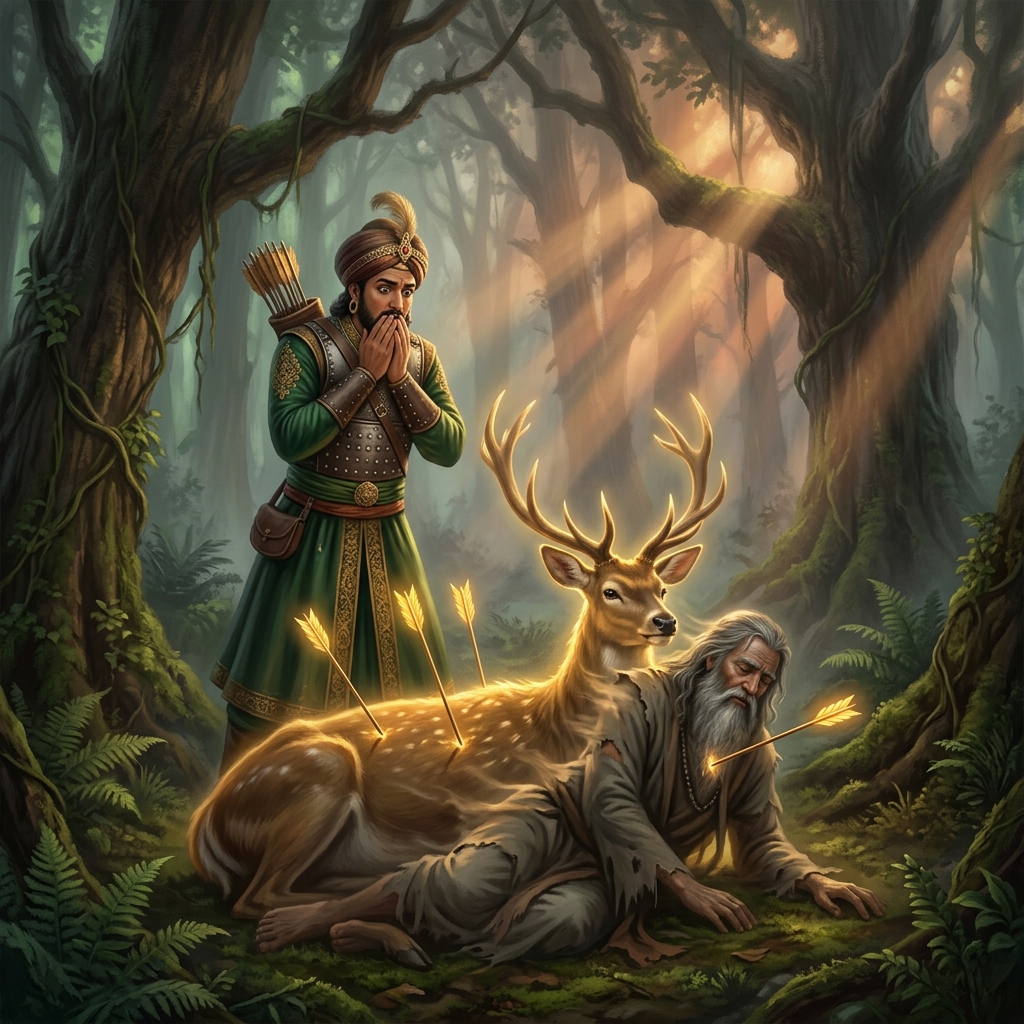
What happened afterwards in the forest, with a sage in the shape of a deer and an arrow loosed at what Pandu took for game, has its own telling. It is enough to say that the king came back from that hunt under a curse that made it death for him to touch either of his wives in desire, and that he renounced the kingdom for it, and that when he went up into the mountains to live as an ascetic both queens went with him.
Nobody asked Madri whether she wished to go, either. She went.
The Mantra Lent Once
Shatashringa was a place of hermitages under the snowline, and the wives of a king lived there in bark and deerskin among ascetics who owned nothing.
Madri, to her own surprise, did not mind the poverty. She minded the silence. In Hastinapura there had at least been a court to be second in; here there were three people and a mountain, and the distance between herself and Kunti had nowhere to hide.
Pandu grieved without stopping for the sons he could not father. It was Kunti who ended that grief, for she carried a mantra given her in girlhood by a difficult sage, by which she could call any deity she chose, and by it she bore Yudhishthira, Bhima and Arjuna, and the ascetics of the mountain named them and the sky was heard to speak over each birth.
Three sons in the hermitage, and none of them hers. Madri did not say a word about it, and Pandu, who could read her, said it for her: he asked Kunti to lend the mantra to his second queen, so that she should not go childless out of the world and so that the whole of his line should not come from one woman. Kunti consented and lent it to her exactly once; Madri thought of the twin Ashvins, the beautiful physicians of heaven, and called them together, and bore Nakula and Sahadeva at a birth.
When Pandu asked for the mantra a second time, Kunti refused, and said plainly why. "She asked once and got two. If I open my hand again she will outrun me, and I will not be outrun twice by a woman who spoke to me so humbly."
Madri did not argue. She had two sons where she had expected one, and a rival who now had a grievance against her, and no way at all of explaining that she had not been clever, only lonely.
After that the five boys grew up together on the mountain, and nobody who watched them could tell which two belonged to which mother.
The Season of Flowers
What happened on that spring day belongs to another telling: the forest in flower, the curse waiting patiently for its occasion, and Pandu dead on the ground with his arms around his second wife.
Madri cried out, and it was that cry that brought them - first Kunti running with her hair loose, and behind her the boys, and behind the boys every ascetic on the mountain.
Kunti reached her and stopped, and looked, and understood the whole thing in a moment.
"Keep the children away," she said to somebody. Then, to Madri: "You knew. You knew better than I did. He has said the words of that curse to us both a hundred times."
"I knew," said Madri.
"Then why did you not run from him? Why did you not call out? I was not far. I would have come."
"Because I could not," Madri said. "I have gone over it while you were coming up the path and I will go over it for as long as I have left, and there is no better answer than that. He came to me out of the flowers with the whole spring in his face and he did not look like a man under sentence, he looked like my husband. I put my hands against him. I said the words. I did not push him away as I would have pushed away a stranger, because he was not a stranger, and I have never once in my life been the first thing in his house, and for a moment I was. That is the whole of it. He is dead because of that moment and because of me."
The ascetics carried the king's body down to the level ground. The five boys stood in a row and did not fully understand.
And Kunti, who had every right to say a cruel thing then, said instead, "He chose too. Do not carry all of it."
"I will carry my share," said Madri. "And then I will go after him."
The Pyre and the Bequest
They built the pyre on the mountain, and then the two widows quarrelled over it in front of the sages, which is the only quarrel of Madri's life that anyone recorded.
"I am the elder wife," Kunti said. "The chief religious merit is mine and so is the right. Let me follow him. Do not stop me."
"You cannot have it," said Madri, "and I will tell you why, and the holy ones here may judge between us. He came to me with his desire unsatisfied, and he died with it unsatisfied. If I stay behind, who will follow him and content him? Let me go to him, and let him find in the next world what he was reaching for in this one.
"And there is the second reason, which is harder to say. There are five boys standing over there and two of them came out of my body. If you die and I live, I will raise all five, and I will swear at this fire to love them equally, and I do not believe my own oath. I would watch. I would count. Some small unfairness would creep in year after year and by the time they were men it would be a wound, and the sin of it would be mine. But you will not do that. You are the elder and the better of us and you are able to do what I am not. If I die and you live, there will be five sons of Pandu and no second queen's children among them."
The ascetics conferred, and they judged that Madri had spoken rightly.
So she went to Kunti and put Nakula and Sahadeva into her hands and asked her to look on them as sons born of her own body, and Kunti took them and gave her word. Then Madri walked up onto the pyre and lay down beside her husband, and the fire was lit, and she did not cry out a second time.
Kunti kept the promise to the letter, all her life. The twins never learned to say the word mother to anyone else. And in Madra, far to the west, Shalya heard the news and wept for the sister he had honoured according to custom, and lived to fight and fall at Kurukshetra with her sons drawn up in the army opposite his.
Dharma Lesson
Madri is never first in anything: not in the marriage, not in motherhood, not in the counting of the five brothers. What she is given she carries with grace, and when the one choice that is truly hers arrives she makes it without hesitating. Her last act is not despair but honest accounting - she judges that she could never love another woman's sons exactly as her own, and rather than let that partiality harden into a lifelong injustice she puts her two into Kunti's keeping and follows Pandu into the fire.