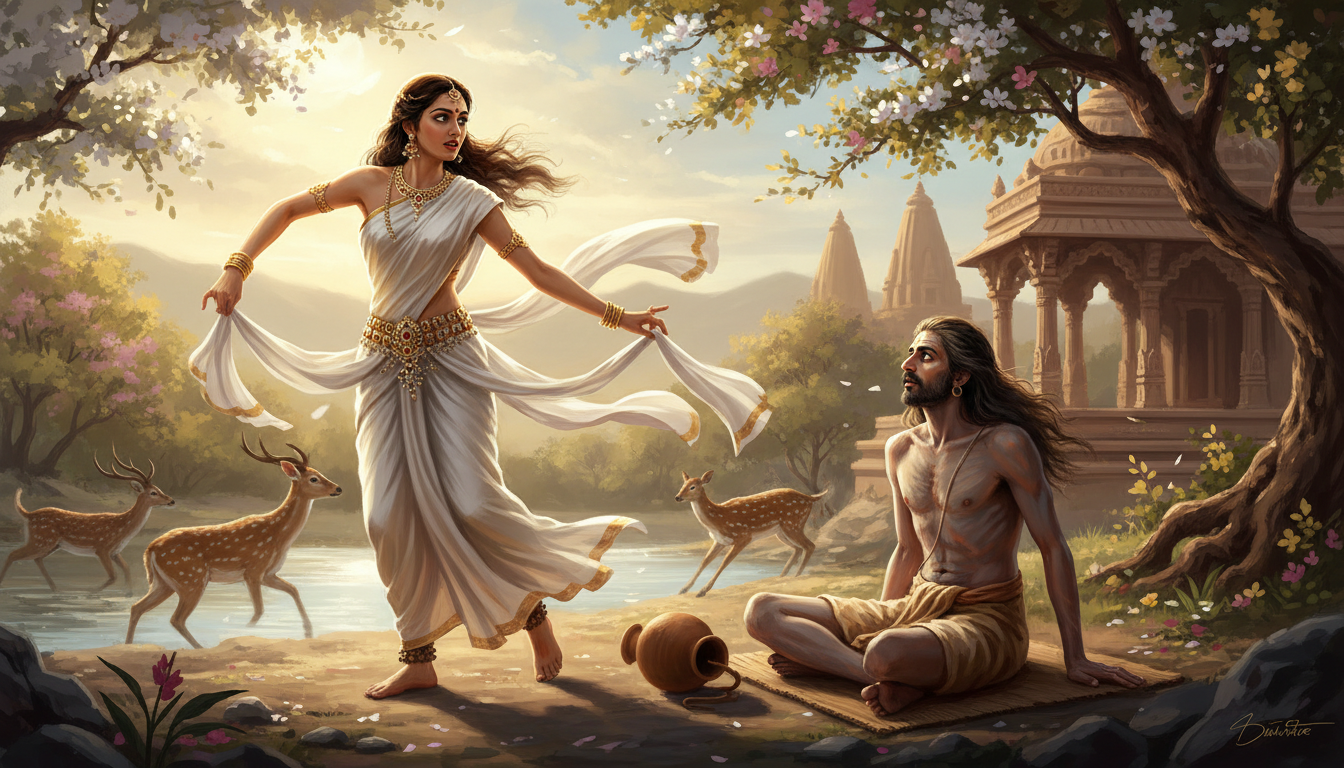
The Apsara Sent to Break a Sage
Menaka's fear, and the child left on the Malini
A Question Asked in an Empty Hermitage
King Dushyanta had left even his reduced retinue at the entrance and walked into the hermitage alone, and found nobody in it.
"What ho," he called, "who is here?" and his own voice came back to him off the trees.
Then a maiden came out of the Rishi's abode, beautiful as Sri herself and dressed as an ascetic's daughter, and bade him welcome and did everything properly: a seat, water for his feet, the arghya, the questions about his health and his peace.
"What must be done, O king?" she said. "I await your commands."
"I have come to worship the highly blessed Rishi Kanva," said Dushyanta. "Tell me, amiable one, where has the illustrious Rishi gone?"
"My father has gone from the asylum to fetch fruit," she said. "Wait a moment and you will see him when he comes."
So the king waited, and looked at her, and what he saw was a woman of perfect symmetry of shape, in the bloom of her youth, decked with three things at once: her faultless features, her ascetic penances, and her humility.
"Who are you? And whose daughter, beautiful one? Why have you come into the woods? Gifted with so much beauty and such virtues, where have you come from? O charming one, at the very first glance you have stolen my heart. I desire to learn everything about you; therefore tell me all."
She answered him smiling, in sweet words, that she was the daughter of the virtuous, wise, high-souled and illustrious ascetic Kanva.
And there Dushyanta stopped her, because he knew something about ascetics.
"The universally worshipped Rishi is one whose seed has been drawn up," he said. "Dharma himself might fall off from his course, but an ascetic of rigid vows never falls off so. Therefore, how have you been born as his daughter? This great doubt of mine it behoves you to dispel."
It was not an insult. It was the plain arithmetic of what everyone knew about Kanva, and the girl had clearly been asked it before, because she had the whole answer ready, exactly as she had once heard her father give it to a visiting Rishi who asked the same thing.
"Hear, O king," said Shakuntala, "what I have learned about all that befell me of old, and how I became the daughter of the Muni."
And she began, as her father had begun, a long way from that riverbank, in the court of the king of the gods.
The Trembling of Indra
Vishvamitra, of old, had been engaged in the austerest of penances, and Indra could not sleep for it.
That is how Kanva told it and that is how the story begins: not with a temptation but with a fright. The chief of the celestials sat in Amaravati and did the arithmetic that gods do when a man on the earth below begins to accumulate more merit than the throne is worth, and he concluded that this mighty ascetic of blazing energy would, by his penances, hurl him down from his high seat in heaven.
So he summoned Menaka, and he flattered her before he asked, which is always the sign of a man who knows he is asking for something bad.
"O Menaka, you are the first of the celestial Apsaras. Therefore, amiable one, do me this service. Hear what I say. This great ascetic Vishvamitra, who is like the sun in splendour, is engaged in the most severe of penances. My heart is trembling with fear."
He did not pretend otherwise. That is the one honest thing in the speech, and Menaka heard it.
"Indeed, slender-waisted one, this is your business," said Indra. "You must see to that Vishvamitra, whose soul is rapt in contemplation, who is engaged in the austerest penances, who might hurl me from my seat. Go and tempt him, and by frustrating his continued austerities accomplish my good. Win him away from his penances, O beautiful one, by tempting him with your beauty, your youth, your agreeableness, your arts, your smiles and your speech."
That was the commission. Six instruments were named, and every one of them was a part of her.
What Menaka Knew About Him
Menaka did not refuse and she did not agree. She did something more dangerous in the court of a nervous king: she told him what she knew.
"The illustrious Vishvamitra is endued with great energy and is a mighty ascetic," she said. "He is very short-tempered too, as you know. The energy and the penances and the wrath of that high-souled one have made even you anxious. Why should I not also be anxious?"
And then she set out the case against the errand, item by item, like a woman reading a list she had been keeping for a long time.
"He it was who made the illustrious Vashishtha bear the pangs of witnessing the premature death of his children.
"He it was who, though born at first a Kshatriya, afterwards became a Brahmana by virtue of his ascetic penances.
"He it was who, for the purposes of his ablutions, created a deep river that can hardly be forded, the sacred stream that is known by the name of the Kausiki.
"It was Vishvamitra whose wife, in a season of distress, was maintained by the royal sage Matanga, who was then living under his father's curse as a hunter. It was Vishvamitra who, when the famine was over and he returned, changed the name of the stream beside his asylum from Kausiki to Para. And it was Vishvamitra who, in return for the services of Matanga, himself became that man's priest at a sacrifice, so that the lord of the celestials went in fear to drink the Soma juice at it."
She let that one sit. Indra had drunk that Soma. Everyone in the hall knew whose sacrifice it had been and who had been made to attend it, and Menaka had just said so out loud.
A Woman Like Me
She had not finished.
"It was Vishvamitra who in anger created a second world," she said, "and numerous stars beginning with Sravana. He it was who granted protection to Trishanku, smarting under a superior's curse. I am frightened to approach a man of such deeds."
Then she named the powers, and the naming has the rhythm of something recited in fear.
"He can burn the three worlds by his splendour. He can, by one stamp of his foot, make the earth quake. He can tear the great Meru out of the ground and hurl it any distance he likes. He can go round the ten points of the earth in a moment. How can a woman like me even touch such a one, full of ascetic virtues, like a blazing fire, with his passions under complete control?
"His mouth is like a blazing fire. The pupils of his eyes are the sun and the moon. His tongue is Yama himself. How shall a woman like me even touch him?
"At the thought of his prowess Yama is terrified, and Soma, and the great Rishis, and the Sadhyas, and the Vishvas, and the Valakhilyas. How can a woman like me look at him without alarm?"
Five times in that speech she says a woman like me. She is the first of the Apsaras of heaven, and standing in front of the king of the gods she describes herself as a small thing being sent against a fire.
And then she agreed.
"Commanded, however, by you, O king of the celestials, I shall somehow approach that Rishi."
That is the whole of the story in one sentence. She had made the complete case for why it should not be her, and she had been given an order, and she went.
The Terms She Set
Having agreed, she named her conditions, and they are the conditions of a professional who intends to survive the job.
"But O chief of the gods, devise some plan whereby, protected by you, I may safely move about that Rishi. I think that when I begin to play before him, Marut, the god of wind, had better go there and rob me of my dress. And Manmatha, the god of love, had also better help me then, at your command. Let Marut on that occasion bear fragrance from the woods there, to tempt the Rishi."
Read it slowly and it is not seduction being planned. It is a woman refusing to be alone in a room with a fire. She will not be the one to reach for the sage; the wind will take her clothes and the god of desire will do the work in his mind, and she will be able to say, afterwards and to herself, that she only danced.
Indra granted all of it at once. He commanded him who can approach every place, the god of the wind, to be present with Menaka at the time she stood before the Rishi. He set the god of love in motion. He arranged for the forest scent.
And Menaka, seeing that everything she had asked for had been duly provided, and having no further ground to stand on, went down to the retreat of the great Kausika.
The timid and beautiful Menaka, the story calls her at that moment. Not the irresistible one, not the destroyer of penances, not any of the titles she would carry ever afterwards in the mouths of men who told this story to warn each other about women. Timid.
The Wind Takes the White Garments
She entered the retreat and saw him.
Vishvamitra had burnt up all his sins by his penances and was still, at that hour, engaged in penance. There was nothing careless about him. He was not a man half fallen already whom a push would finish. He was at the height of it.
Menaka saluted the Rishi, as any visitor would. Then she began to sport before him, playing in the clearing the way her kind play, and she did it in the open where he could not help seeing.
And just at that moment Marut came, as commanded, and did both of the things he had been sent to do. He brought the fragrance of the woods across that clearing, so that the air the Rishi was breathing was suddenly full of flowering trees. And he took from her the garments that were white as the moon.
She ran after them. She ran as if in great bashfulness, to catch hold of her attire, and as if she were exceedingly annoyed with the wind, and she did all of it in front of the very eyes of Vishvamitra, whose energy was like fire.
The word the story uses twice is as if. She was acting. Everyone in the arrangement knew she was acting, including, one suspects, the sage, at least for the first moment.
And Vishvamitra saw her in that attitude. He saw that she was of faultless feature, that she was exceedingly handsome, that there was no mark of age anywhere on her person. Beholding her beauty and her accomplishments, that bull among Rishis was possessed by desire, and he made a sign that he wished for her company.
He invited her. She, of faultless features, expressed her acceptance of the invitation.
And everything that a thousand years of standing on one leg in the sun had built came apart in the time it takes a man to raise his hand and beckon.
A Long Time Like a Single Day
They passed a long time there in each other's company.
The text does not hurry over it and does not moralise about it either. Sporting with each other just as they pleased, for a long time as if it were only a single day, it says, and that phrase is the most merciless thing in the whole account. Whatever it was, it was not a night's lapse. It went on and on and did not feel long to either of them, and every day of it was a day the penance was not being performed.
Indra had what he wanted. Nobody was going to be hurled from any high seat now. And Indra, having got it, does not appear again in this part of the story at all, which is the ordinary way of the ones who give such orders.
In that long single day the Rishi begot upon Menaka a daughter.
What Vishvamitra thought when he understood what he had done is not recorded here. He would go back to it eventually; he always did; he would climb the whole ladder again from the beginning and reach a height no one had reached, and men would tell that story admiringly for ages. This part they told differently, in a lower voice, as an example of how even the greatest ascetic may fall.
But nobody was fooled about the size of what had happened. A man had spent an age punishing his body into a weapon, and the mind inside it had never been touched at all. He had made a second heaven out of temper. He had dug a river because he wanted somewhere convenient to bathe. He had taken a cursed outcaste king for a patron and made the gods drink at his sacrifice out of fear, and every one of those feats had been an exercise of will over the world outside him. Not one of them had ever asked him to govern the man inside.
The austerity had made him powerful. It had not made him master of himself. Those are two different achievements, and only one of them can be won by standing in fire.
And as her conception advanced, Menaka went away.
The Bank of the Malini
She went to the banks of the river Malini, which courses along a valley of the charming mountains of Himavat, and there she gave birth to the daughter.
It is a beautiful place and the text says so, and the beauty is doing a job in the sentence. She did not leave the child in a ditch or a road. She carried her, full term, into the loveliest valley in the northern mountains, to a clear river running through a wood, and bore her there, alone.
And then she left the newborn infant on the bank of that river and went away.
There is no farewell speech. There is no last look recorded, no explanation offered, no plea to anyone to come and find the child. Menaka had been sent down out of heaven to break a man's austerities, she had broken them, and the child was the residue of the assignment. An Apsara has no house to take an infant to. Whatever she felt walking back up into the sky, she did not say it in front of the sages who preserved this story, and they did not invent anything to fill the gap.
So the daughter of the greatest ascetic of the age and the first of the Apsaras of heaven lay in the open, on a riverbank, in a forest with no human being anywhere in it and lions and tigers in the thickets, and the sun moved across the valley of the Himavat, and nothing at all came for her.
Nothing, that is, except the birds.
Ringed by Vultures
A number of vultures came down and sat around the infant, and protected it from harm.
They did not touch her. No Rakshasa took her life, and no carnivorous animal came, and in that solitude of the wilderness the vultures kept their ring around the daughter of Menaka until a man came down to the water.
"I went there to perform my ablutions," Kanva said, "and beheld the infant lying in the solitude of the wilderness surrounded by vultures. Bringing her here, I have made her my daughter."
And then he gave the reasoning, which is the whole of his answer to the doubt Dushyanta had raised.
"The maker of the body, the protector of life, and the giver of food are all three fathers, in their order, according to the scriptures. And because she was surrounded, in the solitude of the wilderness, by Sakuntas, which are birds, therefore I have named her Shakuntala, the bird-protected."
So the girl carried in her name the one hour of her life that nobody had arranged: not Indra's fear, not Menaka's orders, not Vishvamitra's fall, but a circle of ugly birds that did not eat her.
"That is what my father said to the Rishi who asked him," said Shakuntala, standing in the hermitage yard with the king of the Bharatas in front of her. "O king of men, it is thus that you must know I am the daughter of Kanva. And not knowing my real father, I regard Kanva as my father. Thus have I told you, O king, all that I have heard concerning my birth."
Dushyanta had asked how an ascetic could have a daughter. She had answered him with the story of an ascetic who could not stay one, and of a woman who told the king of the gods exactly why the errand would cost her, and went anyway, and paid.
The king had come into that yard to worship a Rishi and had stayed to hear a genealogy, and the genealogy had turned out to be about fear: a god's fear of a man, a woman's fear of a sage, and a newborn left in a place where fear should have finished her and did not. He had asked his question expecting a small correction. He had been given the whole apparatus of heaven and its errands, and the child at the bottom of it, standing in front of him now with fruit still to be fetched and her foster father not yet home.
Dharma Lesson
A power gained by punishing the body is not the same thing as a mind that has been mastered, and Vishvamitra had spent an age acquiring the first while leaving the second untouched. A mission carried out under orders still leaves its cost on the one who obeys: Menaka named every reason the errand would ruin her, was told to go, and went, and paid for it on a riverbank alone.