The Head Off the Praya Bed
Sanjaya said: the whole army shouted at him not to do it, O king, and he did it anyway.
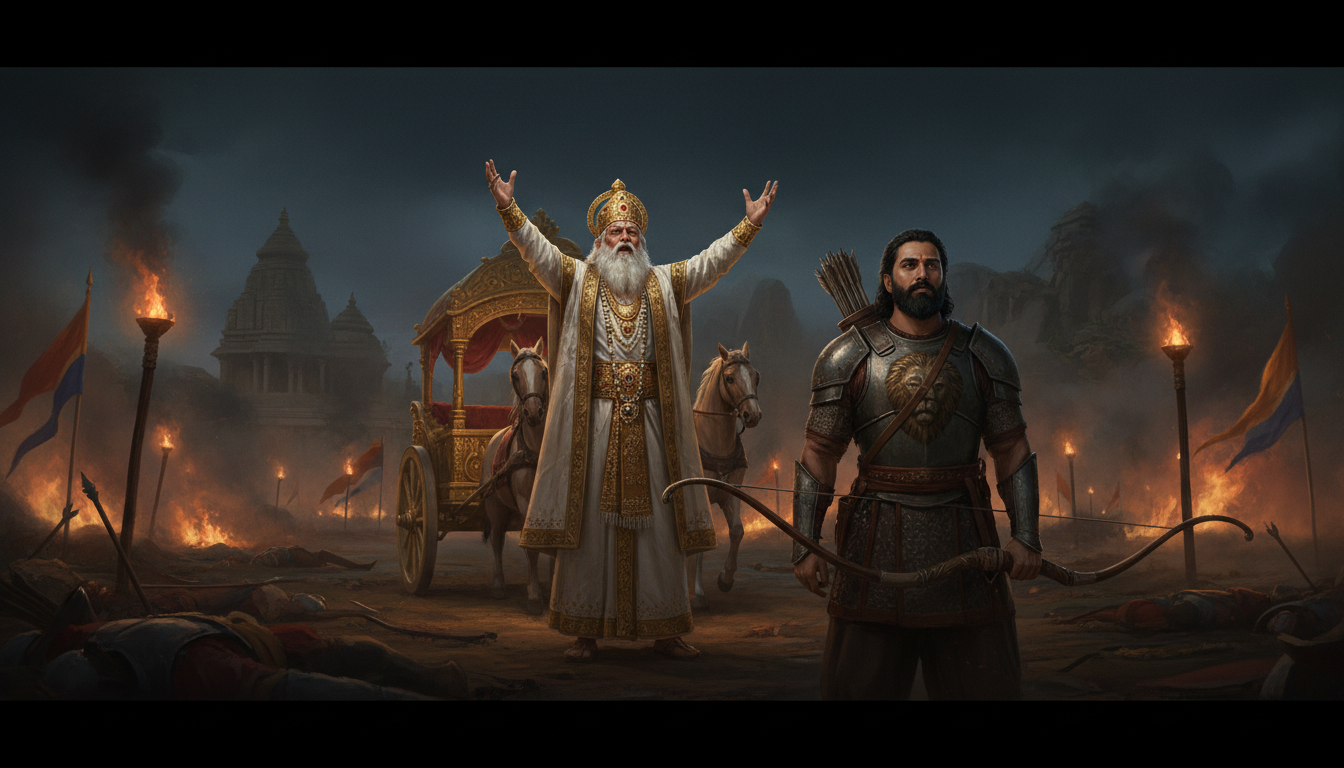
Bhurishravas had spread a bed of arrows with his left hand, his right one being gone, and had fixed his eyes on the sun and set his cleansed heart on the moon and gone into the vow of Praya to leave his body. Arjuna had cut off the arm because it was about to take Satyaki's head off the ground. Now Satyaki got up out of the dirt where he had been held down, drew his sword, and walked over to a man sitting cross-legged with his senses withdrawn from the battle.
Krishna forbade it. Arjuna forbade it. Bhima forbade it, and the two protectors of Arjuna's wheels, and, on the other side of that quarrel, Ashwatthama and Kripa and Karna and Vrishasena and the ruler of the Sindhus, all of them shouting the same thing at the same time.
He cut off the head of the eldest brother of Sala, the giver of plenty in sacrifices, who had already almost been killed by the son of Pandu and who was sitting there with one arm to free his soul from his body.
Nobody applauded. The Siddhas and the Charanas overhead applauded Bhurishravas instead.
"You sinful Kauravas wearing the outward garment of righteousness," Satyaki said to them, "you tell me in words of virtue that Bhurishravas should not be slain. Where did this righteousness of yours go when you killed the son of Subhadra in battle, a child, without arms? I had vowed once, in a fit of haughtiness, that any man who threw me down alive and struck me with his foot in rage would be killed by me, even if he had adopted a vow."
Some of the Kurus argued the matter among themselves afterwards and decided it was fate. It is no fault of the Vrishni hero, they said. What was pre-ordained has happened. Anger is the cause of men's sorrow.
That was one man's opinion. Nobody had yet asked the father.
The Practices of Robbers
Somadatta had watched it from his own car, and when he could speak he did not shout. He asked questions.
"Why, Satwata, having abandoned those kshatriya duties that were ordained by the high-souled gods, have you betaken yourself to the practices of robbers?
"Why would a man observant of kshatriya duties, and possessed of wisdom, strike in battle a person who is turning away from the fight? Or one who has become helpless? Or one who has laid aside his weapons? Or one who begs for quarter?
"Two persons among the Vrishnis are reputed the foremost of great car-warriors: Pradyumna of mighty energy, and you. Why then did you behave so cruelly and so sinfully toward one who had sat down in Praya and who had already had his arms cut off by Partha?"
He was an old man. He had been old when the war started. He had come to the field with his son and his son's uncle and his own aged father, three generations of one house out of a branch of the family that had gone away from Hastinapura precisely so as not to be in the quarrel, and he had watched a man cut his son's head off a meditation mat in front of two armies.
"Take now in battle the consequence of that act of yours, you of wicked behaviour. I shall today, wretch, putting forth my prowess, cut off your head with a winged arrow."
Then he swore, and he swore in the heaviest terms available to a man of his age and house.
"I swear, Satwata, by my two sons, by what is dear to me, and by all my meritorious acts, that if before this night passes away I do not slay you who are so proud of your heroism, together with your sons and your younger brothers, then let me sink into terrible hell, wretch of Vrishni's race."
There was one condition attached to it, and everybody who heard it noticed the condition. Provided, he said, that Jishnu the son of Pritha does not protect you.
Then he blew his conch and roared like a lion.
I Do Not Experience the Slightest Fear
Satyaki had eyes like lotus petals and teeth like a lion's, and he answered without any of the old man's courtesy.
"O you of Kuru's race, whether I am battling with you or with others, I do not ever experience in my heart the slightest fear. If you fight me protected by all the troops, I would not even then experience any pain on your account.
"I am ever observant of kshatriya practices. You cannot frighten me with words that merely smack of battle, or with speeches that insult good men. If you wish to fight with me today, be cruel, and strike me with keen shafts, and I will strike you.
"Your son the mighty car-warrior Bhurishravas has been slain. Sala also, and Vrishasena, have been crushed by me. You too I shall slay today, with your sons and your kinsmen. Stay in battle with resolution, for you are endued with great strength.
"You are already slain, in consequence of the energy of that drum-bannered king in whom are always charity and self-restraint and purity of heart and compassion and modesty and intelligence and forgiveness. You shall meet with destruction along with Karna and Suvala's son. I swear by Krishna's feet and by all my good acts that filled with rage I shall slay you with your sons in battle. If you fly away from the field, then you may have safety."
So the two of them stood there with their eyes red, an old man who had lost a son that morning and a man who had killed him, each having sworn by everything he held, and began to shoot.
Duryodhana did not care to leave it to the arithmetic of one car against one car. He brought a thousand cars and ten thousand horse around Somadatta and set them there. Sakuni came up with his sons and his grandsons and his brothers, all of them armed with every weapon, and the king's brother-in-law, young and hard-bodied, brought a hundred thousand horses of the foremost quality and closed the circle.
Protected by all of that, Somadatta covered Satyaki with clouds of straight shafts, and Dhrishtadyumna came in from the Pandava side with a force behind him, and the noise the two hosts made striking each other was like many oceans lashed into fury by hurricanes.
Nine Arrows Each
The first exchange between them was almost exactly even, which is worth saying because nothing else that night was.
Somadatta pierced Satyaki with nine arrows. Satyaki pierced that foremost of Kuru warriors with nine. Then Satyaki, who was the firmer bowman of the two and had youth in his arms, drove the next flight deep, and the old man sat down on the terrace of his car and lost his senses.
His driver saw him go and did the sensible thing, wheeling the car and carrying that great car-warrior out of the fighting at speed while he was still unconscious in it.
Drona saw it too, and came at Satyaki with the intention of finishing him while the opening was there. Then Yudhishthira and a crowd of Pandava warriors surrounded the perpetuator of Yadu's race to get him out, and what had been a duel between two men over a corpse became a battle between the preceptor and the whole of the Pandava host, resembling, said Sanjaya, the old fight between Vali and the celestials for the sovereignty of the three worlds.
Drona shrouded them all. He pierced Yudhishthira, and Satyaki with ten arrows, and Prishata's son with twenty, and Bhimasena with nine, and Nakula with five, and Sahadeva with eight, and Sikhandin with a hundred, and each of the five sons of Draupadi with five, and Virata with eight and Drupada with ten, and then he went for Yudhishthira again and the army in front of him ran away.
And then the sun finished going down.
What followed was the first night any of them had fought in. Lamps were tied to the cars and to the elephants and carried by foot-soldiers on both sides, and thousands of them went out at once wherever the fighting was thickest, so that men fought in a moving lattice of light and blackness and struck at voices. Ghatotkacha came into it on an iron car thirty nalwas across with a shrieking vulture on the standard, and Ashwatthama killed his son Anjanaparvan in front of him, and Drona's son made a river of blood run across that field with drums for its tortoises and umbrellas for its swans.
Somewhere in all of that, Somadatta woke up, and remembered what he had sworn, and had himself driven back.
The Parigha and the Shaft
He came back covering Satyaki with a dense shower of arrows, and Bhima, who had been fighting nearby, turned his car and came in on Satyaki's side without being asked.
Bhima pierced the Kaurava hero with ten shafts. Somadatta answered him with a hundred.
Then Satyaki, filled with rage, pierced with ten keen shafts endued with the force of thunder that old warrior who was afflicted with grief on account of the death of his son and who was, besides, said Sanjaya, endued with every estimable virtue, like Yayati the son of Nahusha. Having pierced him with great force, he struck him again with seven.
And then the two Pandava warriors, without arranging it, did the same thing in the same instant.
Bhima took up a new parigha, hard and terrible, and hurled it at Somadatta's head. Satyaki, filled with rage, shot at Somadatta's chest an excellent shaft, keen and goodly-winged and resembling fire itself in splendour.
The iron club and the arrow fell on the body of that heroic old man at the same moment, and he went down again on the floor of his car.
It would have finished there, except that the man who came out to avenge him was ninety years old and had left this quarrel behind him two generations ago.
The Old Man Who Had Gone Away
Bahlika was the son of Pratipa and the elder brother of Shantanu.
That is the whole of the explanation and it takes a moment to absorb. He was of the generation above Bhishma. He had been the elder son, with the throne of the Kurus in front of him, and he had gone away west instead and taken a kingdom of his own, and his branch of the house had lived out of Hastinapura for a lifetime and had kept clear of the business of the dice and the assembly hall and the exile. He was Somadatta's father, and Bhurishravas' grandfather, and he had come back with them because the summons went to every Kuru and a Kuru answers it.
Seeing his son fallen in a swoon, that ancient man drove his car at Satyaki, scattering showers of arrows like a cloud in season.
Bhima came across in front of him for Satyaki's sake and pierced him with nine shafts at the head of the fighting.
Then Bahlika, filled with great fury, hurled a dart at Bhima's chest the way Purandara hurls the thunderbolt. It went home. Bhimasena trembled on the terrace of his car and swooned away, and for a moment the strongest man on the field was standing up only because there was a rail behind him.
He came back to his senses, and he did not reach for the bow.
He took up a mace, and threw it, and it snatched away the head of Bahlika, and the son of Pratipa fell down lifeless on the earth like a tree struck by lightning.
So the elder brother of Shantanu, who had removed himself and his line from a quarrel about a throne before most of the men fighting over it were born, died in the dark on the fourteenth night of it, killed by the son of one of the claimants, three feet from where his own son lay unconscious in a chariot.
Ten Sons, Ten Arrows
Ten of Dhritarashtra's sons were standing near enough to see their great-uncle's head come off, and every one of them, said Sanjaya, was equal to Rama the son of Dasaratha in prowess.
They went at Bhima together.
Nagadatta. Dridharatha. Viravahu. Ayobhuja. Dridha. Suhasta. Viragas. Pramatha. Ugrayayin. Sanjaya named them to the blind king one after another, as he named all of them, because that was the only funeral rite any of those young men were going to receive.
Bhima was filled with rage at the sight of them coming, which in his case was not an obstacle to precision. He took up a number of arrows, each of them capable of bearing a great strain, aimed at each of the ten one after another, and shot each one through a vital part.
They fell out of their cars deprived of energy and life, like tall trees broken off mountain cliffs by a tempest.
He did not stop after that either. He shrouded the favourite son of Karna with arrows, and disposed of Karna's brother Vrikaratha who came to help. He killed seven car-warriors among the king's brothers-in-law. He pressed Satachandra down into the earth. Sakuni's five brothers, Gavaksha and Sarabha and Bibhu and Subhaga and Bhanudatta, rushed at him with keen shafts for that, and he killed the five of them with five arrows.
Many great kings began to waver, said Sanjaya, at the sight of it.
And all through it Satyaki was standing off to one side of the fighting, letting Bhima work, waiting for one particular car to be driven back into the light.
Bear Me Toward Somadatta
It came back. Somadatta had woken up a second time, and there was still a piece of the night left, and he had sworn by his two sons.
Satyaki saw the large bow shaking over there in the lamplight and spoke to his charioteer.
"Bear me toward Somadatta. I tell you truly, Suta, that I shall not return from battle today without having slain that foe, that worst of the Kurus, the son of Valhika."
The driver urged the fleet horses of the Sindhu breed, white as conch and capable of bearing any weapon, and they went, endued with the speed of the wind or of the mind, the way the horses of Indra bore him in days of old when he went to quell the Danavas.
Somadatta, seeing him come, fearlessly turned toward him.
And then the two of them fought the longest single duel of that night, and Sanjaya, who had watched a great many men die on that plain and had run out of ordinary language for it, described it entirely in pictures.
Somadatta pierced the hero of Madhu's race with sixty shafts in the chest, and Satyaki pierced him back with whetted arrows, and mangled by each other they looked like a pair of flowering kinsukas in the season of spring.
Dyed all over with blood, those illustrious warriors of the Kuru and the Vrishni races looked at each other with their glances. Riding on cars that coursed in circles, those grinders of foes, of terrible countenances, resembled two clouds pouring torrents of rain.
Their bodies pierced all over, they looked like two porcupines. Pierced with countless shafts equipped with wings of gold, they looked like a pair of tall trees covered with fire-flies. Their bodies bright with the blazing arrows sticking in them, they looked like two angry elephants decked with burning torches.
That is what the two of them looked like from a distance, in the dark, on the fourteenth night, with the lamps going.
The Golden Standard Comes Down
Somadatta, who was old and hurt and had been carried off the field twice already, fought that hour better than he had fought at any point in the war.
He cut off the large bow of Madhava with a crescent-shaped arrow, and then, at a time when speed was of the utmost consequence, put twenty-five shafts into him with great speed, and then ten more.
Satyaki took up a tougher bow and pierced him with five, and then, smiling, cut down the golden standard of the son of Bahlika with a broad-headed arrow.
The old man watched his standard fall and, fearlessly, pierced the grandson of Sini with twenty-five arrows.
Satwata, excited with rage, cut his bow off with a razor-faced arrow and then pierced him with a hundred straight shafts equipped with wings of gold, so that he stood there like a snake without fangs. Somadatta took up another bow and covered him again. Satyaki, inflamed, pierced him again. Somadatta afflicted him with showers.
Bhima came into it once more on Satyaki's behalf and struck the son of Bahlika with ten shafts, and Somadatta struck Bhimasena back with many whetted arrows without turning his head.
Then Satyaki, aiming at his chest, shot a new and terrible parigha with a golden staff, hard as thunder.
And Somadatta, smiling the while, cut that iron club into two halves in the air, and the two pieces fell down on either side of him like crests of a mountain riven by thunder.
It was the last good thing he did.
Like a Hawk on the Chest
Satyaki took him apart then in the order a bowman takes a man apart when he has decided the thing is finished.
A broad-headed arrow for the bow. Five arrows for the leathern fence that cased his fingers. Four shafts for the four excellent steeds, which went to Yama's presence together. One straight shaft, smiling the while, for the head of the charioteer, which came off the trunk.
Then he chose the last one carefully, because it was going to be looked at afterwards: a terrible shaft of fiery effulgence, whetted on stone, steeped in oil, equipped with wings of gold.
Shot by the mighty grandson of Sini, it fell like a hawk upon the chest of Somadatta. Deeply pierced, that great car-warrior fell down from his car and expired.
So the house ended. Bhurishravas in the morning with his arm off and his eyes on the sun. Bahlika in the dark with his head taken by a mace. Somadatta before the night was out, on the ground, under the man he had sworn by his two sons to kill. Three generations of one family, the branch that had walked away from Hastinapura a lifetime ago to keep clear of the throne and the quarrel over it, all of them finished inside the same twelve hours by two men fighting side by side.
The Kaurava warriors rushed at Yuyudhana with a great throng of cars when they saw Somadatta fall, and the fighting went on and closed over the place where it had happened.
Yudhishthira, further up the line, began routing Drona's troops in the preceptor's own sight, and Drona came at him with his eyes red, and they exchanged the Vayavya weapon and cut each other's bows until Krishna rode across and told the king to stop.
"Cease to fight with Drona," he said. "He always strives to seize you. I do not think it fit that you should fight him. He who has been created for Drona's destruction will slay him, without doubt. Leave the preceptor. Kings should fight with kings. Go where Dhananjaya and Bhima are."
So Yudhishthira went, and Drona spent the rest of that night consuming the Panchalas.
Dharma Lesson
A family can move a kingdom away from a quarrel and still be destroyed by it in the space of one night. Bahlika gave up the Kuru throne and lived a lifetime elsewhere so as not to be in this fight, and came back when the summons went out, and lost his grandson, himself and his son inside twelve hours. Distance from a wrong is not the same as being free of it.