The Count on the Nineteenth Morning
Eighteen armies, and the men who walked off the field
What Eighteen Armies Came To
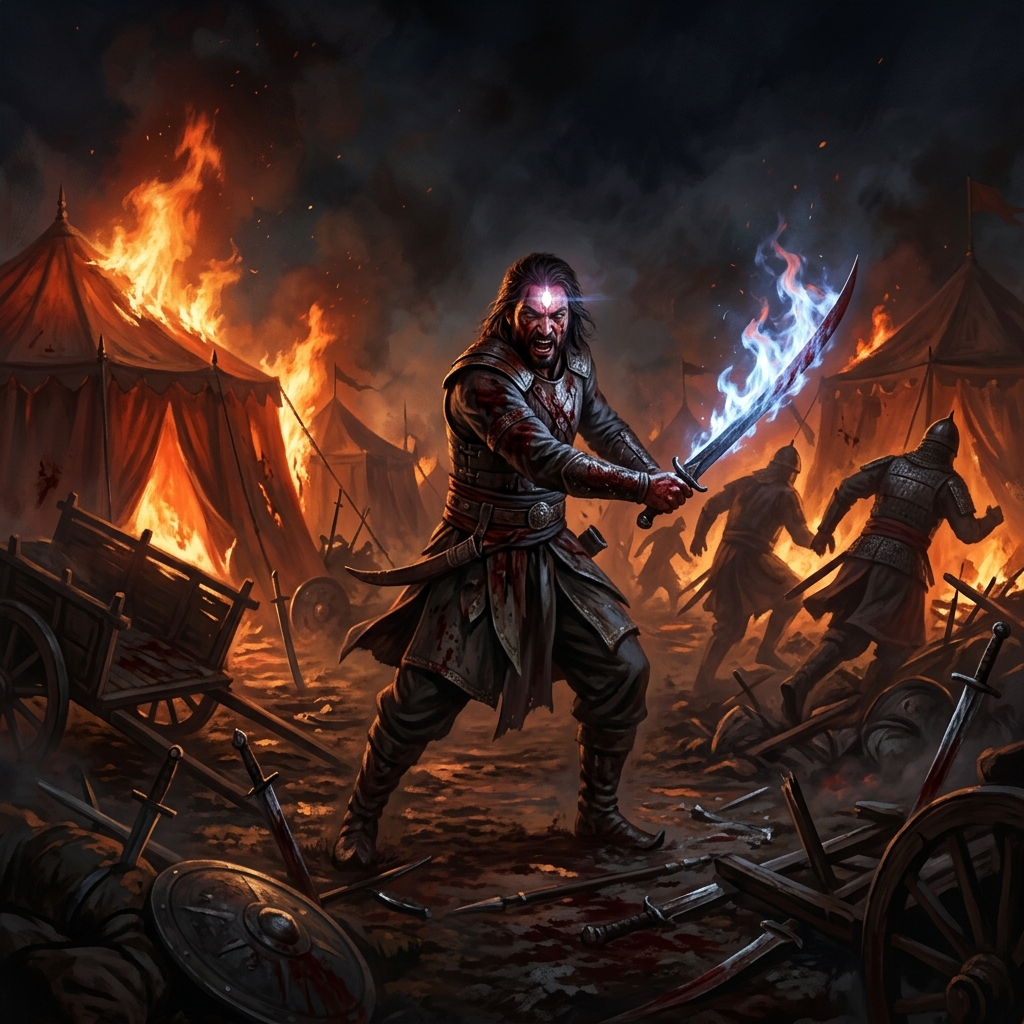
Eighteen akshauhinis marched onto the plain of Kurukshetra when the war began, eleven under Duryodhana's banner and seven under Yudhishthira's, a host so vast that the elders who tried to describe it resorted to comparing it to the stars or the grains of a riverbed rather than to any number a mind could hold at once. Eighteen days later, at dawn on what would have been the nineteenth morning of battle had there been an army left to fight one, the plain held bodies past counting and living men who could be counted on two hands with room to spare.
Tradition has always called the number ten, though anyone who sits down and actually names the survivors will find the list runs to eleven unless a choice is made about how to count Krishna, who carried no weapon through the entire war and stood in the exception every counter must decide for himself: charioteer, counselor, and by his own repeated word not a combatant, yet undeniably a man who walked off that field alive at the end of it. The looseness of the number is itself part of the lesson. A war this large stops being arithmetic anyone can do cleanly long before it is finished.
What can be said without argument is this: of the seven armies that had stood under the five brothers' banners, and the eleven that had stood under Duryodhana's, only a handful of named men remained standing when the fighting itself was done, and each of them lived for a specific, traceable reason rather than by some general grace that had protected the army as a whole. The count is worth walking through by name, because the reasons differ, and because what protected one man would not have saved the next.
The Five and the Two Beside Them
Four of the five Pandava brothers lived for the same reason, though almost none of the soldiers who fought beside them ever learned it. Early in the war, Bhishma had gone privately to Kunti, the mother he had once carried on his own hip as an infant of another man's house, and given her a promise: he would kill neither Yudhishthira, nor Bhima, nor Nakula, nor Sahadeva. Only Arjuna, he said, was a warrior worth his full effort, the one true trial the field could still offer a man who had already lived through every other kind of grief. Bhishma kept that word exactly, through ten days of command, and no general who came after him ever matched the intensity Bhishma alone had reserved for Arjuna. Yudhishthira, Bhima, Nakula, and Sahadeva survived, in large part, because the one man most capable of ending any of them early had already decided, out of love for their mother, not to try.
Arjuna survived by a different mercy entirely, the daily, hour by hour presence of Krishna at the reins of his chariot, turning the horses a hand's width this way or that at moments no mortal charioteer could have judged in time, until the two of them together were spoken of less as archer and driver than as a single weapon no one on the field had an answer for.
Krishna himself survived by choice rather than protection, having sworn before the war began that he would not lift a weapon in it, and having kept that vow through every provocation offered him, including once nearly breaking it with his own hand raised against Bhishma before Arjuna begged him to lower it again.
Satyaki, last of the five to be counted here, survived on skill sharpened under Arjuna's own teaching, skill that carried him through duels other men of his rank did not walk away from, and through at least one moment where Arjuna's own bow, not entirely within the rules, arrived in time to answer a blow meant to finish him.
The One Who Crossed and the Three Who Stayed
Yuyutsu belongs on neither list quite comfortably, because he was born into Dhritarashtra's house, brother in blood to Duryodhana and the rest, and yet stood in Yudhishthira's ranks from the very first morning of the war, having crossed the field before a single arrow was loosed, when Yudhishthira asked aloud whether any Kaurava present wished to fight instead for dharma. He alone answered, and he alone among Dhritarashtra's hundred sons walked off Kurukshetra alive, a survival that was never really luck at all but the direct, foreseeable result of having chosen, on the first morning, which side of the field he meant to die on if it came to that.
On the other side of the war's ledger, three men answered to Duryodhana's banner at the end who had answered to it at the start. Kripa, teacher to both houses, fought every day of the eighteen without ever becoming the specific target that a Bhishma or a Drona or a Karna became, a Brahmin's staff and an old man's caution keeping him always somewhat apart from the duels that killed the great champions one by one.
Kritavarma commanded the Narayani Sena, the army of Krishna's own Yadava kin that had gone, by an old bargain, to Duryodhana's side rather than the Pandavas', and he survived the field the way a general commanding from slightly behind the worst of it often does, present at every day's fighting and yet never quite standing where the day's decisive blow landed.
Ashwatthama survived because he was Drona's son, and more than one Pandava warrior who might otherwise have finished him held back a hand out of what they owed his father, a mercy that would prove, before the war's true ending, to have been extended to the one man least inclined to return it.
What the Other Column Held
Set against ten or eleven names, however the counting is done, stands a column of the war's cost that no single figure can hold. Eighteen akshauhinis had marched out; by the most conservative reckoning the tradition offers, more than a million and a half fighting men lay dead across the plain by the time the eighteenth day's fighting ended, kings and princes and foot soldiers together, a ratio of the dead to the living so extreme that the survivors themselves rarely spoke it aloud in whole numbers, preferring instead to speak of it the way grief usually speaks, in the particular rather than the total.
The particular was this: women without number arrived at Kurukshetra in the days after the fighting stopped to walk the field searching for husbands, fathers, and sons among bodies that the crows and jackals had already begun to claim, and their lament, when it rose together over that ground, was said to be louder than the battle itself had been, a sound with no single voice in it and no single grief either, since every woman standing on that field had lost someone the war had promised her nothing about protecting.
Kingdoms across the known world went, in the space of those eighteen days, from having an heir to having none, thrones that had passed father to son for generations suddenly with no son standing to claim them, alliances built over decades reduced to the single question of who, if anyone, remained alive to honor them. The kingdom the war had been fought to settle was, by the time it was settled, a kingdom of widows and empty houses first, and only afterward a throne for Yudhishthira to sit upon.
The Count Moved Again Before Dawn
Even the count of ten did not hold undisturbed through the first night after the war's end. That night, while the surviving Pandavas and Krishna were away from the main camp, three of the men who belong on this list, Ashwatthama, Kripa, and Kritavarma among them, carried out a raid that belongs to its own telling and will not be repeated here in full, except to say that it reached into the Pandava camp while the camp slept and took, before morning, lives the eighteen days of open battle had spared: Draupadi's five sons among them, and Dhrishtadyumna who had led the Pandava host, and Shikhandi who had stood behind Bhishma's fall.
The ten or eleven who are named as the war's survivors survived that night as well, by the same accident of absence that had kept the five brothers and Krishna and Satyaki outside the camp when the raid came through it, but the count of everyone else who had lived through eighteen days of open war and then died in a single night proved that even after a war is formally finished, its arithmetic is not done being written.
What is left, on the morning that follows that second, quieter subtraction, is a strange kind of victory: a throne won, a dharma technically upheld, and a list of names so short that reciting it aloud takes less time than describing any single day of the eighteen that emptied the field down to this. Whoever tells this story afterward, in whichever hall or generation, owes it to the dead to say the number plainly rather than to let the word victory stand in for it unexamined. Eighteen armies came to this. It is worth saying so, out loud, exactly once, before the story moves on to what the survivors did with what remained to them.
Dharma Lesson
A war's true ledger is never the banners raised at its end but the names still able to answer to a roll call. Kurukshetra teaches that victory purchased at this ratio is not a triumph to be celebrated so much as a debt to be carried, and that every survivor on both sides owed his breath to a specific mercy, oath, or accident that could just as easily have gone the other way.