The Guru of the Mace
In Dwaraka, the city Krishna had built upon reclaimed sea, his elder brother Balarama kept an akhada apart from the palace intrigues, where the mace, not the sword, was taught as the noblest of weapons. Balarama had mastered the gada as a young man and in Dwaraka passed the art to any prince willing to submit to its discipline.
Two pupils outgrew all the rest. Bhima, Pandava son of the wind, brought a strength that needed no teaching, only shaping - Balarama gave that raw power a grammar, footwork, the patience to wait for an opening rather than crash toward one. Duryodhana, Kaurava heir, came to Dwaraka almost in secret, unwilling to be seen learning from his rivals' kin, and stayed because no one else would call him a natural talent and mean it.
Balarama meant it. Something in the prince's hunger to be first, to be loved, moved the old warrior in ways he did not examine too closely. He had no son of his own worth the name; Duryodhana filled that emptiness without either of them naming it so. He corrected Duryodhana's stance with a hand on the shoulder no different from how he touched Bhima's, and yet everyone in the akhada could see it was different - warmer, more forgiving of temper, quicker to praise.
'You strike like a man who has already lost,' he told Duryodhana once, watching him swing wide with fury rather than aim. 'A mace is not vengeance. It is judgment, delivered once, correctly.'
Bhima, watching from the practice yard's edge, said nothing. He did not yet know how much that lesson would cost him, or how long he would carry it, waiting for the day he could deliver a single, correct, terrible blow of his own.
A Brother's Quarrel
As the quarrel between the cousins hardened into war, Balarama watched his younger brother choose, without hesitation, the Pandava cause. Krishna rode to Hastinapura as a peace envoy and returned still counted an ally of the sons of Pandu; he would drive Arjuna's chariot and plan the strategy of an entire war, under the same roof where Duryodhana had once flinched at every teacher's raised voice.
'You call it dharma,' Balarama said to Krishna, and there was real anger in it, rare for a man normally so easy with the world. 'I call it choosing kin over kin and dressing the choice in scripture. I taught both those boys. I will not now decide which one deserves to die by my hand.'
Krishna did not argue the point the way he argued every other point in his life, with proof stacked on proof. He only said, 'Then do not choose, brother. But do not pretend that abstaining costs nothing either.'
Balarama would not be moved. He announced that he would take himself out of Bharatavarsha entirely rather than watch two men he had loved as sons walk toward each other with the weapon he had given them both. He set out on a pilgrimage along the Sarasvati, visiting shrine after shrine, deliberately absent from every council and every muster, so that when the armies finally met at Kurukshetra, neither side could claim him.
It was, everyone understood, its own kind of grief - a teacher leaving the country rather than watch a lesson he could not unteach play out to its end.
The Eighteenth Day
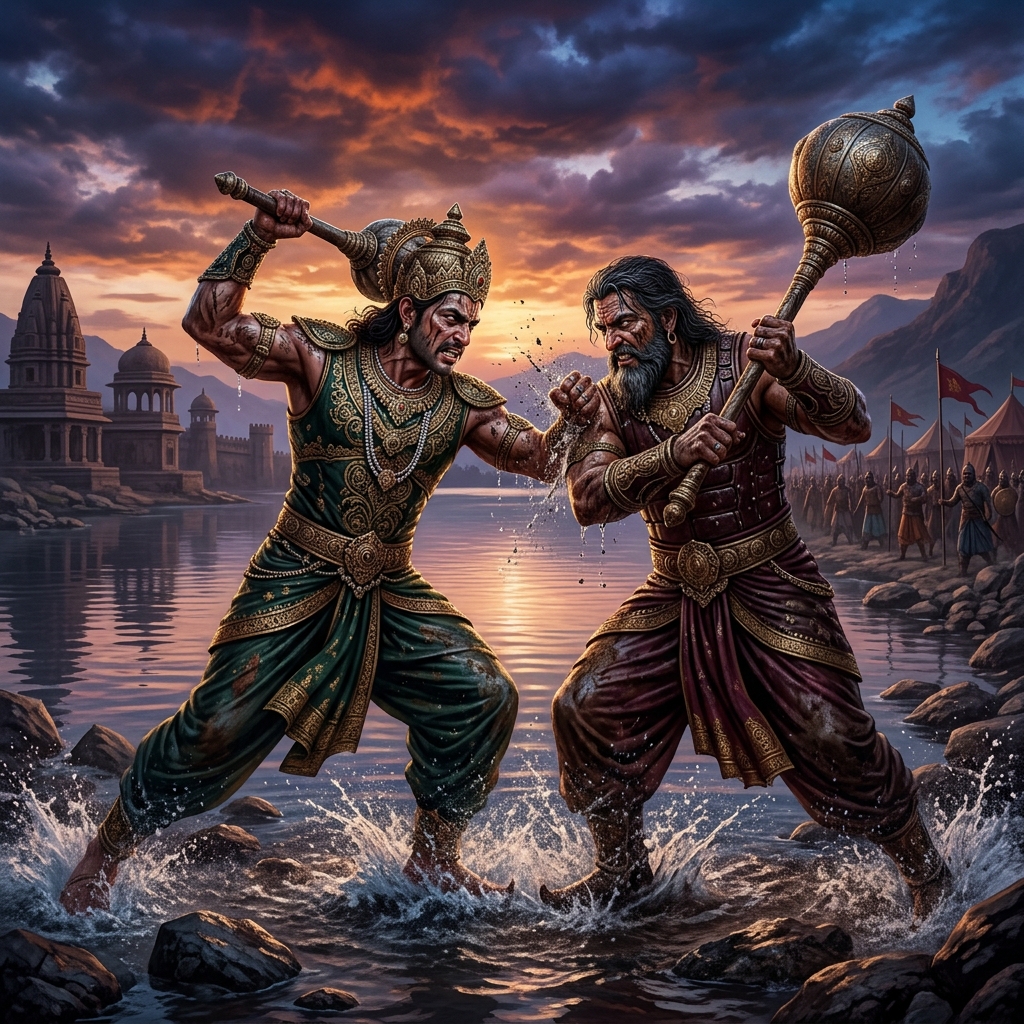
Eighteen days the pilgrimage lasted, matching, coincidence or not, the eighteen days of the war itself. Balarama returned to find not an ended quarrel but its very last hour: on the trampled field of Kurukshetra, before the whole exhausted remainder of two armies, Bhima and Duryodhana stood ankle-deep in blood-dark mud, maces raised, circling each other in the single combat that would decide everything.
He arrived in time to see it, not in time to stop it. Both men were his. Both had learned that same footwork from the same teacher, that same patient waiting for an opening rather than a wild swing. Watching them now, Balarama could read his own teaching in every movement - Duryodhana's improved stance, no longer wide with fury; Bhima's discipline, holding back the strike he wanted to throw in the first exchange.
Krishna stood at the field's edge, watching with the others, and Balarama went to him first, not to the fighters. 'I left,' he said, 'so this would not happen with my blessing on either side. Tell me it will not happen with my hand unable to stop it either.'
Krishna said nothing. There was nothing honest to say. The duel had already gone past any word that could end it - Duryodhana was tiring, Bhima was not, and both men knew, the way only a teacher's best pupils know, exactly what the other's next combination would be, because it was the combination they had both been taught.
Balarama could only stand at the edge of the field he had spent eighteen days deliberately avoiding, watching two lifetimes of his own patient instruction converge on a single, unstoppable ending.
Below the Navel
Bhima found his opening the way Balarama had taught him to find it - not by force but by patience, waiting for Duryodhana's guard to drop half a breath too soon. But the blow he threw was not a lesson. He swung low, below the navel, into the thigh, a strike the mace-code the two of them had studied together expressly forbade.
Duryodhana went down. Balarama's plough was in his hand before he had decided to lift it - the old farmer's weapon he carried always, half tool and half threat - raised over his head to bring down on the pupil who had broken every rule he had ever taught. It was Krishna who stopped him, gripping the plough itself in midair, his hand closing over his brother's before the blow could fall.
'You forbade this stroke in every lesson you gave them,' Balarama said, shaking. 'I trained him. I trained them both. And it changed nothing. Not one hour of this outcome.'
'It was owed,' Krishna said quietly. 'Bhima swore it at the dice hall, before either of them was your pupil. Remember whose oath came first.'
Balarama lowered the plough, but the grief in him did not lower with it. He had spent years believing that if he taught both boys well enough, gave both of them equal patience and equal correction, something in the discipline itself might outlast the hatred that had raised them. It had not. His restraint, his refusal to fight for either side, his entire pilgrimage away from the war, had bought nothing for Duryodhana bleeding in the mud, and nothing for Bhima standing over him with the stroke already thrown. Neutrality, he understood now, was not a shield. It was only a way of being present for the ending without ever being permitted to change it.
The Serpent's Road
Balarama left Kurukshetra without waiting for the war's last formalities, without accepting either side's account of who had won. Some years later, when the Yadava clan destroyed itself in a drunken brawl on the shore at Prabhasa - the calamity the family had been dreading and denying for a generation - he was said to have walked away from the wreckage of his own people and sat beneath a tree in yogic silence, done at last with a world that had never let his goodness matter as much as he needed it to.
Witnesses said that as he sat there, a great white serpent was seen to leave his mouth and move toward the sea, unhurried, as though something ancient in him had simply finished its errand on earth and gone home. He did not fight that ending any more than he had fought at Kurukshetra. Both were, in their way, the same refusal.
What the story of Balarama the teacher leaves behind is not a victory but a debt no one could ever repay him. He had given Bhima and Duryodhana the same lessons, the same patience, the same hope that discipline might be stronger than the hatred each carried into every practice bout. He had loved them both as sons and refused, at terrible cost to himself, to choose between them even when the whole world demanded he must.
It did not save either of them. Neutrality, held with perfect sincerity, could not undo a birth-order grievance, a game of dice, or an oath sworn years before he ever picked up a mace to teach anyone anything. Love divided equally is still, in the end, a kind of absence at the one moment either boy might have needed him whole.
Dharma Lesson
Balarama loved both his pupils and refused to lift his mace against either, believing neutrality itself was a form of righteousness. But dharma asks more than abstention: his silence could not soften the blow that broke Duryodhana's leg, nor undo the vow that guided it. To stand equally beside both sides of an unjust quarrel is still, in the end, to choose nothing at all.