The Old Maiden's Bargain
An ascetic's lifetime of tapas cannot buy her heaven until she takes a husband for one night
The Maiden Who Refused Every Suitor
Balarama's pilgrimage along the Sarasvati carried him from ford to ford, and at each one the sages who kept that place had a story ready for him, a reason why the water ran holy there above all other stretches of the river. At the next crossing after the tale of the boy who had kept the Vedas, the story they told him was of a woman.
She was the daughter of the sage Kuni-Garga, who had brought her into being by the power of his own mind, rejoiced at the sight of her, and then gave up his body and went to heaven. His wish had been that she be given to a husband, but she saw no man anywhere who was her equal, and she turned from marriage altogether.
She wanted no husband, no household, no children to raise. What she wanted was the river, the silence of that solitary forest, and a life spent entirely on austerity, and she meant to have it whether or not it was the life a woman was expected to choose. There was no father left to force her hand, and she stayed.
So she remained at that ford for the length of what became a very long life, taking up practices of fasting and prayer and self-denial so severe that other ascetics, men who had spent their own lives in austerity, spoke of her with something between admiration and unease. Years passed into decades, decades into what the sages who told the story simply called a great while, until the beautiful young woman who had found no husband worthy of her had become, without anyone quite marking the day it happened, an old woman still sitting in the same place, unmarried, and by every account she gave, entirely content.
A Lifetime of Penance
By the time old age had truly settled into her, the sage's daughter had accumulated, the rishis said, tapas of an extraordinary order, the fruit of decades spent denying the body every comfort in pursuit of something beyond it. Her hair had gone white and matted, her frame had thinned to little more than the discipline that held it upright, and still she kept her vows exactly as she had kept them at twenty, rising before dawn, standing for hours in the river's current, eating only what barely kept the breath moving in her.
Those who came to that ford to bathe or to pray spoke of her with real reverence by then. Whatever grievance the world might once have held against a woman who refused marriage and a household, no one voiced it any longer in her presence; her austerities had long since answered any question anyone might have asked about the life she had chosen.
At last, feeling her strength give way entirely and sensing, as such ascetics were said to sense, that her time in the body had run its course, she resolved to leave it the way the great sages left theirs, by will rather than by illness, gathering the mind inward and releasing the breath in a final act of concentration. She believed, and had every reason by the measure of her own effort to believe, that a life of such penance would carry her, once she let go of the body, straight upward into the heaven reserved for those who had mastered themselves as she had. She sat by the river to begin the final withdrawal, at peace, expecting nothing now but the reward she had spent a lifetime earning.
Narada's Warning
It was at that moment, as she gathered herself to leave the body, that the wandering sage Narada came to the ford, as he was known to appear wherever some matter of dharma hung unresolved.
He watched her a moment in silence, and then he spoke, gently but without softening what he had to say. "Your tapas is real," he told her, "and its fruit is greater than that earned by most men who call themselves ascetics. But hear this before you go: a woman's askesis, however vast, does not by itself open the gate of heaven to her. That gate turns also on marriage. Unwed, you may hold merit enough to shake the three worlds, and still that merit will not carry you where you mean to go."
She heard him, the sages said, the way a person hears news of an old wound reopening. This was the one door she had never thought to walk through, the one condition her whole design for her life had left entirely out of account, and Narada had not come to comfort her about it; he had come only to tell her the truth of it plainly, as the rule stood, without apology and without exception made for the depth of her devotion.
For a long moment she sat by the water in silence, the labor of an entire lifetime suddenly weighed against a single unmet condition she had never chosen to meet. Then, because she had spent that whole lifetime disciplining herself against despair as fiercely as against hunger and cold, she did not weep and did not rage at the sage who had told her. She asked him instead, very simply, what a woman in her place, this near to the end, was to do.
Half a Life's Merit
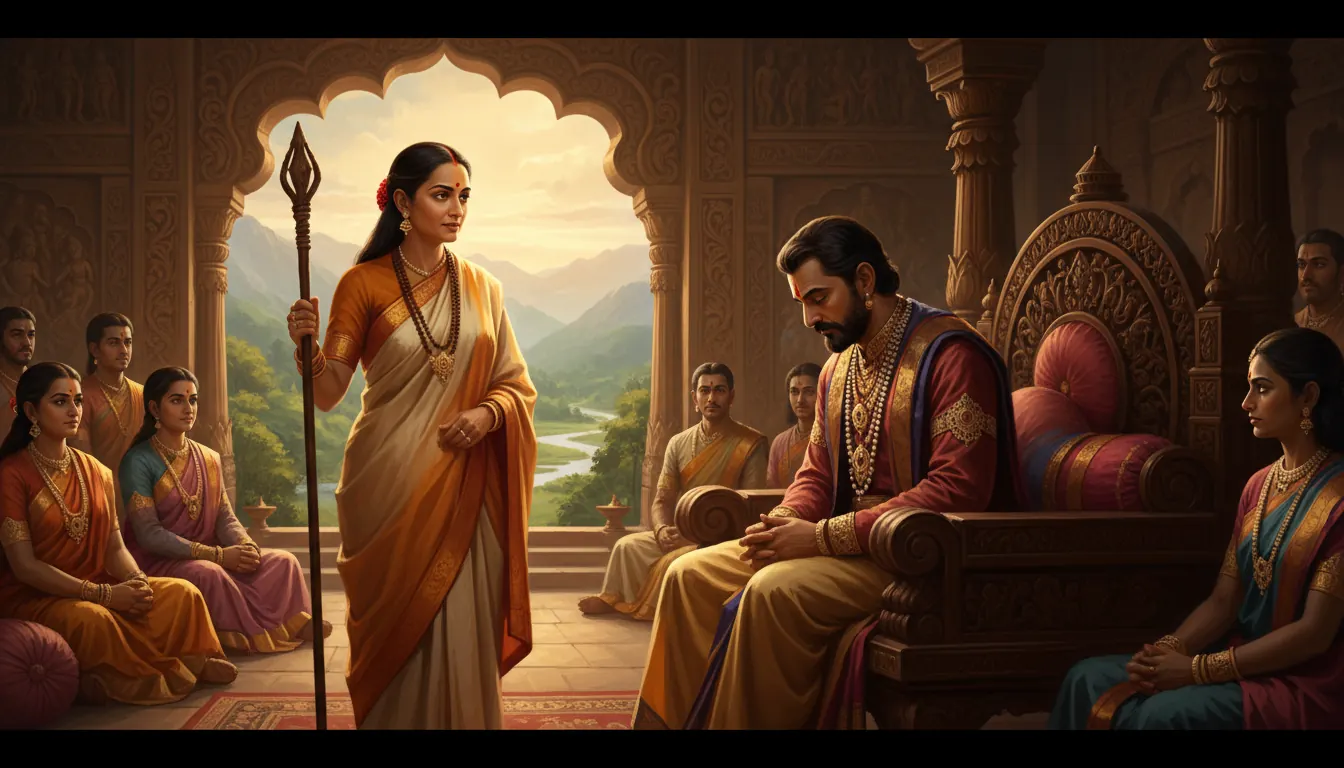
She did not waste the little time she believed remained to her. Rising from the riverbank, she went before an assembly of rishis and made her decision known aloud: she would give half of all the merit her tapas had earned, the whole hoarded fruit of that long unmarried life, to any man willing to take her as his wife.
It was not, by any ordinary measure, an offer many men would have wanted to accept. She was old, wasted by decades of austerity, with nothing to bring a husband but merit that could not be seen or held, only trusted. More than one traveler at that ford, hearing the offer, is said to have looked away and walked on.
But a rishi named Sringavat, the son of Galava, passing that way and hearing what she asked, did not walk on. He had no wife of his own and no particular use for half a stranger's stored penance beyond what dharma itself made of the exchange, and something in the plainness of her need, an old woman asking only for the one thing the rule demanded of her, moved him to answer where others had not. He agreed to marry her, but on a condition of his own: she would live with him for one night only. She accepted.
There was no long courtship, no elaborate rite drawn out over days as marriages among the great houses were drawn out. Sringavat poured the libations on the fire as the ordinances required, quickly and simply, and by nightfall the old woman who had found no husband in her youth stood married at last, not for love, not for a household, but so that a lifetime's tapas would not go to waste for the lack of a single rite she had spent that lifetime avoiding.
Radiant at Dawn
That night she became young again, as beautiful as a goddess, in celestial garments, ornaments and garlands, and Sringavat, seeing her blazing beauty, was delighted. When morning came, she told him the pledge was fulfilled and took his leave, and the sage's daughter, no longer unwed, prepared once more to do what Narada's warning had interrupted.
She sat by the Sarasvati as the sky lightened, gathered her mind inward the way decades of practice had taught her, and released the breath she had held back only long enough to meet the one condition standing between her and the reward she had earned. The sages who witnessed it said she did not go as the frail, worn ascetic she had appeared the evening before, but rose from the body in a blaze of light, radiant with everything that penance had stored in her across a whole lifetime, finally unbarred and finally hers. Sringavat, they say, was left grieving, unable to forget her beauty. Bound by the bargain, he took half her austerities with difficulty, and soon cast off his own body and followed her.
The rishis at that ford, finishing the tale for Balarama, did not try to smooth the story's harder edge, and Balarama, listening, did not ask them to. A woman could out-fast, out-pray, and out-endure any man on the riverbank and still find the gate to heaven closed to her on a single technicality of birth and custom, closed until a stranger's single night of marriage, given almost as an afterthought, opened it. The sages told it exactly as the rule stood, without dressing it as anything gentler than it was, and Balarama rose from that ford in silence, carrying the story onward the way he had carried every other one, toward the next crossing and the next telling.
Dharma Lesson
Even the most extraordinary personal austerity does not exempt a person from dharma's ordinary social obligations - merit and marriage are not substitutes for one another. The rule falls hardest on the one who has already given everything else, and the tale tells that sting straight rather than softening it. Sringavat's quiet, uncalculating consent to help completes what tapas alone could not.