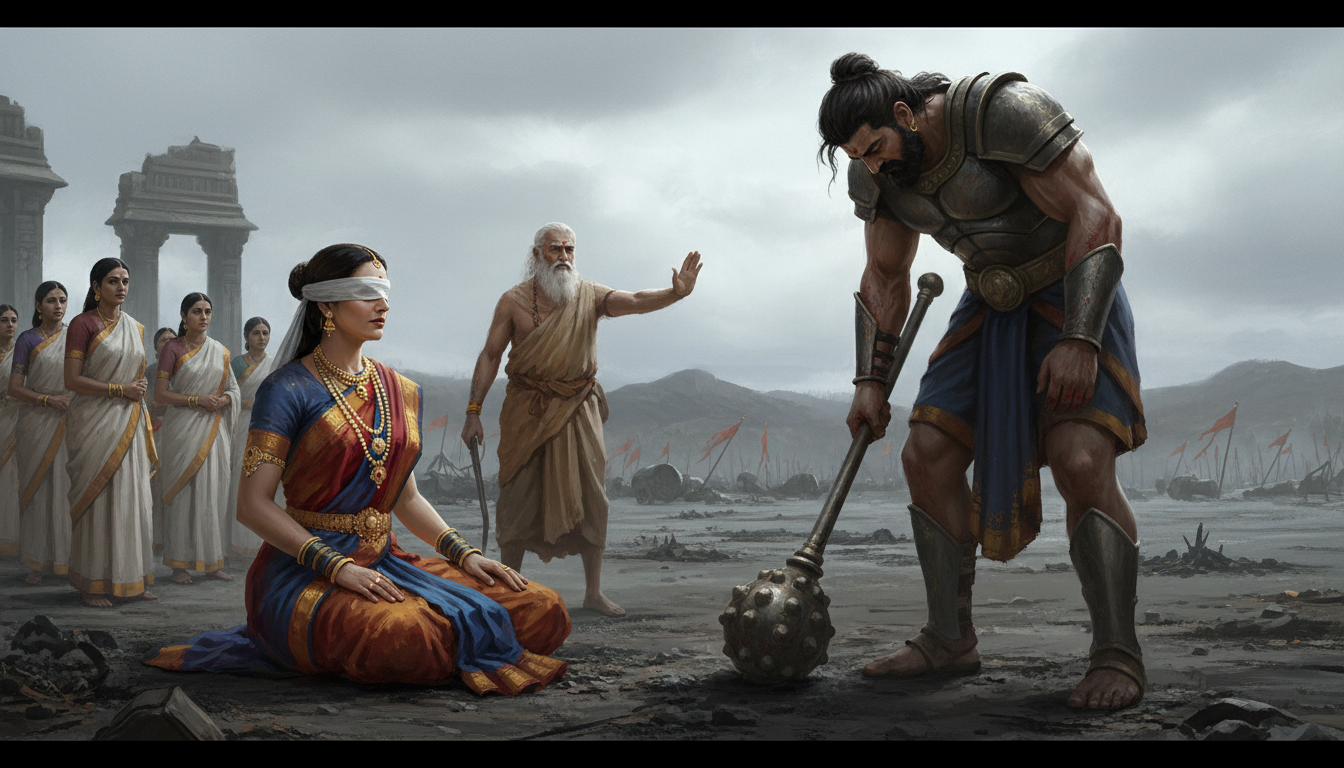
The Queen Asks Her Questions
Gandhari puts the victors on trial, and Vyasa stands in the way
The Errand Nobody Wanted
The maid-servants had only just finished washing the blind king when he gave the order. His chest was still raw where the iron had opened it, and there was blood dried in the white hairs of it, and he had wept a long time for a man who was standing three paces away from him and perfectly alive.
"Go to Gandhari now," Dhritarashtra said. "All of you. Take Krishna with you. She has not spoken since the names were read to her, and she has a right to look at you before anyone speaks of kingdoms."
Nobody moved for a moment. Then Yudhishthira touched his uncle's feet and turned, and his brothers turned after him, and Krishna of the Dasharhas went with them, and the little procession walked out from under the awning into the light.
It was not far. Gandhari had been set down apart from the worst of the field, where the wind carried less of it, on a spread of cloth under a canopy of poles, with the women of the household in a ring behind her. She sat very straight. The bandage across her eyes was the same bandage she had worn since the day she married a man who could not see, and in all the years since, not one person in Hastinapura had ever seen her take it off.
She heard them coming. She had a hundred sons in the dust behind her and she heard five men walking toward her over the same ground, and something went through her that had no name yet.
Yudhishthira the just had killed all his enemies. That was the whole of it, put plainly, and it was the way she was putting it to herself. She had been sitting there assembling a sentence. It was very short and there was a curse folded up inside it, and she had the merit to make it stick: eighteen years of vows kept without one indulgence, a lifetime of blindness taken on voluntarily, the terrible savings of an obedient woman about to be spent all at once.
But Krishna Dvaipayana Vyasa, who had begotten the father of these dead men and the father of those, and who could see into the heart of any creature alive when he turned his mind toward it, had washed himself in the fresh water of the Ganga that morning and had turned his mind toward his daughter-in-law. He arrived the way he always arrived, which was to say that he was suddenly there, ahead of them, standing between the queen and the five men walking toward her.
Eighteen Mornings
"Do not use this," Vyasa said.
Gandhari's head came round toward the voice. "Holy one."
"You have an opportunity here and you have decided what to do with it. Do not spend it on a curse. Spend it on forgiveness. Set your heart on peace, Gandhari, and hold back the words that are already at your lips, and listen to me first."
"You have come a long way to tell me what to say."
"I have come to remind you what you have already said," the sage answered. "For eighteen days, every morning that the battle lasted, your son came to you before he went out. He wanted victory. He asked you for it. 'Mother, bless me, I am going to fight with my foes.' Eighteen mornings, the same request. And what did you answer him? Not once, not twice. Every time."
She did not say it. He said it for her.
"'Thither is victory where righteousness is.' That is what you told him. Every morning of the war, your son asked you for victory and you handed him a condition instead, and he took it and went out and fought anyway."
"I did not send him out to die."
"You sent him out under a rule," Vyasa said. "And I have known you a long time, and I do not remember a single word spoken by you that has turned out to be false. Not one. You are not able to say a false thing; it is the fruit of everything you have done since the day you tied that cloth on. So consider what you are about to do. Those men have crossed to the other shore of a dreadful sea of Kshatriyas, and by your own words they crossed it because righteousness was on that side. If you curse the victor now, you make yourself a liar for the first time in your life, and you do it standing over your own children."
The wind moved the cloth of the canopy. Behind her the women had stopped their weeping to listen.
"You practised forgiveness before this," the sage said. "Why not now? Put down unrighteousness, you who know what righteousness is. Remember your own words, Gandhari, and hold your anger. Do not do otherwise, you who have always been beautiful in speech."
What She Set Down and What She Did Not
For a while Gandhari said nothing at all. Then she let out a long breath and the sentence she had been building came apart in her mouth.
"Holy one, I bear the Pandavas no ill will," she said. "I do not wish them destroyed. Understand me. It is grief for my sons; my heart will not stay still. I know what I owe them. I should guard the sons of Pandu as carefully as Kunti guards them, and so should their uncle, and I know it."
"Then say where the fault lies."
"With my son," she said. "With Duryodhana. With Shakuni, the son of Subala, who could not enter a room without leaving it worse. With what Karna did, and with what Duhshasana did. Those four exterminated the Kurus between them. Not one particle of the blame touches Vibhatsu, or Kunti's son Vrikodara, or Nakula or Sahadeva, or Yudhishthira. The Kauravas went into the field swelling with arrogance and pride and they fell there, and many others fell with them who had come to help them, and I am not grieving over that. That is what a battle is."
She turned her covered face toward the five men who had halted a little way off and had not yet been given leave to come nearer.
"But there is one act," Gandhari said. "One. It was done by Bhima, and it was done in the very presence of Vasudeva, who is standing over there and has not said a word."
Krishna did not say a word then either.
"My son was challenged to a mace encounter. A dreadful encounter, they tell me, and they also tell me that while the two of them were circling and turning through all the movements of that art, it became clear to the challenger that my son was the better man at it. My son was more skilled. So the challenger struck him below the navel."
Her hands were flat on her knees and quite still.
"That is what moves my wrath," she said. "Not that he is dead. That. Why should heroes, for the sake of their own lives, throw away obligations that were fixed by great-souled men who knew every duty there is?"
Bhima Answers for the Thigh
Bhima came forward. The strongest man on earth, who had broken a hundred men of that house with his hands and his mace and had not once looked afraid while doing it, came and stood in front of a blindfolded old woman and looked, to everyone watching, exactly like a man in fright.
"Righteous or unrighteous," he said, "I did it. I did it out of fear and to keep myself alive. Forgive me now, if you can."
"Say the rest."
"Your mighty son could not be killed by anybody in a fair fight. Nobody. That is why I did an unfair thing; there was no other door." He kept his eyes down. "Your son had beaten Yudhishthira unfairly himself, in a hall, with dice, and he never in his life behaved toward us in any other way. He was the last man of his side left standing. If he had won that fight he would have taken the whole earth back from us in an afternoon, and we would have been in the forest again, and this time for good."
"So you struck the thigh."
"I struck the thigh," Bhima said, "because he showed it. You know what your son said to the princess of Panchala when she was brought in with one cloth on her, in her season, in front of everybody. You know he uncovered his left thigh and slapped it and told her to come and sit on it. He earned his death that day. We would have given it to him that day, but Yudhishthira the just held us to the compact he had made, and we let ourselves be held. That is when your son bought this war, queen, and we paid the price of it for twelve years in the woods and one year hidden. I remembered all of that when I lifted the mace. And now Duryodhana has fallen and there is nothing left between us. Your son's brother-in-law has his kingdom back and my wrath is spent."
The Second Charge
"You praise him," Gandhari said.
Bhima looked up.
"You have just told me that my son was the better man with the mace and that no one alive could have taken him fairly. You have praised him to my face. Then he did not deserve to die the way he died." She let that sit. "He did everything else you say he did. I do not dispute one word of it. He said those things to the princess and he showed her his thigh and he cheated your brother in the hall, and I told him at the time what he was and he did not listen to me either."
"Then, queen -"
"Then there is the other thing," she said, "and I want you to answer for that one too."
The wind had dropped. Away over the field the jackals were at work in the middle of the afternoon, which was not their hour, because there was no longer any reason for them to wait for dark.
"Vrishasena took Nakula's horses out from under him," Gandhari said. "That was the day. And on that day, in that battle, you drank the blood out of Duhshasana's body."
Krishna's face did not change. Arjuna, standing behind him, went very still.
"There is no argument you can make to me about that," she said. "It is a cruel act. It is condemned by every good person who has ever spoken on the subject. It suits nobody, Vrikodara, except the lowest sort of man there is. It was a wicked thing, and it was done by you, and it was beneath you. Whatever else you are, you were not born to be that."
The Blood and the Vow
"It is improper to drink the blood of a stranger," Bhima said. "So what am I to say about drinking the blood of my own? A brother is one's own self. There is no difference between the two. I know what I am accused of, and I know how it looked."
"How it looked."
"The blood did not pass my lips," he said. "It did not pass my teeth. Karna knew that; he was near enough to see, and he said so afterwards to men who are still alive. My hands were smeared with it, and I put my hands to my mouth where everyone could see me do it, and I let them believe the rest. Vrishasena had just stripped Nakula of his horses and your sons were cheering. I wanted them to stop cheering. I wanted every brother of that hundred to look at me and be afraid, and they were."
"And the vow."
"And the vow," Bhima said. "When the dice were finished and that man took Draupadi by the hair and dragged her across the floor of the assembly hall, I said certain things out loud in my rage. I remember them exactly. I have remembered them every day since. If I had left that vow unfinished, then for all the years to come I would have been a Kshatriya who said a thing in the hall and did not do it, and I would rather be what you have just called me. That is why I did it, queen. It behoves you not to lay a fault on me for that."
He stopped. Then, because he was Bhima and could never stop one sentence short of the one that cost him, he said it.
"You did not restrain your sons when there was time. Does it become you now to lay the fault on us, who were innocent?"
The Question He Could Not Answer
Gandhari did not answer that. She sat with it a moment, and then she asked the only question of the afternoon that Bhima had no defence prepared for.
"Nobody defeated you," she said. "In the whole war, from the first day to the last, nobody put you down. You went through a hundred sons of this old man and not one of them was able to stop you."
"That is so."
"Then why not one, child?" Her voice did not rise. That was the worst of it. "Why did you not leave one? One of the weaker ones. One of the ones whose offences were smaller; there were some, you know them, you sat at table with them for years. This old couple has lost its kingdom. Why did you not leave us even one crutch to walk on? A blind man and a woman who has bound her own eyes, and a hundred sons, and not one left over to lead us to the water."
Bhima said nothing. There was nothing to say. He had counted them himself, one by one, on his fingers, the way a man checks a debt.
"You are alive and unhurt," Gandhari said. "You have killed all my children and you are standing here without a mark on you, and I tell you honestly, I would not have grieved even at that, not one hour, if you had walked the road of righteousness while you did it."
Krishna looked at the ground. Yudhishthira, who had not yet spoken, had gone the colour of ash. Somewhere behind the queen the women had begun again, quietly, the way people cry when they have already been crying for two days.
Then Gandhari lifted her head, and the wrath came up in her all at once, wrath for a hundred sons and for the grandsons after them, and she said, "Where is the king?"
The Toe and the Blindfold
Yudhishthira came. He was trembling; he did not attempt to hide it. He put his palms together and spoke in the soft voice men use when they have decided not to argue.
"Here is Yudhishthira, goddess. The cruel one who killed your sons. I deserve your curse. I am the cause of this destruction of the whole earth, and I am standing where you can reach me. Curse me. I have no further use for life, or for a kingdom, or for wealth. I have had my friends killed for me. I have proved myself a great fool and a hater of my own people."
Gandhari drew a long breath, and another, and said nothing.
He bent forward to fall at her feet.
She was conversant with the rules of righteousness and she had a great deal of foresight, and she had also just been asked to hand back a curse she had spent a lifetime earning. What she did was very small. From inside the folds of the cloth that covered her eyes she directed her look downward, once, at the tip of his toe as it came toward her.
That was all. Nothing was said. But the king of the Kurus, whose nails had been beautiful all his life, every one of them, had a sore black nail on that toe from that moment, and it never came right again.
Arjuna saw it happen. Arjuna, who had gone in one afternoon through eleven divisions of armed men to keep a vow, quietly moved his position so that Vasudeva was between himself and the old woman. The others shifted where they stood, from one foot to the other, glancing at each other, unable to be still.
Then Gandhari cast off her wrath. She put out her hands and found the head of the man kneeling in front of her, and she comforted the sons of Pandu as a mother comforts, and gave them leave to go.
Two Mothers and a Daughter-in-Law
They went from her to Kunti, and Kunti, who had been sick with fear for them for eighteen days and had heard the lists read out each evening with her hands in her lap, pulled her cloth over her face and wept before she touched any of them.
When she had wept she looked. She went along the five of them and found the wounds, the old scars and the new ones, the shoulder that would not lift properly, the place on Nakula's arm where the fence had been cut away, and she embraced each son and patted him with her hands, over and over, the way one does with something recovered.
Then she went to find Draupadi, and Draupadi was lying on the bare ground.
"Venerable lady," the princess of Panchala said, "where are your grandsons? Where is Abhimanyu, and where are the others? They should have come to you by now. They can see you sitting like this. Why are they so slow in showing themselves?" She was not confused. She knew exactly where they were. "I have no children left. What do I want with a kingdom?"
Kunti raised her, and held her, and could not comfort her, and took her by the hand instead and brought her to Gandhari, going from the woman with five living sons to the woman with none, both of them in more grief than the one they were going to console.
Gandhari heard them come and knew the step.
"Do not grieve like this, daughter," she said. "Look at me. I am as struck as you are. I think this destruction of everything came about by the irresistible course of Time, and no one's will brought it, however much we all worked at it. Vidura foretold this in front of me, on the day Krishna's request for peace was refused, and the words of such men do not fall to the ground. Do not grieve over a thing that could not be avoided, and least of all now, when it has already happened. They fell in battle; they are not to be grieved for. You and I are in the same case, and if we both sit down in the dust, who is left to comfort us?"
She was quiet a moment.
"Through my fault," she said, "the foremost of all races has been destroyed."
Thus, said Vaishampayana, ended the Jalapradanika section, in the parva of the women.
Dharma Lesson
Forgiveness withheld until the accounting is finished is worth more than forgiveness offered instead of it. Gandhari makes the victors answer for every unrighteous thing they did before she lets go of her anger, and even the anger she lets go of leaves a mark on a king's foot.