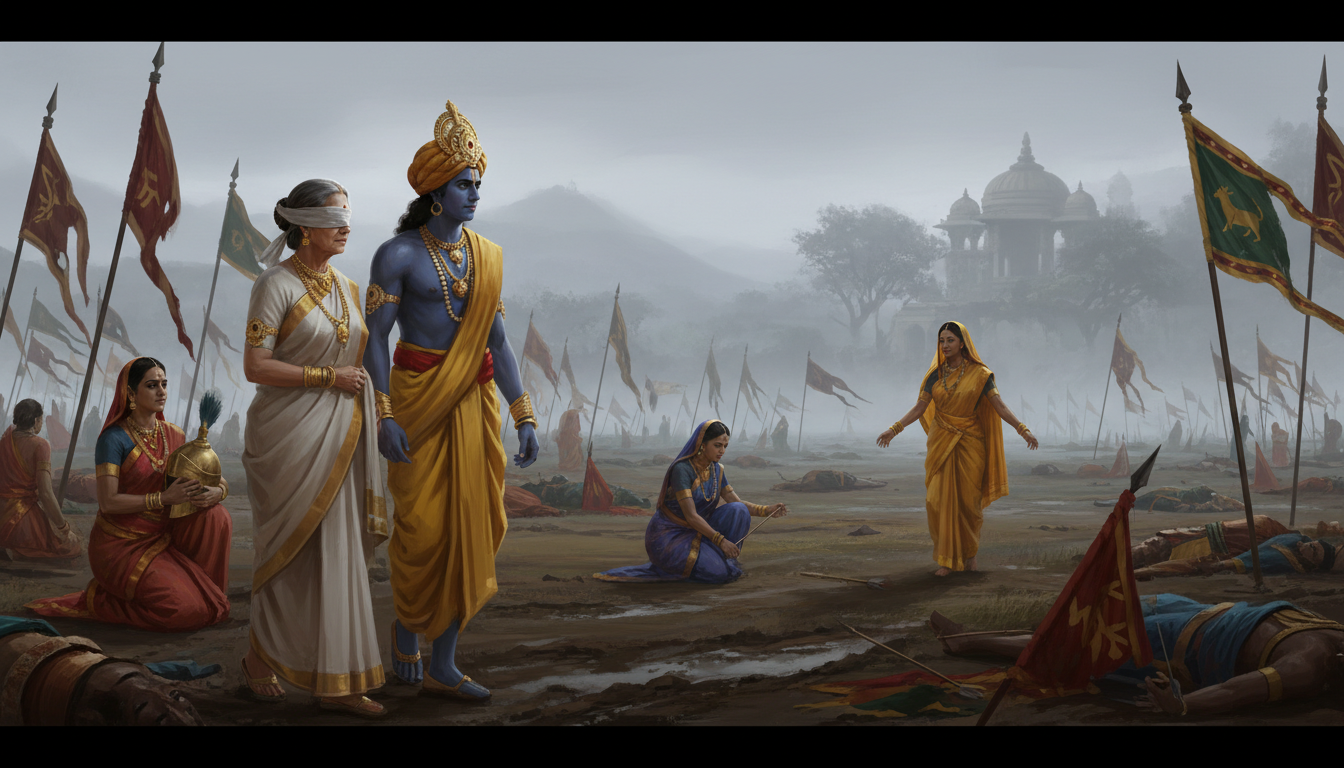
The Queens Who Came a Long Way
What the Kuru quarrel cost the kingdoms that were only allies
Look Further Out
She had done her own hundred first. She had knelt over Duryodhana with the blood still on him and asked Time what it thought it was doing; she had stood at Duhshasana and at Vikarna, whom even his enemies had praised, and at Durmukha, whose face was half eaten and still handsome; she had heard Lakshmana's mother rubbing her husband's body with one hand and her son's with the other. That part was finished. Vyasa's gift let her see the whole plain at once from where she stood, near and far as if they were the same distance, and she had used it on her own family until there was nothing left of them to use it on.
Then Gandhari turned her bandaged face outward, toward the parts of the field where the standards were unfamiliar.
"Look further out, Madhava," she said. "Away from my sons. Out where the banners are ones I could not read even when I could see."
Krishna walked with her. He did not answer any of it; he had been beside her all morning, taking her elbow over the broken ground, and he would not say a word until the very end, when she had finished and turned on him.
"There is a thing I have understood in the last hour," she said, "and I want to say it out loud where you can hear me. My son quarrelled with his cousins. That was the whole of it. A quarrel in one house, over one hall and one throne, between boys who had the same grandfather."
She lifted her hand and swept it slowly across the east of the field, where the dust was still hanging.
"Now count the countries lying out there. Kamboja. Madra. Magadha. Kosala. Avanti. The Sindhu and the Sauviras. Trigarta and the Kekaya hills, and the Kalingas, and the Chedis. Not one of those women out there ever set foot in my house. Not one of them was in the hall when the dice were thrown. Their husbands came because they had given a promise, and they are lying here."
The Girl Looking for a Head
"Begin with my daughter," Gandhari said, "since she is the nearest and she is making the most noise."
Away to the left, where Arjuna had gone through eleven divisions of troops in an afternoon to keep a vow before sunset, the lord of the Sindhus and the Sauviras lay in what was left of his chariot. Vultures had been at Jayadratha since the previous day. His wives had come out to him, the Kamboja women and the Yavana women who had followed him from his own country, and they were doing the only thing there was to do, which was to stand over the body in a ring and drive the birds off it with their hands and their scarves, and they were not managing it. Something had already dragged him a little way toward the scrub.
"That man tried to carry Draupadi off out of the forest," Gandhari said. "He had the Kekayas with him and he put her in his car and drove. He deserved to be killed for it that day, and the Pandavas caught him and had him on the ground with their hands in his hair, and then they let him go. Do you remember why they let him go, Krishna? For Duhshala. Because he was married to my daughter and they did not want to make a girl of that age a widow."
She stopped.
"So why not show her the same regard the second time? What greater grief is there for me than this, that my daughter, who is still of tender years, has no husband, and every one of my sons' wives has no lord?"
Then her voice changed, because the sight had moved.
"There she is. Look at her, Krishna. She has stopped crying, she has put her fear down somewhere, and she is running up and down that field hunting for her husband's head. She is striking herself with her own hands as she goes and cursing the sons of Pandu at every step. That is my daughter, and she is looking for a head in a place where there are ten thousand of them."
The Two Shala Trees
"Take me east a little," she said. "There were brothers from Avanti."
They lay close together, as they had fought, Vinda and Anuvinda, in golden armour with golden angadas on their arms, their swords and their bows still in their hands, garlands unbroken, eyes open, both of them with the wide-set gaze that men in that country call the bull's look.
"Two shala trees in blossom," Gandhari said, "thrown down by one storm in the spring. That is all they are now. And there is the elder of that house too, beyond them, with the jackals and the crows walking over him, that lord of Avanti who killed men in numbers all day and is lying here this morning without a single friend, though he had more friends than any of us. Bhimasena did that. His wives are sitting round him in a circle and crying, and they will still be sitting there at nightfall, and the birds are not waiting for the crying to finish."
She listened.
"They were good to their word," she said. "That is the trouble with all of this. Nobody out here broke an oath. They kept them."
Further along she found the old man of the Bahlikas, Pratipa's son, who had been born before any of the quarrelling was thought of and had stayed alive through all of it until a broad-headed shaft came for him. He lay on his side like a tiger asleep. The colour had not left his face; it was as bright as the moon on the fifteenth night of the lighted fortnight, which is the night when there is nothing left of the moon to add.
"He advised against every part of this," Gandhari said. "He advised against it in my hearing, more than once, and then he put on his armour and went out with the boy who had ignored him, because that is what an old man of a house does."
The Women of Madra
"Shalya," she said. "Where is Shalya?"
He was not far. The king of the Madras, uncle to Nakula and Sahadeva on their mother's side, lay where Yudhishthira the just had put him, and Yudhishthira the just was the last man in either army anyone had expected to kill him.
"He used to boast about you," Gandhari said. "To your face and behind your back. He would tell any assembly that would sit still for it that he was your equal with horses, and that if it came to it he was your equal in other ways too. There he is."
She was quiet for a moment and then said the thing she had been avoiding.
"Look at his face, Madhava. It was as smooth as the moon and his eyes were lotus petals and the crows are eating it. His tongue has rolled out of his mouth. It was the colour of heated gold, that tongue, and the birds are having it."
Around him sat the ladies of the royal house of Madra, wailing, a whole household of them who had come four hundred leagues from the rivers in the north to be at this.
"They are sitting round him," she said, "the way a herd of she-elephants in their season stands round the leader of the herd when he has gone down in a slough and cannot get his feet under him. They cannot lift him and they will not leave him. He was a giver of protection, that man. He was the ornament of any hall he walked into. He is lying on the hero's bed with his body mangled by shafts, and the women of his country are round him in a ring, and his own nephews are on the winning side."
She turned her head.
"And he had already sold them, Krishna. Do you know what I know? When he took the reins of Karna's car he had promised my son he would drive, and he had promised himself he would talk. He drove that chariot all day and spent the whole of it damping the fire in the man beside him, on purpose, to hand the victory to the sons of Pandu. He kept faith with my son's army with his hands and broke it with his mouth, and it did not save him from Yudhishthira, and it has not saved these women anything at all."
The King of the Mountain Country
"Bhagadatta," said Gandhari.
The ruler of the mountain kingdom lay with his great elephant somewhere behind him in the wreck, the foremost of all the men on earth who knew what to do with an elephant-hook, an old man by then and famous before most of the dead here were born.
"He still has the garland on," she said, and there was something close to laughter in it, the dry kind. "Look. The beasts have been at the body all night and the gold is still sitting on his hair, exactly where it was put. It looks well on him."
Krishna said nothing.
"That was a real fight, that one," she said. "He and the son of Pritha went at each other until the hair stood up on the arms of everyone who watched it, like Shakra and the asura Vritra, and he had Dhananjaya in serious difficulty for a while. Everybody says so. And then it ended the way all of them ended."
She was silent a moment. Somewhere ahead the wailing had a different note in it, higher, in a language she did not have.
"He came from the far east," she said. "Past the rivers, up in the hills where the elephants are. Whatever quarrel there is between my sons and my husband's brother's sons, it did not reach that country until a rider came with a letter and a reminder of an old friendship. And now his household is standing on this plain, which none of them had ever seen, and they will carry him home in a jar if they carry him at all."
The Kamboja Queen
They came to the Kambojas, and Gandhari stopped where she was.
The ruler of that people lay in the dust, bull-necked, a big man, a man who by any ordinary reckoning should have been stretched out at his ease at that hour on one of the woollen blankets his country is famous for. His wife was holding his arms.
"Listen to her, Krishna," the queen said. "I want you to hear this one."
The Kamboja woman had a melodious voice, and it was shaking, and she was speaking to her husband as though the conversation were still open.
"Even now they are beautiful," she was saying. "Even now. Look at the palms, look at the fingers on them. These two arms of yours are like a pair of spiked maces, and when I was inside them there was not one moment when joy left me. Not one moment in all those years." She turned his hand over. There was sandal-paste under the blood, from whatever morning had been the last one. "What is going to happen to me? Ruler of men, tell me. What will my end be, without you?"
Behind her stood the rest of the women of that house, thirty or forty of them, worn out with the walking and the heat, their faces burnt by a sun much harder than the one at home. Beauty had not left them for all that. They looked, Gandhari said, like the wreaths the celestials wear, which stay fresh in the middle of the day when every mortal garland has gone limp.
"She is asking him a question," Gandhari said. "That is the part I cannot bear. Every one of these women out here is asking a question of a man who came a thousand miles to help my son with something that was none of their business, and not one of them is going to be answered."
Magadha, Kalinga, Kosala
"The Kalingas," she said, moving on. "Their king is over there with the angadas still on both arms. And past him the Magadhas."
The Magadha women were standing, not sitting, round Jayatsena their king, and it was their crying that had come across the field a little earlier in a pitch nobody else was using. They were young, most of them, long-eyed, with the sweet voices that country breeds, and their ornaments had all slipped out of place from the running.
"That sound is going to stay in my head," Gandhari said. "It is charming, that is the horror of it. Those girls should be on costly beds tonight in their own city with somebody fanning them. They are going to lie down on the bare ground here, in their good clothes, next to that."
She turned again.
"And the Kosalas. Prince Brihadbala."
The women round the ruler of the Kosalas were doing work. They had got him onto his back and they were pulling the arrows out of him one at a time, and there were a great many, and each one that came out took something with it, and every so often one of the women would go over sideways in a faint and be propped up by the others and go back to it.
"A boy killed him," Gandhari said. "Abhimanyu. Sixteen years old, on the day he went into the wheel formation alone, and one of the things he did in there before they finished him was to put those shafts into this man with the full strength of his arms. Those women are taking a dead child's arrows out of a dead king. Their faces are like lotuses left out in the sun."
She stood listening to it for a while.
"And that boy's mother is somewhere behind us on this field," she said, "doing the same arithmetic from the other end."
What Drona Left
"Now show me the ones the preceptor took," Gandhari said, "because there is a pattern in them and I want to say it out loud."
They went to the children of Dhrishtadyumna first, boys of tender years with gold garlands and gold angadas still on them, lying where they had gone in.
"Insects," she said. "That is all. Drona's chariot was a chamber of fire and his bow was the flame in it and his shafts and darts and maces were the fuel, and these boys flew straight into it because it was burning and they were young. Their grandfather's quarrel, not theirs."
The five Kekaya brothers lay together further on, all with their faces turned toward the place where the preceptor's car had stood, their mail the colour of heated gold, their standards and their cars and their garlands all of the same metal, so that the whole group of them threw light across the ground like a row of sacrificial fires.
"They came from the hills to fight for their cousins' cousins," Gandhari said. "None of them turned round."
Then Drupada, the king of the Panchalas, thrown down by Drona the way a big forest elephant is thrown down by a lion, and the two of them had begun as boys together and had spent a lifetime taking pieces out of each other, and had finished within a day of one another. His white umbrella lay near him, still bright, like the moon in an autumn sky. His wives and his sons' wives had already burned him; Gandhari could see them walking away from the pyre, keeping it on their right as the rule requires.
And Dhrishtaketu of the Chedis, that bull among men, who had beaten off a great many of Drona's weapons before one of them went home, lying like a tree the wind has taken out by the roots, with his earrings still in and the birds already at him, and his women lifting his head into their laps. And beside him his son, hacked down by the same hand.
"That child would not leave his father while the fighting was on," Gandhari said, "and he has not left him now."
The Reckoning She Made
She had come nearly to the end of the field and nearly to the end of what she could hold.
"Your Pandavas cannot be killed," she said. "Nor can you. I have thought about it and there is no other explanation. They stood in front of Drona and in front of Bhishma and in front of Karna the son of Vikartana; in front of Kripa, in front of my son, in front of Drona's son, in front of Jayadratha, in front of Somadatta and Vikarna and the brave Kritavarma. Every one of those men could have killed the celestials by force of arms. Every one of them is lying here, and the five of them are standing behind me perfectly well."
She turned around slowly, taking in the whole of it with the sight she had been given.
"Look at what Time turns over," she said. "There is nothing destiny cannot arrange. It has had bulls among men slain by other bulls among men and it has not needed anything more elaborate than that."
"You knew before it began," Krishna said. It was the first thing he had said all morning.
"I knew at Upaplavya," Gandhari answered. "The day you came back from Hastinapura with nothing. My sons were dead from that hour and I said so to myself and did not say it to them. Shantanu's son told me and Vidura told me, both of them in the same week, in the same words: stop loving your children. Those two do not talk for the sake of talking. And now, quite soon, quite quickly, they have been burnt to ashes, my sons, and all these others with them."
She stood a moment longer. The wailing on that plain was in a dozen languages and none of them belonged to the house that had started it. Kamboja women, Madra women, Magadha girls with their ornaments hanging off them, the Kosala household with a boy's arrows in their hands, the Kekaya mothers, the Avanti wives sitting in their circle waiting for dark.
"They had no quarrel here," said Gandhari. "Mine was the quarrel. Theirs is the bill."
Then her fortitude went out of her, and she fell down on the earth and let her senses go, and when she came up out of it she was no longer speaking about the allies. She had turned to the man holding her arm, and she had begun to say something else entirely.
Dharma Lesson
A war is paid for furthest from the place where it is fought, by households that were offered nothing but an alliance. The Kamboja queen and the girls of Magadha kept a promise they had never made, and the quarrel that killed their husbands was decided in a hall none of them had ever entered.