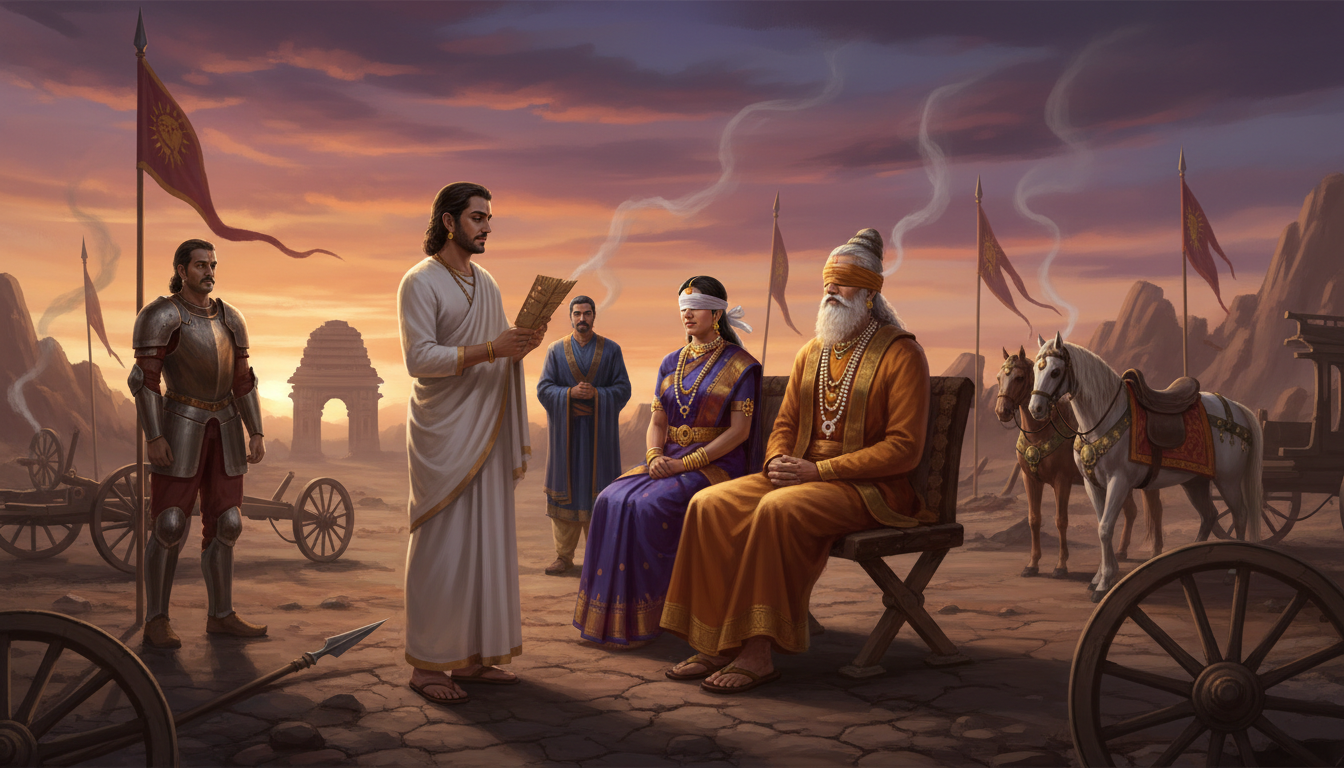
The Count of the Dead
Krishna's blunt answer, and a king who could see where they had gone
Arise, Gandhari
She had walked the whole field on Krishna's arm, from her sons to the allies to the boys, naming them one after another with the sight Vyasa had given her, and at the end of it she had gone down in the dust like a plantain tree cut through and had lain there without moving.
Krishna did not kneel beside her. He stood over her, and what he said was the hardest thing he says anywhere in the long history of that family.
"Get up. Get up, Gandhari. Do not set your heart on grief."
Nobody near them spoke. Yudhishthira, a step behind, did not look up.
"This vast slaughter came out of your own fault," Krishna said. "Your son Duryodhana was wicked-souled, and envious, and beyond measure arrogant. He was hostility itself, walking about in a body. He would not obey the injunctions of the old, not once, not from his father, not from Bhishma, not from Vidura, not from you. And when he did his wicked acts, you applauded them. You looked at them and you called them good. Why do you now wish to fasten your own faults on me?"
The queen's hands moved in the dust and were still again.
"Grieving for a person who is dead or lost gets you nothing but more of it," he said. "Take up grief and it doubles in your hands. You know this. You have known it since you were a girl and could recite it before witnesses."
He was speaking to a woman who had just seen a hundred sons torn by birds, and he was speaking to her in the flat voice of a man reading out an account, and every person standing there understood that he was doing it on purpose.
What a Princess Bears Sons For
"Consider what women bear children for," Krishna said. "A woman of the regenerate class bears them for the practice of austerities. The cow brings forth her calf so that burdens can be carried. The mare foals so that there will be speed in the world. The Shudra woman bears a child and the number of those who serve is increased by one; the Vaishya woman bears and there is one more keeper of cattle."
He paused only long enough for her to know it was coming.
"A princess like you brings forth sons in order that they may be slaughtered."
There is no record of anyone answering him. Sanjaya was there, and Vidura, and Yudhishthira and his brothers, and the priests, and a crowd of the household women, and not one of them said a word, then or afterwards, about what Vasudeva had said to the mother of the hundred while she lay on the ground.
Gandhari heard it. Her heart, agitated already past what a heart is built for, went quiet in a way that was worse than the wailing had been. She did not weep again that afternoon. She did not curse him again either. She simply stopped, the way a musician stops when the string has gone, and lay where she was, and let the words be true or not true somewhere above her head.
It was Dhritarashtra who broke it, and he broke it by changing the subject, which was the only mercy available to him. The old king was holding down the grief that comes out of foolishness; he could feel it moving in him and he put his hand on it and held it there, and he turned his blind face toward the son of Dharma and asked a question with a number in it, because a number is something a man can hold.
The Old King Asks for a Number
"Son of Pandu," Dhritarashtra said. "If you know it, tell me. How many have fallen in this battle? And how many are left alive?"
It was a strange thing to ask on that ground, with the field still ungathered and the birds working over it in every direction, and it was also the first entirely practical sentence anyone had spoken in three days. The whole party turned toward it with something like relief. Sanjaya had told him at the very beginning, on the morning the news came, that eight and ten akshauhinis of combatants had been slain and that the earth was desolate and all but empty; but eighteen divisions is not a number, it is a way of not saying a number, and the old king had been living inside it ever since.
Yudhishthira did know it. He had been keeping the count since the first evening, the way he kept everything, because somebody in that army had to be able to answer for what had been spent, and no one else was going to. Eleven divisions had stood on one side of that plain and seven on the other, and he had watched both of them go into the ground.
"One billion six hundred and sixty million and twenty thousand men have fallen in this battle," he said.
The old king's hands closed on his knees.
"Of the heroes who have escaped with their lives," Yudhishthira said, "the number is two hundred and forty thousand one hundred and sixty-five."
Nobody said the two figures over again. There was no need. Sanjaya, who had reported the war aloud for eighteen days and knew what a division looked like when it was still standing, put his hand over his mouth. Eighteen days, eighteen divisions, and eleven of them on the side of the man who had asked his mother for a blessing every morning; the earth emptied of Kshatriyas from the mountains to the sea; and at the end of it a number that a man could say out loud in one breath, and a second number that could have been fitted into a single town.
Dhritarashtra sat with it. Then, because he was the sort of man who could not leave a thing half-known once it had been put in front of him, he asked the second question, which was much larger than the first.
"Tell me, mighty-armed one, for you are conversant with everything. What ends have those foremost of men attained?"
Where They Went
"Those who cast off their bodies cheerfully in that fierce battle," Yudhishthira said, "have all gone to regions like Indra's."
He was not guessing. Everyone present could hear that he was not guessing, and his brothers looked at him sideways.
"Those who knew death was coming for them and met it without cheer, because they knew it was inevitable and went anyway, have attained the companionship of the gandharvas."
He went on down the list as steadily as he had read the numbers.
"Those who fell at the edge of a weapon while they were turning away from the field, and those who fell while they were begging for quarter, have gone to the world of the guhyakas."
Somebody among the priests drew breath. It is a real world and not a punishment, and it is also not Indra's.
"And those high-souled ones who kept the duties of a Kshatriya and thought running away was shameful, and who went forward unarmed against fighting men and were mangled with keen weapons for it, have all put on shining forms and gone to the regions of Brahman."
That was the top of it. Not the great archers, not the men with the celestial weapons. The men who walked into it with nothing in their hands because turning round was not available to them.
"The rest," he said, "all those who died anywhere within the borders of that field, by whatever means, have attained the region of the Uttara-Kurus."
So it turned out that on the nineteenth morning of the world's largest funeral, the first honest sorting of the dead was not by side and not by rank. It was by the manner of the dying. A man of Duryodhana's eleven divisions who had gone forward empty-handed stood higher in that reckoning than a Pandava who had gone down asking to be spared, and both of them had a place, and nobody had been left out of the account.
By the Power of What Knowledge
"By the power of what knowledge," Dhritarashtra said slowly, "do you see these things, son, like a man crowned with ascetic success? Tell me, if you think I may hear it without impropriety."
The old man was careful about that. He had asked for a great deal already and he knew it, and he was blind and had been fed the war in another man's voice for eighteen days, and he was asking a nephew he had wronged for a look at something that was not his.
"While I wandered in the forest at your command," Yudhishthira said.
The sentence stopped there for a moment, and stayed stopped, and everyone heard the whole of it before he finished it.
"On that journey, going from one sacred place to another, I met the celestial rishi Lomasa. He gave me a boon. He gave me spiritual vision, and I have had it since. That is how, on that former occasion, I obtained second sight through the power of knowledge."
Twelve years in the woods, which the man now asking had signed for and never once revoked. Lomasa had come down out of the sky to walk the pilgrimage with them because Indra had asked him to, and had led them from ford to ford telling them the old stories at each one, and somewhere along that road he had made this gift to a landless king who at the time had nothing to see with it.
And out of those twelve years, this: the ability to look at a plain in the dark and say where every one of one billion six hundred and sixty million and twenty thousand men had gone. The exile had produced the only instrument in the family that was fit for the morning after, and the man who had ordered the exile was now leaning forward to use it.
Dhritarashtra said nothing for a while. Then he asked the last of his questions, and it was not about heaven at all.
Who Will Burn the Ones Nobody Is Left to Burn
"Our people must burn these bodies with the proper rites," the old king said. "The friendless and the friended alike; I am clear about that much. But tell me what we are to do about the ones who have nobody left to look after them, and who have no sacred fires of their own."
He turned his face toward where the field was.
"There is a great deal waiting to be done and I cannot see any of it. Whose last rites are ours to perform? Which of them are we responsible for? And tell me this, Yudhishthira - those men whose bodies are being torn and dragged about by vultures and the other birds while we stand here talking, will they obtain regions of blessedness by the merit of their own acts, or does it matter what we do?"
"Some of them died for my son and never saw him," he said. "Some of them died for yours."
It was the right question and it was asked by the right man. The kings had families. The kings would be burned in sandal and aloe with their names sung over them by people who had known them since they were boys. It was the other ones the blind king was thinking of, the men who had marched in from Kamboja and Trigarta and the Kekaya hills and the Magadha plain and had died four hundred leagues from anyone who knew their fathers' names, and were lying now in heaps with nobody coming.
Nobody had asked about them yet. Not the priests, not the queens, not the victors. The women had come out to look for particular faces, and the sages had spoken about Time, and Krishna had told a mother what princesses bear sons for, and in all of it not one person had raised the question of the men in the heaps. The first person on that field to ask who would burn the friendless was the man who had lost the war, and he asked it two days after he had tried to murder Bhima with his bare arms.
The Order
Yudhishthira, the son of Kunti, did not debate it. He called for the men who could actually do the work, and there were more of them than anyone would have expected, and they came from both sides of a war that had ended the previous day.
Sudharma, who had been the priest of the Kauravas. Dhaumya, who was his own. Sanjaya of the suta order, who had watched the whole thing at second hand and had lost the sight that let him do it. Vidura. Yuyutsu of the Kuru race, the one son of Dhritarashtra who had walked across before the first arrow and was therefore the only one of that hundred still able to stand at a funeral. His own servants, with Indrasena at their head, and every suta who had come with him.
"Have the funeral rites of the slain performed," he told them, "in due order. They number by thousands. See to it that not one of them perishes for want of a person to take care of him."
Then it became an undertaking of carts and lists. They went for sandal and aloe and the other woods that are used on such occasions. They went for clarified butter and oil and perfumes, for costly silken robes and cloth of every other kind, and for heaps of dry wood, more of it than the country round Kurukshetra had ever been asked for at one time.
And when the wood ran short, which it did, they used what was standing on the field. Broken cars. Splintered yokes and axles and car-boxes. Bows, darts, spiked clubs, spears, the whole enormous inventory of eighteen days, pulled up out of the mud and stacked under the dead who had been killed with it.
The Fires and the Names
They burned the kings first, in proper order, with the clarified butter going onto the fires in torrents until the flames stood straight up.
Duryodhana and his hundred brothers. Shalya. King Bhurishrava. Jayadratha of the Sindhus and Abhimanyu the son of Subhadra on the same evening. The son of Duhshasana, and Lakshmana, and king Dhrishtaketu; Vrihanta and Somadatta and hundreds of the Srinjayas; king Kshemadhanva, and Virata, and Drupada. Shikhandi the prince of the Panchalas. Dhrishtadyumna of Prishata's race. Yudhamanyu and Uttamauja, who had guarded Arjuna's wheels for a fortnight and were burned side by side. The ruler of the Kosalas. The five sons of Draupadi. Shakuni the son of Subala. Acala and Vrishaka. King Bhagadatta with his elephant-hook. Karna, and Karna's son of great wrath. The Kekaya princes and the great car-warriors of the Trigartas. Ghatotkacha the prince of rakshasas, and the brother of Vaka, and Alambusha, and king Jalasandha. And hundreds and thousands of other kings whose names the reciters got through somehow before morning.
Nobody sorted that list. It was read out as the bodies came, and so the man who had cheated at dice went onto a fire within an hour of the man he had cheated, and Drupada's pyre and Drona's pupils were on the same field, and the grandson of the blind king lay beside the son of Arjuna, and the priests said the same words over all of them because there is only one set of words.
Over some of them the pitri-medha rites were performed there on the ground. Some men sang the Samas. Others simply stood and made the noise that people make.
The Heaps of the Friendless
Between the chanting of Samas and Riks on one side and the crying of the women on the other, every living creature on that plain was stupefied by the time the night was half through. The funeral fires burned without smoke, bright and separate in the dark, so that from the high ground they looked like luminous planets in a sky packed with cloud.
The friendless ones were done last, and were done differently, because there was no other way to do them. They were piled together in thousands of heaps, men out of realms that nobody standing there could have found on a road, and Vidura set a great number of people to the work, and those people did it coolly and steadily and out of nothing but goodwill and affection, which is the only wage available for that particular labour. The pyres were plain dry wood. There was no sandal left by then, and no silk, and nobody to say a name.
It was still the king's order and it was still the king's account. That was the whole of what Yudhishthira had answered his uncle with: not a doctrine about heaven, which he had already given, but a list of men with instructions, so that nobody on that field should perish for want of a person to take care of him.
When it was finished, and the last of the heaps had gone down to ash, Yudhishthira put the blind king at the head of the whole company, in front of the victors and in front of the widows, and they went down together toward the Ganga.
Dharma Lesson
Grief that will not be argued with can still be counted, and naming the dead by how they died is the first honest thing anyone does after a war. The reckoning puts a frightened man who begged for quarter and a king who walked forward unarmed in their true places, and it leaves nobody out.