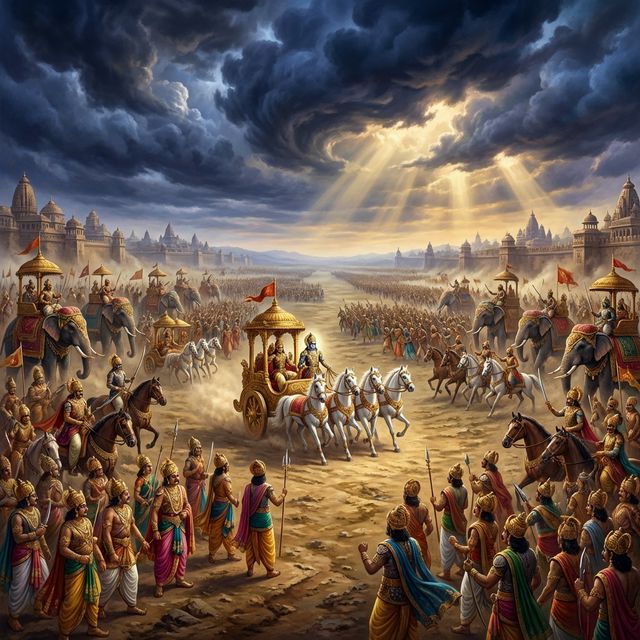
Gandhari Shows Krishna the Field
With the sight Vyasa gave her, the blindfolded queen walks Krishna through the dead of Kurukshetra
The Eye That Vyasa Gave Her
Vaishampayana, telling the story to king Janamejaya, said that when Gandhari had finished speaking to Kunti and to the princess of Pancala, she was still standing on ground at some distance from the field of battle.
She could see none of it. A cloth had covered her eyes for as long as she had been Dhritarashtra's wife. Devoted to her lord, she had practised high vows, she had undergone the severest penances, and she had never in her life been known to speak an untruth. In consequence of a boon given her by the great rishi Vyasa of sanctified deeds, she had come to possess spiritual knowledge and spiritual power, and that morning the boon opened.
Endued with great intelligence, the Kuru dame saw the field of the slain from far away, but as though she were standing in the middle of it.
It was terrible to behold and full of wonderful sights. It was scattered all over with bones and hair and covered with streams of blood, and strewn on every side with thousands upon thousands of dead bodies. It was miry with the blood of elephants and horses and car-warriors and men of every other kind, and it teemed with headless trunks and with heads that had no trunks under them. It resounded with the cries of elephants and steeds and men and women together. It abounded with jackals and cranes and ravens and kankas and crows. It was the sporting ground of rakshasas that subsist on human flesh. It swarmed with ospreys and vultures, and the howls of jackals came up out of it from every quarter, and there was nothing auspicious in the sound.
She saw all of it at once, in a single unbroken sight, the way no one else on that field would ever see it. And she stood there in her blindfold and began to lament aloud.
The Road Out to the Field
Then Vyasa gave the order, and the whole house went out to look at what it had done.
King Dhritarashtra went at the command of the rishi. All the sons of Pandu went, with Yudhishthira at their head. Vasudeva went with them, and behind them came the ladies of the Kuru race, every one of them bereaved of a husband or a son or a father or a brother, riding out in costly vehicles toward Kurukshetra.
They reached the field and found their dead lying where they had fallen, and in the course of being devoured. Beasts of prey were at them, and wolves, and ravens and crows, and ghosts and pishachas and rakshasas and diverse other wanderers of the night. The carnage that lay before those women resembled nothing so much as the sporting ground of Rudra.
They uttered loud shrieks. They came down quickly out of their fine carriages, not waiting to be helped, and went in among the bodies. They had never in their lives witnessed anything of the kind. The Bharata ladies felt the strength go out of their limbs and fell down on the ground where they stood. Others were so stupefied that they lost their senses altogether. The Pancala women and the Kuru women, who had come out that morning from opposite sides of a quarrel, were plunged together into one distress for which there is no word.
The field rang in every direction with the crying of those women.
Gandhari, the daughter of Subala, who was acquainted with every duty, heard it and saw it and turned to the one person on that field who could be expected to bear being told. She addressed the lotus-eyed Keshava, foremost of all men, and began to describe to him what he was already looking at.
Behold These Daughters-in-Law of Mine
"Behold, O lotus-eyed Madhava, these daughters-in-law of mine," she said. "Deprived of their lords, with their hair unbound, they are uttering piteous cries of woe like a flight of she-ospreys. They meet a body and it calls back to them the memory of some great chief of the Bharatas. They are running hither and thither in large bands, toward their sons and their brothers and their sires and their husbands.
"Behold, O mighty-armed one, the field is covered over with the mothers of heroes, and not one of those mothers has a child left. There, those other portions of it are covered with the wives of heroes, and not one of those wives has a husband left.
"Behold, the field of battle is adorned with those tigers among men, with Bhishma and Karna and Abhimanyu and Drona and Drupada and Shalya, as a place is adorned with blazing fires. It is adorned also with the golden coats of mail of high-souled warriors, and with their costly gems, and with their angadas and their keyuras and their garlands. It is strewn with darts and spiked clubs that heroic hands hurled, and with swords, and with bows, and with keen shafts of every kind. Beasts of prey have assembled on it in companies, and are standing about, or sporting, or lying down as it pleases them. Behold, O puissant hero, the field of battle is even such. At this sight, O Janardana, I am burning.
"In the destruction of the Pancalas and the Kurus, O slayer of Madhu, I think the five elements themselves have been destroyed.
"Fierce vultures in thousands are dragging those blood-dyed bodies away, seizing them by the armour, and devouring them. Who is there who could ever have thought of the death of such heroes as Jayadratha and Karna and Drona and Bhishma and Abhimanyu? They were incapable of being slain, and they have been slain. Behold, vultures and kankas and ravens and hawks and dogs and jackals are feasting on them."
The Beds of Heroes
"There, O Krishna, those tigers among men who fought on Duryodhana's side and took the field in wrath are lying like fires that have gone out.
"Every one of them was worthy of sleeping on a soft and clean bed. Plunged into distress, they sleep today on the bare ground. Bards who recited their praises used to delight them at the proper hours; they are listening now to the fierce and inauspicious cries of jackals. Those illustrious men who used to sleep on costly beds with their limbs smeared with sandal paste and powdered aloe are sleeping in the dust, and these vultures and wolves and ravens have become their ornaments. The creatures utter their harsh cries and drag the bodies about.
"And yet they delighted in battle, and they look cheerful still. Their keen shafts are beside them, and their well-tempered swords, and their bright maces, as if life had not yet departed from any of them. Many of them, possessed of beauty and fair complexions and adorned with garlands of gold, are sleeping on the ground while beasts of prey drag at them and tear them. Others, with massive arms, are sleeping with their maces held in their embrace, as though the maces were beloved wives. Others are still cased in armour and still holding their bright weapons in their hands, and the beasts are not mangling those, O Janardana. They take them to be alive.
"The beautiful garlands of pure gold that were on the necks of other illustrious heroes lie scattered on every side as the carnivorous creatures drag the bodies from place to place. There, fierce wolves in their thousands are pulling at the golden chains round the necks of men whom death has stilled.
"Many of these were men whom bards well trained to their work used to wake every morning with hymns and eulogies of grave import. This morning they are surrounded by fair ladies stricken with grief, who weep and cry around them in woe, O tiger of the Vrishni race."
This Is Not This One's
"The faces of those beautiful ladies, O Keshava, are pale, and they are resplendent still, like an assemblage of red lotuses.
"They have ceased to weep now, those Kuru women, with their followers and companions about them. They are filled with anxiety. Overwhelmed with sorrow, they are running from one place to another, and with weeping and with anger their faces have become as bright as the morning sun, or as gold, or as burnished copper. They are calling out to one another in sentences that do not finish, and because of the loud wails bursting from every side they cannot catch one another's meaning. Some of them draw long sighs, and lament, and lament again, and are stupefied by grief, and give up their life-breaths where they stand. Others, beholding a body, weep and set up loud wails. Others strike their own heads with their own soft hands.
"The earth is strewn with severed heads and hands and other limbs mingled together and gathered into large heaps, and it looks splendid with all this havoc on it.
"Beholding headless trunks of great beauty, and heads that have no trunks, those fair ones have been lying senseless on the ground a long while. They are fitting particular heads to particular trunks, and then discovering their mistake and saying, 'This is not this one's,' and weeping more bitterly than before. Others are fitting arms and thighs and feet that shafts have cut off, and losing their senses again at the sight of the forms they have restored. Some among the Bharata ladies, looking at the bodies of their own lords, mangled by animals and by birds and severed of their heads, are not succeeding in recognising them.
"Miry with flesh and blood, the earth has become impassable, with arms lying on it that still grip their swords, and heads that still wear their earrings.
"Without doubt I must have perpetrated great sins in my former lives, O Keshava, since I am beholding my sons and my grandsons and my brothers all slain by foes."
And while she was speaking in this way, Gandhari's eyes fell upon her son.
Duryodhana Among the Vultures
Beholding Duryodhana, Gandhari was deprived of her senses by grief and fell suddenly to the earth like a plantain tree torn up by the roots.
She came to herself soon, and began to weep, and uttered loud wails again and again at the sight of her son lying on the bare ground covered with blood. She put her arms round him. She drenched with her tears that body with its massive shoulders, still wearing its garlands and its collar. Alas, O son, she said. Alas, O son.
Then she spoke to Hrishikesha, who was standing near.
"On the eve of this battle that has exterminated our race, O puissant one, this foremost of kings said to me, 'In this internecine battle, O mother, wish me victory.' And I, knowing that a great calamity had come upon us, said this much to him and no more: 'Thither is victory where righteousness is. And since thy heart is set on battle, thou wilt without doubt obtain those regions that are attainable by the use of weapons, and sport there like a celestial.' Those were the words I said to him. I did not grieve for my son then. I grieve now for the helpless Dhritarashtra, bereaved of his friends and his kinsmen.
"Behold him, O Madhava, wrathful, skilled in weapons, irresistible in battle, sleeping on the bed of heroes. Behold the reverses brought about by Time. This scorcher of foes, who used to walk at the head of all crowned persons, sleeps in the dust. Inauspicious jackals are delighting that prince now, who was formerly delighted by the fairest of ladies sitting round him. He who was encircled by kings vying with one another to give him pleasure is encircled by vultures. He who was fanned with beautiful fans by fair ladies is fanned by carnivorous birds with the flaps of their wings.
"He had assembled eleven akshauhinis of troops, O Keshava, and by his own evil policy he has been slain. He disregarded Vidura, and he disregarded his own sire, and this reckless and foolish prince has succumbed to death for his contempt of the old. He ruled the earth without a rival for thirteen years. Not long ago, O Krishna, I beheld the earth full of elephants and kine and horses, and ruled by Duryodhana. Today I see her ruled by another, and destitute of elephants and kine and horses.
"What need have I, O Madhava, of life?"
The Mother of Lakshmana
"Behold, again, this sight that is more painful to me than the death of my son. Behold these fair ladies weeping beside the slain.
"Behold the mother of Lakshmana, O Krishna, with her tresses dishevelled, that dear spouse of Duryodhana, who resembles a sacrificial altar of gold. Without doubt this damsel of great intelligence, while her mighty-armed lord was alive, used to sport within the embrace of his handsome arms. Why does this heart of mine not break into a hundred fragments at the sight of my son and my grandson slain in one battle?
"That faultless lady is smelling the head of her son, which is covered with blood. Now she is gently rubbing Duryodhana's body with her fair hand. At one moment she sorrows for her lord and at the next for her son. At one moment she looks at her lord and at the next at her son. Behold, O Madhava, she strikes her head with her hands and falls upon the breast of her heroic husband, the king of the Kurus. Possessed of a complexion like the filaments of the lotus, she looks beautiful still, like a lotus herself. The unfortunate princess rubs now the face of her son, and now the face of her lord.
"If the scriptures and the shrutis be true, without doubt this king has obtained those regions of blessedness that a man may win by the use of weapons.
"Behold, O Madhava, my century of sons, whom no exertion in battle could tire, all slain by Bhimasena with his mace. And what grieves me more today than that is this, that these my daughters-in-law, of tender years, deprived of their sons, with their hair loose about them, are wandering over this field. They used to walk only on the terraces of goodly mansions, with ornaments on their feet. Now, in great affliction of heart, they are obliged to set those feet on this hard earth, miry with blood. They reel in their sorrow and wander like people who have been made drunk, and they can hardly drive the vultures and the jackals and the crows away."
Dushasana, and the Advice She Gave
"Behold that lady of faultless limbs and slender waist, seeing this carnage, falling down overwhelmed. My heart is torn at the sight of her. These beautiful women, some seeing their brothers, some their husbands, some their sons lying dead on the bare ground, are falling down themselves, seizing the arms of the slain. Listen, O unvanquished one, to the wailing of the elderly among them and of those others of middle age. Supporting themselves against broken boxes of cars, and against the bodies of dead elephants and steeds, worn out with fatigue, they are resting. Behold that one, taking up some kinsman's severed head with its beautiful nose and its earrings, standing there in grief.
"Our acts, righteous or unrighteous, cannot go for nothing, O thou of Vrishni's race.
"Behold, O Govinda, the shields decked with a hundred moons, the standards of solar effulgence, the golden coats of mail, the collars and cuirasses of gold and the head-gears of my sons, scattered on the earth and blazing like sacrificial fires over which libations of clarified butter have been poured.
"There Dushasana sleeps, felled by Bhima, the blood of all his limbs quaffed by that heroic slayer of foes. Behold that other son of mine, slain by Bhima with his mace, at the urging of Draupadi and of the recollection of his own wrongs at the time of the match at dice. This Dushasana, wishing to do what was agreeable to his elder brother and to Karna, addressed the dice-won princess of Pancala in the midst of the assembly and said to her, 'Thou art now the wife of a slave. With Sahadeva and Nakula and Arjuna, O lady, enter our household now.'
"On that occasion, O Krishna, I said to king Duryodhana, 'O son, cast off the wrathful Shakuni. Know that thy maternal uncle is of very wicked soul and exceedingly fond of quarrel. Cast him off without delay and make peace with the Pandavas. O thou of little intelligence, dost thou not think of Bhimasena filled with wrath? Thou art piercing him with thy wordy shafts like a man striking an elephant with burning brands.'
"Disregarding my words, he vomited his wordy poison at them, as a snake vomits its poison at a bull, at men who had already been pierced with his wordy darts. There Dushasana sleeps, stretching out his two massive arms, slain by Bhimasena as a mighty elephant is slain by a lion. And the very wrathful Bhimasena perpetrated a most horrible act, drinking in battle the blood of his foe."
She Names Them One by One
"There, O Madhava, my son Vikarna, whom the wise applauded, lies on the bare ground, slain by Bhima and horribly mangled. Deprived of life, he lies in the midst of the slain elephants like the moon in an autumn sky surrounded by blue clouds. His broad palm, cased in its leathern fence and scarred with the constant wielding of the bow, is so hard that the vultures who wish to feed on it are piercing it with difficulty. His helpless young wife is trying, and failing, to drive those vultures off. He was youthful and brave and handsome, brought up in luxury, deserving of every kind of weal, and he sleeps in the dust. Clothyard shafts and bearded arrows and nalikas have pierced all his vital parts, and even so the beauty that was his has not forsaken this best of the Bharatas.
"There my son Durmukha, that slayer of whole bands of foes, sleeps with his face toward the enemy, slain by the heroic Bhimasena in observance of his vow. His face, O Krishna, half eaten away by beasts of prey, looks more handsome for it, like the moon on the seventh day of the lighted fortnight. How could that son of mine, before whom no foe could stand, be slain by foes and made to eat the dust?
"Behold that other son of Dhritarashtra, Chitrasena, lying slain, who was the model of all bowmen. Those young women, afflicted and uttering piteous cries, are sitting round his fair form with its wreaths and garlands, and the beasts of prey are sitting there with them. These wails of women and these roars of beasts together seem to me an exceedingly wonderful thing, O Krishna.
"Youthful and handsome, always waited upon by the most beautiful of ladies, my son Vivinsati sleeps there, stained with dust, his armour pierced with arrows, and the vultures wait upon him now. Having penetrated the ranks of the Pandava army, he lies on the bed of a hero, which is to say on the bed of an exalted kshatriya. Behold his beautiful face with the smile still playing on it, O Krishna, with its excellent nose and its fair eyebrows, resembling the Moon himself.
"And who could ever endure my son Duhsaha, that slayer of heroic foes, that ornament of assemblies, that resister of enemies? His body, covered over with arrows, looks splendid, like a mountain overgrown with flowering karnikaras. With his garland of gold and his bright armour on him, Duhsaha, though he is deprived of life, looks splendid yet, like a white mountain on fire."
The Girl Who Had Him Seven Months
"He whose might and courage were reckoned, O Keshava, one and a half times greater than his sire's and thine, he who alone and without a follower pierced the impenetrable array of my son, he lies there, having himself succumbed to death. And I see, O Krishna, that the splendour of that son of Arjuna, of Abhimanyu, has not been dimmed even by dying.
"There is the daughter of Virata, the daughter-in-law of the wielder of gandiva, overwhelmed at the sight of her heroic husband. She is rubbing him gently with her hand. She has taken off his golden coat of mail, and she is gazing at the blood-dyed body underneath it. And she turns and addresses thee, O Krishna, and says, 'This hero whose eyes resembled thine has been slain. In might and energy and prowess he was thy equal, O sinless one, and he sleeps on the ground, slain by the enemy.'
"Then she speaks to him. 'Thou wert brought up in every luxury and usedst to sleep on the soft skins of the ranku deer. Does not thy body feel pain today, lying on the bare ground? Why dost thou not address me, who am weeping so? I do not remember ever to have offended thee. O reverend sir, whither wilt thou go, leaving behind thee Subhadra and my own wretched self?'
"Behold her, O Krishna, gathering the blood-dyed locks of her lord with her hands and placing his head upon her lap and speaking to him as though he were alive. 'How could those great car-warriors slay thee, thee that art the sister's son of Vasudeva and the son of the wielder of gandiva? Fie on Kripa and Karna and Jayadratha and Drona and Drona's son, by whom thou wert deprived of life. What was in their minds when they surrounded a boy and slew him? When one's hour has not come one cannot die, since, wretched that I am, I still draw breath after seeing thee slain. Thy union with me in this world had been ordained, it seems, for six months only, for in the seventh, O hero, thou hast been bereft of life.'
"The ladies of the royal house of Matsya are dragging Uttaraa away while she laments in this strain, and they are more afflicted than she is, for they have seen Virata lying mangled with the shafts of Drona, encompassed by screaming vultures and howling jackals. They are trying to turn the body of the Matsya king over, and are too weak with grief to do it.
"Behold also, O Madhava, the other children besides Abhimanyu. Uttara, and Sudakshina the prince of the Kambojas, and the handsome Lakshmana, all lying on this field."
Dharma Lesson
Gandhari has been blind by her own choice for a lifetime, and the first thing her sight is used for is this. She does not look away from any of it, and she does not spare herself either: the mother who told her son that victory follows righteousness also remembers that she never made him give up Shakuni, and she says so to Krishna while standing over the body. The epic gives her no consolation in this hour and offers none to the reader. It simply insists that somebody count the dead properly, one name at a time, with their wives in the frame, before anyone is allowed to call the outcome a victory.