The Man Who Was Not Allowed In
A Sudra's hermitage, a sage's kindness, and two lives turned inside out
A Question About Teaching
By this point in the teaching Yudhishthira had learned to bring his hardest questions early, while the old man's voice was still strong and the sun had not yet gone round to the west of the arrow bed.
"Royal sage," he said, "I wish to know something, and I want it expounded to me in detail, not in a sentence. Suppose a man imparts instruction to a person belonging to a low order of birth. Suppose he does it out of friendship. It may be interested friendship, where he hopes for something back, or it may be disinterested friendship, where he hopes for nothing at all. Is any fault incurred by the one who gives the instruction?"
Bhishma did not answer at once.
"The course of duty is exceedingly subtle," Yudhishthira went on, as though apologising for the question. "Men are often seen to be stupefied in respect of that course. I am one of them."
"In this connection," Bhishma said at last, "I shall recite to you, in due order, what I heard certain Rishis say in days of yore. Hear the rule first, and then hear the story, and do not confuse the one with the other. The rule is this. Instruction should not be imparted unto one that belongs to a low or mean caste. It is said that the preceptor who imparts instruction to such a person incurs great fault."
"That is a hard rule."
"It is. Listen, chief of Bharata's race, while I recite to you an instance that occurred in days of old, of the evil consequences of the imparting of instruction unto a low-born person fallen into distress. The thing happened in the asylum of certain regenerate sages that stood on the auspicious breast of Himavat, and no one in it did anything wicked. That is what makes it worth telling you."
The Asylum on the Breast of Himavat
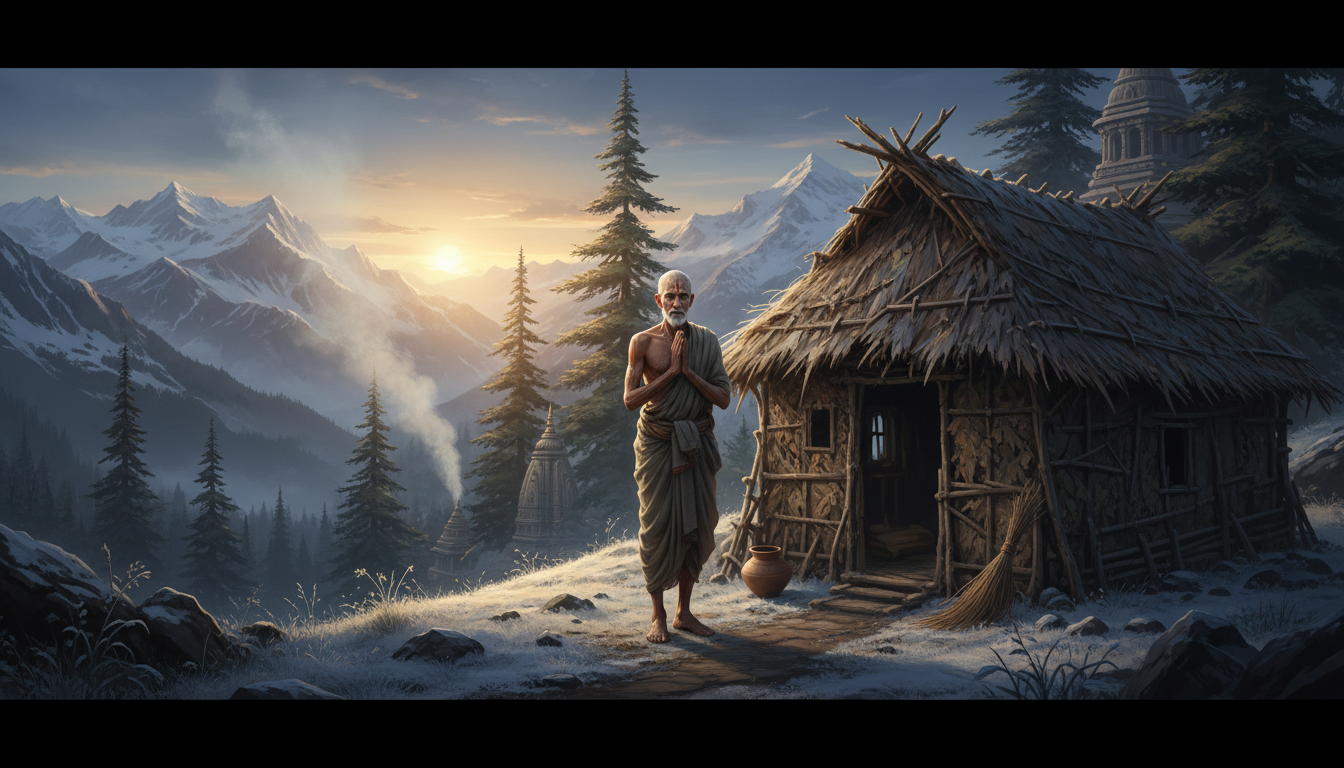
There, on the breast of that prince of mountains, stood a sacred asylum adorned with trees of many kinds, overgrown with diverse species of creepers and plants, the resort of animals and birds. Siddhas and Charanas lived in it. It was delightful in every season because there was always something in flower.
Many Brahmacharins dwelt there, and many who had taken up the forest mode of life. Many Brahmanas had settled there, highly blessed men who resembled the sun or the fire in energy and effulgence. Ascetics of every kind were in that place, observant of various restraints and vows. Some had undergone Diksha and were frugal in fare and possessed of cleansed souls. There were large numbers of Valakhilyas among them, and many who had taken the vow of Sanyasa. Because of all this the asylum resounded from morning to night with the chanting of the Vedas and with sacred Mantras uttered aloud by the men who lived there.
Into that place, one day, came a Sudra.
He came alone, and he came on foot, and he had no business there of any kind that anybody could name. He was a man endued with compassion for all creatures, and something in him had turned toward that mountain and would not turn back.
The ascetics did not drive him off. They honoured him duly, as guests are honoured, and gave him what they had. He, for his part, walked among them and looked at them, at the various classes of them, endued with great energy, resembling the deities in purity and power, observing their several kinds of Diksha, and he became highly pleased at heart. He had never in his life seen anything he wanted so much.
Beholding everything, the Sudra felt inclined to devote himself to the practice of penances.
At the Feet of the Kulapati
He went to the head man of the group, the Kulapati, and touched his feet, and did not get up at once.
"Through thy grace, foremost of regenerate persons," he said, "I desire to learn the duties of religion and to practise them. It behoveth thee, illustrious one, to discourse to me on those duties, and to introduce me into a life of Renunciation by performing the rites of initiation." Then, because it was going to be said by somebody and he preferred to say it himself, he said it. "I am certainly inferior in colour, illustrious one. I am by caste a Sudra, best of men. I desire to wait upon you here and serve you. Be gratified with me, who humbly seek thy shelter."
The Kulapati was not a cruel man. He answered him plainly and without contempt, which in its way made the answer worse.
"It is impossible that a Sudra should live here adopting the marks specially intended for those practising lives of Renunciation. If it pleases thee, thou mayest stay here, engaged in waiting upon us and serving us. Without doubt, by such service thou shalt attain to many regions of high felicity."
There it was. He might have the mountain and the company and the labour. He might carry water and sweep the platforms and cut fuel for other men's fires for as long as he lived, and heaven at the end of it. What he might not have were the marks: the shaven head, the staff, the water pot, the formal words said over him by a preceptor that would make him what the others were.
The Sudra stood there and began to reflect in his mind, saying to himself, How should I now act? Great is my reverence for those religious duties that lead to merit. Let this, however, be settled, that I shall do what would be for my benefit.
A Little Way Off
What he settled upon was this. He proceeded to a spot that was distant from that asylum, and there he made a hut of the twigs and leaves of trees.
He was careful about it. He erected a sacrificial platform. He made a little space for his sleep, no more than he needed. He built some platforms for the use of the deities. Then he began to lead a life regulated by rigid observances and vows and to practise penances, and he did the whole of it abstaining entirely from speech.
He performed ablutions three times a day. He kept vows in respect of food and sleep. He made sacrifices to the deities and poured libations on the sacrificial fire and adored the deities in that way, morning and evening, with nobody watching and nobody to certify that any of it had been done correctly. He restrained all carnal desires. He lived abstemiously upon fruits and roots. He controlled his senses.
And every day, whoever came to that retreat he welcomed and entertained as a guest, offering them the herbs and fruits that grew plentifully around his hut. That was the one part of his discipline that had a witness. Men walking the mountain paths found a silent man in a leaf hut who would put food into their hands and gesture them to a seat and take nothing from them at all.
In this way he passed a very long time in that hermitage of his. From the asylum, on a still day, he could hear the Vedas being chanted a little way off, by the men who had told him he might sweep their floors.
The Visitor
One day an ascetic came to that Sudra's retreat for the purpose of making his acquaintance. He had heard of the silent man, and he was curious, and that was the whole of his errand.
The Sudra welcomed and worshipped the Rishi with due rites and gratified him highly. Everything was in order. The water was there for his feet, the seat was there, the fruits were there, and the man who set them out said nothing.
The Rishi was endued with great energy and possessed of a righteous soul, a man of rigid vows, and he was not put off by the silence. He conversed with his host on many agreeable subjects and informed him of the place whence he had come. It is a small thing to describe and it was not a small thing to receive. Nobody had told that man where they had come from in a long time.
After that the Rishi came back. He came into the asylum of the Sudra times out of number, for the object of seeing him, walking the extra distance past the great hermitage with its chanting to sit in front of a leaf hut with a man who could not answer him. That is the entire nature of the friendship, and it is the reason for everything that follows: the Rishi wanted nothing from him. There was nothing the man had to give.
The Seat Turned the Wrong Way
On one of these occasions the Sudra broke his silence, because there was a thing he could not do without asking.
"I desire to perform the rites that are ordained for the Pitris," he said. "Do thou instruct me kindly in this matter."
"Very well," the Brahmana said.
The Sudra purified himself by a bath. He brought water for the Rishi to wash his feet. He brought Kusa grass, and wild herbs and fruits, and a sacred seat, and the low seat called the Vrishi. And he set the Vrishi down towards the south, with its head turned to the west, because he had never been taught and had guessed.
The Rishi looked at it. He knew at once that it was against the ordinance, and he knew what the ordinance said about who might be told, and he was sitting in a leaf hut on a mountain with a man who had fed him fruit for years.
"Place the Vrishi with its head turned towards the East," he said, "and having purified thyself, do thou sit with thy face turned towards the north."
The Sudra did everything as the Rishi directed. And then, having begun, the Rishi did not stop halfway. Possessed of great intelligence and observant of righteousness, the Sudra received from him every direction about the Sraddha as laid down in the ordinance: the manner of spreading the Kusa blades, and the placing of the Arghyas, and the rites to be observed in the matter of the libations to be poured, and the food that was to be offered to the fathers.
After the rites in honour of the Pitris had been accomplished, the Rishi was dismissed by the Sudra, whereupon he returned to his own abode. Neither of them thought anything further about it. It had taken part of one afternoon.
Two Deaths and Two Births
After a long time, the whole of which he passed in the practice of such penances and vows, the Sudra ascetic met with his death in those woods.
In consequence of the merit he had acquired by those practices, he took birth in his next life in the family of a great king, and in course of time became possessed of great splendour. Everything the Kulapati had promised him, he got. He got it in the shape of a prince.
The regenerate Rishi also, when the time came, paid his debt in Nature. In his next life he took birth in the family of a priest, which is to say that a man who had been a Rishi of austere penances came back a step lower down, into the class that serves at other men's altars and is paid for it.
Both of them grew, and both acquired great knowledge in the usual branches of study. The Brahmana became well versed in the Vedas, and in the Atharvans also. In the matter of all sacrifices ordained in the Sutras, and of that Vedanga which deals with religious rites and observances, and astrology and astronomy, the reborn Rishi attained great excellence. In the Sankhya philosophy too he began to take great delight. He was, by any measure anybody had, a learned and accomplished man.
Meanwhile the reborn Sudra, who was now a prince, lost his father. He performed the last rites, and purified himself by accomplishing all the obsequial ceremonies, and was installed by the subjects of his father as their king on his paternal throne.
And soon after his own installation, the first thing he did was to install the reborn Rishi as his priest.
The King Who Laughed
Having made the Brahmana his priest, the king began to pass his days in great happiness. He ruled his kingdom righteously and protected and cherished all his subjects, and there was no fault in him that anyone could find.
Except one. Every day, on the occasion of receiving benedictions from his priest, and again during the performance of the religious and other sacred rites, the king smiled or laughed at him loudly.
It happened at the Homa. It happened at the rites of propitiation. It happened when the priest raised his hand to bless him in front of the court. The king would look at his priest and his face would break, and once or twice the laughter came out of him like something he had not intended to let go of. In this way, on numberless occasions, the reborn Sudra who had become a king laughed at the sight of his priest.
The priest bore it for a long time, and then he became angry. There is no dignity to be salvaged from being laughed at daily by the man you are blessing.
On one occasion he met the king in a place where there was nobody else. He began by pleasing him with agreeable discourse, and then, taking advantage of that moment, he said, "O thou of great splendour, I pray thee to grant me a single boon."
"Best of regenerate persons," said the king, "I am ready to grant thee a hundred boons. What dost thou say then of one only? From the affection I bear thee and the reverence in which I hold thee, there is nothing that I cannot give thee."
"I desire to have only one boon, O king, since thou hast been pleased with me. Swear that thou wouldst tell me the truth instead of any untruth."
The king said, "So be it. If what thou wouldst ask me be known to me, I shall certainly tell thee truly. If, on the other hand, the matter be unknown to me, I shall not say anything."
The Truth He Had Sworn To
"Every day," said the priest, "on occasions of obtaining my benedictions, when again I am engaged in the performance of religious rites on thy behalf, on occasions also of the Homa and the other rites of propitiation, why is it that thou laughest upon beholding me? Seeing thee laugh at me on all occasions, my mind shrinks with shame. I have caused thee to swear that thou wouldst answer me truly. It does not behove thee to say what is untrue. There must be some grave reason for thy behaviour. Thy laughter cannot be causeless. Great is my curiosity. Do thou speak truly unto me."
"When thou hast addressed me in this strain," the king said, "I am bound to enlighten thee, even if the matter be one that should not be divulged in thy hearing. Listen with a concentrated mind. I remember my former birth.
"In my former life I was a Sudra, employed in the practice of severe penances. Thou wert a Rishi of austere penances. And thou, sinless one, gratified with me and impelled by the desire of doing me good, wert pleased to give me certain instructions in the rites I performed on one occasion in honour of my Pitris. The instructions thou gavest me were in respect of the manner of spreading the Vrishi and the Kusa blades, and of offering libations and food to the manes.
"In consequence of this transgression of thine, thou hast taken birth as a priest, and I have taken birth as a king. Behold the vicissitudes that Time brings about. Thou hast reaped this fruit in consequence of thy having instructed me.
"It is for this reason that I smile at sight of thee. I do not laugh from any desire of disregarding thee. Thou art my preceptor. At this change of condition I am really very sorry. My heart burns at the thought. I remember our former births, and so I laugh at the sight of thee."
Then he said the sentence that ended the man's employment. "Thy austere penances were all destroyed by the instructions thou gavest me. Relinquishing thy present office of priest, do thou endeavour to regain a superior birth. Do thou exert thyself so that thou mayst not obtain in thy next life a birth meaner than thy present one. Take as much wealth as thou wishest, learned Brahmana, and cleanse thy soul."
The Road Back Up the Mountain
Dismissed by the king from the office of priest, the Brahmana did not argue and did not complain.
He made many gifts, unto persons of his own order, of wealth and land and villages. He observed many rigid and severe vows as laid down by the foremost of Brahmanas. He sojourned to many sacred waters and made many gifts unto Brahmanas in those places. Making gifts of kine unto persons of the regenerate order, his soul became cleansed, and he succeeded in acquiring a knowledge of it.
Then he went back. Repairing to that very asylum where he had lived in his former birth, he practised very severe penances there, on the same mountain, within hearing of the same chanting. As a consequence of all this that Brahmana succeeded in attaining to the highest success, and he became an object of veneration with all the ascetics that dwelt in that asylum.
"In this way, best of monarchs," Bhishma said, "that regenerate Rishi fell into great distress. Unto Sudras, therefore, the Brahmanas should never give instructions. The Brahmana should avoid imparting instruction to such as are low-born, for it was by imparting instruction to a low-born person that a Brahmana came to grief. Brahmanas and Kshatriyas and Vaisyas, the three orders, are regarded as twice-born, and by imparting instruction unto these a Brahmana does not incur any fault.
"It is for this reason that ascetics adopt the vow of silence, and pass through Diksha without indulging in speech. For fear of saying what is incorrect, or what may offend, ascetics often forego speech itself. Even men that are righteous and possessed of every accomplishment, endued with truth and simplicity of behaviour, have been known to incur great fault in consequence of words spoken improperly. If in consequence of the instructions imparted the instructed commit any sin, that sin attaches to the Brahmana who imparted the instruction. And that instruction which is imparted in barter for money always pollutes the instructor. Very often persons become plunged into great afflictions in consequence of imparting instructions."
Yudhishthira said nothing for a while. He had asked whether disinterested friendship made a difference, and he had been given a story in which it made none at all, and in which the man who was ruined had done nothing but turn a small wooden seat around so that a silent man on a mountain could feed his own dead correctly.
Dharma Lesson
The epic itself records a rule so harsh that a good man is ruined for a kindness, and it lets the king who profited by it laugh and grieve at the same time rather than pretend the ruling is comfortable. Bhishma states the rule, tells the story, and leaves Yudhishthira with the gap between them. Some of what the tradition hands down is meant to be looked at squarely, not swallowed.