The Braid She Refused to Bind
Draupadi answers Bhima's peace with her own hair
After Sanjaya Rode Home
Janamejaya said, "When Sanjaya had carried the old king's answer back to the Kurus, what did my grandsires, the sons of Pandu, do then? I wish to hear all of it."
Vaishampayana said: They gathered in the hall at Upaplavya, in the Matsya country, where seven armies lay camped along the water and the horse lines ran further than a man could walk before noon. Yudhishthira sat with Krishna beside him, and he did not begin with the war. He began with friendship.
"The hour has come," he said, "when friends must show what their friendship is. I see nobody else who can carry us out of this. You have stood between the Vrishnis and every calamity that came at them. Stand between us and this one."
"Here I am," Krishna said. "Say what you want said, and I will say it."
"You heard Sanjaya. An envoy speaks with his master's mouth, and if he speaks otherwise he deserves to be killed, so I take every word of it for Dhritarashtra's own. He wants peace without giving back the kingdom. At his command we spent twelve years in the woods and a thirteenth in hiding, and the brahmanas who were with us can testify that we did not break the terms by a single day. Now he will not keep his."
He put his hands flat on his knees.
"I sent him a number. Not the kingdom. Five villages. Avisthala, Vrikasthala, Makandi, Varanavata, and any fifth of his choosing. Five villages where five men might live together, because we do not want the Bharatas destroyed. He would not give five. What is more sorrowful than this, that a man with the Kasis and the Panchalas and the Chedis and the Matsyas for allies cannot feed his own mother?"
What Krishna Said First
"I have heard Sanjaya," Krishna said, "and now I have heard you, and I know the purposes of both. Your heart leans toward righteousness; theirs leans toward enmity. What can be got without war is worth a great deal to you, I know that. But a long life of celibacy and alms is not the duty of a kshatriya. Men of all four orders have said it: a kshatriya does not live on alms. Victory or death in battle was ordained for him by the Creator, and cowardice earns no applause."
"I do not think it cowardice to ask for five villages."
"Nor do I. I think it useless. Hear the proof of it. As long as you behave mildly with them, they will keep your kingdom. Not from compassion, not from mildness, not from any sense of right will the sons of Dhritarashtra do what you want. Remember what they did and what they felt afterward. They put you in a beggar's cloth in front of the Grandsire and Drona and the wise Vidura and the brahmanas and the citizens, and they were not stung with remorse for one moment. Duryodhana boasted among his kinsmen while the courtiers sat with their heads down, weeping with choked voices, and not one king in that hall applauded him. To a man of noble descent even censure is death. He was censured by every king on earth and felt no shame. He died that day and does not know it."
"Then you think it is war."
"I think I should go anyway," Krishna said. "I will stand in that court and count out your virtues before all the assembled kings, and then I will count out his, and every ruler in the room will understand what avarice looks like when it is spoken aloud. Nobody will be able to say afterward that you did not ask."
He looked toward the doorway, where the evening was coming on.
"Meanwhile, ready your weapons and your machines and your mail. Look to the elephants and the horses. Birds and beasts have been screeching at dusk for a month, the best of the elephants are taking on shapes I do not like, and the sacrificial fire is burning in colours it has no business burning in. Havoc has come among us and is walking about the camp. Gather everything you will need."
Bhima Asks for Peace
Then Bhima stood up, and the hall settled, because when that man rose it was generally to say one thing.
"Speak to the Kurus in such a way that there may be peace," he said. "Do not threaten them. Be mild with him."
Nobody answered. Sahadeva turned to look at his brother as though he had never seen him before.
"I know what he is," Bhima went on. "Nobody in this room needs it explained to him less than I do. Duryodhana is sinful of heart like a robber, drunk on his own prosperity, cruel in speech, quick to censure, slow to be pacified, incapable of being taught, and willing to give up his life rather than give up an opinion. He lies coiled in his own nature like a serpent hidden in reeds. Peace with such a man is the hardest thing I can imagine asking for. I am asking for it."
He named the destroyers, one after another, in the flat voice of a man reciting a list he had gone over many nights. Udavarta among the Haihayas. Vahula among the Talajanghas. Hayagriva among the Videhas. Sahaja among the Chedis and the Matsyas. "Eighteen kings," he said, "who annihilated their own kinsmen and friends and relatives, one born in each race at the end of each age. So Duryodhana has been born at the end of this one, among us, the Kurus. That is all he is. And by his anger the Bharatas will be burned the way a forest is burned by fire at the end of the dewy season, and there will be nothing left of us to quarrel over."
"You want us to submit," said Satyaki.
"I want us to live," Bhima said. "All of us would rather follow Duryodhana in humiliation than see the Bharatas wiped out. Let us be strangers to the Kurus if it must be that, but let the race stand. Ask the aged Grandsire and the other counsellors to make brothers of brothers again. This is what I say. The king approves of it. And Arjuna is averse to war, for there is great compassion in him."
The Laughter of Krishna
Krishna laughed out loud.
It was as unexpected in that hall as a hill losing its weight, or fire going cold, and he did not stop for some time. Then he leaned forward toward the biggest man in the room and began to fan him the way a breeze fans a fire.
"At every other time, Bhimasena, you praise nothing but war. You do not sleep. You sit up all night with your face turned down toward the floor. You come out with sudden frightful noises of rage, and then you sigh like a weak man carrying a load too heavy for him, and the people who do not know why think you are mad. You walk about breathing hard and shaking the ground under you, like an elephant grunting over uprooted trees and treading them flat. You take no pleasure in company. Night or day, nothing suits you like being alone. Sitting apart, you laugh out loud for no reason anyone can see. Sometimes you put your head down between your two knees and stay like that a long while with your eyes shut. Then you pull your brows together and bite your lips and stare in front of you, and every one of these is the same thing wearing a different face, and the thing is wrath."
Bhima did not move.
"Once, in the middle of your brothers, you took hold of your mace and swore this: that as surely as the sun rises in the east showing his light and truly sets in the west having journeyed around Meru, so surely will you kill the insolent Duryodhana with that mace, and that this oath of yours would never be untrue. How does that same heart now follow the counsels of peace?"
He let the silence sit for a moment.
"When fear enters your heart, it is certain that the hearts of all men who want war are upset when war actually arrives. Perhaps you have been seeing bad omens, asleep and awake. Alas, you show not one sign of the manliness that is in you. Your mind is overwhelmed, your thighs are trembling, and that is why you want peace. The hearts of mortals are as inconstant as salmali pods in a wind. Remember your own deeds, and the house you were born in, and stand up, and be firm. A kshatriya never enjoys what he has not taken by his own strength."
The Marrow of My Bones
Bhima came awake the way a high-mettled horse comes awake, and answered without losing a moment.
"I mean to act in one way and you take me in quite another. That I delight in war, and that my strength has never been baffled, must be known to you, since we have lived side by side a long time. Or perhaps you do not know me at all, like a man swimming in a lake who has no idea how deep it is. Who else, knowing me to be Bhimasena, could speak to me in words like these?"
He held out his arms.
"To boast of one's own prowess is a low act, and I am about to do it, because you have pierced me. Look at the sky and look at the earth, immovable, immense, without end, in which all these countless creatures are born and take refuge. If those two came together in anger like two colliding hills, I could hold them apart with these, and everything that moves and everything that does not would stay where it is. Look at the joints of these mace-like arms. I have never found the man who could get himself out of them once he had come inside. Himavat, the ocean, and the wielder of the thunderbolt himself: those three together could not pull free the person I have taken hold of. I will trample flat under my feet every kshatriya who comes to fight the Pandavas."
"Then why ask for peace?"
"Because the marrow of my bones has not yet decayed and my heart does not tremble. If the whole world rushes at me in wrath I feel no fear at all. It is only out of compassion, slayer of Madhu, that I show goodwill to the enemy. I am bearing all our injuries quietly so that the Bharata race may not be torn out by the root. You wound me with cruel words and it is like the pain of opening a foul tumour. But know me to be mightier than the account I have just given of myself."
Krishna's voice changed altogether.
"It was affection that made me say all that, and the wish to know your mind. Not reproach, not pride of learning, not anger. A thousand times greater is the benefit you will confer on this cause than the benefit you think yourself able to confer. Tomorrow I go to Dhritarashtra. I will try for peace without selling your interests. If they will not hear me, then the war is certain, and the burden of it rests on you and on Arjuna, and the rest will follow the two of you. And in that war I will be the driver of Arjuna's car, because that is what he wishes, and not because I have no wish to fight myself. That is all I intended. I only rekindled your fire, Vrikodara."
The Others Speak, and the Hall Roars
Arjuna spoke next, and quietly. "The king has said what should be said. But hearing you, it seems to me you think peace is not to be had, either because of Dhritarashtra's covetousness or our present weakness. Nothing should be called impracticable. Peace, if it is properly proposed, may still be concluded, and you are the foremost friend of both houses, as Prajapati is of gods and asuras alike. Yet I will not pretend. You know how Draupadi was insulted in the middle of that assembly, and how we bore it. That Duryodhana will behave justly toward us is the one thing I cannot bring myself to believe. Wise counsel will be lost on him like seed sown on barren ground. Do therefore whatever you think proper, and it will be honoured by us, peace or war."
"I will do what human exertion can do," Krishna said. "Consider the field. A man clears the weeds and wets the soil, and without rain it yields nothing. Some say irrigation answers for rain, and then the water that was let in dries up in a drought that no man ordered. The wise of old therefore said that human affairs move on two legs, the divine and the human. I will do all that can be done by exertion at its best. What is providential I cannot control. But do not expect peace of the foe. A year ago, coming back from Virata's cattle, Bhishma himself pressed Duryodhana about this very peace and got nothing. He will not part with the smallest portion of the kingdom for the shortest period of time."
Nakula said, "Go and speak first with mildness and then with threats, so that the wicked Suyodhana is shaken. Seven full akshauhinis stand outside this door. What man of flesh and blood would meet the king and Bhimasena and Arjuna and Sahadeva and myself and you and Rama and Satyaki, with Virata and Drupada and Dhrishtadyumna behind them? Say the mild words. Then say the others."
Sahadeva said, "What the king has said is eternal virtue. Act, all the same, in such a way that war certainly happens. Even if the Kauravas ask for peace, provoke them to war. I saw the princess of Panchala brought into that assembly in that condition. How is my wrath to be appeased without the slaughter of Suyodhana? If Bhima and Arjuna and the king are determined to be virtuous, then I will abandon virtue, and I ask for Duryodhana in battle."
"The son of Madri has spoken the truth," said Satyaki. "The rage I have toward Duryodhana can be appeased by his death and by nothing else. Do you not remember your own rage, Krishna, when you saw them in the woods in rags and deerskins? Every warrior assembled here subscribes to what he said."
And at that the whole hall set up a lion's roar, and men cried out Excellent, excellent, and began openly to rejoice, because they were going to be allowed to fight.
The Woman Who Rose
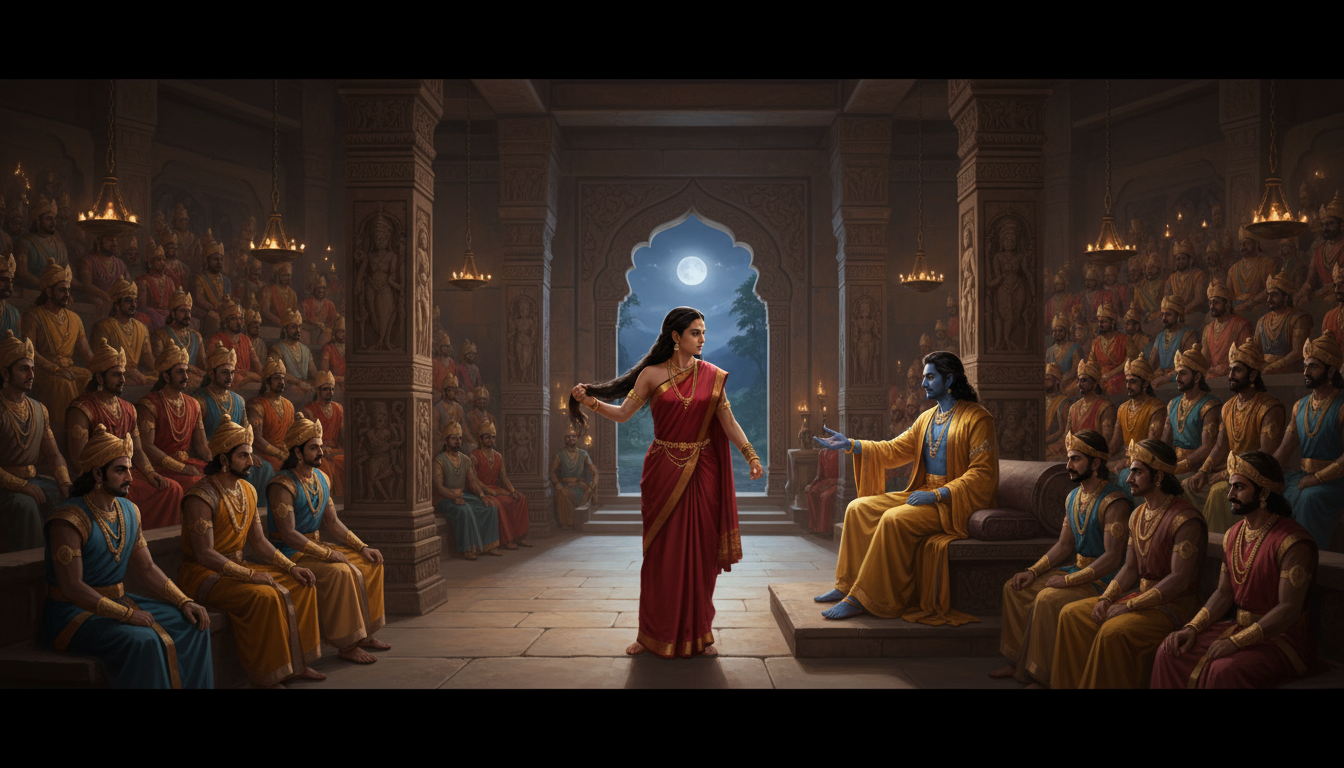
When the noise had died, Drupada's daughter rose, and every man in the hall sat down again.
She applauded Sahadeva first, and then Satyaki, so that the two youngest voices in the room would not stand alone. Then she turned to the man seated beside her husband.
"Slayer of Madhu, you know by what deceit the son of Dhritarashtra and his counsellors robbed us of our happiness. You know what message was given privately to Sanjaya, and you heard what was said to Sanjaya in this hall. Let only five villages be granted to us, Avisthala and Vrikasthala and Makandi and Varanavata, and for the fifth any other he pleases. That was the message that went to Duryodhana. And hearing those words of Yudhishthira, which were modest and anxious for peace, Suyodhana has not acted on them."
Her voice was steady. The tears were already on her face.
"If Suyodhana wants peace without surrendering the kingdom, then there is no necessity of going there at all to make such a peace. The Pandavas with the Srinjayas are quite able to withstand the Dhritarashtra host, however inflamed. When men are no longer open to conciliation, it is not proper that you should show them mercy. Enemies with whom peace cannot be made by conciliation or by gifts should be treated by a man who wants to keep his life with severity, and the punishment should be heavy and it should be quick."
She looked at Yudhishthira and did not spare him either.
"Those who know the scriptures say that sin is incurred in killing one who does not deserve to be killed. They say also that there is equal sin in not killing one who does deserve it. Act, therefore, with the forces of the Pandavas and the Srinjayas in such a way that sin does not touch you. From excess of confidence in you I will say again what has been said again and again."
Whatever Woman Is There on Earth Like Me
"Whatever woman is there on earth like me?
"I am the daughter of king Drupada. I did not come into the world in the ordinary way; I rose from the sacrificial altar. I am the sister of Dhrishtadyumna, who is your dear friend. By marriage I became a lady of Ajamida's line, the daughter-in-law of the illustrious Pandu. I am the queen of Pandu's sons, who are like five Indras for splendour. By these five heroes I have five sons who are mighty car-warriors, and who are bound to you as Abhimanyu himself is bound to you.
"Being all that, I was seized by the hair. I was dragged into the assembly. I was insulted in the very sight of the sons of Pandu and in your lifetime. The Pandavas were alive, Krishna. The Panchalas were alive. The Vrishnis were alive. And exposed to the gaze of that hall I was handled as a slave by those sinful wretches. And when the Pandavas saw the whole of it and sat still without giving way to wrath, then in my heart I called out to you, saying, Save me, save me.
"Then the illustrious king Dhritarashtra, my father-in-law, said to me, Ask any boon, princess of Panchala, you deserve boons and honour at my hands. And I said: let the Pandavas be free men, with their cars and their weapons. They were freed, Kesava. They were freed in order to be exiled into the woods.
"Morally I am the daughter-in-law of both Bhishma and Dhritarashtra. Being that, I was forcibly made a slave. Fie on Partha's bowmanship. Fie on Bhimasena's might, since Duryodhana lives for even a moment longer. If I deserve any favour at your hands, if you have any compassion for me at all, let your wrath be turned on the sons of Dhritarashtra."
The Braid in Her Left Hand
Then she crossed the floor toward him, and she was weeping now without any attempt to govern it, and her eyes were black and long like lotus leaves, and she walked with the heavy grace of a cow-elephant.
She put her left hand behind her and gathered up her own hair. It was deep blue in hue and curled at the ends, scented with every perfume, marked with every auspicious sign, and though it had been gathered into a braid it was still soft and glossy, and it lay along her hand like a great snake. She held it out to him at arm's length, so that he had to look at it.
"Lotus-eyed one, you who are so anxious for peace with the enemy: in everything you do, call to your mind these tresses of mine, seized by Dussasana's rude hands.
"If Bhima and Arjuna have sunk so low as to long for peace, then my aged father with his warlike sons will avenge me in battle. My five sons also, who have great energy in them, with Abhimanyu at their head, will fight with the Kauravas.
"What peace can this heart of mine know until I have seen Dussasana's dark arm cut away from his trunk and ground to atoms? Thirteen long years I have waited for a better time, hiding my wrath in my heart like a fire smouldering under ash. And now, pierced by Bhima's wordy darts, that heart of mine is about to break. The mighty-armed Bhima is casting his eye on morality."
Her voice broke on the last of it. The tears came down her cheeks in a rush and she wept aloud with convulsive sobs, and the tears fell on her breast and they were hot as liquid fire, and no one in the hall said anything at all.
The Oath Answered
Krishna took the braid out of her hand and gave it back to her, and then he spoke, and what he said was not comfort of the ordinary kind.
"Soon you will see the ladies of Bharata's race weeping as you are weeping now. They also will weep like you, timid one, with their kinsmen and their friends slain. The men you are angry with have already lost their warriors and their kinsmen; they simply have not been told yet.
"With Bhima and Arjuna and the twins, at Yudhishthira's command, and in agreement with fate and with what the Ordainer has already set down, I will accomplish the whole of it. Their hour has come. If the sons of Dhritarashtra will not listen to my words, they will lie down on the earth as morsels for dogs and jackals.
"The mountains of Himavat might shift off their foundations. The earth herself might split into a hundred fragments. The firmament with its thousands of stars might come down. My words will still not be futile.
"Stop your tears. I swear it to you, Krishna: soon you will see your husbands with their enemies slain and prosperity crowning them."
Vaishampayana said: So the council ended, with the men roaring for a war they had already decided on and one woman standing in the middle of the floor with her hair loose in her hand. In the morning Krishna went to Hastinapura all the same, and asked for the five villages, and was refused, and everything he had sworn in that hall came to pass exactly as he had sworn it, except that it took eighteen days and cost more than either army had been willing to count beforehand.
Dharma Lesson
A wrong that the wronged has not agreed to forgive cannot be settled over her head by the men who failed to prevent it. Draupadi does not argue that war is wise; she argues that the injury is hers and the accounting is therefore hers to demand. The men in that hall had thirteen years to answer her and spent them talking about morality instead.