What Kunti Sent Instead of Comfort
A mother counts her sons aloud, then tells them to fight
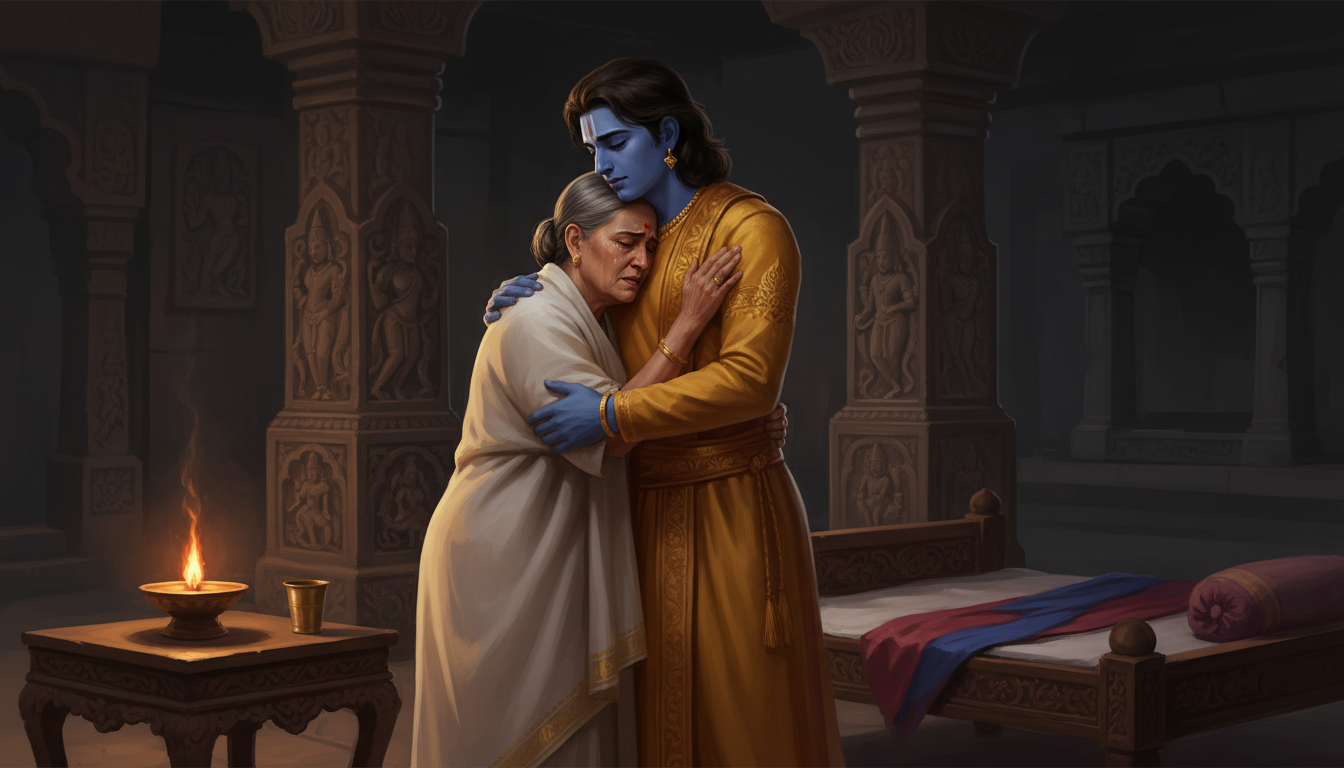
Her Arms Around His Neck
He came to her in the afternoon, after he had seen Vidura and before he went to Duryodhana's palace, and his face as he came into her rooms had the effulgence of the sun on it.
Pritha did not wait for the greeting. She put both arms round his neck and held on, and began to weep, because this was the man who had grown up with her children and had played beside them and gone hunting with them, and to look at him after so long was to look at all five of them at once. The tears came fast and she let them come.
Then the rites of hospitality were performed, and that foremost of warriors took his seat, and his aunt sat down opposite him with her face gone to ruin and her voice choking on itself, and began to talk.
"They waited on their superiors with reverence from their earliest years," she said. "They were attached to one another in friendship. They were deceitfully robbed of their kingdom and they went away into seclusion, though they deserved to live in the middle of friends and attendants. They had subdued both wrath and joy. They were devoted to brahmanas and truthful in speech. And those children of mine abandoned a kingdom and every enjoyment in it and left their miserable mother behind them and went to the woods, and in going they plucked the very roots of my heart.
"They have suffered woe, Kesava, and they did not deserve any of it. Tell me how they lived in that deep forest, which is full of lions and tigers and elephants. They lost their father when they were infants. They were tenderly brought up by me. How did they live in that great forest without ever seeing either parent?"
The Children Woken by Conches
"From their infancy," she said, "the Pandavas were roused out of their beds by the music of conchs and drums and flutes. At home they slept in high palatial chambers on soft blankets and on the skins of the runku deer, and they were waked in the morning by the grunting of elephants and the neighing of steeds and the clatter of car-wheels, and by conchs and cymbals sounding together with the notes of flutes and lyres.
"At early dawn they were adored with sacred hymns uttered by brahmanas, and they in their turn honoured those among them who deserved honour with robes and jewels and ornaments, and were blessed by those illustrious men of the regenerate order in return for the homage they received.
"That such men could sleep in the deep woods, which resound with the shrill and dissonant cries of beasts of prey, is a thing I can hardly bring myself to believe. They did not deserve that much woe.
"How could they, Janardana, who were waked by cymbals and drums and conchs and flutes, by the honeyed strains of singing women and the eulogies chanted by bards and professional reciters, be waked in a deep wood by the yelling of wild animals? Tell me how that was done. I have thought about it every night for thirteen years and I still cannot make the picture come."
She was asking about mornings. That was the shape her grief had taken. Not the battles they had fought or the hunger they had gone through, but the first minute of every day for thirteen years, and who had been there to hear them wake.
She Goes Through Them One by One
She began with the eldest, and she did it the way a woman counts over things she is afraid of losing.
"He is endued with modesty. He is firm in truth. His senses are under control and he has compassion for every creature. He has vanquished both lust and malice and he always treads the path of the righteous. He has ably borne the heavy burden borne before him by Amvarisha and Mandhatri and Yayati and Nahusha and Bharata and Dilipa and Sivi the son of Usinara and the other royal sages of old. He is of excellent character and disposition, he is conversant with virtue, and his prowess cannot be baffled. He is fit to be monarch of the three worlds, because he possesses every accomplishment there is. He is the foremost of all the Kurus lawfully and in learning and in disposition. He is handsome and mighty-armed and he has no enemy.
"Tell me how he is. That Yudhishthira of virtuous soul, whose complexion is like pure gold. Tell me how he is."
Krishna did not answer, and she did not stop for him to. She had been holding these questions for thirteen years with nobody in that house to ask them of, and now that a man had come who had seen her sons within the month she was not going to spend the visit waiting for replies. She went to the next one.
The Second and the Third
"He has the strength of ten thousand elephants and the speed of the wind," she said. "He is mighty and always wrathful among the sons of Pandu. He always does good to his brothers and is therefore dear to them all. He is the one who killed Kichaka with all his relatives; who killed the Krodhavasas, and Hidimva, and Vaka; who in prowess is equal to Sakra and in might to the wind-god; who is terrible, and in wrath is equal to Madhava himself. He is the foremost of all smiters.
"And that wrathful son of Pandu, that chastiser of foes, restraining his rage and his might and his impatience and holding his soul in, is obedient to the commands of his elder brother. Speak to me, Janardana. Tell me how that Bhimasena is, whose very name is the truth about him, who has arms like maces, that mighty second son of Pandu.
"And Arjuna, who has two arms and always thinks himself the superior of his namesake of old who had a thousand; who at one stretch shoots five hundred arrows; who in the use of weapons is equal to king Kartavirya, in energy to Aditya, in the restraint of his senses to a great sage, in forgiveness to the Earth, and in prowess to Indra himself. By his strength, slayer of Madhu, the Kurus obtained this extensive empire among all the kings of the earth. No enemy who has met him in battle has escaped with his life. He is the conqueror of all and cannot be conquered by any. He is the refuge of the Pandavas as Vasava is of the celestials.
"How is that Dhananjaya now, who is your brother and your friend?"
Madri's Sons, and the Woman Who Went With Them
"He is compassionate to all creatures, endued with modesty, acquainted with mighty weapons, soft and delicate and virtuous, and he is dear to me," she said. "That mighty bowman Sahadeva, that ornament of assemblies, who is youthful in years and devoted to the service of his brothers, and conversant with both virtue and profit, whose brothers always applaud the disposition of that high-souled and well-behaved son of mine. Tell me about him. He waits submissively on his elder brothers and so reverentially on me.
"And Nakula, who is delicate and youthful and brave and handsome; who is dear to his brothers and to everybody; who is their very life walking about in a separate body; who is conversant with every mode of warfare and is a mighty bowman. Is that dear child of mine well in body and mind? He was brought up in every luxury and he did not deserve any woe. Shall I ever see him again? I am a woman who could lose her peace by losing sight of Nakula for the time it takes to wink, and here I am, still alive.
"And more than all my sons, Janardana, the daughter of Drupada is dear to me. High-born, possessed of great beauty, endued with every accomplishment, truthful in speech. She chose the company of her lords and gave up the company of her sons. She left her dear children behind her and followed the sons of Pandu. She was waited on once by a large train of servants and adored by her husbands with every object of enjoyment. How is that Draupadi now? Having five heroic husbands who are all mighty bowmen, each equal to Agni in energy, woe has still been the lot of Drupada's daughter.
"For fourteen long years I have not seen the princess of Panchala, who has herself been eaten by anxiety for children she has not seen for the same fourteen years. When a woman of that disposition does not enjoy uninterrupted happiness, it seems to me, Govinda, that the happiness a person enjoys is never the fruit of that person's acts."
The Grief That Outranked the Others
Then her voice changed.
"When I remember the forcible dragging of Draupadi to the assembly," she said, "then neither Vibhatsu nor Yudhishthira nor Bhima nor Nakula nor Sahadeva is an object of affection to me.
"Never before had a heavier grief been mine than the one that pierced my heart when that wretch Dussasana, moved by wrath and covetousness, dragged Draupadi, who was then in her flow and clad on that account in a single garment, into the presence of her father-in-law in that hall, and exposed her to the gaze of all the Kurus.
"King Bahlika was pierced with grief at the sight, and Kripa, and Somadatta; it is known. But of all those who were present in that assembly, it is Vidura whom I worship. Neither by learning nor by wealth does a man become worthy of homage. It is by disposition alone that a man becomes respectable. The character of the illustrious Vidura, who is endued with great intelligence and profound wisdom, adorns the whole world the way an ornament adorns the man who wears it.
"The loss of the kingdom did not grieve me. The defeat at dice did not grieve me. That the illustrious and beautiful princess of Panchala was dragged into that assembly while clad in a single raiment, and made to hear bitter words, grieved me most. What could be a greater grief to me than that? Ever devoted to kshatriya custom, and endued with great beauty, she underwent that cruel treatment while she was ill, and though she had powerful protectors she was then as helpless as if she had none.
"I had you for a protector, and Rama, and that mighty car-warrior Pradyumna. I had my sons, the invincible Bhima and the unretreating Vijaya, both alive. And I had still that grief to bear. It is certainly strange."
The Voice in the Lying-In Room
"In the matter of my present sorrows," she said, "I blame neither myself nor Suyodhana. I blame my father. Like a wealthy man giving away a sum of money in gift, my father gave me away to Kuntibhoja. I was a child playing with a ball in my hands, Kesava, and your grandfather handed me over to his friend. Abandoned by my own father, and afterward by my father-in-law, and afflicted with woes that cannot be borne, what use is there in my being alive?
"Neither the loss of my husband nor the loss of wealth nor our hostility with the Kurus ever inflicted such rending pains on me as this separation from my children. What peace can my heart know when I do not see the wielder of Gandiva in front of me? For fourteen years I have not seen Yudhishthira, or Dhananjaya, or Vrikodara. Men perform the funeral rites of those who are missing a long time, taking them for dead. Practically speaking, Janardana, my children are dead to me, and I am dead to them.
"But hear this also, and then judge whether I am simply a woman weeping.
"On the night when Savyasachin was born, in the lying-in room, an invisible voice spoke to me. It said: this son of yours will conquer the whole world and his fame will reach the very heavens. Slaying the Kurus in a great battle and recovering the kingdom, your son Dhananjaya will, with his brothers, perform three grand sacrifices.
"I do not doubt the truth of that announcement. I bow to Dharma, who upholds the creation. If Dharma is not a myth, then you will surely accomplish everything that voice said.
"I never made any distinction between Dhritarashtra's sons and mine, so far as a mother's affection goes. By that truth, Krishna, I shall surely behold you and the Pandavas come safely out of this strife, with their foes slain and their kingdom recovered."
The Message She Sent Instead
"Now say this to them for me.
"Say to the virtuous king Yudhishthira: your virtue, son, is decreasing daily. Act therefore in such a way that your religious merit does not diminish. Fie on those who live by dependence on others. Even death is better than a livelihood got by meanness.
"Say to Dhananjaya, and to the ever-ready Vrikodara: the time has come, in view of which a kshatriya woman brings forth a son. That is what she carries him for and what she raises him for, and this is the hour. If you let this time slip without achieving anything, then, though you are at present respected by all the world, you will only be doing what everyone will regard as contemptible. And if contempt touches you, I will abandon you for ever. When the hour comes, even life, which is so dear, should be laid down.
"Say to Madri's sons, who are always devoted to kshatriya custom: strive to win, more than life itself, the objects that can be got by prowess, since only what is won by prowess pleases the heart of a person who intends to live as a kshatriya lives.
"And repair to that foremost of all bearers of arms, Arjuna, the heroic son of Pandu, and say to him this: tread the path that may be pointed out to you by Draupadi.
"You know, Kesava, that when they are inflamed with rage Bhima and Arjuna are each like the universal Destroyer and can slay the gods themselves. That was a great insult offered to them, that their wife Krishna, having been dragged into the assembly, was addressed in such humiliating terms by Dussasana and by Karna. Duryodhana insulted Bhima of mighty energy in the very presence of the Kuru chiefs. I am sure he will reap the fruit of that behaviour, for Vrikodara, once provoked by a foe, knows no peace, and does not forget for a long while, not until he has exterminated the enemy and his allies."
What He Said to Her Before He Went
Then the friend of Partha comforted his paternal aunt, and he did it without contradicting one word she had said.
"What woman is there in the world like you, aunt? You are the daughter of king Surasena, and by marriage you were admitted into Ajamida's race. You are like a lotus lifted out of one mighty lake and set down in another. Endued with every prosperity and great good fortune, you were adored by your husband. The wife of a hero, you have given birth to heroic sons.
"Possessed of every virtue and endued with great wisdom, it becomes you to bear both happiness and misery with patience.
"Overcoming sleep and langour, and wrath and joy, and hunger and thirst, and cold and heat, your children are always in the enjoyment of the happiness that heroes ought to have. Endued with great exertion and great might, your sons do not affect the comforts that satisfy the low and the mean. They pursue the happiness that heroes should pursue and are not satisfied like little men with mean desires.
"The wise enjoy or suffer whatever there is to be enjoyed or suffered. Ordinary persons desire an equable state of dullness with no excitement in it. Those who are superior desire either the acutest human suffering or the highest enjoyment that is given to man. The wise always delight in extremes. They find no pleasure in what lies between, and what lies between they regard as misery.
"The Pandavas with Draupadi salute you through me. They report themselves to be well and they have asked after your welfare. You will soon behold them lords of the whole world, with their foes slain and prosperity upon them."
Kunti, afflicted with grief for her sons, dispelled the darkness that had come over her understanding, and answered him.
"Whatever you regard as proper to be done, mighty-armed one, let that be done, without sacrificing righteousness and without the least guile in it. I know what the power of your truth is and what your lineage is. I know what judgment and what prowess you bring to bear on anything that concerns your friends. In our race you are Virtue itself. You are Truth. You are the embodiment of ascetic austerity. You are the great Brahma, and everything rests upon you. What you have said must therefore be true."
He bade her farewell and walked round her in reverence, and then Govinda of the mighty arms went out and set off for Duryodhana's mansion.
He carried two things out of that room. One was a lament that had lasted the better part of an afternoon and had named every one of her children and their wife and had counted the years twice. The other was four sentences to be delivered at Upaplavya, and not one of them asked anybody to come home safe.
Dharma Lesson
A mother's love is not always the voice that asks you to come home safe. Kunti spends an afternoon grieving over five men she has not seen in fourteen years, and then sends them word that the hour has come for which a kshatriya woman bears a son, and that she will disown any of them who lets it pass. Grief and duty were never separate things for her.