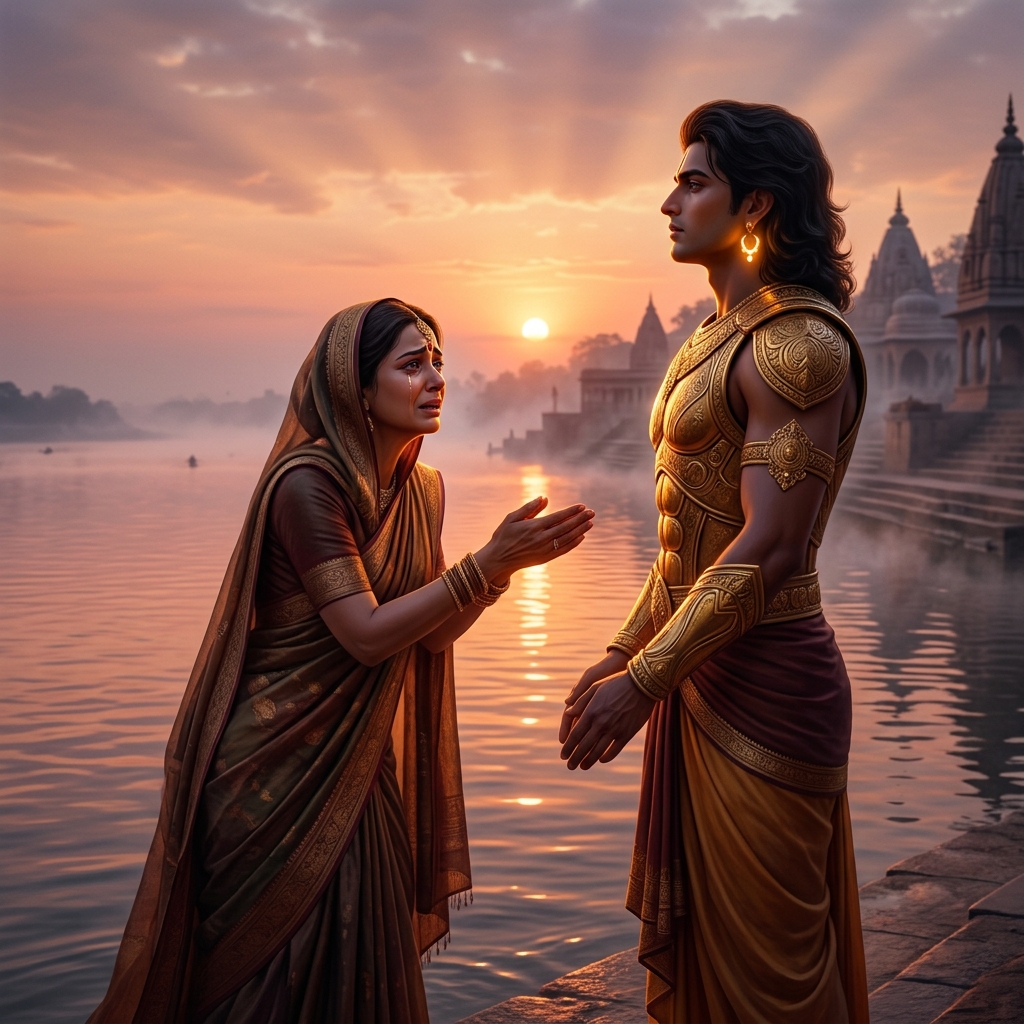
The Farewell at Hastinapura
The embassy had failed. Krishna had stood in the hall of the Kurus and offered peace with both hands open - five villages, even a single village, anything short of war - and Duryodhana had answered by trying to bind him in chains, as if a noose could hold what the whole world could not. Now the horses were yoked again, the chariot turned west toward Upaplavya, and before he left the city of the Kurus one last time, Krishna went to see Kunti.
She received him in the narrow rooms where she had lived for years as a guest in the house her sons should have inherited. There was no comfort in the greeting. She did not ask first whether the embassy had gone well; she had read the answer in his face before he spoke a word.
"You go back to war," she said. "Then go back to war. I will not send my sons soft words to keep them safe. I have watched Yudhishthira weigh dharma against dharma until the scales themselves grew tired, and I fear the scale has worn a groove where restraint always wins. Tell him instead a story I have carried since I was a girl in my father's house - not mine, but old before I was born, and truer than anything I could say new."
Krishna, who rarely deferred to any voice, drew close and sat to listen, because he understood - as he always understood - that a mother's grief, turned to purpose, was a weapon no armory held. Kunti folded her hands in her lap, closed her eyes as though returning to a room she had not entered in decades, and began.
The Queen Who Found Her Son Lying Down
"There was once a queen named Vidula," Kunti said, "a kshatriya woman married into a proud house, whose son bore the name Sanjaya - not the charioteer who narrates this war to blind Dhritarashtra in his hall, but another Sanjaya entirely, a prince of that older story, and you must not confuse the two though the years have tangled their names together.
"This Sanjaya went to battle against the king of Sindhu and was beaten - not merely defeated but broken, driven from the field, his pride ground into the dust along with his chariot's wheels. He came home and did not rise again. He lay on his bed with his face turned to the wall, and grief wrapped around him like a second skin, and he told himself, and anyone who would listen, that the battle was lost, that fortune had abandoned their line, that there was nothing left to do but endure what could not be changed.
"Vidula found him like that - a grown man, a kshatriya born to the bow, curled in on himself like a widow at a pyre. And where another mother might have wept beside him, might have stroked his hair and told him rest was earned, might have let sorrow be its own justification, Vidula did not sit down at all. She stood over him. She looked at what defeat had made of her son, and something in her that was mother and something in her that was queen rose up together and would not be separated, and she began to speak in a voice that had no pity in it whatsoever, because she had already decided that pity was the one thing she would not give him."
Better to Blaze Than to Smolder
"Get up," she said. "You lie there as though lying down were itself an answer. Rise, my son, and be what I bore you to be, or else stop calling yourself a kshatriya and go sit among the women, for a warrior who will not fight is neither man nor woman - he is some third, nameless thing that neither side will claim."
He stirred but did not rise, and murmured that the enemy was too strong, that fortune had turned her face away and could not be called back by wishing.
"Fortune," Vidula said, "follows effort the way a shadow follows the body - not ahead of it, never apart from it, but bound to it and moving only when the body moves. You wait for fortune to come first, as though it were a guest you could simply receive, but it is not a guest. It is a servant that comes only after the master has already begun to walk. Rise, and it will follow. Lie still, and it will lie down beside you and grow as still as you are, and call that stillness your fate."
She crossed the room and stood over him so that he could not look anywhere but up at her face. "Better," she said, "to blaze up for a single moment, bright enough that the world remembers the light, than to smolder for a hundred years in smoke that warms no one and lights nothing and is only mistaken for fire by those too far away to feel its cold. I did not carry you nine months and nurse you at this breast to raise a smoldering thing. I bore a son. I will not now unmake that by watching him become smoke."
The Crow and the Kingdom
He answered her again, weaker this time: what use was pride to a man with no army left, no allies willing to bleed a second time, nothing behind him but the ash of the first defeat? Better, he said, to live quietly, to accept what remained, to be grateful for breath if nothing else.
"Do not speak to me of gratitude for scraps," Vidula said. "There is a crow that walks behind the sacrifice picking at what the priests discard, and it calls that peace, because it has never known what it is to take its food from the sky by its own strength. I did not raise a crow. A hawk does not thank the world for leavings; it hunts, and if it fails it hunts again, and if it dies hunting at least it dies as a hawk and not as something that learned to be grateful for less than it was made for. Which of the two do you mean to be, my son - the bird that begs, or the bird that strikes?
"And do not tell me the enemy is strong," she went on, before he could answer. "Strength is not a fixed thing handed out once at birth and never touched again. It is built the same way it is lost - by what a man does with the days given to him. You were not born beaten. You were beaten once, on one field, on one day, and you have mistaken a single day for the whole of your life."
Something in him broke open at that - not the broken thing that grief had made, but something older underneath it, the will he had been born with before defeat had buried it. He rose. He called for his weapons. He gathered what men remained loyal and what allies could still be persuaded, and he went out again against Sindhu not with a larger army than before but with a different spirit inside the same body - and where the first battle had broken him, the second battle he won, and took back the kingdom his despair had already surrendered before a single arrow was loosed in its defense.
The Fire Kunti Sends to War
Kunti opened her eyes. The room around her was Hastinapura again, not the older kingdom of her story, and Krishna sat where he had sat through the whole telling, unmoving, his face unreadable in the way it became only when he had heard something worth keeping.
"That is my message," she said. "Not sorrow. Not longing for the old days at Indraprastha, though I have those too and keep them to myself. Tell Yudhishthira the tale of Vidula and her son, word for word if your memory holds it, and let him understand what his mother sends him is not comfort. I will not be the voice that gives him permission to kneel. He has spent thirteen years weighing dharma with such care that I fear he has forgotten a kshatriya's first dharma is simply to stand and be counted among the living, not among those already mourning themselves.
"Tell him fortune follows effort as a shadow follows the body. Tell him better to blaze for a moment than smolder for a lifetime. Tell him his mother did not bear five sons to watch even one of them become a crow picking at what Duryodhana leaves on the ground and calling it dharma."
Krishna rose and touched her feet, as he did for no one else in that house, and said nothing, because there was nothing to add to what she had already made whole. He mounted the chariot that carried him back toward Upaplavya, and though he brought no new army and no new terms of peace, he understood, driving out through the gates of Hastinapura for what might be the last time before the war, that he was carrying the truest declaration of war the Pandavas would receive - not written by a king, not sealed by a council, but spoken by a mother who had chosen fire over grief, and trusted her sons to recognize the difference.
Dharma Lesson
A kshatriya's dharma is to act, not to accept defeat as fate; despair dressed as acceptance is still despair. Fortune answers effort before it answers grief, so sorrow without motion changes nothing while it waits to be rescued. Vidula's love for her son takes the shape of refusal rather than comfort, because true care sometimes demands more of us than kindness alone allows.