The Errand Vidura Did Not Want
Carrying the invitation to the dice game he had begged the king not to send
The Brother Who Said No
Vaisampayana told it to Janamejaya this way. The hall was already built. Dhritarashtra had ascertained the inclinations of his son, and knowing that Fate is inevitable, he had given the order, and thousands of skilled artificers had worked with alacrity until the crystal-arched palace stood finished, a thousand columns, a hundred gates, gold and lapis lazuli, two miles one way and two the other, covered with many-coloured carpets inlaid with gold. All that remained was to fill it.
So the king summoned the chief of his ministers.
Vidura was his younger brother, born of the same house but of a serving woman, which had kept him off the throne and put him where a king can least afford an honest man, at his own elbow. He had been telling Dhritarashtra the truth for thirty years and being thanked for it and disregarded. He heard the command now, and that foremost of intelligent men did not approve his brother's words.
"I approve not, O king, of this command of thine," he said. "Do not act so. I fear this will bring about the destruction of our race. When thy sons lose their unity, dissension will certainly ensue amongst them. This I apprehend, O king, from this match at dice."
He had said the whole thing in four sentences. The race, the sons, the dissension, the dice. Nothing was hidden from the man who was about to send for the Pandavas, and nothing he was told that day was ever afterwards news to him.
Dhritarashtra answered with the argument he used on himself.
"If Fate be not hostile, this quarrel will not certainly grieve me. The whole universe moveth at the will of its Creator, under the controlling influence of Fate. It is not free."
It is a doctrine, and it is also a way of putting down a burden. The king who had just commanded a gambling hall into existence out of nothing was explaining to his brother that nobody in the world decides anything.
"Therefore, O Vidura, going unto king Yudhishthira at my command, bring thou soon that invincible son of Kunti."
The man who had said the dice would destroy the Kuru race was told to go and fetch the players.
Horses Quiet and Patient
Thus commanded against his will, Vidura set out.
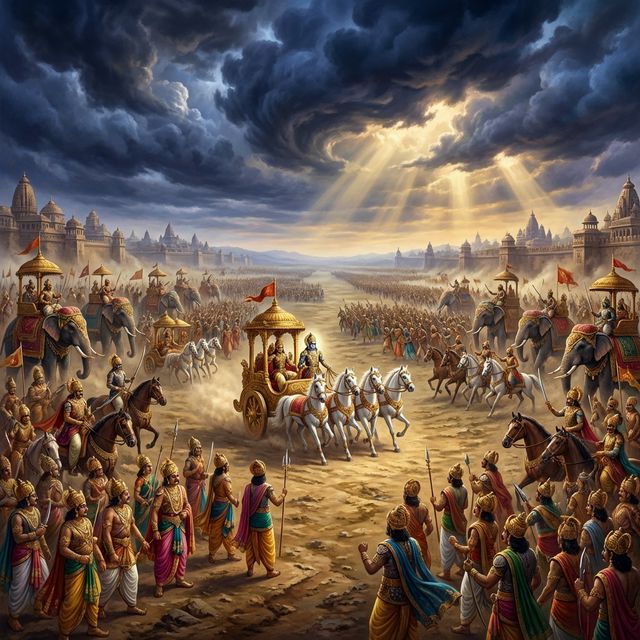
Vaisampayana lingers over the horses, and it is worth asking why. They were of high mettle, endued with great speed and strength, and quiet and patient. Everything a man could want under him on a long road, and every one of those qualities was wasted on this errand, because the one thing Vidura did not want was to arrive quickly. He had argued and lost, and now his own excellent horses were carrying him at their best pace toward the thing he had said would end his house.
He went by the way that leads to the capital of the Pandavas. The road ran down out of the old Kuru country toward the new city on the Yamuna, the one the Pandavas had raised out of a burned forest and made into an imperial seat, and by the end of it he was riding into Indraprastha as an ambassador of Hastinapura, worshipped by numberless Brahmanas who came out into the streets because Vidura was a man that Brahmanas came out into the streets for.
He entered the city and went toward the palace.
It was even like unto the mansion of Kuvera himself, the lord of treasures, whose house is the standard the poets reach for when a building has passed the point where lists of gems mean anything. Vidura had been in it before. He had come for the rajasuya, when the kings of the earth had stood in that hall and paid tribute and the assembly built by Maya had made men mistake water for floor and floor for water, and the son of his brother had fallen into a pool in front of everybody and gone home to Hastinapura with something lodged in him that would not come out.
That was what this hall of a thousand columns was answering. Vidura knew it. He walked in under a roof that had been the pride of the world at its own festival, carrying an invitation to come and see a better one.
The virtuous Vidura approached Yudhishthira, the son of Dharma.
Thy Mind Seemeth to Be Cheerless
The illustrious Ajamida, devoted to truth and having no enemy on earth, saluted his uncle reverentially and asked after Dhritarashtra and his sons. That is the courtesy, and Yudhishthira never failed of it. But he had looked at the man's face first.
"O Kshatta," he said, using the name the court used for Vidura, the steward, the one who keeps the door, "thy mind seemeth to be cheerless. Dost thou come here in happiness and peace? The sons of Dhritarashtra, I hope, are obedient to their old father. The people also, I hope, are obedient to Dhritarashtra's rule."
He had read the whole embassy off the messenger's expression before a word of it was delivered. Everything that followed, Vidura said to a man who already knew something was wrong.
"The illustrious king, with his sons, is well and happy," Vidura said, "and surrounded by his relatives he reigneth even like Indra himself. The king is happy with his sons who are all obedient to him and hath no grief."
Then, in the middle of the formula, one sentence that is not a formula at all.
"The illustrious monarch is bent on his own aggrandisement."
Vidura delivered the message. The king of the Kurus commanded him to enquire after Yudhishthira's peace and prosperity, and to ask him to repair to Hastinapura with his brothers, and to say, after beholding Dhritarashtra's newly erected palace, whether it was the equal of his own. Let them enjoy themselves in that mansion. Let them sit to a friendly match at dice. The Kurus had already arrived there.
And then Vidura told him the rest, which no ambassador is obliged to tell.
"And thou wilt see there those gamblers and cheats that the illustrious king Dhritarashtra hath already brought thither. It is for this, O king, that I have come hither. Let the king's command be approved by thee."
He had carried the invitation the whole way and set it down, and in the same breath he told the man he was inviting exactly what was waiting at the other end of the road. He was too loyal to refuse the errand and too honest to complete it cleanly. He did both, badly, which was the only thing left to him.
The Names of the Players
"O Kshatta," Yudhishthira said, "if we sit to a match at dice, we may quarrel. What man is there, who knowing all this, will consent to gamble? What dost thou think fit for us? We all are obedient to thy counsels."
It is the sentence a nephew says to an uncle he trusts, and it puts the decision squarely in Vidura's hands, which is precisely where Vidura could not take it.
"I know that gambling is the root of misery," he said, "and I strove to dissuade the king from it. The king, however, hath sent me to thee. Having known all this, O learned one, do what is beneficial."
That is the whole of his counsel. I tried. I failed. I am standing in your hall because I failed. Now you decide. He would not tell Yudhishthira to disobey the head of the family, and he would not pretend the invitation was innocent, so he handed back a warning with no instruction attached to it, and a man who has been offered that has been offered nothing he can act on.
Yudhishthira asked the practical question instead.
"Besides the sons of Dhritarashtra what other dishonest gamblers are there ready for play? Tell us, O Vidura, who they are and with whom we shall have to play, staking hundreds upon hundreds of our possessions."
Vidura gave him the list, and gave the first name its full description, because the first name was the point of the list.
"O monarch, Sakuni, the king of Gandhara, an adept at dice, having great skill of hand and desperate in stakes. Vivingati. King Chitrasena. Satyavrata. Purumitra. And Jaya. These, O king, are there."
Six men waiting in a hall two miles across, and the first of them Shakuni of Gandhara, brother of the blindfolded queen, the man who had already told Duryodhana that betting was his bow, the dice his arrows, the marks upon them his bowstring and the board his chariot.
Yudhishthira had now been told the room, the game, the stakes and the names.
If He Challenges Me I Will Never Refuse
"It would seem then," Yudhishthira said, "that some of the most desperate and terrible gamblers always depending upon deceit are there."
He had understood it exactly. Nothing was concealed from him, and nothing in what follows can be explained by ignorance.
Then he reached for the same doctrine his uncle had used at the other end of the road.
"This whole universe, however, is at the will of its Maker, under the control of fate. It is not free."
Dhritarashtra had said that in Hastinapura to excuse doing what he wanted. Yudhishthira said it in Indraprastha to excuse doing what he did not want, and the words did not change on the journey. Two men on opposite sides of a quarrel, each using the will of the Creator to explain why he could not help himself, and between them they arranged the ruin of both houses.
"O learned one, I do not desire, at the command of king Dhritarashtra, to engage myself in gambling. The father always wisheth to benefit his son."
That clause is the trap closing. Dhritarashtra stood to him as a father. A father wishes his son's good. Therefore the summons, whatever it obviously is, must be treated as a father's kindness, and the son who has taken his stand on dharma cannot be the one to say otherwise.
"Thou art our master, O Vidura. Tell me what is proper for us."
He asked a second time. Vidura had already given the only answer he had.
So Yudhishthira laid out the narrow ground he would stand on, and it was narrow indeed.
"Unwilling as I am to gamble, I will not do so, if the wicked Sakuni doth not summon me to it in the Sabha. If, however, he challengeth me, I will never refuse. For that, as settled, is my eternal vow."
There it is. He would not sit down of his own motion. But if challenged in open assembly, he would not decline, because a kshatriya does not decline, and the vow was older than the quarrel and he had never in his life broken one.
He had just told the whole world, and Vidura, and by report Shakuni, precisely how to make him play.
Tied As It Were With a Cord
Having said this to Vidura, King Yudhishthira the just commanded that preparations for his journey be made without loss of time.
The next day he set out for the capital of the Kurus with his relatives and his attendants, and he took the women of the household with him, with Draupadi in their midst. Nobody was left behind. He rode in the car given him by the king of Valhika, attired in royal robes, blazing with royal splendour, with Brahmanas walking before him, and as he went out of his own gates he said one thing aloud.
"Like some brilliant body falling before the eyes, Fate depriveth us of reason, and man, tied as it were with a cord, submitteth to the sway of Providence."
Then, says Vaisampayana, that chastiser of the foe set out with Kshatta without deliberating upon that summons from Dhritarashtra. He had done all the deliberating he was going to do.
At Hastinapura he went straight to his uncle's palace, and the greetings took a long time, because Yudhishthira greeted everyone. Bhishma, Drona, Karna, Kripa, and the son of Drona, embraced and embracing. Then Somadatta, then Duryodhana and Shalya and the son of Suvala, and the other kings who had come in before him. Then the brave Dushasana, then the rest of his cousins one by one, then Jayadratha, then the whole of the Kurus in order, courteously, and none of them refused him.
Surrounded by his brothers he entered the apartments of the wise king. He beheld the reverend Gandhari, ever obedient to her lord, standing among her daughters-in-law like Rohini among the stars, and he saluted her and was blessed by her, and then he came to his old uncle, that illustrious monarch whose wisdom was his eye. Dhritarashtra smelt the head of each of the five in turn, beginning with Bhimasena, and all the Kurus were exceedingly glad to see those tigers among men.
The Pandavas were shown to chambers furnished with jewels and gems. The women of the household came visiting, with Dussala at their head, and the daughters-in-law of Dhritarashtra looked at the blazing beauty and prosperity of Yajnaseni and went away cheerless and filled with jealousy.
Then the five men took their exercise, performed the rites of the day, put on sandal paste of the most fragrant kind, gave gifts to Brahmanas for benedictions, ate food of the best taste, and were put to sleep with music by handsome women. They passed that delightful night with cheerful hearts.
Bards woke them at dawn. They rose, went through the usual rites, and entered the assembly house, and were saluted by the men who were sitting there ready for gambling.
Dharma Lesson
Nothing here is done in ignorance. Vidura names the ruin before it starts, Dhritarashtra hears him and gives the order anyway, and Yudhishthira is told the room, the game and the names of the cheats before he packs. What each of them reaches for instead of a decision is the same sentence, that the universe is not free and moves at the will of its Maker, and in every mouth it does the same work: it turns a choice into a weather report. Fate in this episode is not a force that overrides men. It is the name they give to what they have already decided not to refuse.